

The thyroid and the skin: coat changes, recurrent infections and the derm overlap
Alastair Greenway
BVM&S MRCVS
If your dog has been losing coat in a slow, even pattern, or keeps getting skin and ear infections that clear on antibiotics and then come straight back, the thyroid is one of the first things worth ruling in or out. The skin is the system most owners notice first with hypothyroidism, and skin or coat change is the commonest reason a hypothyroid dog ends up at the vet in the first place (Fernandez & Seth 2016; AAHA 2023). This piece is about that overlap, what the thyroid does to the coat and skin, why it shows up as stubborn infections, and how long it takes to put right.
It's the partner to our two other hypothyroid pieces, the over-active versus under-active explainer and the one on getting the diagnosis right, and you'll see the same caution carried through here. A skin problem on its own doesn't prove it's the thyroid, and a low blood result on its own doesn't either. More on that below.
The classic coat: even, non-itchy, and slow to come back
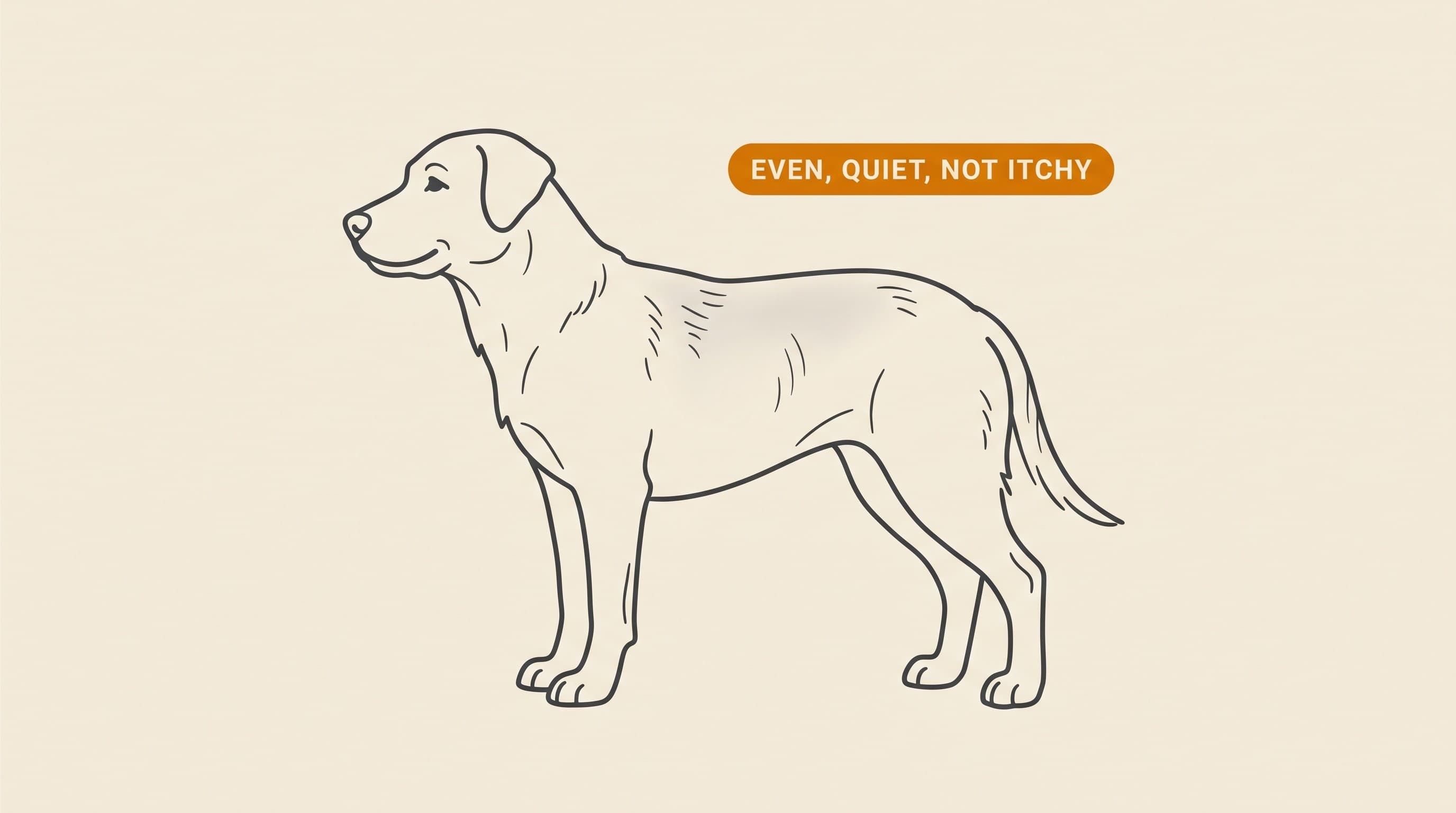
The hallmark of thyroid skin disease is hair loss that's bilaterally symmetric and, crucially, not itchy. It tends to start in the areas that get the most wear and friction, the sides of the body, the underside of the chest, the neck and the tail, and then spreads into even hair loss across the trunk. The head and the lower legs are usually spared (Fernandez & Seth 2016). Hair loss running along the tail is recognised enough to have its own name, the "rat tail" (Fernandez & Seth 2016; Costa et al. 2016).
That "symmetric but not itchy" pattern is the thing that points a vet towards a hormonal cause rather than an allergy. Allergic skin disease is usually itchy and patchy. Endocrine hair loss like this tends to be even and quiet, which is exactly why hypothyroidism sits on the list of hormonal causes of non-itchy hair loss alongside Cushing's (Merck Veterinary Manual; Costa et al. 2016). If you've landed here from an allergies and skin work-up, that's the connection, and it's worth reading our hair-loss-without-itching piece in the Allergies & Skin space too.
Alongside the hair loss, you might notice the coat looking dull, dry and brittle, hair that doesn't grow back after a clip (post-clipping alopecia), the skin darkening in patches (hyperpigmentation), and flaky or greasy skin (seborrhoea) (Heseltine, Today's Veterinary Practice; Cornell Riney Canine Health Center; Fernandez & Seth 2016). Wounds can be slow to heal too (Fernandez & Seth 2016). In more advanced cases the skin of the face thickens because of a build-up of glycosaminoglycans and hyaluronic acid in the dermis, which puffs the folds above the eyes and droops the upper eyelids into the so-called "tragic" facial expression (Costa et al. 2016; Merck Veterinary Manual).
None of these on its own is dramatic, which is part of the problem. They creep in slowly, and it's easy to put a scruffy coat and a bit of weight gain down to age. Dermatological signs of one kind or another turn up in roughly 60 to 80% of hypothyroid dogs, so the coat really is where this disease tends to announce itself (Fernandez & Seth 2016; Costa et al. 2016; AAHA 2023).
Recurrent infections: when the skin is the only clue
Here's the part that catches owners and sometimes vets out. Hypothyroidism lowers the skin's defences, so a hypothyroid dog is prone to repeated bacterial skin infections (superficial pyoderma), yeast infections (Malassezia dermatitis) and ear infections (otitis externa) (Heseltine, Today's Veterinary Practice; Cornell Riney Canine Health Center). And these recurrent infections can be the only sign on show, with no obvious symmetric hair loss yet (Heseltine, Today's Veterinary Practice; Costa et al. 2016).
This is also the usual reason a hypothyroid dog itches. The endocrine hair loss itself isn't itchy, but a secondary infection on top of it very much can be, and concurrent pyoderma is common (Fernandez & Seth 2016). So please don't assume "itchy means allergy, not thyroid". The two can sit together.
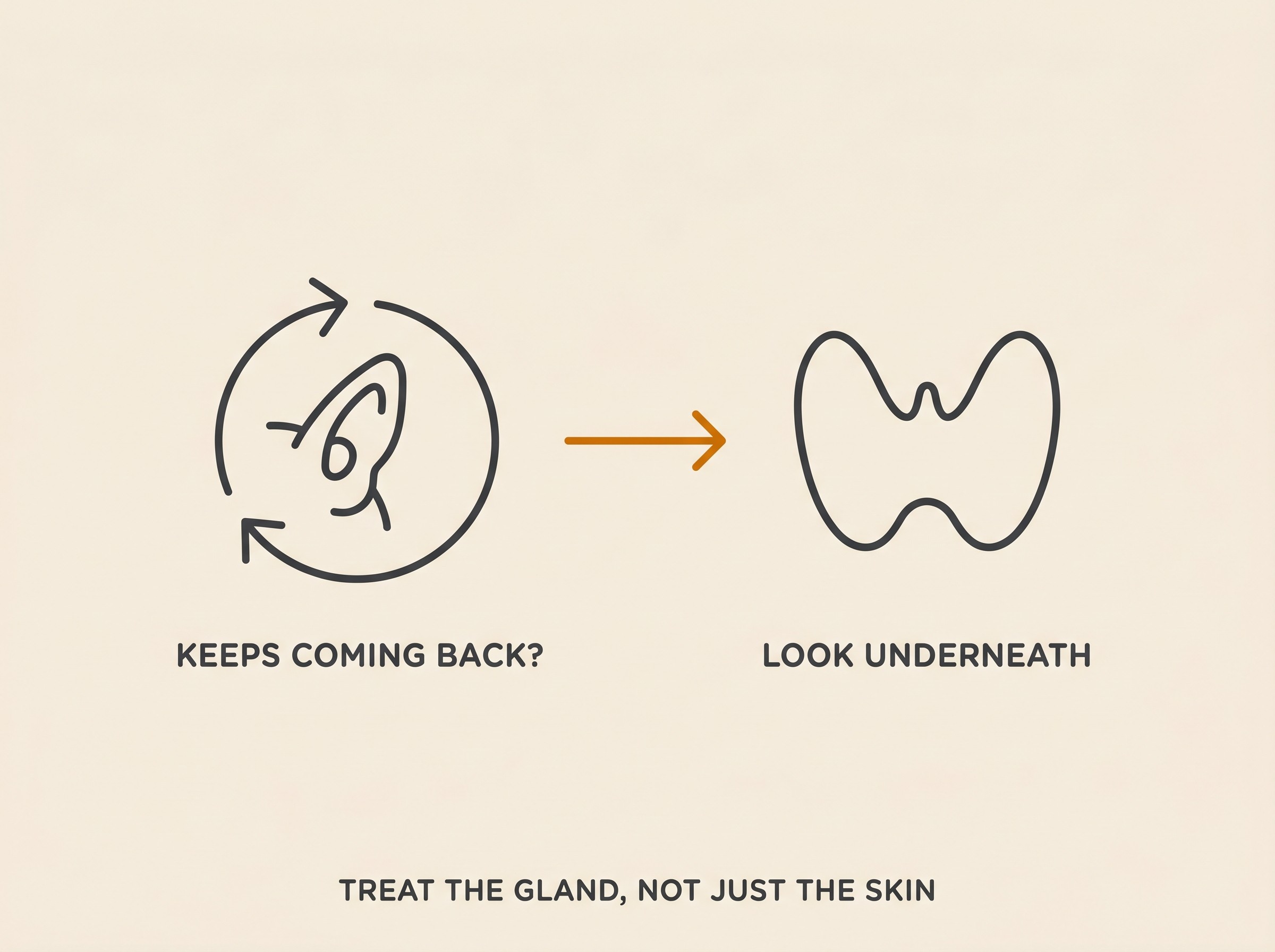
The practical message is the one that matters most in this whole piece. If your dog keeps getting pyoderma, yeasty skin or ear infections that respond to treatment and then relapse, that pattern deserves a look underneath, not just another course of the same topical or antibiotic. There's a documented case of recurrent Malassezia dermatitis driven by an underlying hypothyroidism, where the skin kept relapsing at around 45 days until the thyroid disease itself was treated with thyroxine, after which it settled (Singh et al. 2016). Treat the gland, in other words, not just the skin.
One more pattern worth knowing. A sudden outbreak of generalised demodectic mange (demodicosis) in a dog older than about two is usually a sign the immune system is compromised by something underneath, and hypothyroidism is one of the recognised triggers, alongside Cushing's and, less commonly, cancer (dvm360 demodicosis). So adult-onset demodex is another reason to look for an endocrine cause rather than treating the mites in isolation.
The catch: a skin problem isn't a thyroid diagnosis, and neither is a low result
This is the safety point of the piece, and it cuts both ways. The fact that thyroid disease shows up in the skin does not mean every dog with a skin or coat problem is hypothyroid. And, just as importantly, a single low total T4 blood result on its own does not confirm hypothyroidism either (Heseltine, Today's Veterinary Practice; dvm360 overdiagnosis).
That second point is the one that gets dogs put on lifelong tablets they may not need. Being ill for some other reason, what's called non-thyroidal illness or "euthyroid sick syndrome", lowers thyroid blood results without there being any thyroid disease at all. So do several common medications, including glucocorticoids such as prednisone, the epilepsy drug phenobarbital, and trimethoprim-sulphonamide antibiotics (Heseltine, Today's Veterinary Practice). That's especially awkward in a skin work-up, because the very dog being tested may be on a course of steroids or a sulphonamide antibiotic for its skin or ears at the time, which can drag the result down and make a healthy thyroid look under-active.
A low total T4 is therefore a screen, not a diagnosis. Confirming it means the fuller panel, free T4 by equilibrium dialysis and TSH, read together with the clinical picture, before anyone commits your dog to thyroxine for life (Heseltine, Today's Veterinary Practice; AAHA 2023). It's worth knowing that around 20 to 40% of dogs with genuine hypothyroidism actually have a normal TSH, so no single number settles it either way (Heseltine, Today's Veterinary Practice; AAHA 2023). Our "getting the thyroid diagnosis right" piece walks through the tests and the traps in detail. The short version: confirm before you commit.
How long the coat takes to come back
If the diagnosis is solid, the treatment is a daily levothyroxine tablet (synthetic T4) for life, and with accurate diagnosis, the right dose and regular monitoring the outlook is good (Cornell Riney Canine Health Center; AAHA 2023). But the skin needs patience.
Most of the general signs of hypothyroidism, the energy, the demeanour, start to improve within about four to six weeks. The skin and coat are slower. Coat regrowth takes months, not weeks, to fully resolve (Heseltine, Today's Veterinary Practice; Fernandez & Seth 2016). It's common to see things look a little worse before they look better, as old coat sheds and new coat pushes through.
That timeline matters, because if you're expecting a quick visual fix you might wrongly assume the treatment has failed, or start pushing for dose changes, before the skin has had a fair chance. Give it the months it needs on a steady dose, and judge the coat at the rechecks rather than week to week. The dog often feels better long before it looks better.
If your dog is also drinking and weeing more than usual, that points away from a straightforward hypothyroid picture and towards the wider hormone differential, so it's worth measuring the water intake (our Thirst & Wee tracker and the "is my pet drinking too much?" measuring card make that easy) and reading the start-here funnel piece. But for the classic slowed-down dog with a quiet, thinning, even coat and the odd recurrent skin or ear infection, the thyroid is a very reasonable thing to investigate, and a very treatable thing to find. The next step is simply a vet visit to confirm it properly before any lifelong tablet, and then the patience to let the coat catch up.
References
- Fernandez Y, Seth M. "Diagnosis and treatment of canine hypothyroidism." Vet Times, 11 July 2016.
- 2023 AAHA Selected Endocrinopathies of Dogs and Cats Guidelines. Bugbee A, Rucinsky R, Cazabon S, Kvitko-White H, Lathan P, Nichelason A, Rudolph L. J Am Anim Hosp Assoc. 2023;59(3):113-135. DOI: 10.5326/JAAHA-MS-7368.
- Costa GM, Araujo SL, Xavier Júnior FAF, Viana DA, Evangelista JSAM. "Dermatological manifestations associated with canine hypothyroidism: A review." Revista Brasileira de Higiene e Sanidade Animal, 2016;10(4):781-797. DOI: 10.5935/1981-2965.20160064.
- Merck Veterinary Manual — "Hypothyroidism in Animals" (The Thyroid Gland).
- Heseltine J (DVM, MS, DACVIM). "Canine Hypothyroidism: Diagnosis and Treatment." Today's Veterinary Practice.
- Cornell University College of Veterinary Medicine, Riney Canine Health Center — "Hypothyroidism."
- Singh SK, et al. "Recurrent Malassezia dermatitis due to hypothyroidism in a dog and its management." Comparative Clinical Pathology, 2016 (Springer). DOI: 10.1007/s00580-015-2218-5.
- "Update on the treatment of demodicosis" (adult-onset generalised demodicosis secondary to underlying disease incl. hypothyroidism and hyperadrenocorticism). dvm360.
- "Canine hypothyroidism: Shield your patients from overdiagnosis." dvm360.
Keep track of how your pet is doing
The owners who cope best are the ones who notice changes early. A simple health log shows you what is working, and what is not, before the next vet visit.
Start tracking, freeYou're not doing this alone
Compare treatment journeys and talk to owners managing hormone health. Free to join.
Join PetsLikeMine