

Treating hyperthyroidism: the four options, compared honestly
Alastair Greenway
BVM&S MRCVS
When your cat is diagnosed with an over-active thyroid, you'll quickly notice that whoever you ask seems to favour a different treatment. That's not because anyone's being dishonest, it's because there are genuinely four good options, and the right one depends on your cat, your budget, the state of your cat's kidneys and what's available near you. The one thing the single-product leaflets won't do is lay all four side by side. So that's what this article does.
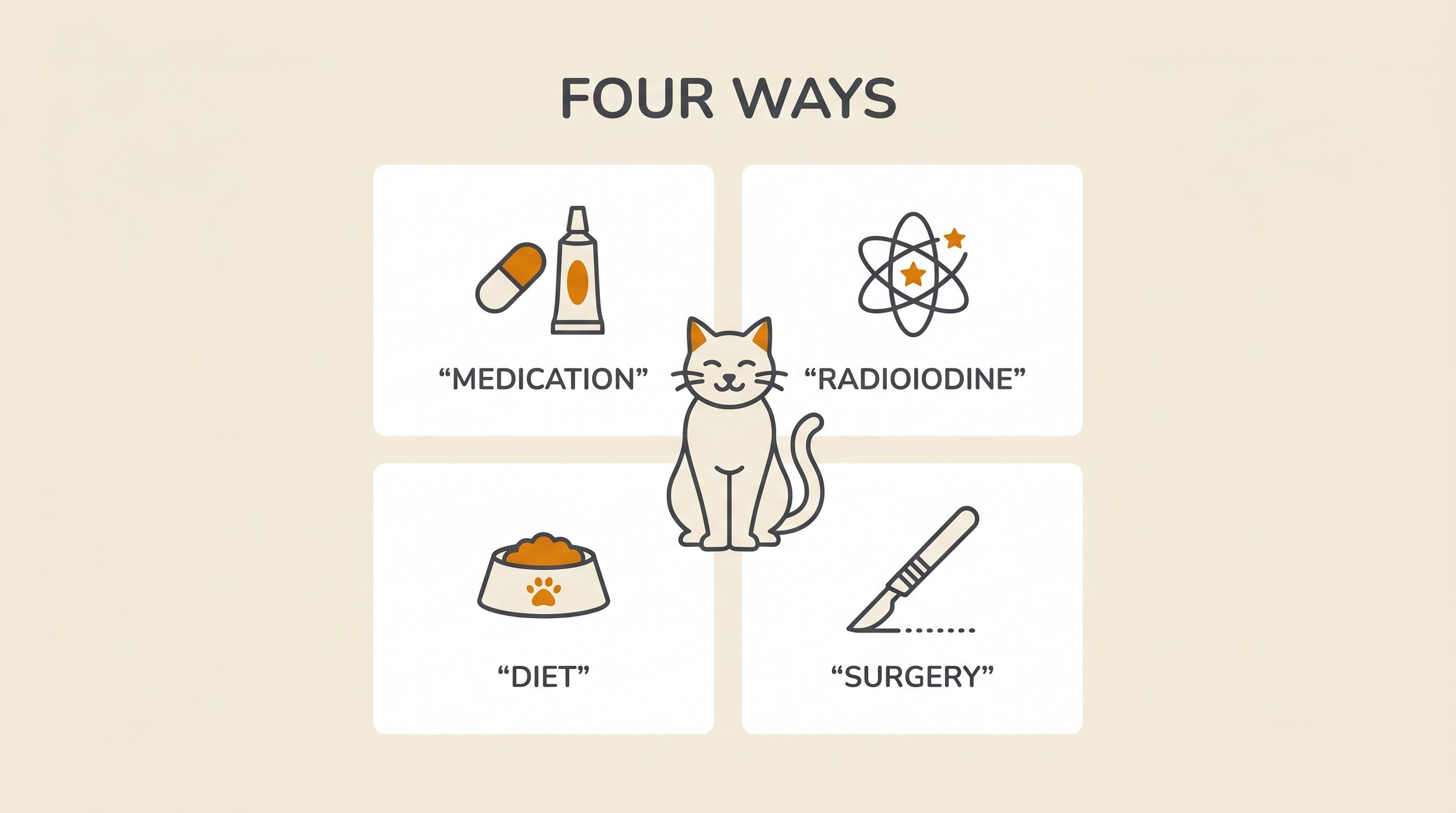
The four routes are anti-thyroid medication, radioiodine, an iodine-restricted diet, and surgery. Two of them control the condition (medication and diet) and two of them can cure it outright (radioiodine and surgery). Here's each one in full, the upsides and the catches, and then how to think about choosing.
Anti-thyroid medication: flexible, reversible, lifelong
Anti-thyroid tablets work by blocking the thyroid's hormone production, switching off the overdrive without removing the gland (AAFP 2016). The two you'll meet are methimazole (also called thiamazole) and carbimazole, which the body simply converts into methimazole, so they're really the same active drug by different routes. Most cats are brought into the normal range within about two to three weeks of starting (AAFP 2016). It's usually the first thing reached for, and for good reasons.
The big advantages are flexibility and reversibility. Tablets are inexpensive to start, widely available, and if they don't suit your cat you simply stop. There's a standard tablet given twice a day and a controlled-release version designed for once-daily dosing, plus an ear gel for cats who won't be pilled, all covered in the living-with article. But the single most valuable thing about medication is that it's reversible, and that turns out to matter enormously when it comes to the kidneys (more on that below).
The downsides are real. Medication controls the condition but never cures it, because the abnormal thyroid tissue keeps growing underneath, so over time some cats need higher doses, stop tolerating it, or stop responding altogether (AAFP 2016). It's for life and usually twice daily, and it needs periodic blood tests, both to check it's working and to catch side effects. Most side effects are mild and show up in the first four to six weeks: a bit of tummy upset, lethargy, or an itchy face. Rarely, methimazole can upset the liver or the blood cells, which is exactly why a blood count is part of the monitoring (AAFP 2016). For many cats, though, medication is a steady, manageable answer that works well for years.
Radioiodine: the one-and-done cure
If there's an under-offered option, it's this one. A single injection of radioactive iodine (I-131), given under the skin like a vaccine, is taken up by the overactive thyroid tissue and destroys it from the inside, while sparing everything around it because the radiation only travels a couple of millimetres (AAFP 2016). Most experts consider it the treatment of choice for the majority of cats (AAFP 2016).
The headline is the cure rate: a single treatment cures roughly 95% of cats, with figures of 95 to 98% reported (AAFP 2016; Cornell). There are no lifelong tablets and no anaesthetic. It even mops up stray overactive thyroid tissue in unusual spots, which happens in perhaps one in five to one in ten cats and which surgery would miss entirely (AAFP 2016). For the right cat, it's as close to a clean fix as this condition offers.
The catches are practical rather than medical. It's referral-only and not available everywhere. Because your cat is briefly radioactive, there's a hospital isolation stay, anywhere from a few days to a few weeks depending on local radiation rules, with a typical stay of three to five days, followed by some simple at-home precautions for a couple of weeks: avoiding prolonged cuddling, keeping litter and food separate from other cats, and keeping young children and anyone pregnant at arm's length (AAFP 2016; Cornell). There's a meaningful upfront cost. One more thing to expect is that some cats dip temporarily under-active afterwards, which the vet watches for and occasionally treats for a while; permanent under-activity is uncommon (AAFP 2016). And it's irreversible, which is exactly why it isn't always the right first move. The full detail of what radioiodine involves is in its own article.
The iodine-restricted diet: no pills, but all-or-nothing
The thyroid needs dietary iodine to make its hormone, so a food severely restricted in iodine (Hill's y/d) starves the gland of the raw material and brings hormone levels down (AAFP 2016). For the right household it's elegant: no tablets, nothing invasive, just a change of food.
It does work. With good compliance, around three-quarters of cats have significantly lower thyroid levels within a month, and a one-year study found about 83% in remission (AAFP 2016).
But there's one unforgiving condition: it only works if it's the only thing your cat eats, for life. No other food, no treats, no stealing from another cat's bowl, and no hunting (AAFP 2016). That makes it genuinely difficult in multi-cat homes or for cats who go outside, where you simply can't control what goes in. Some cats don't find it palatable either, around one in eight in studies (AAFP 2016). It also controls rather than cures, so if you stop the food the thyroid climbs straight back up, and because severely restricting iodine over the long term is relatively new, the very-long-term picture isn't fully known (AAFP 2016). For an indoor, single, food-cooperative cat it can be a lovely solution; for a hunting farm cat it's a non-starter.
Surgery: a potential cure, with anaesthetic and parathyroid risk
Removing the overactive thyroid tissue (thyroidectomy) can cure the condition too. Most cats are cured, with over 90% achieving normal thyroid levels and a relapse rate of around 5% over three years (AAFP 2016; Naan 2006).
The trade-offs are the ones you'd expect from surgery in an older cat. There's an anaesthetic risk, which matters more in elderly patients who may have heart or kidney issues alongside (AAFP 2016). The signature complication is a drop in blood calcium, because the tiny parathyroid glands that control calcium sit right against the thyroid and can be bruised or removed during the operation. This typically shows up in the first few days afterwards, and how often it happens depends heavily on the surgical technique, so an experienced surgeon matters (AAFP 2016). Other recognised risks include nerve effects such as a droopy eyelid or a change in voice, and recurrence if any abnormal tissue is left behind. Because a small proportion of cats have overactive tissue in awkward, hidden locations, a pre-operative thyroid scan helps the surgeon find and remove all of it and reduces the chance of needing a second operation (AAFP 2016). Surgery still has a genuine place, particularly where radioiodine isn't accessible, but it's chosen less often now that the one-injection cure exists.
The thread running through all four: the kidneys
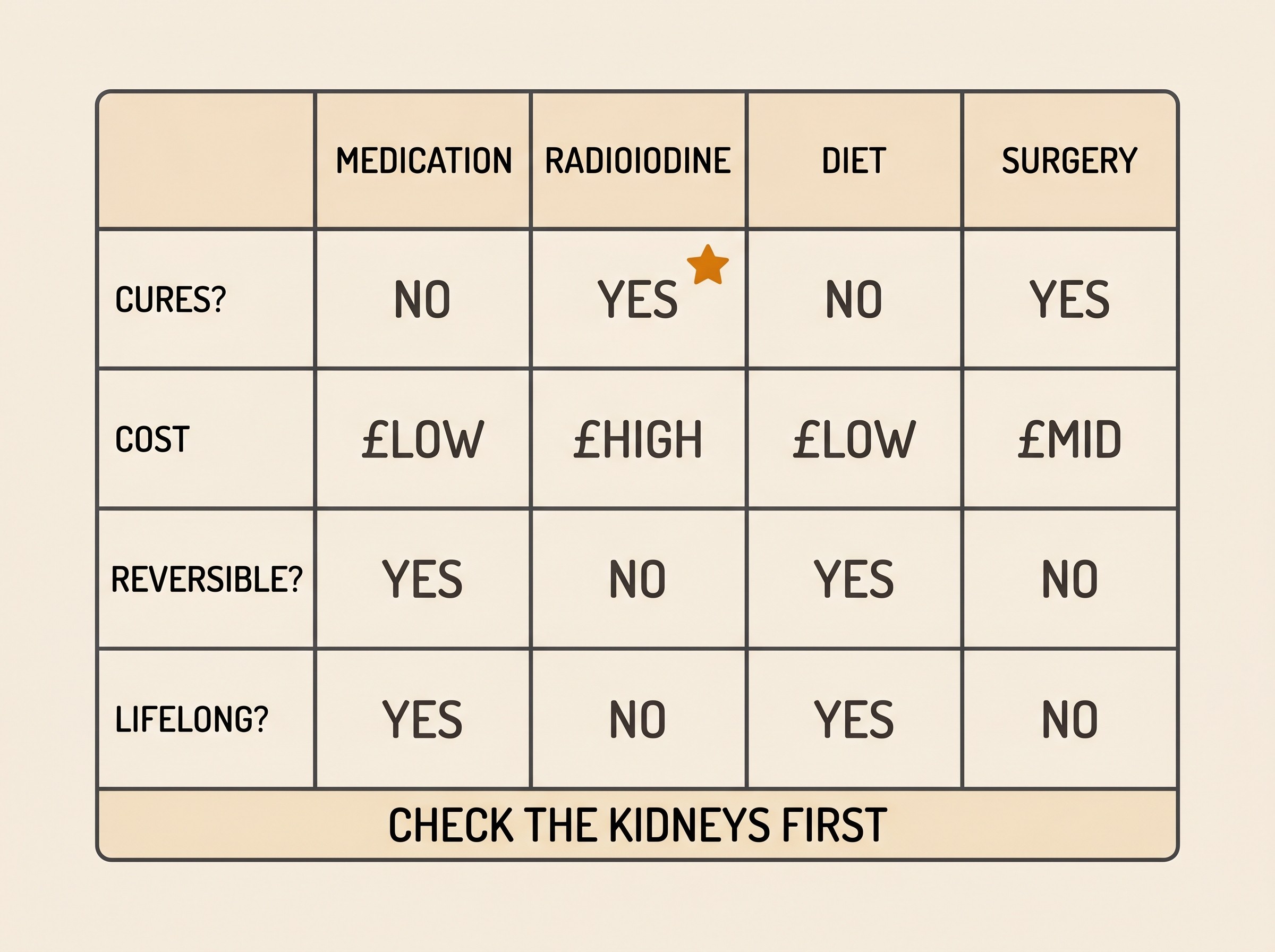
Here's the idea that ties the whole decision together. An over-active thyroid artificially boosts blood flow through the kidneys, which can hide kidney disease sitting underneath. Treat the thyroid by any method and that flattering effect comes off, which can reveal kidney trouble that was masked all along (AAFP 2016). The kidney values and the thyroid values have to be read together, not one at a time.
This is the real reason medication or diet often comes first. Both are reversible, so they act as a trial: lower the thyroid, watch what happens to the kidneys over a few weeks, and if the kidneys cope well you can move confidently to a permanent cure like radioiodine or surgery (AAFP 2016). If the kidneys struggle, you've learned that without having done anything you can't undo. Your vet will check kidney status properly before any treatment, using blood pressure and urine tests alongside the bloods, and will stage any kidney disease so you both go in with eyes open (AAFP 2016).
One warning worth stating plainly: deliberately keeping a cat a little bit hyperthyroid to "protect" the kidneys is not a good plan. It lowers the creatinine number artificially while the high thyroid quietly damages the heart and the kidneys anyway, which gives false reassurance based on a flattering blood result (AAFP 2016). The aim is good thyroid control with the kidneys carefully watched, not a permanently half-treated cat.
So how do you choose?
There's no single right answer, only the right answer for your cat. In practice the decision turns on a handful of things:
- The kidneys. Any doubt, and a reversible trial (medication or diet) comes first, before committing to a one-way cure.
- Cure versus management. If your cat's kidneys are sound and you want this gone for good, radioiodine is usually the standout. If you'd rather keep things flexible and adjustable, medication is the workhorse.
- Access and budget. Radioiodine means a referral centre, an isolation stay and an upfront cost; medication spreads the cost over time but never ends; the diet's only extra cost is the food, if your household can stick to it.
- Your household. The diet only works in a strictly controlled, single-diet, ideally indoor situation. Persistent difficulty giving tablets pushes towards the gel, or towards a cure.
- Your cat's age and anaesthetic risk. This weighs against surgery and, gently, in favour of the non-anaesthetic options for a frail older cat.
A good way to use all this is to talk it through with your vet with the four options genuinely on the table, not just the one in front of you. The printable treatment-compare sheet lays them side by side so you can weigh them up at home, and the kidney-catch article explains the monitoring that sits behind the choice. Whatever route you pick, a treated hyperthyroid cat usually does very well, and the reassuring truth is that you're choosing between four good options, not scrambling for one.
References
- Carney HC, Ward CR, Bailey SJ, et al. 2016 AAFP Guidelines for the Management of Feline Hyperthyroidism. J Feline Med Surg 2016;18(5):400-416.
- Cornell University College of Veterinary Medicine. Feline Hyperthyroidism.
- Naan EC, Kirpensteijn J, Kooistra HS, Peeters ME. Results of thyroidectomy in 101 cats with hyperthyroidism. Vet Surg 2006;35(3):287-293.
Keep track of how your pet is doing
The owners who cope best are the ones who notice changes early. A simple health log shows you what is working, and what is not, before the next vet visit.
Start tracking, freeYou're not doing this alone
Compare treatment journeys and talk to owners managing hormone health. Free to join.
Join PetsLikeMine