

The over-active thyroid: why your older cat is wasting away despite eating everything
Alastair Greenway
BVM&S MRCVS
If your older cat is eating like never before and still getting thinner, it's natural to find that frightening. The most likely explanation is one of the most common things we see in senior cats, it's well understood, and it's very treatable. It's called hyperthyroidism, an over-active thyroid, and this article is here to tell you calmly what's going on and what happens next.
The classic picture
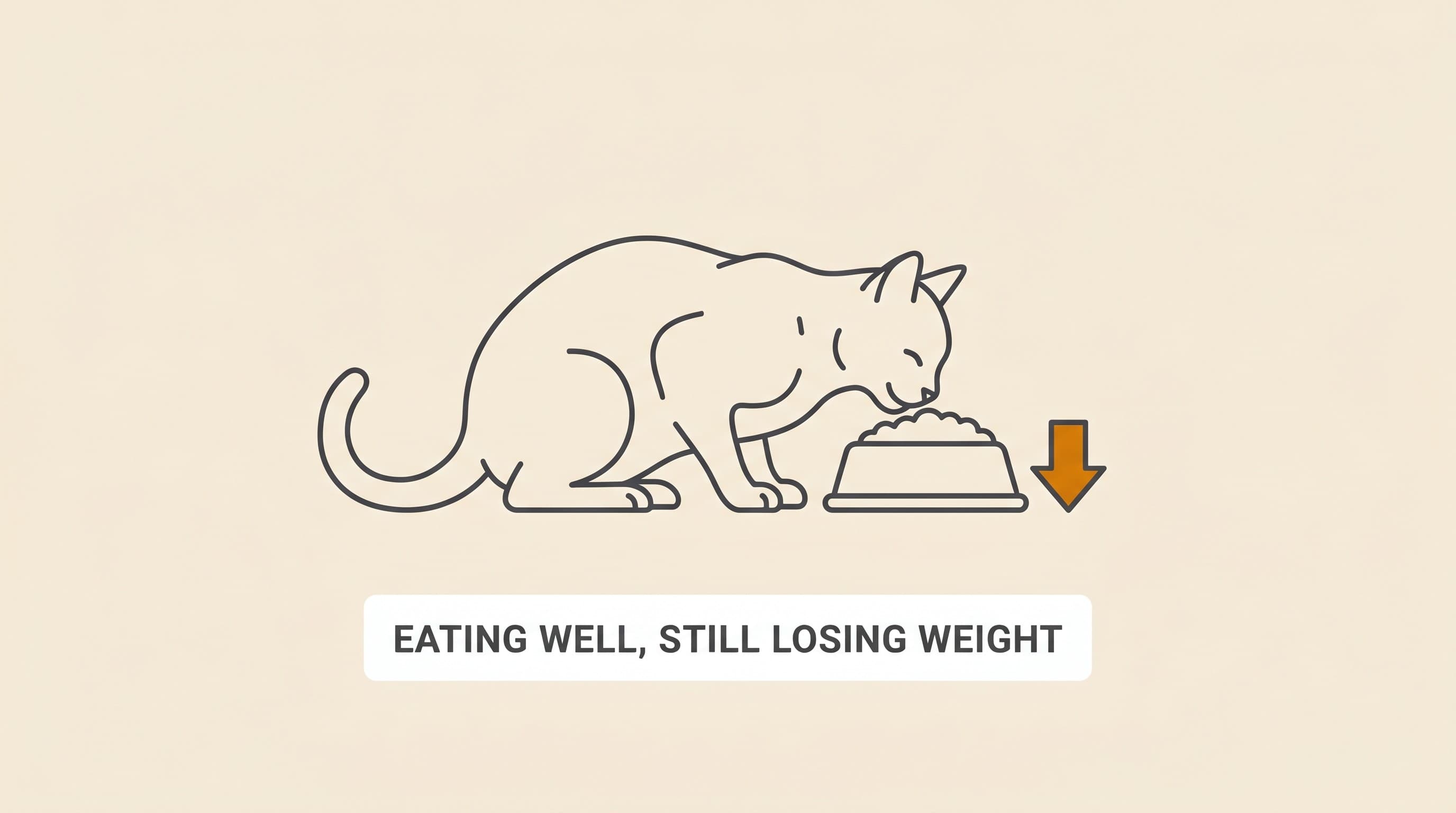
The cat we picture with this condition is older, usually past about ten, ravenously hungry yet steadily losing weight. That combination, eating well but wasting away, is the hallmark sign (AAFP 2016). Alongside it, owners often notice some of the following:
- Drinking and weeing more than usual
- Vomiting or looser, more frequent stools
- Restlessness, irritability, or a cat who seems "wired"
- More vocalising, including yowling at night
- A scruffy, unkempt coat that's lost its usual gloss
- A racing or pounding heart
Not every cat shows the full set, and earlier cases can be subtle. Weight loss is the commonest sign by far, and is found in the great majority of affected cats. The others appear in anywhere from a third to most cats depending on the study (Peterson 2020). If your vet runs their hands down your cat's neck, they're often feeling for a small enlarged thyroid gland, a "goitre", which is present in most hyperthyroid cats and supports the suspicion (AAFP 2016). It's a helpful clue, not a diagnosis on its own.
What's actually happening
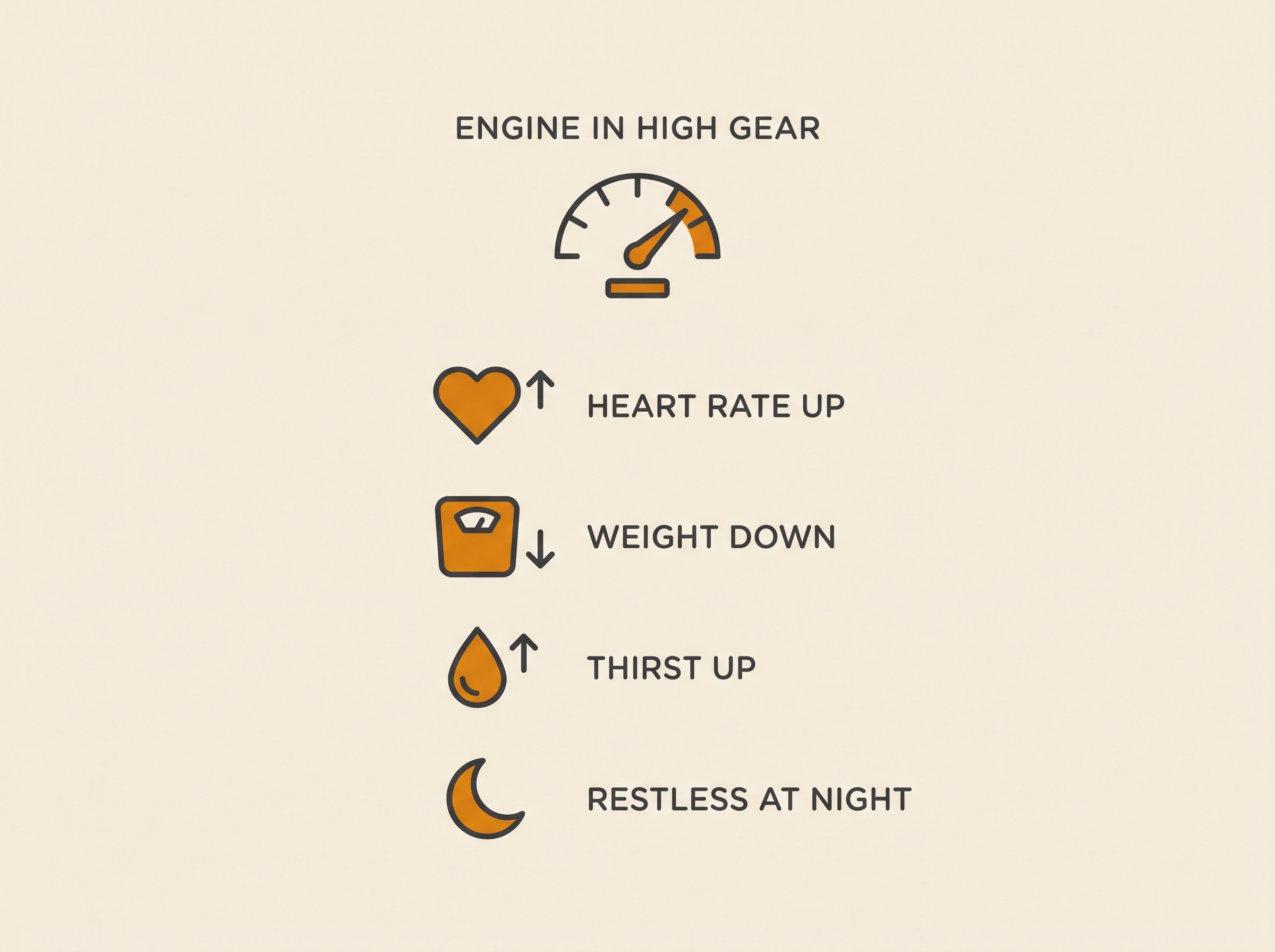
The thyroid is a small gland in the neck that sets your cat's metabolic "pace". In hyperthyroidism, the gland overgrows and pours out too much thyroid hormone, so the whole body runs too fast. Think of an engine stuck in high gear, burning fuel hard even at rest. That's why the signs are so body-wide: the appetite, the weight, the heart rate, the restlessness and the thirst are all the same problem showing up in different systems.
The reassuring part is what's behind it. In the great majority of cats this overgrowth is benign, a non-cancerous change in the gland, not a tumour in the worrying sense. Only around 2% of hyperthyroid cats have a malignant thyroid carcinoma at diagnosis (AAFP 2016). So in nearly all cases we're treating an over-active gland, not cancer.
Getting the diagnosis
Confirming it is usually straightforward. Your vet will run a blood test for total thyroxine (total T4), normally as part of a wider senior screen that also checks the blood count, organ chemistry and a urine sample (AAFP 2016). In most cats with the classic signs, a clearly raised total T4 settles it there and then.
A small number of cats sit in a grey zone, where the suspicion is strong but the T4 comes back normal or borderline. This happens in early disease, or when another illness is dragging the reading down. In those cases the work-up steps up a level: repeating the total T4, adding a free T4 by equilibrium dialysis with a TSH measurement, or moving to a T3-suppression test or a thyroid scan (scintigraphy) at a referral centre (AAFP 2016). One thing worth knowing, in the spirit of not over-diagnosing, is that a free T4 on its own isn't a diagnosis. It can read high in cats who are simply unwell for another reason, so it's always interpreted alongside the total T4, the TSH and the whole clinical picture (AAFP 2016; Peterson 2020).
Your vet will usually also check your cat's blood pressure and listen carefully to, or scan, the heart at this stage (AAFP 2016; ACVIM 2018). That isn't them expecting the worst. It's because the overdrive puts a strain on both, and it's far better to know the starting point.
Why it's worth treating, and treating properly
Left to run, an over-active thyroid quietly wears the body down. The commonest effect is on the heart: the constant overdrive thickens the heart muscle, a change called hypertrophic cardiomyopathy, and occasionally, if it goes on long enough, tips into heart failure (Vet Sci 2025). It can also push the blood pressure up, and high blood pressure is dangerous in its own right, threatening the eyes, kidneys, brain and heart. One thing to watch for is sudden blindness, which can happen if high pressure detaches the retinas. If your cat seems to lose their sight suddenly, ring the vet that day (ACVIM 2018).
Here's the genuinely encouraging part. Most of that heart strain is at least partly reversible once the thyroid is brought back under control, and hyperthyroidism is described as the most treatable cause of heart muscle disease in cats (Vet Sci 2025). So this isn't a "wait and see" condition. It's a "treat it, and treat it carefully" one.
The kidney catch, worth flagging now
There's one piece of this you should hear early, because it shapes how treatment is started. A high thyroid level can mask underlying kidney disease. The overdrive raises the blood flow through the kidneys and burns off muscle, and both of those pull a key kidney marker (creatinine) down, so hidden kidney trouble can stay invisible until the thyroid is treated (Syme 2005). In other words, calming the thyroid can sometimes unmask kidney disease that was there all along.
This sounds alarming and it really isn't, as long as it's handled properly. It's a reason to monitor, not a reason to avoid treating. The standard approach is to check kidney values before and during treatment, and to start with a reversible treatment (anti-thyroid medication, or the special diet) first, so that if kidney numbers do change, treatment can be adjusted before anything permanent has been done (AAFP 2016). Importantly, the guidance is clear that hyperthyroid cats should still be treated even when there's some kidney disease alongside, because leaving the thyroid untreated harms the kidneys and the heart too (AAFP 2016). There's a fuller piece in this space on exactly how the thyroid and kidney numbers are read together, and it's worth a read once the dust settles.
If you'd like to keep an eye on your cat's drinking yourself, our Thirst and Wee tracker lets you log measured water intake and spot a change early, and there's a printable card on how to measure it at home.
The four ways to treat it
You don't have to decide anything today, but it helps to know that there are genuinely four routes, not one:
- Anti-thyroid medication (methimazole or carbimazole), given as a tablet or as a gel rubbed into the ear. It controls the thyroid rather than curing it, and it's reversible, which makes it the usual first step.
- Radioactive iodine (I-131), a single injection that's generally considered the treatment of choice because it's safe, effective and usually a one-and-done cure (Lucy 2017). Many owners are never even told it exists.
- An iodine-restricted diet, which limits the raw material the gland needs to make hormone.
- Surgery to remove the over-active gland.
Each has real pros and cons, and the right choice depends on your cat, your budget, the kidney picture and what's available near you, not on which product a particular website happens to sell. We've written a straight, side-by-side comparison of all four in "Treating hyperthyroidism: the four options, compared honestly", and there's a printable treatment-compare download to take to your appointment.
For now, the thing to hold onto is this: your cat is eating well because their body is working too hard, not because anything is hopeless. This is common, it's understood, and in nearly every case it's very treatable. The next step is simply that conversation with your vet about which of the four routes fits your cat best.
References
- Carney HC, Ward CR, Bailey SJ, Bruyette D, Dennis S, Ferguson D, Hinc A, Rucinsky AR. 2016 AAFP Guidelines for the Management of Feline Hyperthyroidism. Journal of Feline Medicine and Surgery. 2016;18(5):400-416.
- Peterson ME. Diagnosis and management of feline hyperthyroidism: current perspectives. Journal of Feline Medicine / Vet Med (Auckl).
- Cardiac Abnormalities in Feline Hyperthyroidism. Veterinary Sciences (MDPI). 2025;12(12):1115.
- Acierno MJ, Brown S, Coleman AE, Jepson RE, Papich M, Stepien RL, Syme HM. ACVIM consensus statement: Guidelines for the identification, evaluation, and management of systemic hypertension in dogs and cats. Journal of Veterinary Internal Medicine. 2018;32(6):1803-1822.
- Syme HM. Cardiovascular and renal manifestations of hyperthyroidism (Hyperthyroidism and the Kidney). Veterinary Clinics of North America: Small Animal Practice. 2005;35(5):1419-1430.
- Lucy JM, Peterson ME, Randolph JF, et al. Efficacy of Low-dose (2 millicurie) versus Standard-dose (4 millicurie) Radioiodine Treatment for Cats with Mild-to-Moderate Hyperthyroidism. Journal of Veterinary Internal Medicine. 2017;31(2):326-334.
Keep track of how your pet is doing
The owners who cope best are the ones who notice changes early. A simple health log shows you what is working, and what is not, before the next vet visit.
Start tracking, freeYou're not doing this alone
Compare treatment journeys and talk to owners managing hormone health. Free to join.
Join PetsLikeMine