

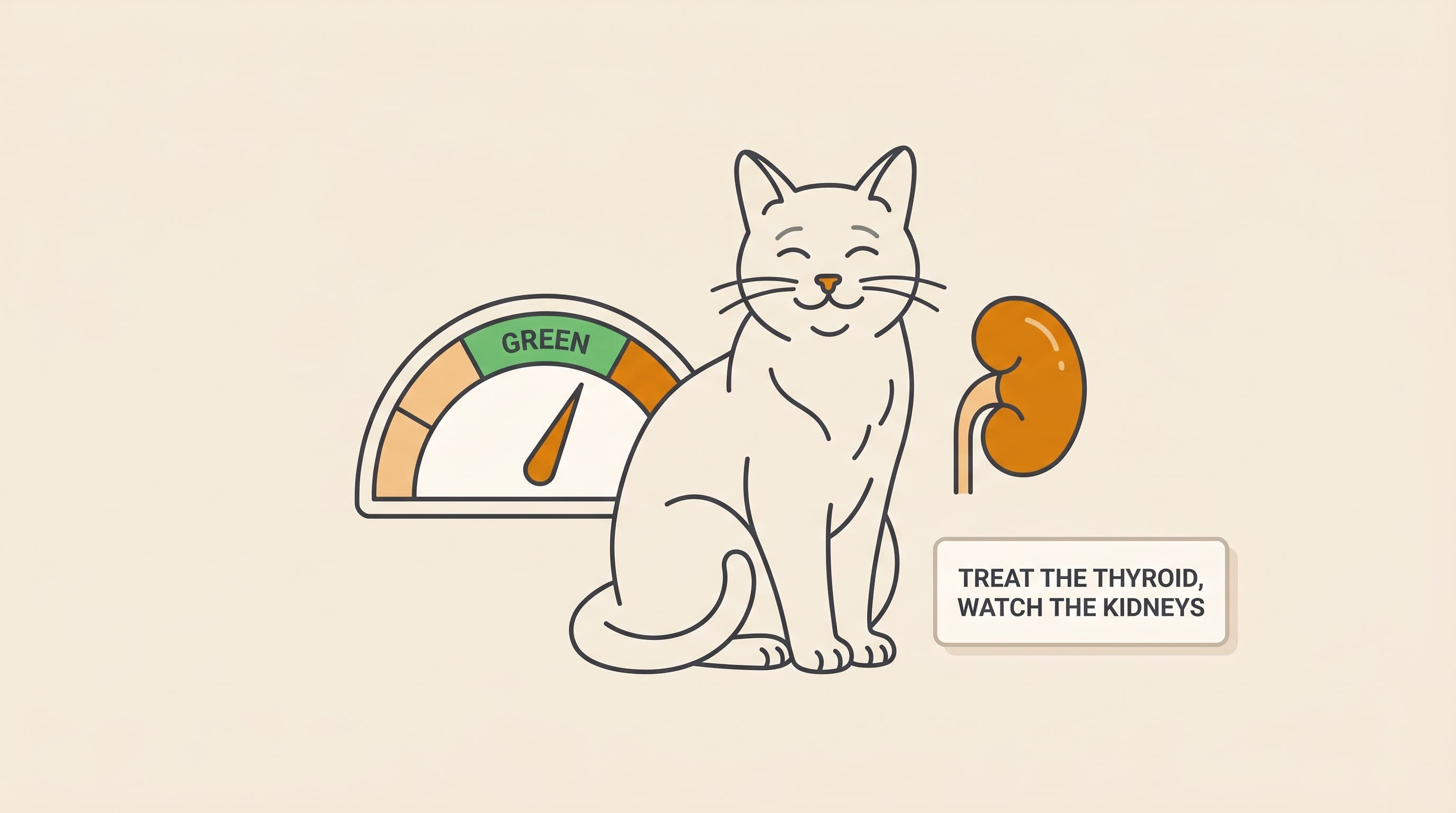
The kidney catch: why treating the thyroid can unmask kidney disease
Alastair Greenway
BVM&S MRCVS
If your cat has just been diagnosed with an over-active thyroid, you'll probably have been told that it's common, well understood and very treatable. All of that is true. But one piece often gets left out of the first conversation, and it surprises owners. Treating the thyroid can reveal kidney disease that was hiding underneath the whole time.
That sounds alarming, but the treatment doesn't break your cat's kidneys. The kidney disease was already there, quietly, and the high thyroid was flattering the numbers so nobody could see it. Understanding why is the difference between feeling blindsided at the first recheck and feeling prepared for it, and it's genuinely useful to know before you pick a treatment.
Why a high thyroid hides bad kidneys
Hyperthyroidism is the commonest hormonal disease of older cats (AAFP 2016), and chronic kidney disease (CKD) is one of the commonest diseases of older cats full stop. The two turn up together a lot, simply because both are diseases of getting on in years (Vaske et al. 2016). So a cat that has one quite often has the other.
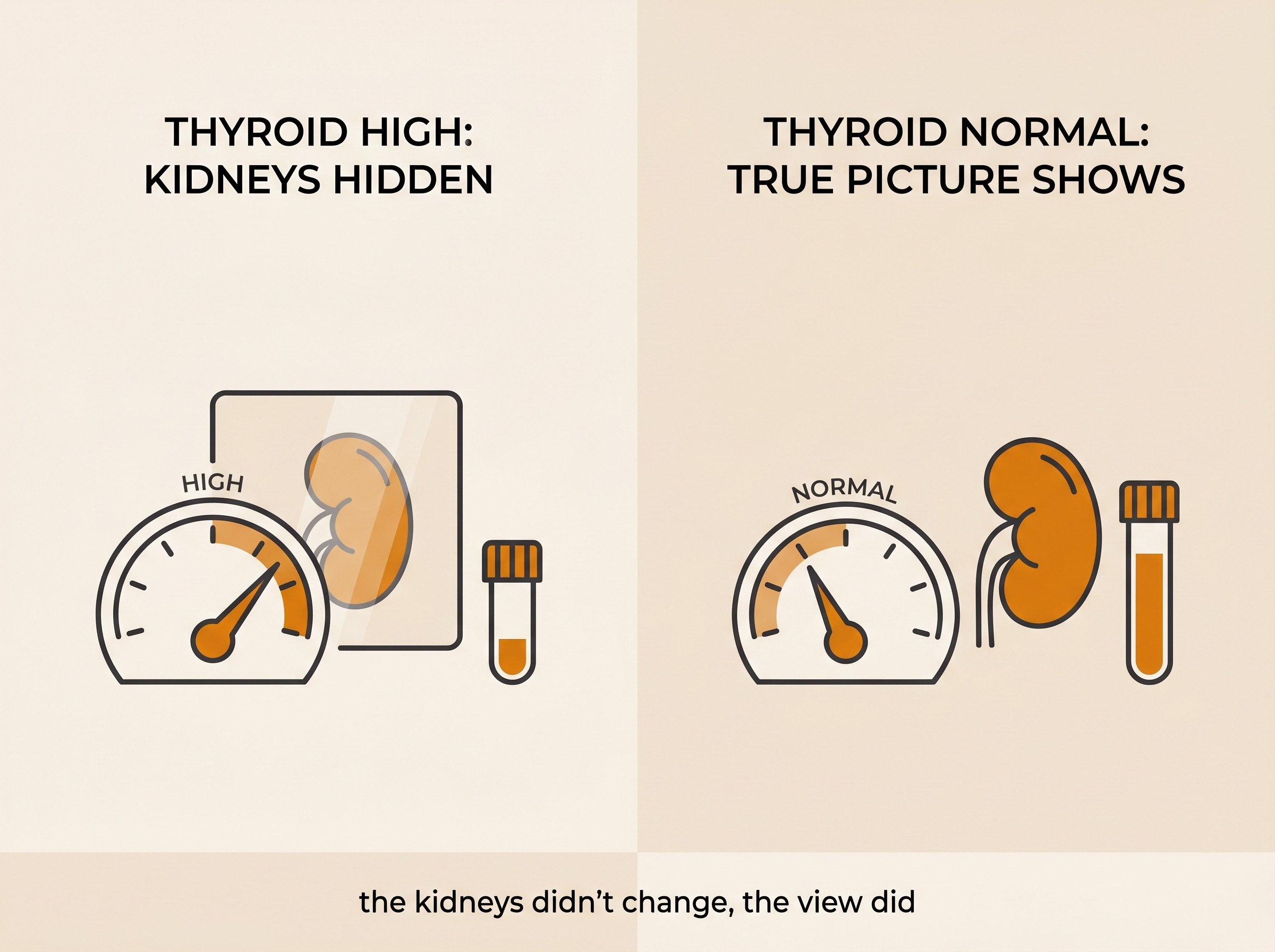
Here's the catch. Too much thyroid hormone pushes more blood through the kidneys and lifts their filtering rate, the GFR (Vaske et al. 2016). On top of that, an over-active thyroid burns through muscle, and it's muscle that produces creatinine, the waste product vets measure to judge kidney function (Vaske et al. 2016). So two effects pull in the same direction. The kidneys are working harder than they normally would, and the blood test meant to flag kidney trouble reads artificially low because there's less muscle feeding it.
The upshot is that the kidney numbers look better than the kidneys really are. Vets call this "masking" (Vaske et al. 2016). When you bring the thyroid back under control, the GFR settles back down and the muscle returns, so the creatinine rises to its true level. If there was underlying CKD, it now shows up as azotaemia, a build-up of those waste products in the blood. The disease didn't appear. It was unmasked (Vaske et al. 2016). So if your cat's kidney values look fine at diagnosis, that's reassuring, but it isn't a guarantee. The high thyroid is sitting in front of the answer.
How often this actually happens
This is a real, everyday thing, not a rare twist. Somewhere between about 10% and 23% of hyperthyroid cats are already showing kidney trouble at the point of diagnosis, and somewhere between about 15% and nearly half go on to show it after treatment (Vaske et al. 2016). That's a wide range, and the spread is genuine, depending on how the cats were studied and where the line for "azotaemia" was drawn. As one concrete example, in a study of 262 cats treated with radioiodine, around 16% became azotaemic afterwards (Peterson et al. 2018). The takeaway isn't a single scary number. It's that a meaningful minority of treated cats turn out to have kidneys that need watching, so it pays to plan for the possibility rather than be ambushed by it.
Why your vet checks the kidneys before and during treatment
This is exactly why a good work-up for a hyperthyroid cat isn't just a thyroid test. Before settling on a plan, your vet will usually stage the kidneys properly, which means creatinine, often an SDMA, a urine sample to see how well the kidneys are concentrating, blood pressure, and a check for protein in the urine (AAFP 2016). That's the standard IRIS work-up, and it gives a baseline to measure against once the thyroid comes down.
A quick word on SDMA, because owners often ask. It's a newer kidney marker, and its strength is that it isn't thrown off by muscle mass the way creatinine is, so it can pick up trouble a bit earlier. It's a genuinely helpful extra number, but it's not a crystal ball. As a way of predicting in advance which cats will become azotaemic after treatment, it does poorly on its own. In the 262-cat study, a raised SDMA before treatment flagged only about a third of the cats who later became azotaemic, although when it was raised it was rarely a false alarm (Peterson et al. 2018). So a high SDMA beforehand is worth taking seriously, but a normal one doesn't promise the kidneys will sail through.
Then, once the thyroid is under control, your vet rechecks the kidney values to see what they're really doing now the masking has lifted (AAFP 2016). None of this is a reason to panic. It's the reason the monitoring exists.
The reversible-trial-first rule
This is where the kidney catch should genuinely shape your decision.
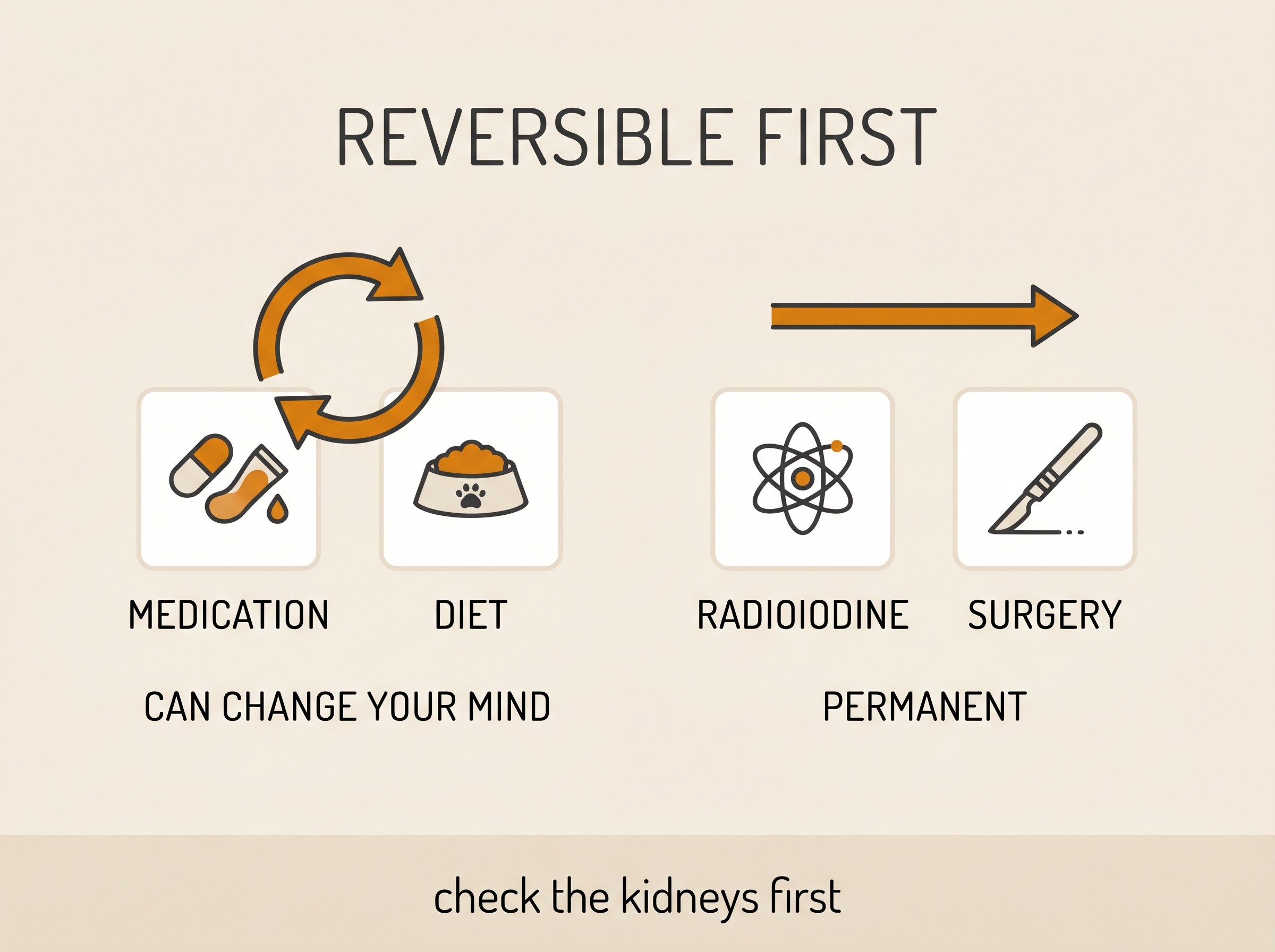
There are four ways to treat an over-active thyroid, and we compare them frankly in our piece on the four options. Two are reversible. Anti-thyroid medication (methimazole or carbimazole, as a tablet or a skin gel) and a strict iodine-restricted diet both bring the thyroid down, and if you stop them, the effect lifts back off again (Vaske et al. 2016). The other two are permanent. Radioiodine in particular is a one-and-done cure, which is its great strength, and it cures roughly 95% of cats with a single treatment (see our radioiodine article). But you can't undo it.
Put those two facts together and the safe order becomes obvious. For any cat that already has kidney disease, or that looks at risk of it, you start with a reversible treatment. You bring the thyroid down, you watch the kidneys, and you find out what they do before committing to anything permanent. If the kidneys hold up well, you can then move to a definitive cure with confidence. If they don't, you've changed nothing you can't change back (AAFP 2016). The reversible options let you take the thyroid down, look, and change your mind. Radioiodine and surgery don't give you that second chance.
This is the AAFP's recommendation for cats that are azotaemic or at risk at diagnosis (AAFP 2016). Check the kidneys first, treat carefully, and trial something reversible before you reach for something you can't undo.
Don't aim too low: the real villain is over-treatment
Here's the part that surprises people, because it's the opposite of what you'd assume. The aim of treatment isn't to push the thyroid as low as possible. It's to get it to the right level, and pushing it too low can be worse for the kidneys than leaving it slightly high.
If treatment over-shoots and the thyroid ends up under-active, that's called iatrogenic hypothyroidism, meaning hypothyroidism we've caused. It's common after any effective treatment (AAFP 2016), and it matters, because an under-active thyroid does the reverse of an over-active one. It drops the GFR, which can unmask or worsen the kidney trouble (Williams et al. 2010). After radioiodine, a notable share of cats end up at least temporarily under-active, with reported figures spanning roughly 20% to 50% (AAFP 2016).
So in a cat with kidney disease, the target isn't the bottom of the range. The AAFP advises keeping the thyroid hormone (T4) in the upper half of the normal range, not suppressed below it, specifically to protect kidney function (AAFP 2016).
Reassuringly, over-treatment is fixable, and this is the practical thing to take away. If your treated cat goes flat, starts gaining weight, or the kidney numbers slip, ask your vet to check the thyroid level. If it's gone too low, the dose can be reduced, or a thyroid supplement (levothyroxine) added back in after radioiodine or surgery (AAFP 2016). Catching that is part of why the rechecks matter.
Why mild kidney trouble after treatment isn't a disaster
It would be easy to read all this and conclude that azotaemia after treatment is a catastrophe to dread, and that you should deliberately under-treat your cat to keep the kidneys "safe". That's the wrong lesson, and the survival evidence is actually reassuring here. What seems to shorten lives isn't mild kidney trouble on its own. It's the combination of an under-active thyroid and kidney trouble together (Williams et al. 2010). In a large group of cats treated with radioiodine, those who became azotaemic did have shorter survival than those who didn't, around 34 months versus 52 months on average (JAVMA 2025). Please don't read that as a countdown. Read it as the reason the monitoring is worth doing, because a lot of what drives that gap is over-treatment, and over-treatment we can correct.
In fact, the more recent evidence suggests that topping up thyroid hormone in cats who have become under-active, but whose kidneys are still coping, helps their survival, while cats who are both under-active and azotaemic don't get the same benefit (Cox et al. 2025). So a well-compensated cat with mild kidney changes shouldn't be denied an effective thyroid treatment out of fear (NDSR, clinical opinion). Keep the thyroid at the right level rather than too low, treat any under-activity, and many cats with some kidney compromise still do well. The kidneys are something to manage, not something that makes the situation hopeless.
What this means for you and your cat
None of this changes the headline, which is genuinely a calm one. Your cat's over-active thyroid is treatable, and treating it is the right thing to do. The kidney catch just means doing it with your eyes open.
So the practical next steps are simple. Make sure the kidneys are staged before you settle on a treatment. If your cat has any kidney concern, ask your vet about starting with a reversible option (medication or diet) so you can see how the kidneys respond before committing to a permanent cure. Keep up with the rechecks, which watch the thyroid level and the kidneys together, not just one of them. And if your cat seems flat or off after treatment, get the thyroid level checked rather than assuming it's "just the kidneys".
If your cat is drinking and weeing more than usual, that's worth measuring rather than guessing at, and our Thirst & Wee tracker turns it into a number your vet can use. It's also worth reading our piece on living with a treated thyroid cat for the longer-term rhythm of tablets, gels and rechecks, and our four-options comparison if you're still weighing up the route to take. The renal side of the story carries on in our urinary-health (kidney disease) section.
The kidney catch isn't a reason to be afraid of treating your cat. It's the reason to treat carefully and keep watching, and that's a very manageable thing to do.
References
- Carney HC, Ward CR, Bailey SJ, Bruyette D, Dennis S, Ferguson D, Hinc A, Rucinsky AR. 2016 AAFP Guidelines for the Management of Feline Hyperthyroidism. J Feline Med Surg 2016;18(5):400-416. DOI: 10.1177/1098612X16643252.
- Vaske HH, Schermerhorn T, Grauer GF. Effects of feline hyperthyroidism on kidney function: a review. J Feline Med Surg 2016;18(2):55-59. DOI: 10.1177/1098612X15575385.
- Peterson ME, Varela FV, Rishniw M, Polzin DJ. Evaluation of Serum Symmetric Dimethylarginine Concentration as a Marker for Masked Chronic Kidney Disease in Cats With Hyperthyroidism. J Vet Intern Med 2018;32(1):295-304. DOI: 10.1111/jvim.15036.
- Williams TL, Elliott J, Syme HM. Association of iatrogenic hypothyroidism with azotemia and reduced survival time in cats treated for hyperthyroidism. J Vet Intern Med 2010;24(5):1086-1092. DOI: 10.1111/j.1939-1676.2010.0566.x.
- Hyperthyroid cats that develop azotemia following successful radioiodine treatment have shorter survival times compared to cats that remain nonazotemic. J Am Vet Med Assoc 2025;263(4). Article id javma.24.10.0653.
- Cox SE, Wakeling J, Hall T, Williams TL. Survival of radioiodine treated hyperthyroid cats that are euthyroid and hypothyroid after treatment, and effect of levothyroxine supplementation on survival time of cats with iatrogenic hypothyroidism. J Vet Intern Med 2025;39(1):e17295. DOI: 10.1111/jvim.17295.
- North Downs Specialist Referrals (NDSR). The Thyroid and the Kidneys: a Love-Hate Relationship! (referral-hospital clinical insight).
Keep track of how your pet is doing
The owners who cope best are the ones who notice changes early. A simple health log shows you what is working, and what is not, before the next vet visit.
Start tracking, freeYou're not doing this alone
Compare treatment journeys and talk to owners managing hormone health. Free to join.
Join PetsLikeMine