

How much to lose and how fast: safe rates for dogs and cats
Alastair Greenway
BVM&S MRCVS
A weight-loss plan really comes down to two numbers: how much to lose, and how fast to do it. Here they are, up front, so you can stop worrying and start.
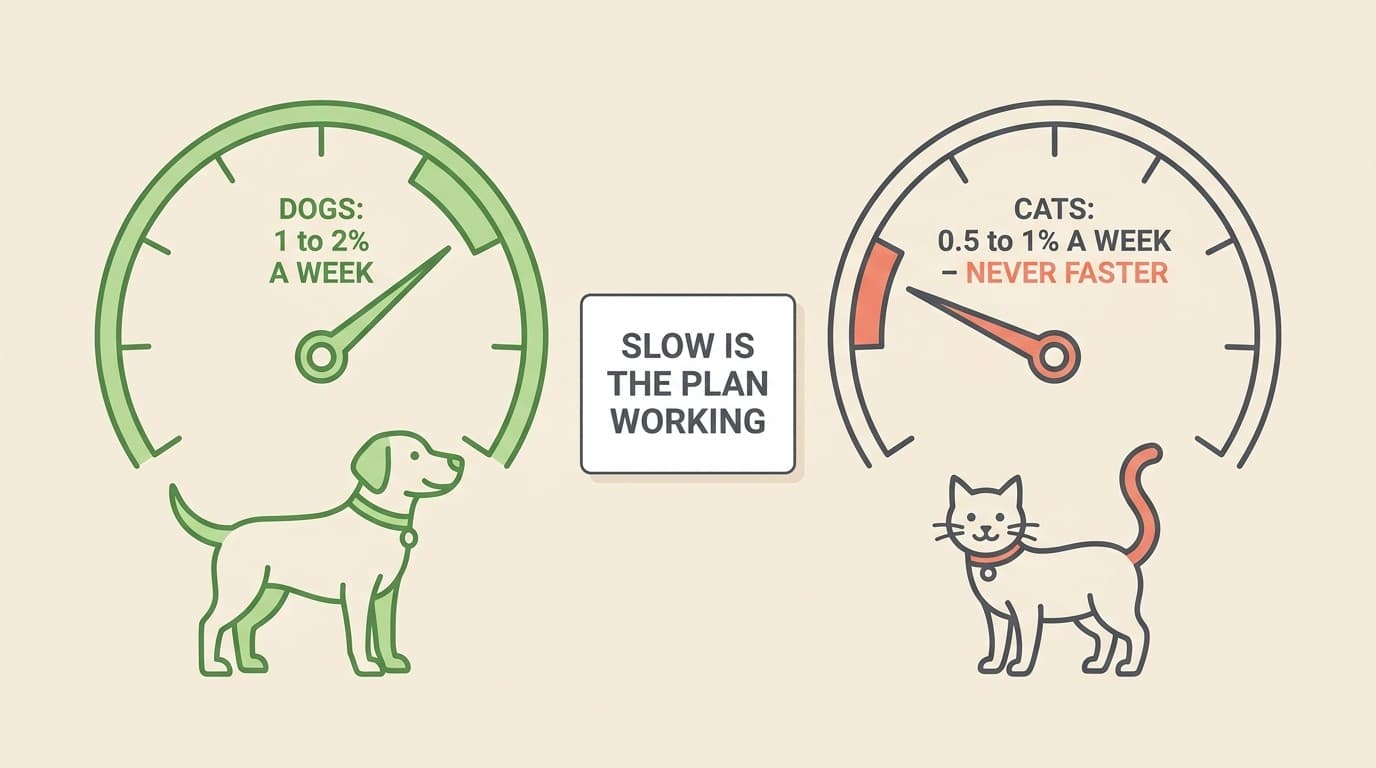
Most overweight pets need to lose the excess they're carrying over their ideal weight, which for a pet that's just a bit heavy is usually around 10 to 15% of their current weight, and more if they're properly obese. The safe pace to take it off is about 1 to 2% of body weight a week for dogs, and about 0.5 to 1% a week for cats, never faster (Cornell Riney Canine Health Center; APOP). That's it. The rest explains why those numbers are what they are, what they mean in weeks and months, and the one hard rule that keeps a slimming cat safe.
One thing is worth fixing in your head before you read on. Slow is not the diet failing. Slow is the diet working. A plan that takes months is one that's protecting your pet's muscle and is far more likely to stick.
The two numbers, how much and how fast
Start with how much. The goal isn't a round number you've decided sounds good, it's the weight your pet is carrying above their ideal. For a mildly overweight pet that excess is often about 10 to 15% of what they weigh today. For an obese pet it's more. If you haven't pinned down the ideal weight itself yet, that's the job of working out what your pet should actually weigh, and it's worth doing first so you're aiming at a real target rather than a guess.
Then how fast. This is where dogs and cats part company, and the difference matters.
For dogs, a safe rate is about 1 to 2% of body weight a week. Cornell's Riney Canine Health Center puts it plainly: "dogs can expect to safely lose 1-2% of their weight weekly. For example, a 50-pound dog could safely lose half to one pound in a week" (Cornell Riney Canine Health Center). A general clinical guideline across both species sits between 0.5% and 2% a week (VCA).
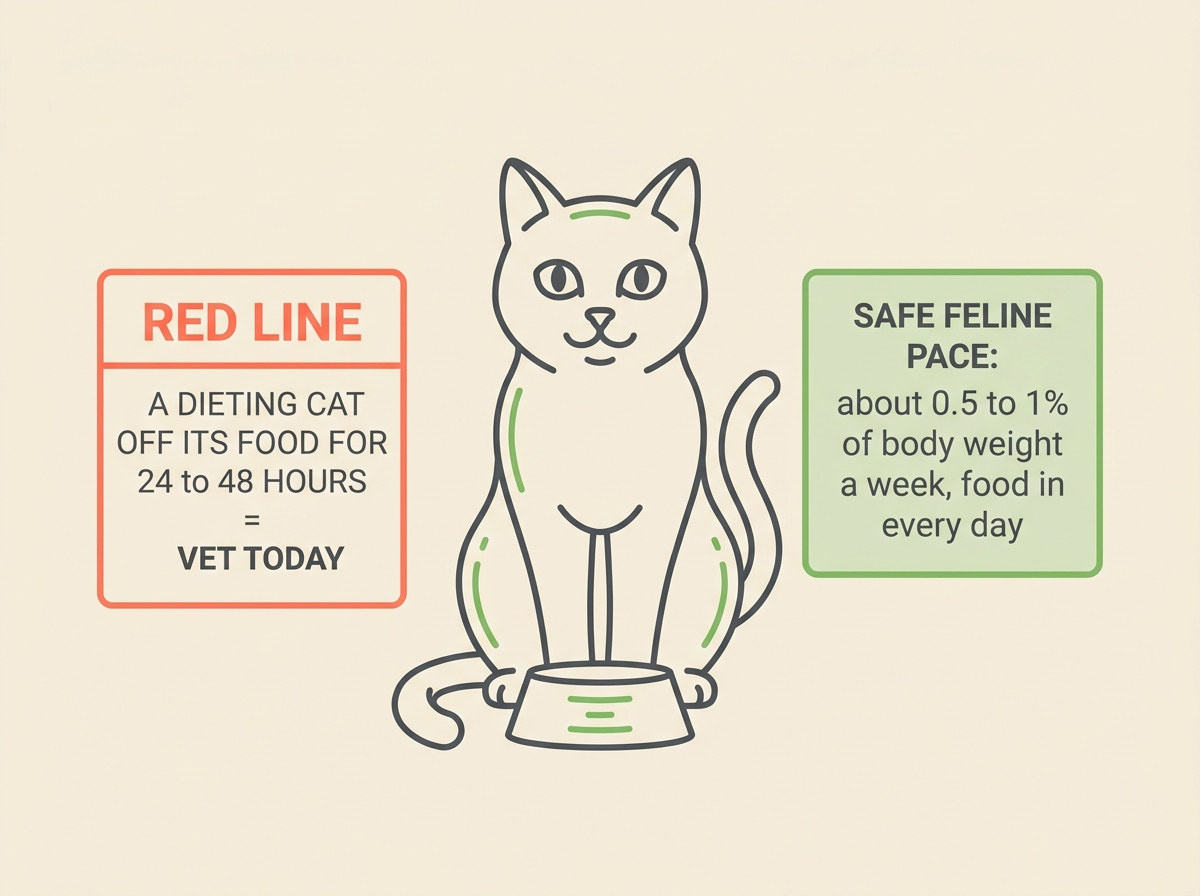
For cats, the ceiling is lower and harder. Aim for about 0.5 to 1% of body weight a week, and treat the top of that range as a limit, not a target to push against. The Association for Pet Obesity Prevention recommends a conservative starting point of about 0.5% of current body weight per week, roughly half a pound to a pound a month (APOP). Do not let anyone talk you into "up to 2% a week" for a cat. That upper figure belongs to dogs. For a cat, the slower number is the whole point, and the next section explains why.
Why a slow loss protects the muscle (and the cat red line)
The pace is capped for a real reason, and it's the same reason crash-dieting backfires even when the scale looks like it's cooperating.
When weight comes off too fast, a big share of what's lost is muscle, not fat. That matters for two reasons. First, the muscle your pet keeps is metabolically active tissue: it's part of what burns calories, so losing it makes the next bit of weight harder to shift and makes regain easier. Second, lost muscle is exactly how crash diets rebound. You drop weight quickly, you strip lean tissue along with the fat, and the body bounces back heavier than before.
Slow loss does the opposite. In a study of overweight dogs that lost weight at a gentle pace of under 1% a week, the tissue they lost was about 84% fat to 15% lean, with the lean muscle largely preserved (German et al., 2007). That's the goal: lose the fat, keep the muscle, and the muscle you keep is what holds the new weight in place. Gradual loss also avoids the metabolic slowdown and the constant hunger that fast restriction triggers, which is a large part of why steady diets are the ones owners can actually sustain (APOP; AAHA, 2021).
For cats, slow isn't just better. It's a safety rule you cannot cross.
Never crash-diet a cat, and never let a slimming cat stop eating. A cat that's fed far too little, or that goes off its food, can develop a condition called hepatic lipidosis, or fatty liver. The body mobilises fat faster than the liver can process it, fat floods the liver, and it can become life-threatening within days. It tends to strike exactly the cat you'd worry about least: as VCA puts it, "hepatic lipidosis can occur in an otherwise healthy cat that involuntarily has severely restricted food intake, such as from overzealous caloric restriction for weight reduction" (VCA; Webb, 2018).
So the feline red line is simple and absolute. An overweight cat that won't eat for 24 to 48 hours is a vet-today emergency, not a diet that's finally working. APOP is unambiguous: "if your cat refuses food for 24 hours during a weight-management program, contact your veterinarian immediately" (APOP). And you should never restrict a cat's food without your vet's input in the first place, because sudden food restriction can itself make a cat ill (International Cat Care). A slimming cat needs food going in every single day. If she stops eating, the diet stops, and you call.
So how long does it actually take? Months, not weeks
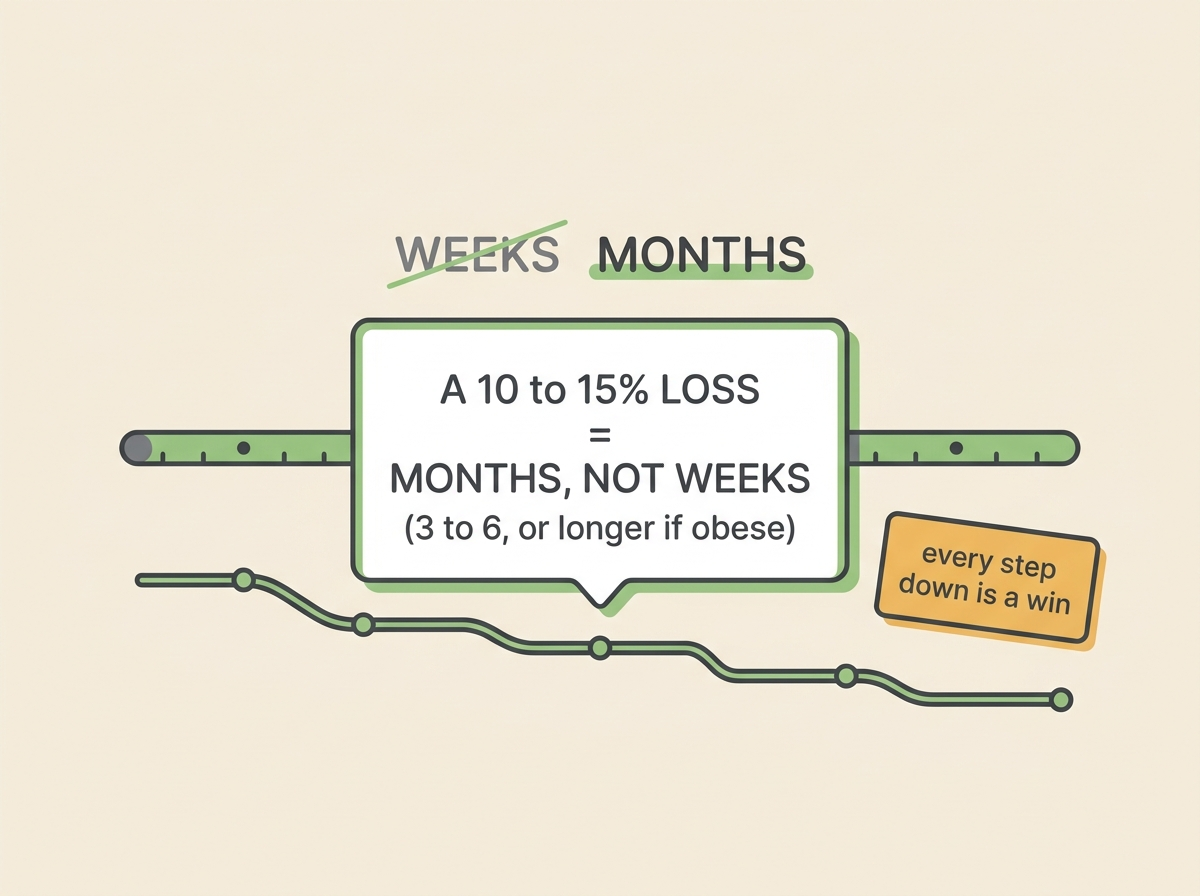
People quietly dread this part, so let's do the arithmetic out loud and take the sting out of it. At a safe pace, getting an overweight pet down to ideal is a months-long project. For a pet that's only mildly overweight, think roughly 3 to 6 months. For an obese pet, 6 to 12 months, and sometimes longer. That isn't slow because something's wrong. It's slow by design.
Take a dog. VCA works through a real example: an 88-pound (40 kg) dog that needs to lose 10 pounds, losing at the safe rate, needs "11 or 12 months to reach the goal weight" (VCA). That's most of a year for a 40 kg dog shedding 10 pounds, done properly. APOP's general guidance lands in the same territory, with many dogs reaching target over six to eight months and obese ones taking longer (APOP).
Now a cat. Picture a 6 kg cat who should be nearer 5 kg, so she's carrying about 1 kg of excess. At roughly 0.5 to 1% of body weight a week, that's somewhere around 30 to 60 grams a week. A kilogram, taken off at that pace, is a many-months job, and International Cat Care notes it may take up to a year for a severely overweight cat to reach a healthy weight (International Cat Care; APOP). For a cat, that long horizon is the safe horizon. There's no shortcut that doesn't risk the liver.
Saying all this plainly isn't meant to discourage you. It's the opposite. If you set out knowing the distance, "still going in month four" reads as on track, not as failure, and the long stretch doesn't catch you out and make you quit.
Plateaus are part of the plan, not a wall
Expect one more thing before it happens, because it's the moment most pet diets fall apart: the scale will, at some point, stop moving. This is normal. It is not the diet breaking.
The mechanism is simple. As your pet gets lighter, they burn fewer calories than they did when they were heavier, simply because there's less of them to run. So the ration that started as a real deficit slowly drifts toward "just about enough", and the weight loss flattens out (VCA; AAHA, 2021). That's not your pet being stubborn or having a uniquely slow metabolism. It's arithmetic, and it's exactly why the food has to be recalculated as they shrink, rather than set once and forgotten.
The full playbook for breaking a stall, the calorie creep to check for, when to recalculate and when to loop in your vet, lives in how to bust a weight-loss plateau and why the ration has to change as they shrink. For now, the only thing you need to carry into the diet is this: a plateau is a checkpoint, not a wall, and it's coming, so it won't throw you when it does.
Set the pace and hold it
So you've got your two numbers. Lose the excess over ideal, at about 1 to 2% a week for a dog or about 0.5 to 1% a week for a cat, over a span you should now expect to count in months. Here's how to lock that in and keep it on track.
Set the target and the pace in the Feeding Calculator, which turns your pet's ideal weight into the daily amount of the food you already own. If you want to see the sums behind that number, how many calories your pet actually needs and where the figure comes from, that's how the feeding maths works. You don't need a special diet to do this safely, you need the right portion of sensible food and the patience to hold the rate, and you can very often just measure and cut back what's already in the cupboard. Then log the weigh-ins on the Healthy Weight Tracker, which plots the trend against the target, flags a cat that's dropping too fast, and tells you when a plateau is expected rather than alarming.
And weigh the trend, not the daily wobble. A single weigh-in is noise: it moves with a full bladder, a big meal, the time of day. What matters is the line over weeks, sloping gently down. If you're slimming a cat, keep the hepatic lipidosis rule pinned somewhere you'll see it, because it's the one number on this page that isn't a guideline but a hard limit: food in every day, and off her food for 24 to 48 hours means the vet today, not tomorrow.
Pick the safe rate for your species, set it, and hold it. The slow version is the one that gets your pet moving better, climbing the stairs and jumping on the sofa again, and stays gone.
References
- Cornell Riney Canine Health Center. Obesity and weight loss in dogs. Cornell University College of Veterinary Medicine.
- Association for Pet Obesity Prevention (APOP). Cat Weight Loss; Dog Weight Loss.
- VCA Animal Hospitals. Tips for Successful Weight Loss in Dogs and Cats; Hepatic Lipidosis in Cats.
- German AJ, Holden SL, Bissot T, Hackett RM, Biourge V. (2007). Dietary energy restriction and successful weight loss in obese client-owned dogs. J Vet Intern Med, 21(6), 1174-1180.
- American Animal Hospital Association (AAHA) (2021). 2021 AAHA Nutrition and Weight Management Guidelines for Dogs and Cats. J Am Anim Hosp Assoc, 57(4), 153-178.
- Webb CB (2018). Hepatic lipidosis: clinical review drawn from collective effort. J Feline Med Surg, 20(3), 217-227.
- International Cat Care. Obesity in Cats.
Keep track of how your pet is doing
The owners who cope best are the ones who notice changes early. A simple health log shows you what is working, and what is not, before the next vet visit.
Start tracking, freeYou're not doing this alone
Compare treatment journeys and talk to owners managing weight management. Free to join.
Join PetsLikeMine