

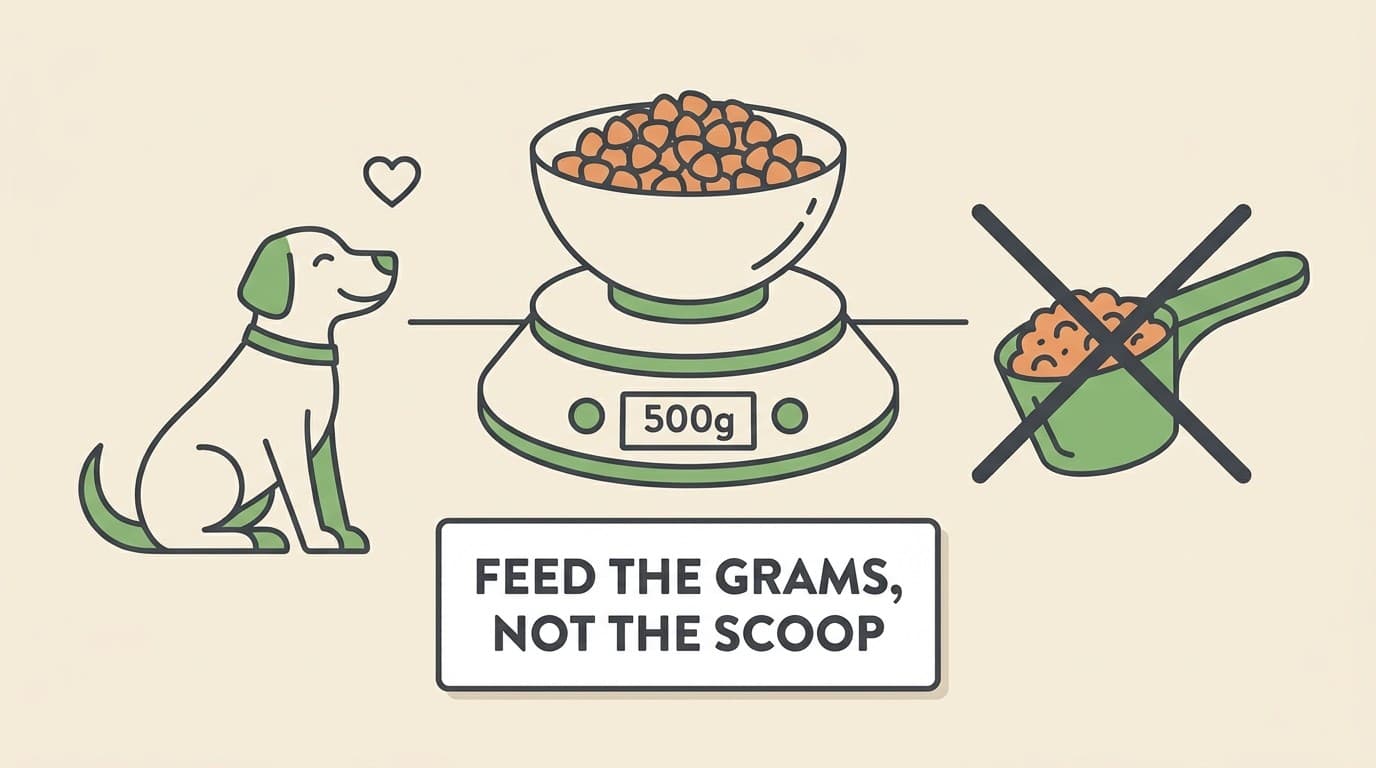
How Much Should I Actually Feed? Why the Bag Is Lying to You
Alastair Greenway
BVM&S MRCVS
Feeding by the scoop and the side of the bag is the normal way most people do it, and it doesn't make you a bad owner. The trouble is that you've been handed a guide that was never built to be precise.
The numbers back that up. In the Association for Pet Obesity Prevention's 2025 survey, only about 16% of dog owners and 3% of cat owners actually weigh their pet's food (APOP, 2025). Everyone else measures with a cup, eyeballs it, or leaves the bowl topped up. So if "feed less" left you staring at a scoop with no idea how much, you're in very good company, and it isn't your fault. The tools you were handed were vague.
This is the single most-asked, worst-answered question in pet weight loss. The good news is that there's a clear answer, you can do it with the food already in your cupboard, and it takes about ten minutes to set up. Let's go.
Why the bag overfeeds
The feeding guide on the back of the bag isn't wrong, exactly. It's just built for an average that probably isn't your pet.
Those tables are calibrated for an active adult at a healthy weight. Most household pets are neutered, spend a lot of the day asleep on the sofa, and are already carrying a bit too much, so they need materially less than the table suggests. There's a structural reason the numbers run generous too, and it's worth saying plainly: a brand sells more food when you pour more. The guide has no incentive to err on the low side.
There's solid evidence the labels themselves contribute to overfeeding. One peer-reviewed study found that inaccurate pet-food labels, alongside owners misjudging their pet's body condition, are a genuine cause of pets being fed too much (Alvarez et al., 2017). And the corrective principle the profession uses for weight loss is the opposite of what the bag does: you work out what the pet needs based on its ideal weight, and you recommend feeding downward from there (Cline et al., 2021).
So treat the bag as a generous starting point, not a prescription.
Why the scoop makes it worse
If the bag runs high, the scoop adds a second layer of error on top.
A measuring cup feels precise, but it really isn't. When researchers asked people to portion dry kibble with a cup, the results ranged from an 18% under-estimate all the way to an 80% over-estimate of the intended amount (German et al., 2011). Eighty per cent over. That's nearly double the food, scooped in good faith, every single day.
Part of the problem is the food itself. Kibble size and density vary from brand to brand and formula to formula, so a level cup of one food is a very different number of calories from a level cup of another. As APOP put it, even five to ten extra kibbles a meal can quietly wipe out the deficit you were trying to create (APOP, 2025). Eyeballing kibble isn't portion control. It's the opposite of it.
The fix isn't a fancier scoop. It's a different unit entirely.
What your pet actually needs is a calorie count
Your pet doesn't need "a cup". It needs a number of calories a day, and once you have that number, everything else falls into place.
Here's the simple version of how that number is built. Every pet has a resting energy requirement, the calories it burns just existing, and that scales with body size. The formula is RER = 70 x (ideal weight in kg) to the power of 0.75. You don't need to do that by hand, but it's the engine under the bonnet. On top of resting needs you'd normally add a lifestyle factor for how active the pet is.
Now the load-bearing bit, the part the bag can't tell you. For weight loss, you feed to the weight you want your pet to be, not the weight they are now. You take the resting requirement for their target weight and feed roughly that, which builds the deficit in automatically. A 20kg dog who should be 16kg gets fed for a 16kg dog. Feed for today's heavier weight and you simply maintain the problem.
A couple of caveats. This number is a starting estimate, not a guarantee, because real pets vary by as much as 50% either side of the formula. You refine it against the scales over the following weeks: if the weight isn't moving after a few weeks, the ration comes down a little; if it's dropping too fast, it goes up. And there's a floor. You don't drop a pet below about 70% of their resting requirement without veterinary nutrition advice, because over-restriction causes its own problems. Slow and steady wins this one.
Turning calories into grams of your food
This is where it gets satisfying, because the last step uses the bag after all, just a different part of it.
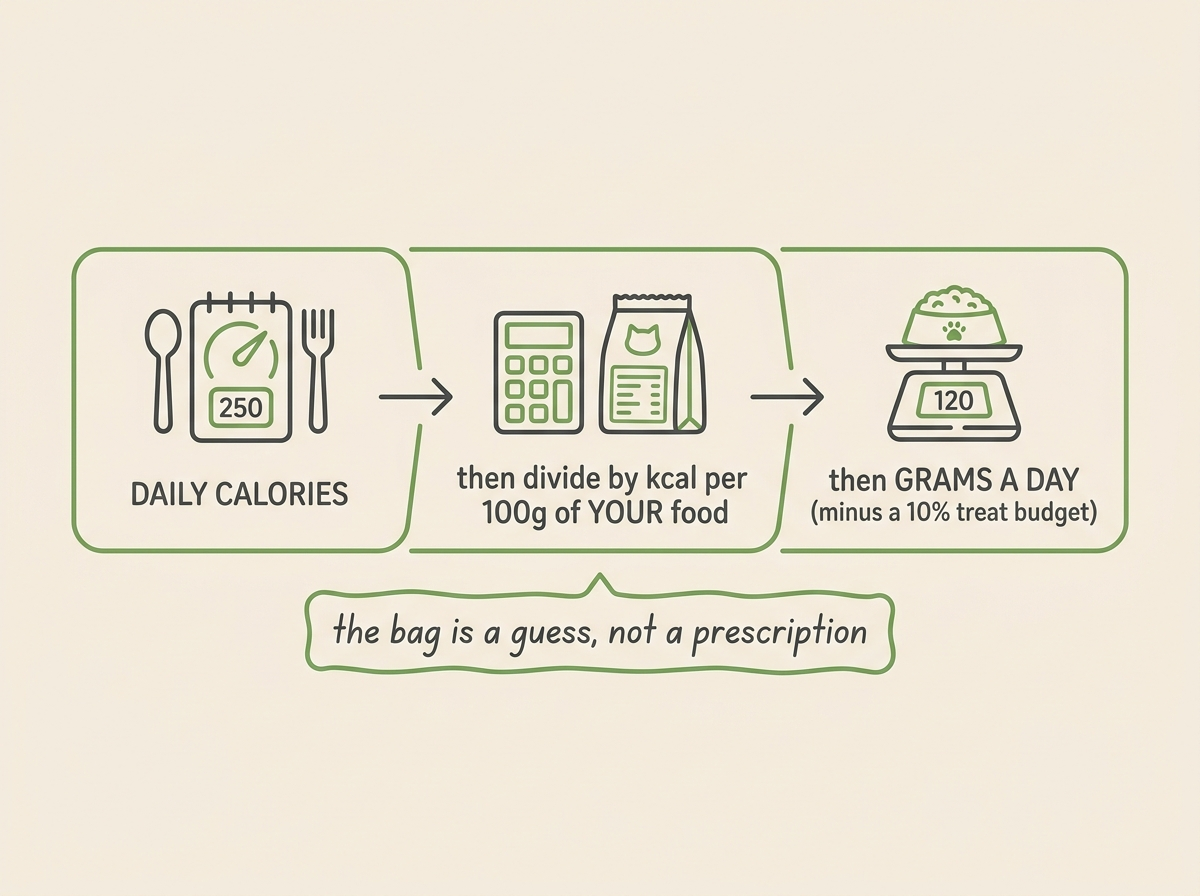
UK and EU pet foods are legally required to declare their energy as kcal per 100g of food (FEDIAF, 2021). It's on the label, often in small print near the composition. Once you've found it, the maths mirrors exactly what the Feeding Calculator does:
- Start with the daily calorie target.
- Take 10% off the top for treats (more on that below), leaving 90% for the food.
- Divide the food calories by the kcal per 100g on the bag, then multiply by 100. That's grams of food per day.
A worked example for a dog. Say the daily target works out at about 700 kcal. Carve off 10% for treats and the food needs to provide around 630 kcal. The bag says 375 kcal per 100g. So 630 divided by 375, times 100, is about 168g of food a day. Not "a cup". A weighable number you can hit exactly.
And for a cat, because the densities differ. Say a cat's daily target is about 200 kcal. Take off 10% for treats and the food provides around 180 kcal. If she's on a wet food at 85 kcal per 100g, that's 180 divided by 85, times 100, or roughly 210g a day; if she's on a dry food at 380 kcal per 100g, the same 180 kcal is only about 47g. Same cat, same calories, wildly different gram weights depending on the food. Which is exactly why "a cup" was never going to work.
The good news: you don't have to do any of this by hand. The Feeding Calculator runs the whole thing in about ten seconds. You put in your pet's ideal weight and the kcal per 100g off your bag, and it hands you back the grams, treat budget already deducted. The maths above is just so you can see it isn't a black box.
Weigh it, don't scoop it
Here's the single highest-impact change you can make today, and it costs about a fiver: a kitchen scale.
Once you know the grams, weighing them out is the bit that makes the whole plan real. Scoops drift, especially when several people feed the pet or you're rushing in the morning. A scale doesn't. The easiest routine is to weigh the whole day's ration into a tub first thing in the morning, then feed from that tub across the day, so you can see at a glance whether there's any left or whether someone's been generous. When the tub's empty, that's it until tomorrow.
It feels fussy for the first week. By the second week it's just what you do, and it's the difference between a diet that works and one that quietly doesn't. There's more on the practicalities, scales, fiddly cats, the lot, in Measure, don't scoop.
Leave room for treats
Notice we carved 10% off the top before working out the food. That wasn't an accident.
Treats should be no more than about 10% of your pet's daily calories, with the remaining 90% coming from a complete, balanced food (Cline et al., 2021). Build the treat budget in from the start and you don't have to choose between a workable diet and being able to reward your dog or make a fuss of your cat. You keep the ritual; the maths still holds. Try to bolt treats on top of a full ration, though, and you'll wipe out the deficit without realising. There's a whole approach to keeping treats without blowing the plan, including the swaps that barely cost anything, in The treat budget.
A quick, important word on cats
Everything above applies to cats too, with one firm safety line on top: never crash-diet a cat.
<aside class="safety">A cat that's fed far too little, or that stops eating, can develop a serious liver condition called hepatic lipidosis within days. The calculator's number is a gentle starting point, not a target to undercut, and feline weight loss should be slow, never below about 70% of resting needs. If an overweight cat goes off its food for 24 to 48 hours, that's an emergency, not a successful diet. Please read <a href="/articles/f7">Never crash-diet a cat</a> before you start.</aside>Done slowly and steadily, slimming a cat is safe and genuinely worth it. It just has to be done the right way.
Where this leaves you
So, the headline. The bag was never lying to hurt you, it was just never built to be precise, and the scoop on top of it turns a rough guide into a daily guess. Almost nobody weighs the food, which means almost nobody knows how much they're really feeding, and most owners are genuinely amazed how little their pet actually needs once they do the sums.
Your number is a starting estimate, not a verdict. You'll refine it against the scales over the coming weeks, because every pet is different. But you now have a method that beats a scoop and a hunch, and that's the hard part done.
Your next step is the easy one: pop your pet's details into the Feeding Calculator and get your grams. Then set up your weigh-ins with the Healthy Weight Tracker so you can watch the trend, not just today's number.
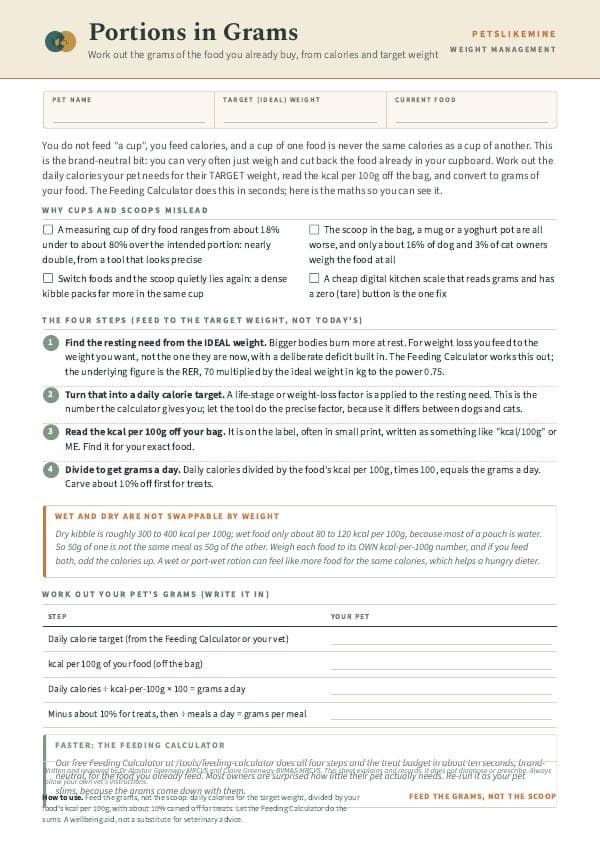
When you're ready to go deeper: Measure, don't scoop for the weighing routine, Cut back the food you have, or switch to a diet food? for the food-choice decision, The treat budget to keep treats in the plan, and How many calories? The feeding maths, made simple for the full version of the sums. You can also print the portions-in-grams guide and stick it on the fridge.
References
- Association for Pet Obesity Prevention (APOP) (2025). 2025 Pet Obesity and Nutrition Survey Results.
- Alvarez EE, Schultz KK, Floerchinger AM, Hull JL (2017). Inaccurate Assessment of Canine Body Condition Score, Bodyweight, and Pet Food Labels: A Potential Cause of Inaccurate Feeding.
- Cline MG, et al. (2021). 2021 AAHA Nutrition and Weight Management Guidelines for Dogs and Cats. Journal of the American Animal Hospital Association, 57(4), 153–178.
- German AJ, Holden SL, Mason SL, Bryner C, Bouldoires C, Morris PJ, Deboise M, Biourge V (2011). Imprecision when using measuring cups to weigh out extruded dry kibbled food. Journal of Animal Physiology and Animal Nutrition, 95(3), 368–373.
- FEDIAF (2021). Nutritional Guidelines for Complete and Complementary Pet Food for Cats and Dogs / Best Practice Guide on Pet Food Labelling.
Free downloads
Companion worksheets to put what you've read into practice. Free PDFs, print at home.
Keep track of how your pet is doing
The owners who cope best are the ones who notice changes early. A simple health log shows you what is working, and what is not, before the next vet visit.
Start tracking, freeYou're not doing this alone
Compare treatment journeys and talk to owners managing weight management. Free to join.
Join PetsLikeMine