

How many calories? The feeding maths, made simple
Alastair Greenway
BVM&S MRCVS
Two numbers and a target
The word "calories" can sound like it comes with algebra attached. It doesn't. There are really only two steps. First you work out how many calories your pet needs in a day. Then you turn that number into grams of the food you already have in the cupboard. That's the whole thing.
You are not going to do this by hand. Our Feeding Calculator does the sums for you in about ten seconds. But it helps to see where the number comes from, so it isn't a black box. The bag on your shelf gives you a portion and never shows its working. We'd rather show ours.
One thing to expect before we start. When people see the real number, they're almost always amazed how little their pet actually needs. The portion that felt mean is usually the right one, and the portion that felt normal was quietly too much. That isn't a failing on your part. It's just what the maths says, and the maths has been hidden from you until now.
Step 1: resting needs scale with size (the RER)
Every pet has a resting energy requirement, or RER. That's the calories they'd burn just ticking over, doing nothing in particular, like the idle on an engine.
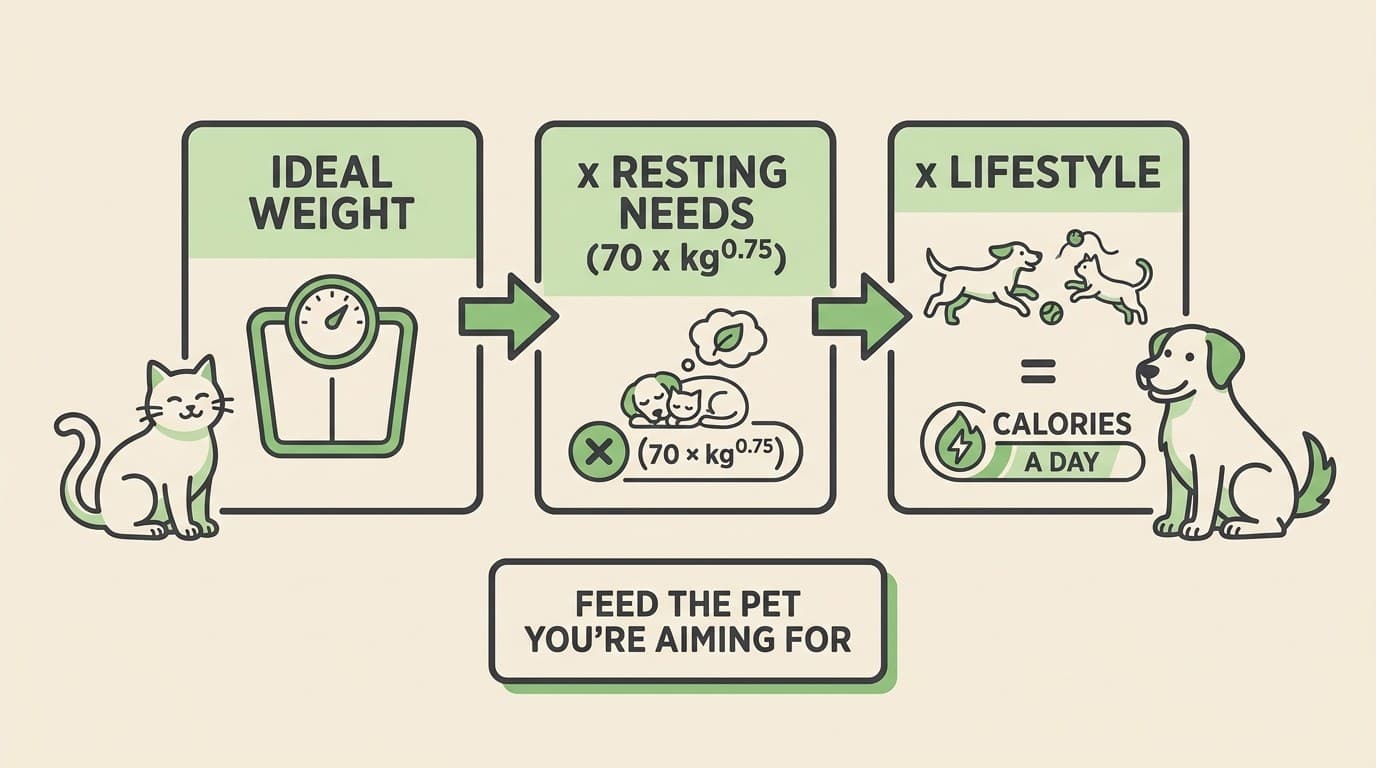
The thing people get wrong is assuming it scales in a straight line. It doesn't. A cat that's half the weight of another cat doesn't need half the food. Resting needs follow a curve, because smaller bodies are a bit more energy-hungry per kilogram. So the formula vets use has that curve built into it:
RER (calories a day) = 70 x (ideal weight in kg, to the power of 0.75)
The "to the power of 0.75" is the curve. You will never type that into a calculator yourself, and you don't need to understand the exponent to use the number. The Feeding Calculator does the ^0.75 for you. We're showing it only so you can see the number isn't plucked from the air.
To make it real: a 10kg dog at rest needs about 400 calories a day (70 x 10^0.75 is roughly 400). That's the worked example in the WSAVA Global Nutrition Toolkit itself (WSAVA, 2021). You may see a quick "30 times the weight plus 70" shortcut elsewhere, but it only holds between about 2kg and 45kg, so we use the proper curved version, which is right at any weight.
Step 2: multiply for real life (the lifestyle factor)
Resting isn't living. A pet that pootles round the garden, sleeps, plays and goes for a walk burns more than the idle figure. So you multiply the RER by a lifestyle factor to get the calories for an actual day.
The factor depends on how active and what life stage your pet is. Here are the exact bands the Feeding Calculator uses:
| Less active or prone to weight gain | Typical activity (neutered adult) | Very active or entire | |
|---|---|---|---|
| Dogs | 1.4 x RER | 1.6 x RER | 1.8 x RER |
| Cats | 1.0 x RER | 1.2 x RER | 1.4 x RER |
For most pets reading this, the middle column is the one. A neutered adult dog of typical activity sits at about 1.6 x RER, and a neutered adult cat at about 1.2 x RER (WSAVA, 2021; Pet Nutrition Alliance, 2023). That gives you the maintenance number, which is the calories that hold a pet steady at the weight you typed in. It answers the question "how much keeps them as they are".
If your pet is overweight, though, "as they are" isn't where you want to stay. And that leads to the one rule that does the real work.
Feed to the target weight, not today's
This is the part worth underlining. For weight loss, you do not feed a fraction of what your pet eats now. You feed to the weight you're aiming for.
It works for a simple reason, and it's gentler than it sounds. A lighter pet needs fewer calories than a heavier one. That's just the RER curve again. So if you calculate the resting needs of the ideal weight and feed to that, the calorie deficit is already built in, because you're feeding a smaller pet than the one currently on the scales. You don't have to starve anyone. You just feed the pet you're aiming for, not the pet you've got.
In numbers, you take the RER of the target weight and apply a weight-loss factor:
- Dogs: feed about 1.0 x the ideal-weight RER.
- Cats: feed about 0.8 x the ideal-weight RER.
Cats are held a little tighter than dogs, but notice that even the cat figure is a gentle, deliberate reduction, never a crash. That distinction matters enormously for cats, who can develop serious liver problems if they lose weight too fast or stop eating. We don't re-teach that here because it has its own piece, Never crash-diet a cat: the hepatic lipidosis rule, and the Healthy Weight Tracker flags it for you. The one-line version: slow and steady, food going in every day, no exceptions.
You don't need to work out the ideal weight yourself either. That's covered in What should my pet actually weigh? Finding the ideal, and how fast it's safe to lose is in How much to lose and how fast. This piece just takes the target weight as your starting point and turns it into food.
Two worked examples, and turning calories into grams
Let's walk one dog and one cat the whole way through, then do the bit that actually feeds them, turning calories into grams.
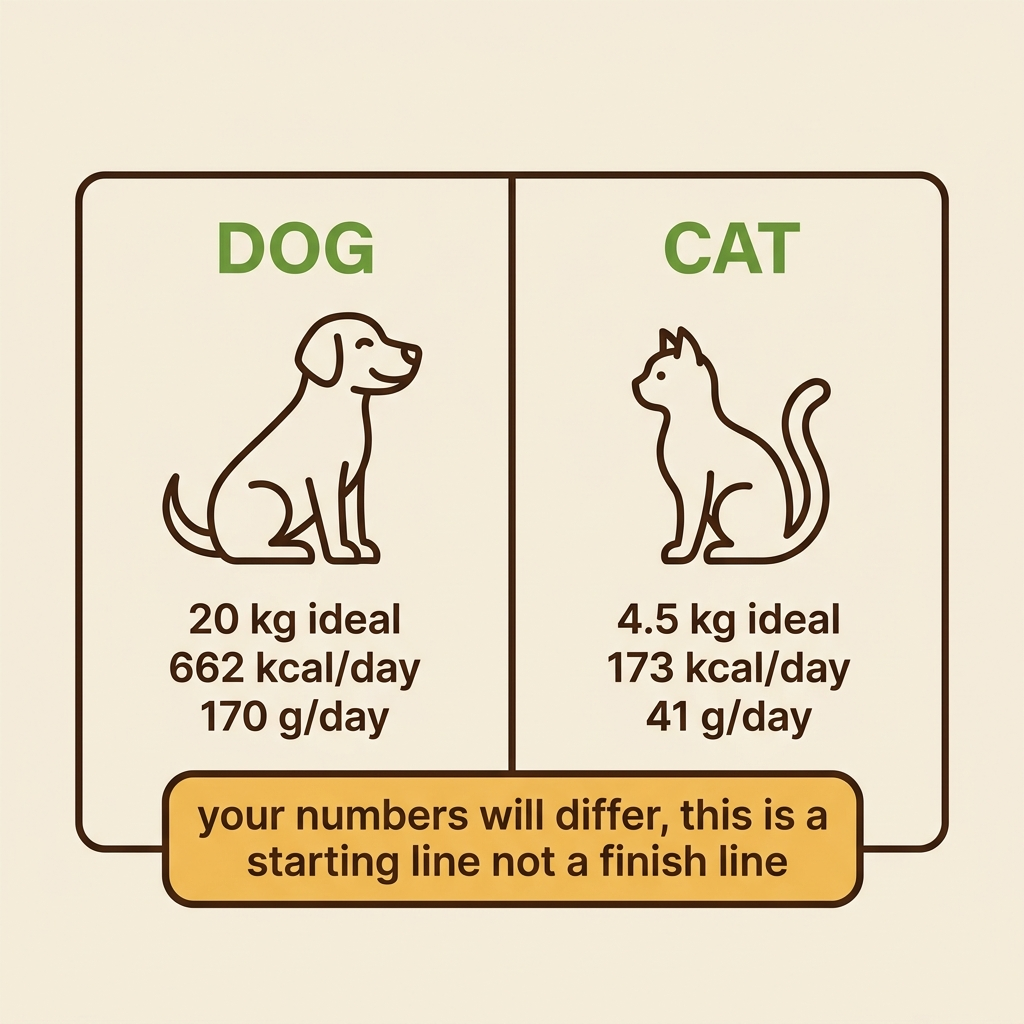
The dog: an overweight Labrador, 25kg now, ideal 20kg. Say the dry food is 350 calories per 100g and you feed twice a day.
- RER of the ideal weight: 70 x 20^0.75 = 662 calories a day.
- Weight-loss factor for dogs (1.0): 662 x 1.0 = 662 calories a day.
- Carve 10% for treats (66 calories), leaving 596 calories from food.
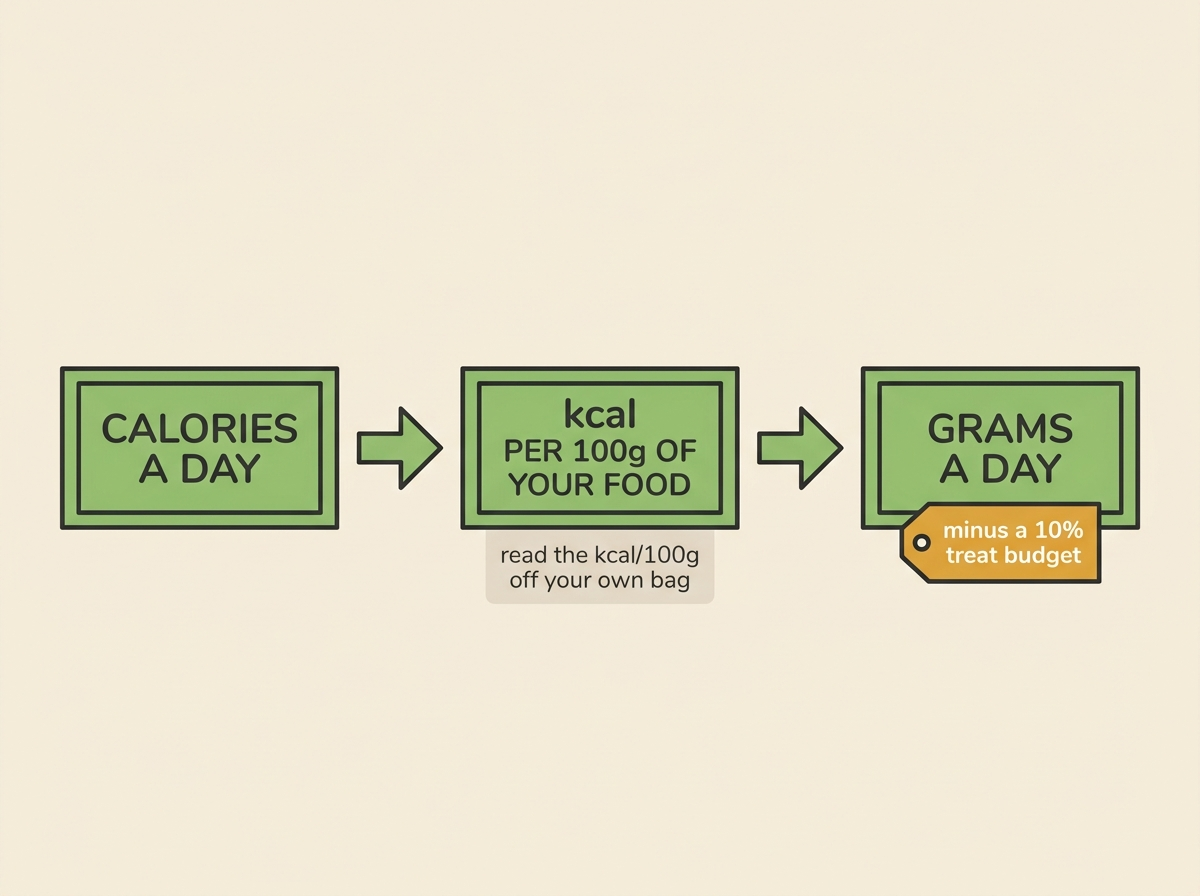
- Grams of the 350-calorie food: 596 divided by 350, times 100 = 170g a day, so about 85g per meal.
To show how much of a deficit that is: once she reaches 20kg and switches to maintenance at the typical 1.6x, she'll get about 1,059 calories a day. So the diet ration is a genuine, meaningful reduction, but it's set by the goal weight, not by guesswork.
The cat: an overweight cat, 6kg now, ideal 4.5kg. Say the dry food is 380 calories per 100g, fed twice a day.
- RER of the ideal weight: 70 x 4.5^0.75 = 216 calories a day.
- Weight-loss factor for cats (0.8): 216 x 0.8 = 173 calories a day.
- Carve 10% for treats (17 calories), leaving 156 calories from food.
- Grams of the 380-calorie food: 156 divided by 380, times 100 = 41g a day, so about 21g per meal.
That's roughly a third of a standard cup, per day, for the whole cat. This is the "amazed how little" moment in action. It looks too small until you remember it's calorie-dense food measured against a small animal's real needs.
The conversion step is the same every time, and it's the bit the bag hides. Read the calories per 100g off your own packet (UK labels have to state it, usually near the feeding guide), then divide your food calories by that number and multiply by 100. Split the result across however many meals you feed.
Notice the treat carve-out in both sums, too. We took about 10% off the top for treats, so the maths survives contact with real life, the dental chew, the training rewards, the bit of cheese. How to spend that budget without blowing the diet is its own piece, The treat budget. For now, just know the 10% is already in the numbers above.
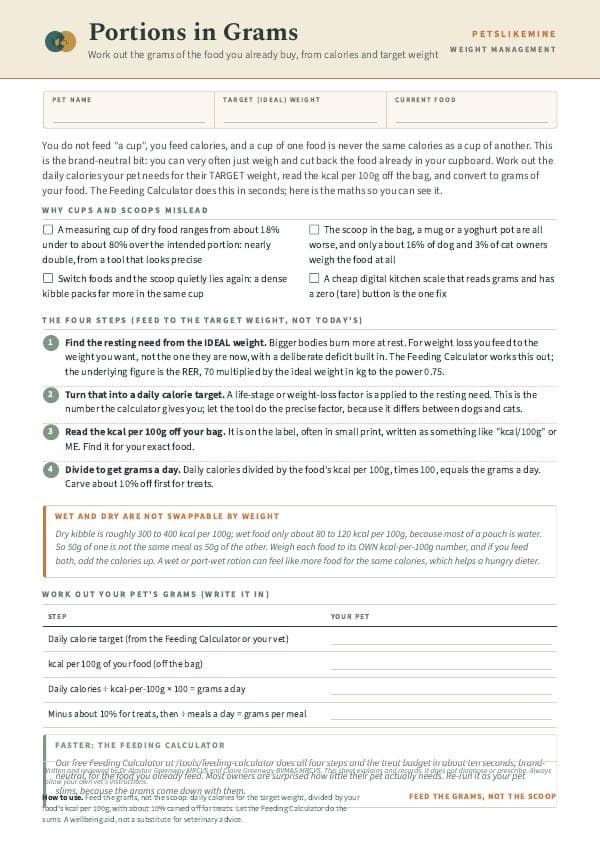
This is exactly what the Feeding Calculator produces. You put in the target weight, the activity, your food's calories per 100g and your meals, and it hands back the grams, the per-meal amount and the treat allowance, with the same arithmetic we just did by hand. You can also keep a printed copy from the portions-in-grams guide.
A starting line, not a finish line
There's one catch worth knowing. These numbers are a brilliant starting point, but they're an estimate, not a prescription.
Individual pets vary, and vary a lot. Real-world energy needs can sit as much as 50% either side of the calculated figure in cats, and around 30% in dogs (Pet Nutrition Alliance, 2023; Merck Veterinary Manual, 2022). That's not the formula being vague. It's biology. Two cats of the same ideal weight can genuinely need different amounts. So the calculated ration is where you begin, then you let the scales and the body condition score fine-tune it over the following weeks.
In practice that means: feed the calculated amount, weigh your pet regularly, and watch the trend. If the weight isn't shifting after a few weeks, nudge the food down a little and check again. If it's coming off too quickly, especially in a cat, ease back up. That's the loop, and Tracking that works and the Healthy Weight Tracker are built to run it with you, plotting the weigh-ins against the target so you can see the line move.
One last reassurance, because the maths can feel like an accusation and it isn't. If the number is smaller than you've been feeding, that doesn't mean you've been careless. It means the guide on the bag was never a prescription, the scoop was never accurate, and you simply hadn't been shown the real figure. Now you have it.
So go and get your number. Put your pet's target weight and your own food into the Feeding Calculator, and you'll have the grams in about ten seconds.
References
- World Small Animal Veterinary Association (WSAVA) (2021). WSAVA Global Nutrition Toolkit. World Small Animal Veterinary Association.
- Pet Nutrition Alliance (2023). Calculating Calories Based on Pet Needs (MER/RER). Pet Nutrition Alliance.
- Merck Veterinary Manual (2022). Nutritional Requirements of Small Animals. Merck & Co.
Free downloads
Companion worksheets to put what you've read into practice. Free PDFs, print at home.
Keep track of how your pet is doing
The owners who cope best are the ones who notice changes early. A simple health log shows you what is working, and what is not, before the next vet visit.
Start tracking, freeYou're not doing this alone
Compare treatment journeys and talk to owners managing weight management. Free to join.
Join PetsLikeMine