

The hormone blood tests, explained (T4, ACTH stim, LDDST, basal cortisol)
Alastair Greenway
BVM&S MRCVS
Your vet has "run some bloods", or mentioned "a stim test", or said the first result "isn't quite enough on its own". If you're now staring at a form full of acronyms, this page is for you. It walks through the handful of blood tests behind the four common hormone diseases (the over-active thyroid in cats, the under-active thyroid in dogs, Cushing's and Addison's), what each one is actually asking, and the single most useful thing to understand about all of them.
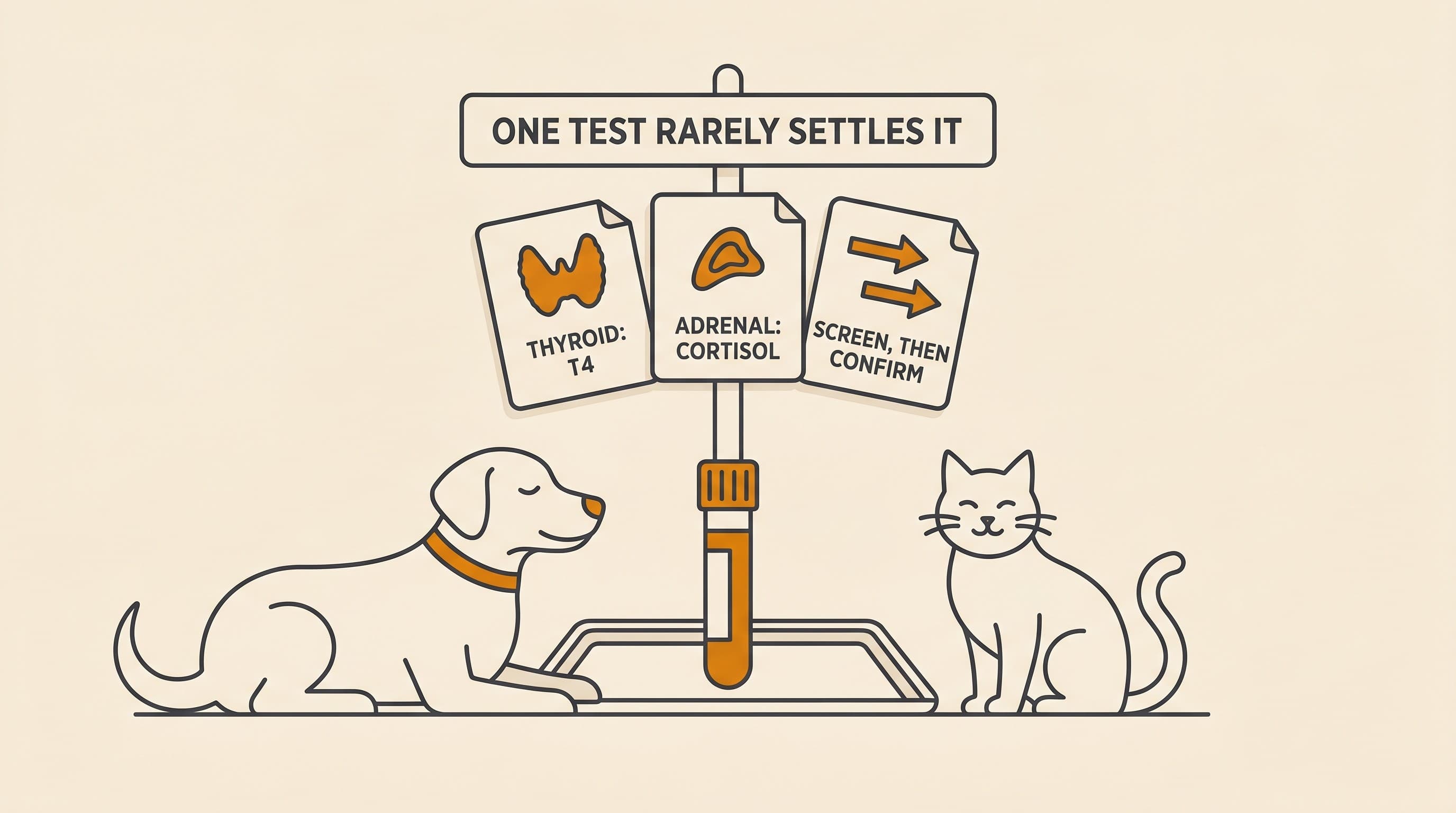
That one thing: one number rarely settles it. Hormones swing about, illness and medicines nudge the results, and every one of these tests has a job it does well and a job it does badly. So vets read them in a sequence, usually a screening test first and a confirming test after, against the clinical picture in front of them (AAHA 2023). Knowing why turns a confusing list into something you can follow.
The thyroid tests: T4, free T4 and TSH
Thyroid hormone sets the body's idle speed, and the main blood marker is total T4 (the total amount of the hormone circulating). What a result means depends entirely on which way the thyroid has gone, and that splits neatly by species.
In an older cat, the question is usually "too much". For feline hyperthyroidism, a high total T4 plus the typical signs is often all it takes. A definitive diagnosis needs a persistently raised thyroid hormone (total T4, or T4 plus free T4 by equilibrium dialysis) alongside one or more of the classic signs, so the number and the cat have to agree (AAFP 2016). One catch worth knowing: in mild or early disease, a cat's T4 can drift in and out of the normal range, so a single normal result doesn't rule it out in a cat that really looks hyperthyroid. Your vet may simply repeat the test a few days to weeks later, or add free T4 (Higgs 2014; AAFP 2016). If you'd like the fuller picture of the over-active thyroid first, see our older-cat hyperthyroid explainer.
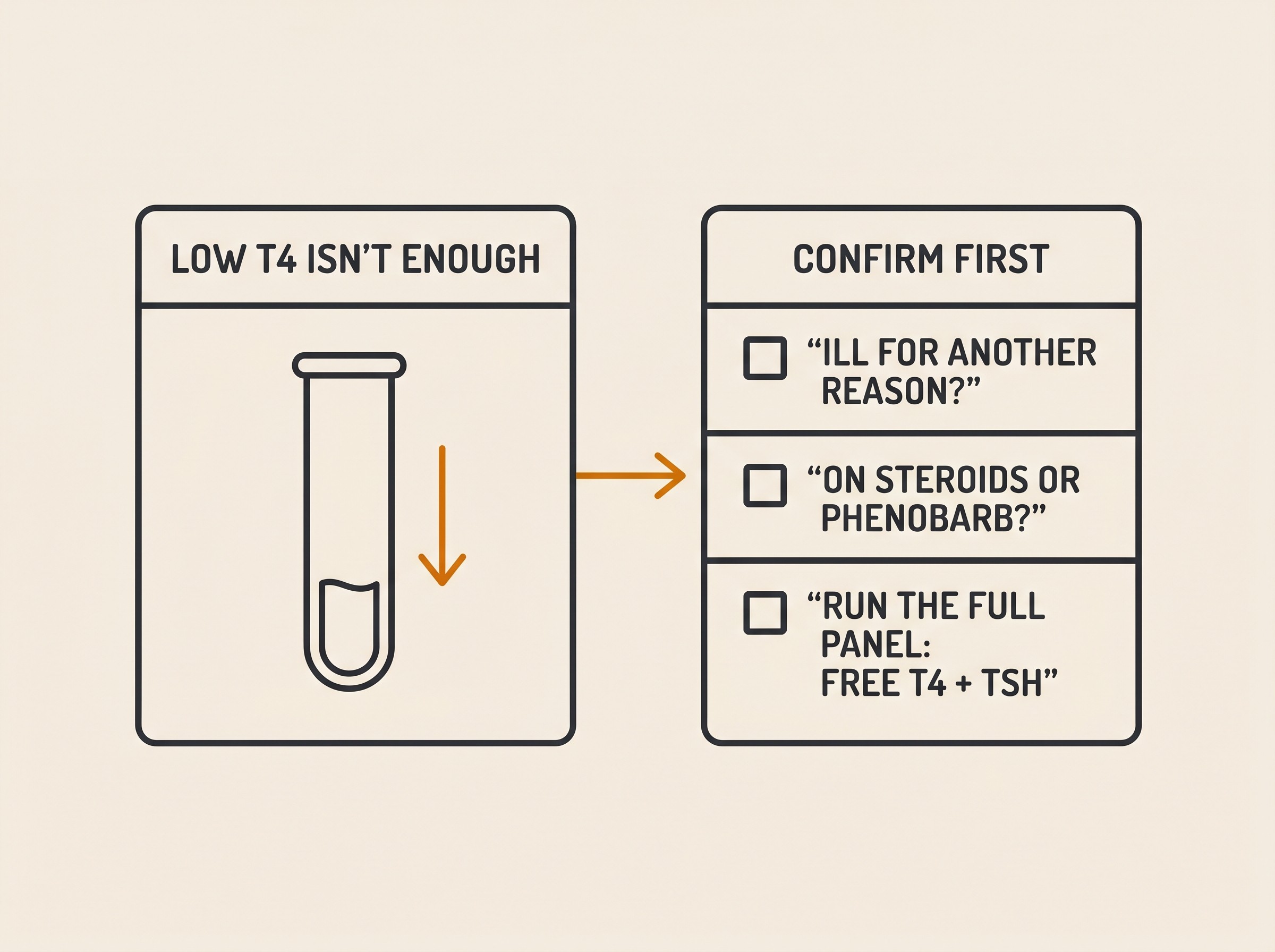
In a dog, the question is usually "too little". Here total T4 is a good screening test (it picks up most truly hypothyroid dogs, with a reported sensitivity of roughly 89 to 100%), but a low result on its own is not a diagnosis (AAHA 2023). A low total T4 alone does not mean your dog is hypothyroid. Plenty of things drag thyroid results down without any thyroid disease at all. A dog that's simply ill for another reason ("euthyroid sick", or non-thyroidal illness) often has low thyroid numbers, and it's one of the commonest thyroid-related findings in dogs (Merck Veterinary Manual). Common medicines do the same: steroids suppress total T4, and phenobarbital lowers it too, with both effects reversing once the drug is stopped (Bolton 2023). Trimethoprim-sulphonamide antibiotics are a slightly different case, in that prolonged courses can bring on genuine (usually reversible) hypothyroidism rather than just an artificially low reading (Bolton 2023).
So before a dog is committed to a tablet for life, the picture is filled in: free T4 by equilibrium dialysis (the most accurate single measure of free T4, because it sidesteps the binding proteins and antibodies that can distort total T4) and TSH, read together with how the dog actually looks (AAHA 2023). A definitive diagnosis is a low total T4 and a low free T4 with a high TSH, but here's a useful nuance: around 20 to 40% of genuinely hypothyroid dogs have a normal TSH, so vets take two of the three results pointing the same way, in a dog with a fitting clinical picture, as enough to support it (AAHA 2023). The practical takeaway for owners is simply this: testing a dog while it's unwell, or on steroids, is a classic way to get a false "hypothyroid" answer, so timing and context matter. There's more on the traps in our dog-thyroid testing piece.
The adrenal tests: basal cortisol, the ACTH stim and the LDDST
The adrenal glands make cortisol, the body's stress hormone, and two of our four diseases are about cortisol going wrong: too much (Cushing's) or too little (Addison's). Three test names cover both ends.
The ACTH stimulation test measures cortisol before and after an injection that tells the adrenals to fire. It's the one test that does double duty at both ends of the spectrum, which is why you'll meet it whichever adrenal disease is in question (Cornell University). It confirms too little cortisol in Addison's, and it's also the test that diagnoses the steroid-caused form of Cushing's and that checks adrenal reserve during Cushing's treatment.
For suspected Cushing's, the usual first screen is the low-dose dexamethasone suppression test (LDDST). A small dose of a steroid is given, and a healthy adrenal system responds by switching its own cortisol off for a while. A Cushing's dog fails to switch off properly. The LDDST is the preferred initial screen because it's very sensitive (a reported 85 to 100%), better at catching the disease than the ACTH stim test (ACVIM 2012; Clinician's Brief). The ACTH stim test is less sensitive for spontaneous Cushing's (around 60 to 85%, and weaker for the adrenal-tumour type) but more specific, and it remains the test of choice for the steroid-induced kind (Clinician's Brief; Merck Veterinary Manual).
Both Cushing's screens share an important weakness, and it's the funnel-level version of a wedge we keep coming back to: they throw false positives in a dog that's stressed or ill for another reason. A dog with significant illness elsewhere shouldn't be screened for Cushing's, because the more severe that other illness, the more likely the cortisol fails to suppress and mimics a Cushing's result, with specificity reported as low as around 0.44 in some non-adrenal-disease groups (ACVIM 2012; Clinician's Brief). The plain-English rule is test the right dog: chase Cushing's when the picture genuinely fits, not in a dog that's under the weather for an unrelated reason. Our Cushing's testing-maze article walks through this in full.
For suspected Addison's, the screen is the basal (resting) cortisol, a single tube of blood. This one is genuinely good news for worried owners, because it's an excellent rule-out. A comfortably normal resting cortisol (above roughly 2 micrograms per decilitre, about 55 nanomoles per litre) makes Addison's very unlikely, with a reported sensitivity of around 99 to 100%, so a normal result essentially rules the disease out and saves an unnecessary stim test (Bovens 2014). But it cuts only one way. A low basal cortisol does not diagnose Addison's, because the screen isn't specific enough on its own, so a low result always has to be confirmed with an ACTH stimulation test before anyone says your dog has the disease (Bovens 2014; AAHA 2023). If your vet has run a resting cortisol and now wants a stim test, that's not bad news piling up, that's exactly the right sequence. The Addison's diagnosis piece covers what the stim test shows.
Why your vet runs more than one
It can feel as though every visit adds another test, but the logic is consistent. A screen is built to catch the disease and rarely miss it, which is exactly what makes it prone to the odd false alarm. A confirming test is built to be sure. So a low T4 gets the fuller thyroid panel, a positive Cushing's screen gets followed up, and a low resting cortisol gets the stim test, before anyone commits your pet to lifelong treatment. The numbers themselves (the exact micrograms and nanomoles) vary between laboratories and assays anyway, which is another reason your vet reads them in context rather than against a single fixed line.
Two of these diseases do have a sharper edge that lives in their own sections, and it's worth a one-line flag here: under-active adrenals can tip into an Addisonian crisis (a collapse, with a dangerous rise in potassium), and over-treated Cushing's can be over-suppressed into a crisis the other way. Both are "ring the vet now" situations, and both are covered properly in the Addison's and Cushing's articles rather than here.
If you've not yet measured the thing that often triggers all of this, the drinking, that's the best next step. Marked thirst is roughly more than 100 ml per kg per day, and it's worth measuring rather than guessing (Today's Veterinary Practice). Our "drinking and weeing far more than usual" guide and the Thirst & Wee tracker show you how, and the classic hormone signs explainer maps which signs point at which gland. None of these tests is something you have to interpret alone, so if a result has left you unsure, ask the vet who ran it what the next step is. There usually is a clear one.
References
- 2023 AAHA Selected Endocrinopathies of Dogs and Cats Guidelines. J Am Anim Hosp Assoc 2023;59(3):113–135. DOI: 10.5326/JAAHA-MS-7368.
- Carney HC, Ward CR, Bailey SJ, et al. 2016 AAFP Guidelines for the Management of Feline Hyperthyroidism. J Feline Med Surg 2016;18(5):400–416. DOI: 10.1177/1098612X16643252.
- Higgs P, Murray JK, Hibbert A. "More Than Just T4: Diagnostic testing for hyperthyroidism in cats." J Feline Med Surg (review).
- Bolton TA, Panciera DL. "Influence of medications on thyroid function in dogs: An update." J Vet Intern Med 2023;37(5):1626–1640. DOI: 10.1111/jvim.16823.
- Merck Veterinary Manual — "Hypothyroidism in Animals."
- Behrend EN, Kooistra HS, Nelson R, Reusch CE, Scott-Moncrieff JC. "Diagnosis of Spontaneous Canine Hyperadrenocorticism: 2012 ACVIM Consensus Statement (Small Animal)." J Vet Intern Med 2013;27(6):1292–1304. DOI: 10.1111/jvim.12192.
- Clinician's Brief — "Demystifying Tests for Hyperadrenocorticism."
- Merck Veterinary Manual — "Cushing Disease (Pituitary-Dependent Hyperadrenocorticism) in Animals."
- Cornell University Animal Health Diagnostic Center — "Canine Adrenal and Pituitary Function Tests."
- Bovens C, Tennant K, Reeve J, Murphy KF. "Basal serum cortisol concentration as a screening test for hypoadrenocorticism in dogs." J Vet Intern Med 2014;28(5):1541–1545. DOI: 10.1111/jvim.12415.
- Today's Veterinary Practice — "A Stepwise Diagnostic Approach to Polyuria and Polydipsia."
Keep track of how your pet is doing
The owners who cope best are the ones who notice changes early. A simple health log shows you what is working, and what is not, before the next vet visit.
Start tracking, freeYou're not doing this alone
Compare treatment journeys and talk to owners managing hormone health. Free to join.
Join PetsLikeMine