

Hip Scoring and Buying From a Responsible Breeder: OFA, PennHIP and the BVA/KC Scheme
Alastair Greenway
BVM&S MRCVS
Hip dysplasia is substantially inherited, so the single most powerful thing you can do for a large-breed puppy happens before you ever bring it home: choosing parents whose hips have been screened. No scheme guarantees perfect hips, but breeding from low-scoring dogs measurably lowers the odds. This guide walks through the three main screening schemes and how to read them.
If you have not yet committed to a litter, you may also want our guide on whether your large-breed puppy is at risk and how to prevent hip dysplasia, which covers the diet, growth and exercise side of the story. This article is about the genetics and the paperwork: what the scores mean, what a hip guarantee really covers, and what good evidence from a breeder actually looks like.
Why screening shifts the odds without promising healthy hips
Hip dysplasia is heritable, but it is not inherited like eye colour. It is polygenic, meaning many genes each contribute a small amount, and the picture is then shaped by environment: growth rate, body weight, nutrition and exercise during the first year of life.
Heritability estimates vary, and that variation is the whole point. Across studies, the heritability of hip dysplasia is usually cited somewhere between 0.2 and 0.6, with many breed estimates landing around 0.4 to 0.5. A large UK study of Labrador Retrievers found a heritability of about 0.34 from the parents combined. In other breeds the figure has been lower; one study of more than 1,700 Boxers found a heritability of only about 0.11 for clinical signs. A heritability of, say, 0.4 means that roughly 40% of the variation between dogs is explained by genetics, and the remaining majority by environment and chance.
The practical message is sobering and worth sitting with. Two structurally excellent parents can still produce an affected puppy, because the puppy inherits only a sample of each parent's genes and then grows up in a real home with real food bowls and real stairs. Screening shifts the odds in your favour. It does not remove risk, and any breeder who tells you a puppy is guaranteed to be free of hip dysplasia is overselling what the science can deliver. There is currently no reliable DNA test for hip dysplasia, so for now the only genuine screening is a radiograph of the hip itself.
The three main screening schemes
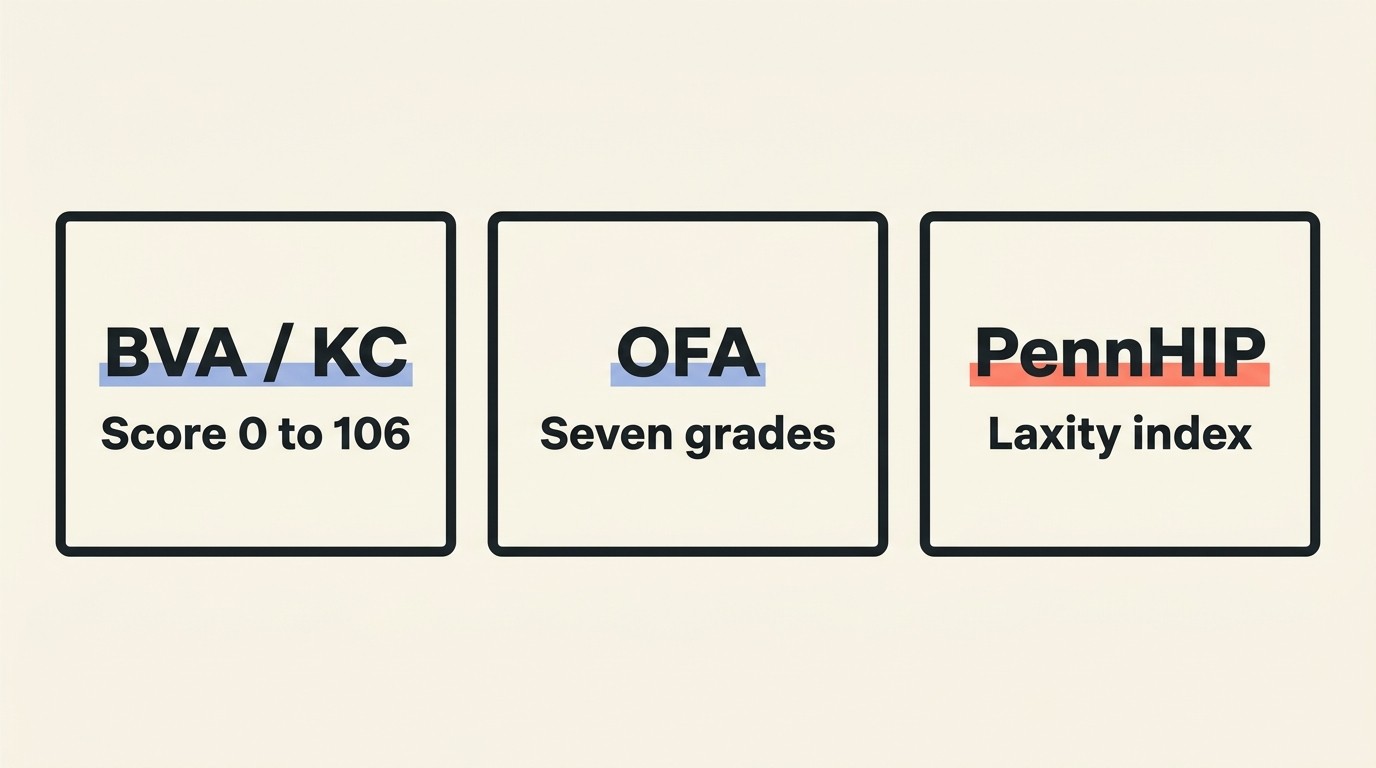
Three schemes dominate worldwide, and you will meet different ones depending on where you and the breeder are based. They overlap but they are not interchangeable, and a number from one means nothing until you know which scheme it came from.
The BVA/Kennel Club Hip Scoring Scheme (UK). This is the scheme you are most likely to encounter from a British breeder. A radiograph of each hip is assessed against nine separate features, and each feature is scored from 0 (ideal) to 6 (the worst). The first three features describe the shape and fit of the joint; the remaining six pick up secondary changes, meaning early arthritis. The scores are added up, so each hip can score between 0 and 53, and the two hips combine to a total between 0 and 106. Lower is better. To remove individual bias, scrutineers work in pairs and agree the score together. The dog must be at least 12 months old and permanently identified by microchip.
The OFA scheme (United States). The Orthopedic Foundation for Animals uses descriptive grades rather than a number. There are seven categories. Three are considered within normal limits: Excellent (a deep-seated ball sitting tightly in a well-formed socket), Good, and Fair. Then comes Borderline, where the picture is not clear-cut. The three dysplastic grades are Mild, Moderate and Severe. Each film is reviewed independently by three board-certified veterinary radiologists, and the consensus grade is recorded.
PennHIP (worldwide, performed by certified vets). PennHIP takes a different approach. Rather than judging the appearance of the joint, it measures how loose it is, because laxity is the underlying driver of the disease. The result is a distraction index (DI), a number between 0 (no laxity at all) and 1 (a fully dislocatable joint). Lower is tighter and better. A dog's DI is then compared against a breed-specific database, so you can see how it ranks against others of its breed.
Age requirements, and making sense of the results
The schemes do not all start at the same age, and this matters when buying. Both the BVA/KC scheme and final OFA certification require the dog to be at least 12 months old for the UK scheme, and at least 24 months old for a permanent OFA grade. OFA does offer preliminary evaluations from 4 to 23 months, but these are exactly that, preliminary. PennHIP can be performed much earlier, and is considered accurate from as young as 16 weeks of age, which is why it is the scheme most often used when an early decision is needed.
Reading the results is where owners most often go wrong. A score only has meaning relative to the breed. A combined BVA/KC score of 15 sounds high if you imagine the scale stops at 20, but it is excellent in a breed whose median is in the high twenties, and it is poor in a breed whose median is single figures. The BVA publishes a breed median score for every breed in the scheme, recalculated from all the scores recorded over the previous five years. The official advice is to breed only from dogs scoring below, or close to, that breed median. The same logic applies to PennHIP, where you want a DI in the tighter (lower) half of the breed's range. As a rough rule from the published research, dogs with a DI below about 0.3 are very unlikely to go on to develop arthritis, while the risk climbs as the DI rises above that.
When you look at a litter, ask for both parents' results and check them against the breed median, not against an imaginary perfect score. A litter from two below-median parents is a better genetic bet than a litter where one parent is well above the median, even if that parent's number looks reassuringly small in isolation. Better still, ask whether the breeder has looked at the wider family. Because the condition is polygenic, the hip quality of grandparents, siblings and previous litters tells you more than the parents alone. Some UK breeds now have Estimated Breeding Values (EBVs), which pool a dog's own score with those of its relatives to give a more reliable prediction of what it will pass on. Where an EBV is available, it is more useful than a single hip score.
What a hip guarantee really covers
Many breeders offer a health or hip guarantee, and it is worth understanding what these typically do and do not do, because they vary enormously and the word guarantee promises more than the document usually delivers.
A hip guarantee is a contract, not a clinical safeguard. In practice most guarantees say that if the dog is diagnosed with hip dysplasia within a set period, often the first two years, the breeder will offer a remedy. Read the remedy clause carefully, because it is rarely a simple refund. Common terms include a partial refund, a replacement puppy, or a contribution towards costs, and many are conditional. Typical conditions include keeping the dog at a vet-recommended weight, following a specified diet or supplement, restricting exercise during growth, and obtaining a diagnosis confirmed by radiograph. Some require you to return or neuter the affected dog to claim, which few owners are willing to do once the dog is part of the family.
The real limits are these. A guarantee does not prevent hip dysplasia or reduce your dog's pain; it only addresses money after the fact. It rarely covers the full cost of treatment, which for a total hip replacement can run well into the thousands of pounds. And the conditions can be hard to meet to the letter. A guarantee is reassuring as a sign that the breeder takes hip health seriously, but the screening evidence on the parents protects your puppy far more than any clause protects your wallet. Treat a generous guarantee as a bonus on top of good screening, never as a substitute for it.
Questions to ask a breeder, and what good evidence looks like
When you contact a breeder, a short, specific set of questions will tell you very quickly whether hip health is truly part of their programme or merely a talking point.
- May I see both parents' hip screening certificates, with the dogs' microchip or registration numbers on them? Good evidence is an official certificate (BVA/KC, OFA or PennHIP) that names and identifies the individual dog, not a verbal assurance or a vague claim that the line is healthy.
- How do the parents' scores compare with the breed median or breed average? A breeder who is serious about hips will know their breed's median and where their dogs sit relative to it.
- What are the hip results for the grandparents, the siblings and any previous litters? Because hip dysplasia is polygenic, family history adds real information that the parents' scores alone cannot.
- Are the parents kennel-club registered, and have they had any other relevant orthopaedic screening, such as elbow scoring in breeds where that matters?
- What is your guarantee, and exactly what does it cover and require of me? Ask to read it before you commit.
- How are the puppies reared, fed and exercised, and what diet do you recommend after they come home? This connects directly to the environmental half of the risk, which our prevention guide explores in detail.
Good screening evidence is verifiable, identifies the specific dog, comes from a recognised scheme, and is offered freely rather than reluctantly. Be wary of a breeder who cannot produce certificates, who confuses the schemes, who insists their line never has hip problems, or who treats reasonable questions as an insult. A confident, transparent breeder welcomes them.
The welfare picture: worth doing, even though it is imperfect
It is fair to ask whether all of this screening achieves anything at the level of the breed, and the answer is a qualified yes. Where breeders consistently select for tighter, lower-scoring hips over generations, the average hip quality of a breed can improve, and selection programmes using breeding values have shown measurable progress. Every litter bred from screened, below-median parents is a small contribution to lowering the burden of this painful condition in the population. That is a good reason to seek out breeders who screen, and to reward them with your custom.
But the candour has to run both ways. Because the condition is polygenic and shaped by environment, even a carefully chosen litter from two excellent parents can produce an affected dog. Screening is a way of loading the dice in your favour, not a way of guaranteeing the outcome. If your puppy is later diagnosed despite your best efforts at the buying stage, that is not a sign you chose badly, and our guide for owners whose puppy has just been diagnosed walks through what comes next.
For the full clinical picture of what hip dysplasia is, why a loose joint leads to arthritis, how it is diagnosed and the mechanics of every surgical option, see our deep-dive guide, Hip Dysplasia: Understanding the Condition and Its Surgical Options. As always, your own vet, and where needed an orthopaedic surgeon, is the right partner for any decision about an individual dog.
References
- American College of Veterinary Surgeons. Canine Hip Dysplasia. ACVS. 2024.
- Orthopedic Foundation for Animals. Hip Dysplasia. OFA. 2024.
- Orthopedic Foundation for Animals. Frequently Asked Questions. OFA. 2024.
- British Veterinary Association. BVA/Kennel Club Hip Dysplasia Scheme for dogs. BVA. 2024.
- British Veterinary Association. Understanding the results. BVA Canine Health Schemes. 2024.
- The Royal Kennel Club. Hip dysplasia screening scheme. Royal Kennel Club. 2024.
- Antech Imaging Services. Measuring Hip Joint Laxity with PennHIP. Antech Diagnostics. 2024.
- Runge JJ, Kelly SP, Gregor TP, Kotwal S, Smith GK. Distraction index as a risk factor for osteoarthritis associated with hip dysplasia in four large dog breeds. J Small Anim Pract. 2010.
- Cornell University Riney Canine Health Center. Canine hip dysplasia (CHD). Cornell University College of Veterinary Medicine. 2024.
- American Kennel Club. Genetics of Hip Dysplasia in Dogs: A Guide for Breeders. AKC. 2023.
- Ginja M, Gaspar AR, Ginja C. Emerging insights into the genetic basis of canine hip dysplasia. Vet Med (Auckl). 2015.
- Goh CSS. Hip Dysplasia: Navigating Surgical Options and Timing. Today's Veterinary Practice. 2022.
Keep track of how your pet is doing
The owners who cope best are the ones who notice changes early. A simple health log shows you what is working, and what is not, before the next vet visit.
Start tracking, freeYou're not doing this alone
Compare treatment journeys and talk to owners managing hip dysplasia. Free to join.
Join PetsLikeMine