

Hip Dysplasia Surgery by Age: Which Options Are Open at Your Dog’s Stage
Alastair Greenway
BVM&S MRCVS
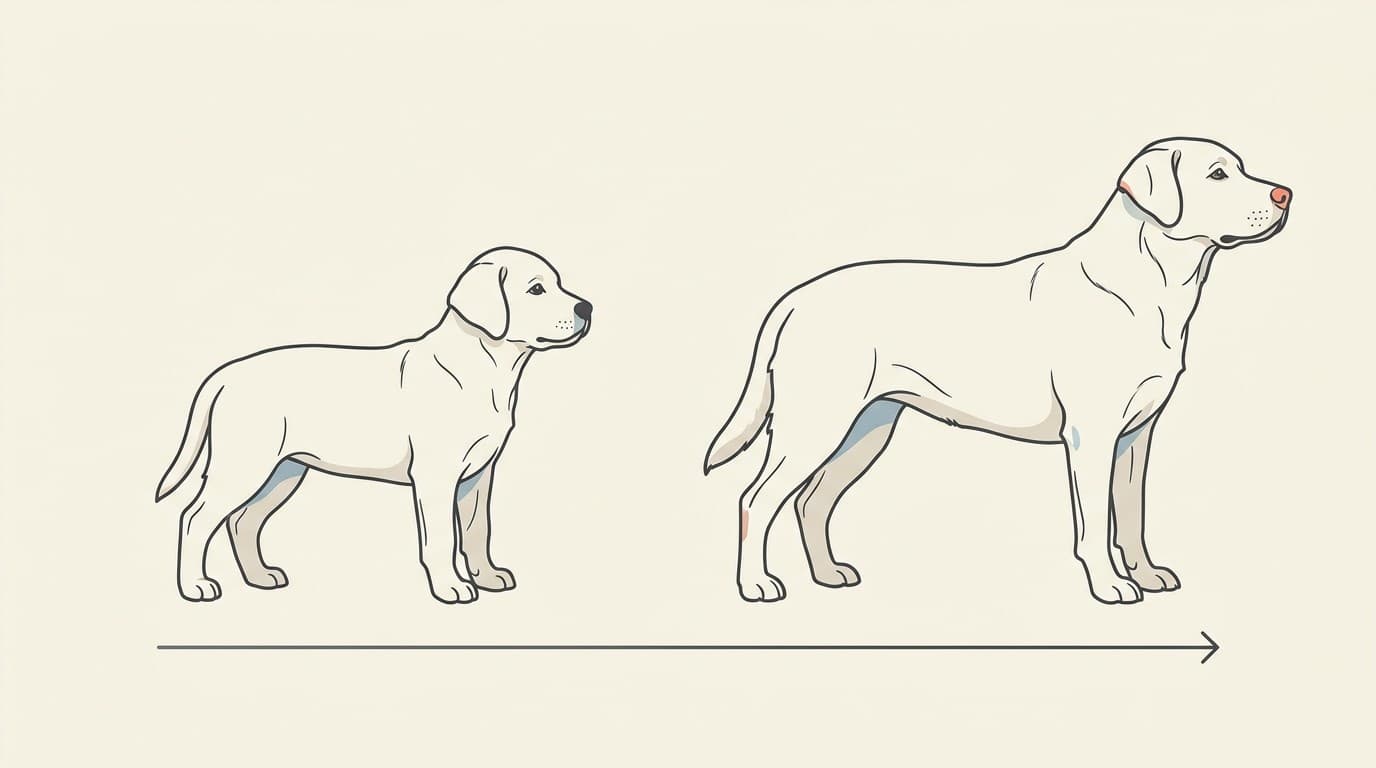
For a young large-breed dog with hip dysplasia, the surgical options on offer depend heavily on age. Some of the most useful procedures can only be done in puppyhood, and those doors close early. This guide maps which options fit which stage, so you know what is still on the table.
Most owners, told this before their puppy has so much as limped, want to know which operation fixes it. The more useful first question is a quieter one: at my dog’s current age and joint state, which procedures are even possible? It matters because hips do not stand still. They keep growing, the joint changes as they do, and the surgical toolkit shrinks accordingly.
Think of this article as the timing map. It does not re-explain how each operation works in detail. For the mechanics of every procedure, and for how a loose joint leads to arthritis, our deep-dive guide to hip dysplasia and its surgical options covers that ground thoroughly. Here we focus on the windows: what is possible now, what is closing, and how promptly you may need to act.
Why timing is the whole story
Hip dysplasia begins as a joint that is too loose. That laxity is present and measurable very early, often long before any pain or limp. Over time the loose joint wears, cartilage is lost and the body lays down extra bone, and that is the osteoarthritis owners come to recognise. The Cornell Riney Canine Health Center puts it plainly: early diagnosis and intervention often produce the best outcomes.
The reason some operations are puppy-only is purely mechanical. A few procedures work by gently steering the pelvis as it grows, redirecting the natural growth of the bone so the socket ends up covering the ball more snugly. That only works while the bone is still growing fast. According to Today’s Veterinary Practice, around 80 percent of pelvic growth is complete by roughly 17 weeks of age, which is why the earliest preventive surgery has to happen within a few short weeks of a puppy coming home.
Once growth slows and finishes, those steering options are gone. What remains are procedures that work on a mature joint instead. A missed window is not a disaster, but it does explain why an at-risk puppy deserves prompt assessment rather than a wait-and-see year.
The age windows, mapped
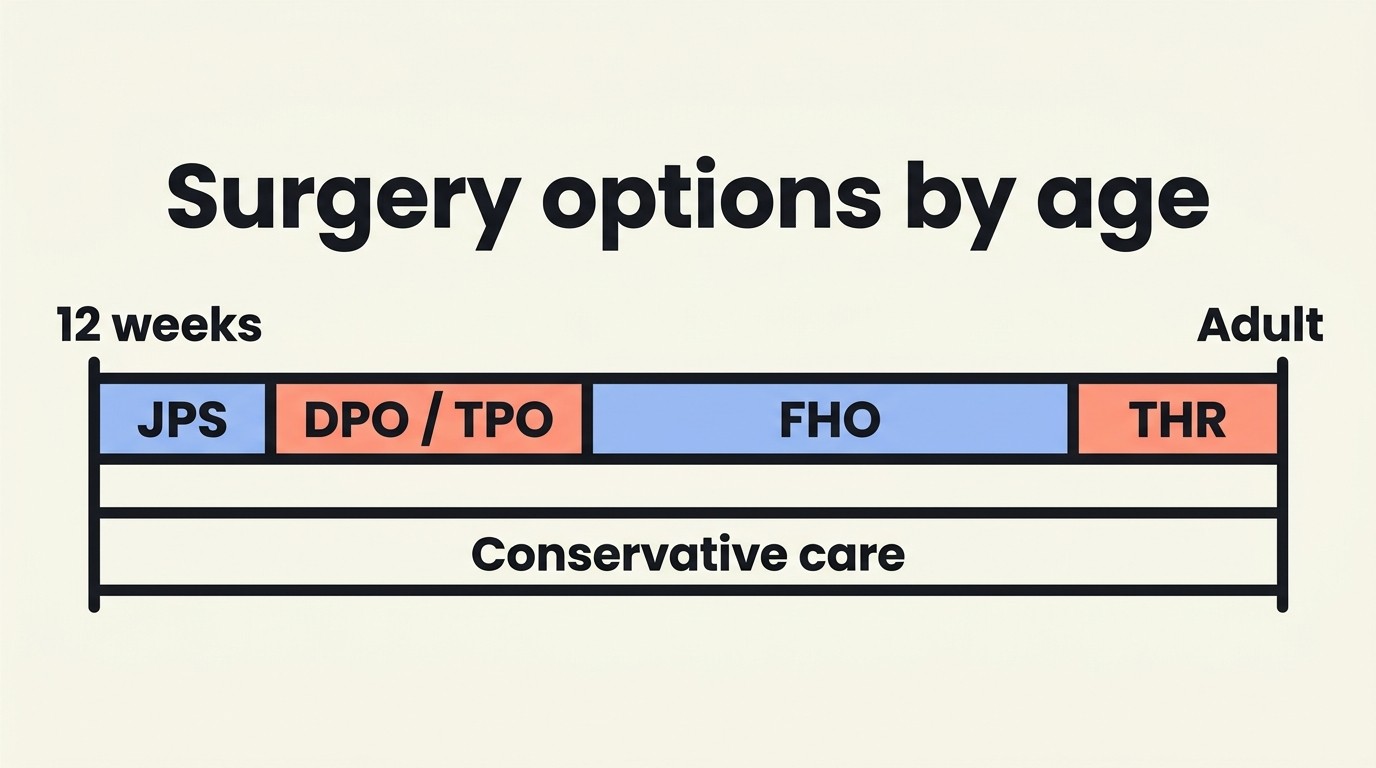
Here is the practical map. Treat it as a guide for conversation with your vet, not a verdict. The exact thresholds shift with breed, size and how the individual joint looks on imaging.
Juvenile pubic symphysiodesis (JPS): the very young puppy only, roughly 12 to 20 weeks. This is the earliest and least invasive preventive option, and it has the tightest window of all. Today’s Veterinary Practice describes the ideal timing as between 12 and 18 weeks, with completion before 16 weeks preferred for predictable results, and a little later (up to about 22 weeks) sometimes possible in giant breeds. Because it relies on the pelvis still growing, a puppy who is even a few weeks too old has missed it. It suits puppies with mild to moderate laxity, and many of these puppies show no pain at all at this stage, which is exactly why it is so easy to miss. For how the procedure actually steers the growing pelvis, see our full guide.
Double or triple pelvic osteotomy (DPO/TPO): the young dog, roughly 5 to 10 months, before arthritis sets in. These procedures reposition the socket to cover the ball better. The window is broader than JPS but still firmly in the young dog, typically quoted at around 5 to 10 months, with the strong preference being before orthopaedic maturity. Today’s Veterinary Practice and the ACVS both note that for a Labrador-sized dog that maturity point is around 8 months. The make-or-break factor is not just age but the joint itself: the ideal candidate has significant laxity but good bone shape with no secondary remodelling or osteoarthritis yet. Once arthritis has started, the chance has effectively passed, even if the dog is still young in months. Tellingly, many ideal candidates have minimal or absent clinical signs at the time the surgery would work best, which again argues for early assessment rather than waiting for a limp.
Femoral head ostectomy (FHO): any age, best suited to smaller, lighter dogs. FHO removes the head of the femur so the body forms a fibrous false joint. Because it does not rely on growth, it can be done at any age, which makes it the option that stays open longest. It is most reliable in smaller, lighter dogs. The Cornell Riney Center notes outcomes are generally good, particularly for dogs under about 40 lb (roughly 18 kg). Today’s Veterinary Practice reports that, while size historically counted against larger dogs, recent literature describes similar outcomes regardless of size provided the dog has committed rehabilitation, though it notes that objective gait abnormality is common afterwards even where owners are satisfied. For a careful comparison of when FHO makes sense over a replacement, our guide to FHO versus total hip replacement weighs the two side by side.
Total hip replacement (THR): from skeletal maturity, around 9 to 12 months and older. THR replaces the whole joint with an implant and is widely regarded as the option that restores the most normal, pain-free function. It needs the skeleton to have largely finished growing. Most surgeons prefer a skeletally mature patient, and the practical lower bound is often quoted around a year old, though some implant systems have been used successfully in younger dogs. Helpfully, THR remains available as a fall-back for a young dog who was not a candidate for JPS or DPO/TPO, or whose preventive window was missed: they are managed conservatively until mature enough for replacement. Modern implant ranges have also widened the size of dog that can be fitted.
One more point worth stating clearly: the BVA/Kennel Club hip score, the UK’s formal screening, is only carried out from 1 year of age, with each hip scored from 0 to 53 across nine features (a total range of 0 to 106, lower being better). That formal score is a breeding and assessment tool for the mature dog. It is not the early-warning test for catching the puppy-only surgical windows, which is a point worth holding onto.
Conservative management is a real path, not a waiting room
Don’t read the timeline above as surgery-or-failure. Conservative management runs alongside every age band, and for a great many dogs it is the chosen route in its own right, not a holding pattern while you brace for an operation.
What it involves is consistent and unglamorous, and that is precisely its strength. The ACVS and Cornell both centre it on keeping the dog lean from the very start (excess weight loads a vulnerable joint), sensible controlled exercise to build the muscle that supports the hip, physiotherapy, and pain relief used thoughtfully under veterinary supervision. The ACVS is candid that the evidence for cartilage supplements is weak, so spend your money where it counts.
Plenty of dogs with dysplastic hips, managed this way, live full and comfortable lives and never need an operation. Our guide to conservative management for a young dysplastic dog sets out how to do this well in a still-growing dog, where the balance between protecting the joint and letting a youngster be a youngster needs particular care. The reality, which any good orthopaedic surgeon will share, is that surgery is not always necessary.
Why the preventive windows are narrow, and what to do about it
The frustrating truth is that the operations with the most preventive promise (JPS, then DPO/TPO) are the ones with the shortest windows, and they work best in puppies who feel completely fine. By the time a dog is visibly sore, those doors have usually closed and you are choosing among the mature-joint options.
So early assessment and laxity testing matter a great deal for at-risk puppies, meaning the large and giant breeds, and any pup from a line with known hip problems. Hip laxity can be measured very young. The PennHIP method can be performed from about 16 weeks of age and produces a distraction index that scores joint looseness, and because passive laxity does not change much as the dog grows, an early score is strongly predictive of later trouble. PennHIP describes a distraction index under 0.3 as carrying very low risk, while 0.3 and above places a dog in the susceptible group. For JPS specifically, Today’s Veterinary Practice cites a distraction index in the 0.4 to 0.6 range (ideally under 0.5) as the sweet spot.
The practical message is simple. If your puppy is an at-risk breed, raise hip screening with your vet early, in the first few months, not at the first limp. An early laxity test is the single thing most likely to keep the preventive options open.
A framework to take to your vet
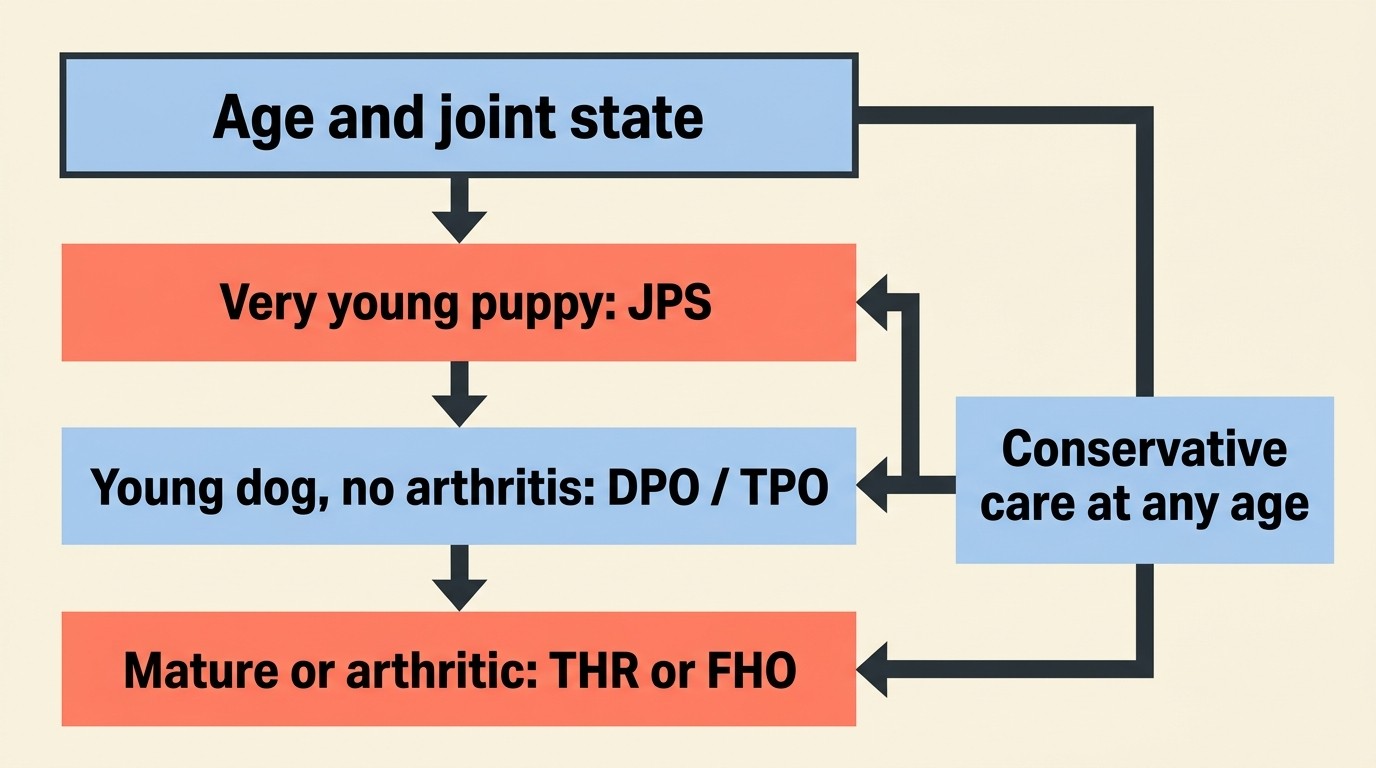
None of this is yours to decide alone, and it shouldn’t be. The choice of procedure, or of no procedure, is one to make with your vet and, where surgery is on the table, an orthopaedic surgeon. Here is a way to organise the conversation by stage.
If your puppy is under about 16 to 20 weeks and at risk: ask about early hip assessment and laxity testing now, while JPS is still possible. The question to put is: based on the laxity, is my puppy a JPS candidate, and if so, how quickly would we need to act? Time is short here.
If your dog is roughly 5 to 10 months: ask whether the joint shows laxity but still has good bone shape with no arthritis, which is the window for DPO or TPO. The questions are: do the X-rays show any arthritic change yet, and are we still inside the window for a pelvic osteotomy? This is the point to ask for an orthopaedic referral promptly rather than reviewing in a few months.
If your dog is approaching or past skeletal maturity, or already has arthritis: the conversation shifts to total hip replacement, FHO and conservative management. Useful questions: given my dog’s size and weight, is THR or FHO the better fit, what would each cost and what does recovery realistically involve, and could we manage well conservatively instead?
At every stage, ask how confident the vet is that surgery is even needed, what the conservative route would look like, and whether referral to an orthopaedic specialist for an opinion is worthwhile. A referral is not a commitment to operate. It is buying the most informed view of which doors are open.
On urgency: a suspected JPS or DPO/TPO candidate is time-sensitive, because the windows are measured in weeks and months, so push for a prompt referral. A mature dog being considered for THR or FHO, or managed conservatively, is rarely an emergency, and you have room to take the decision carefully.
The bottom line
Which hip operations are open to your dog is largely a question of age and joint state, and the most preventive options have the narrowest windows in early puppyhood. That is the case for getting an at-risk puppy assessed promptly rather than waiting for a limp. At the same time, conservative management is a legitimate, often excellent path at any age, and surgery is not always needed. The best choice is individual, it changes with your dog’s stage, and it is one to reach together with your vet and an orthopaedic surgeon who has seen the joint for themselves.
References
- Today’s Veterinary Practice. Hip Dysplasia: Navigating Surgical Options and Timing. Today’s Veterinary Practice. 2022.
- American College of Veterinary Surgeons. Canine Hip Dysplasia. ACVS Small Animal Topics. 2024.
- Cornell University College of Veterinary Medicine. Canine Hip Dysplasia (CHD). Riney Canine Health Center. 2024.
- British Veterinary Association. BVA Hip Dysplasia Scheme for Dogs. BVA Canine Health Schemes. 2024.
- Antech Imaging Services. PennHIP FAQ. Antech Diagnostics. 2024.
- Antech Imaging Services. Measuring Hip Joint Laxity. Antech Imaging Services. 2024.
Keep track of how your pet is doing
The owners who cope best are the ones who notice changes early. A simple health log shows you what is working, and what is not, before the next vet visit.
Start tracking, freeYou're not doing this alone
Compare treatment journeys and talk to owners managing hip dysplasia. Free to join.
Join PetsLikeMine