

My Puppy Has Just Been Diagnosed With Hip Dysplasia: What Happens Now
Alastair Greenway
BVM&S MRCVS
Hip dysplasia is one of the commonest orthopaedic conditions in large breeds, and a diagnosis in a young dog is far more manageable than it sounds in the moment. Most of these dogs go on to live full, happy, active lives. Here is what it means and the calm, practical steps to take next.
Start here: this is workable
The words "hip dysplasia" can ring in your ears for days after a consultation, so let me put the most important thing first. This is not a death sentence, it is not a verdict on your dog's future, and it is not a sign that you have done something wrong. Hip dysplasia is common in growing large and giant breeds, and we have more good options for a young dog than for almost any other orthopaedic condition. Many puppies given this diagnosis grow into dogs whose owners barely think about their hips from one year to the next.
It is also worth saying plainly: the worst time is often right now, at the moment of diagnosis, when everything feels uncertain and the internet has shown you the most alarming version of every story. The reality for most dogs is far gentler than the worst case. What helps now is a clear head, a sensible plan, and a vet or orthopaedic surgeon you trust.
What the diagnosis actually means
In a healthy hip, the ball at the top of the thigh bone (the femoral head) sits snugly inside a cupped socket in the pelvis, and the two move smoothly together. In hip dysplasia, the joint is loose. Vets call this looseness laxity. The American College of Veterinary Surgeons describes the condition as instability or a loose fit of the hip joint that develops as the dog grows, so that as the dog bears weight the ball moves abnormally within the socket. Cornell's Riney Canine Health Center puts it simply: the hip joint forms incorrectly, leading to looseness, and that looseness is what causes trouble over time.
The key word is developmental. Your puppy was not born with worn-out hips. The hips developed this way as the skeleton grew, and the cause is multifactorial. Genetics is the single biggest risk factor, but it is not the whole story. How fast the puppy grows, how much it is fed, body weight, and early exercise and environment all play a part. The ACVS notes that rapid weight gain and growth from excessive feeding can complicate how the condition develops.
I want to be direct about one thing, because so many owners quietly blame themselves. This is not your fault. The strongest driver is inherited, set long before the puppy came home to you, and even the most attentive owner cannot prevent a hip that was always going to grow loose. What you do from here matters a great deal, but the diagnosis itself is not a reflection on your care.
Two chapters of trouble, years apart
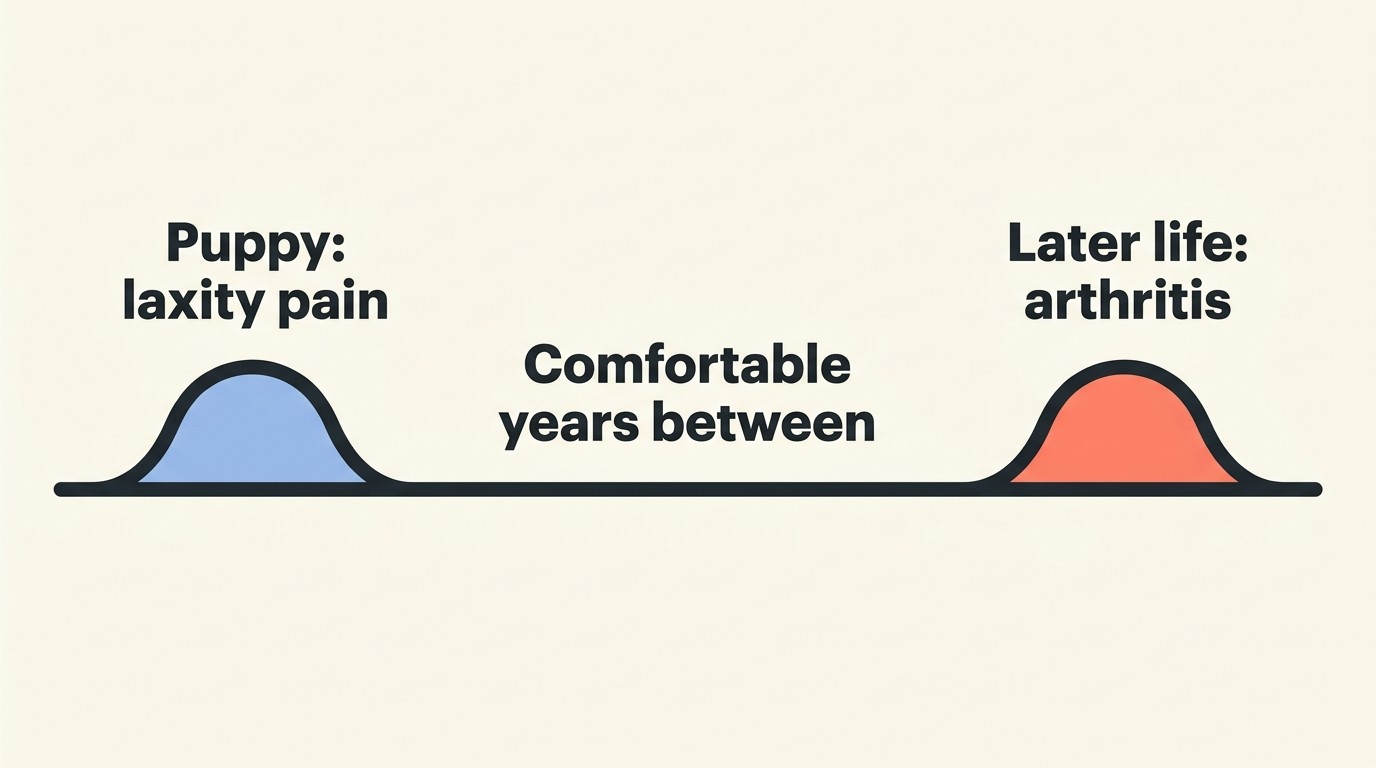
One of the most useful things to understand early is that hip dysplasia tends to cause trouble in two separate chapters of life, often with comfortable years in between. Knowing this stops a quiet day in adulthood from feeling like a false dawn, and stops a stiff morning in old age from feeling like a sudden catastrophe.
The first chapter is laxity pain in the growing dog. In a young dog, it is the looseness itself that hurts. The loose joint allows abnormal movement, the soft tissues around it are inflamed, and this is why some puppies show signs from just a few months of age, as Cornell notes. You might see a "bunny-hopping" gait when running, reluctance to jump or climb stairs, stiffness after rest, or weight shifted forwards off the back legs. Some young dogs are truly uncomfortable; many are only mildly affected; and a good number show very little at all and are picked up incidentally.
The second chapter, often years later, is osteoarthritis. Over time the body responds to that lifelong looseness by losing cartilage, laying down scar tissue, and forming bony spurs (osteophytes) around the joint. This is the arthritis we may see in middle or older age. It is important to keep this in proportion: it is a possibility to manage, not a certainty on a fixed timetable, and how leanly and sensibly your dog lives in between has a real influence on when and how severely it shows up.
Why the clock matters now
For a young dog, the menu of options is unusually wide, but some of the best preventive choices depend entirely on age, and a few of their windows close early.
Some surgical procedures are designed to be done while the skeleton is still growing, to improve how the hip is shaped before arthritis ever sets in. The preventive options narrow as the puppy matures. To give a sense of how early some windows are: one of the keyhole procedures is most effective when done in the first few months of life, because so much of the pelvis has finished growing by around four months of age, as Today's Veterinary Practice explains. Other reshaping operations are typically considered in large or giant breeds between roughly five and ten months. Once the skeleton has matured and arthritis is established, those particular doors are closed, and the options shift towards managing pain and, where needed, joint replacement later in life.
I am deliberately not going into the mechanics of each operation here, because our deep-dive guide to hip dysplasia and its surgical options already explains every procedure (and there is a great deal to explain) in full. Our companion guide to which hip dysplasia surgery options are open at each age maps out the timing in detail. The point for today is simpler: because some of the best preventive windows are narrow and age-dependent, this is not a diagnosis to sit on for a few months and see. It is worth getting your dog properly assessed soon, ideally with a conversation about whether referral to an orthopaedic surgeon is appropriate, so that no good option quietly expires while you wait. That does not mean surgery is the answer, or even likely. It means the assessment is time-sensitive even if the treatment is not.
Your first few weeks: a calm, practical plan
You do not need to decide everything today. What follows is a sensible order of priorities for the next few weeks.
Confirm the diagnosis and ask about referral. Depending on how the diagnosis was reached, your vet may suggest dedicated hip radiographs, often under sedation for a properly positioned view, and a hands-on orthopaedic examination. There are also specialist screening methods that quantify laxity. PennHIP can measure hip looseness as a distraction index from as early as 16 weeks of age, which is one of the few tools that can give an objective number while a puppy is still very young. Separately, the UK BVA and Kennel Club Hip Scheme scores radiographs from one year of age, with each hip judged on nine features and a combined score running from 0 to 106 where lower is better; note that this scheme is principally a breeding tool rather than a treatment guide. Ask your vet which assessment makes sense for your dog's age and whether a referral to an orthopaedic specialist is worthwhile. A specialist opinion early is one of the best investments you can make, even if the conclusion is "watch and manage".
Keep your puppy lean. This is the most important thing you can do. Body weight is the lever you control that has the largest, best-evidenced effect on how this condition unfolds. In a landmark lifelong study of Labradors by Kealy and colleagues, dogs kept on 25% less food than their littermates developed hip osteoarthritis later and less severely, and lived a median of around 1.8 years longer. Run your hands over your puppy: you should feel the ribs easily and see a waist from above and from the side. A lean puppy is not a deprived puppy, it is a protected one. For practical detail on feeding and body condition, our arthritis hub guides on weight and exercise are the place to go, and they apply just as much to a young dysplastic dog as to an old arthritic one.
Move to sensible, controlled exercise, not cage rest. A common instinct on hearing the diagnosis is to wrap the puppy in cotton wool and shut down all activity. Please do not. Permanent crate rest is the wrong answer for a growing dog. Muscle around the hip is part of what holds a loose joint together and keeps your dog comfortable, and that muscle is built through movement. What you want is controlled, low-impact, regular exercise rather than high-impact chaos. Cornell specifically recommends regular low-impact exercise such as lead walking and swimming. Steady lead walks on good footing, gentle hills, and swimming are excellent. The things to dial down are the joint-jarring extremes: repetitive jumping, skidding turns on slippery floors, long ball-chasing sessions, and stairs taken at speed. Our guide to conservative management for a young dysplastic dog goes through all of this in practical detail, including how to build a routine that keeps muscle on without overloading the joints.
Sort out the insurance question now, and go in with your eyes open. This is the moment to read your policy. In the UK, a pre-existing condition is broadly any illness your pet had or showed signs of before the policy started, and the Association of British Insurers uses that same definition. Hip dysplasia, once diagnosed or once clinical signs have been noted, will normally be treated as pre-existing by a new insurer. The hard truth is that if you are not already insured, you are unlikely now to find new cover that will pay for this specific condition. If you do have an existing lifetime policy that was in place before the diagnosis, that is welcome news, because a lifetime policy is designed to keep covering an ongoing condition year after year up to its annual limit, which can matter a great deal if surgery is ever needed. Check your annual and per-condition limits, confirm what is and is not covered, and keep every invoice. If you are not insured, do not panic, but do start setting money aside, and factor cost realistically into any decisions you make with your vet.
Step away from the 1am search results. It is natural to read everything, but the online picture is skewed towards extreme stories and confident sellers. Be cautious with supplements marketed as cures; the ACVS notes that cartilage-protective supplements lack good peer-reviewed evidence of effectiveness, even though some are reasonable to discuss with your vet. Treat every big decision as one to make together with your vet or an orthopaedic surgeon, not alone at a keyboard.
Realistic hope, and where to go next
I will not pretend hip dysplasia is nothing, and I will not promise you a perfect outcome, because false comfort would not serve you here. But the realistic picture is encouraging. Cornell's plain summary is the one I would leave you with: dogs with hip dysplasia can lead good quality lives with proper care, depending on severity. Many young dogs need nothing more than steady weight control and sensible exercise to do beautifully. Some benefit from surgery, and the results of modern hip surgery, when it is the right choice at the right time, can be excellent. Either way, you have far more influence over your dog's future than the diagnosis made it feel at first.
So, to recap your next steps: confirm the diagnosis and ask whether an orthopaedic referral is worthwhile, keep your puppy lean, swap chaotic exercise for controlled low-impact activity, sort the insurance question, and breathe. When you are ready to dig deeper, our guide to conservative management for a young dysplastic dog covers the day-to-day plan, our guide to which hip dysplasia surgery options are open at each age covers the time-sensitive choices, the deep-dive guide to hip dysplasia and its surgical options explains the condition and every procedure in full, and the arthritis hub guides on weight and exercise will support you for the long road ahead.
References
- American College of Veterinary Surgeons. Canine Hip Dysplasia. ACVS Small Animal Topics. 2024.
- Cornell University College of Veterinary Medicine, Riney Canine Health Center. Canine Hip Dysplasia (CHD). 2023.
- Today's Veterinary Practice. Hip Dysplasia: Navigating Surgical Options and Timing. Today's Veterinary Practice. 2022.
- British Veterinary Association. BVA/Kennel Club Hip Dysplasia Scheme for dogs. BVA Canine Health Schemes. 2024.
- Smith GK, Paster ER, Powers MY, et al. Lifelong diet restriction and radiographic evidence of osteoarthritis of the hip joint in dogs. Journal of the American Veterinary Medical Association. 2006;229(5):690-693.
- Lawler DF, Larson BT, Ballam JM, et al. Diet restriction and ageing in the dog: major observations over two decades. British Journal of Nutrition. 2008.
- Association of British Insurers. Pet insurance guide: what pet insurance does not cover. ABI. 2024.
Keep track of how your pet is doing
The owners who cope best are the ones who notice changes early. A simple health log shows you what is working, and what is not, before the next vet visit.
Start tracking, freeYou're not doing this alone
Compare treatment journeys and talk to owners managing hip dysplasia. Free to join.
Join PetsLikeMine