

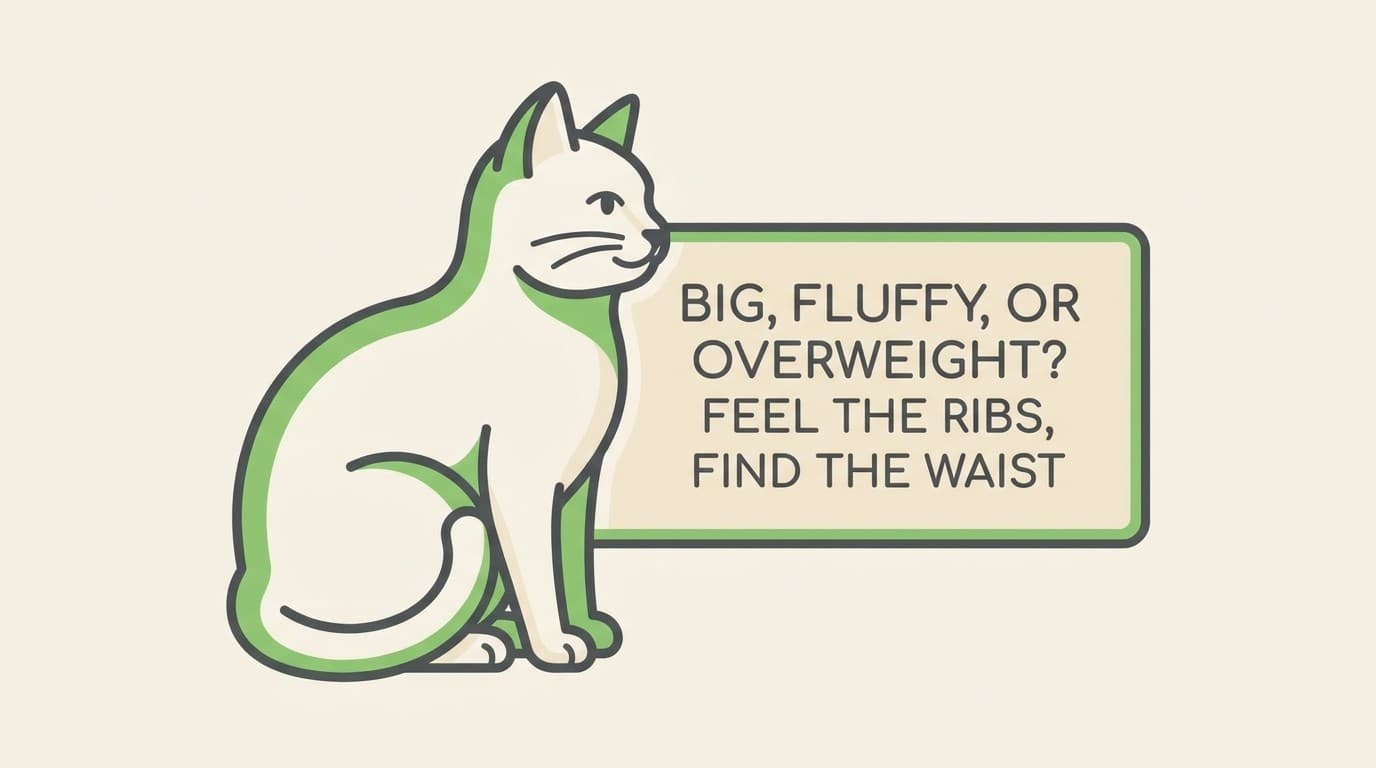
"He's just a big cat": when round is a real problem
Alastair Greenway
BVM&S MRCVS
A round cat is cute online and a real problem in the notes
The internet loves a chonky cat. A big, soft, round cat reads as cuddly and content, and the comments fill up with hearts. In the consulting room that same roundness reads differently. It's one of the most common welfare issues we see in cats, and it quietly costs them comfort and movement every day.
Plenty of owners look at their cat and genuinely can't tell whether she's overweight or just a big, fluffy girl. That's exactly the right question to ask, and you're in very good company asking it. Around 4 in 10 to half of UK cats are carrying too much weight. The PDSA's 2024 Big Weigh In found 43% of the cats it weighed were overweight or obese (PDSA, 2024). So this is normal, not negligent. A great many people have a cat who slowly drifted heavier without anyone noticing.
The point worth leading with isn't about how long she lives. It's about how she lives now. An overweight cat finds it harder to spring onto the windowsill, harder to twist round and groom her own back end, and harder to move through her day without effort. A lot of the things a cat does to be a cat get quietly smaller. Getting the weight off is, more than anything, about giving those things back to her.
Big-framed, fluffy, or genuinely overweight? Do the hands-on check
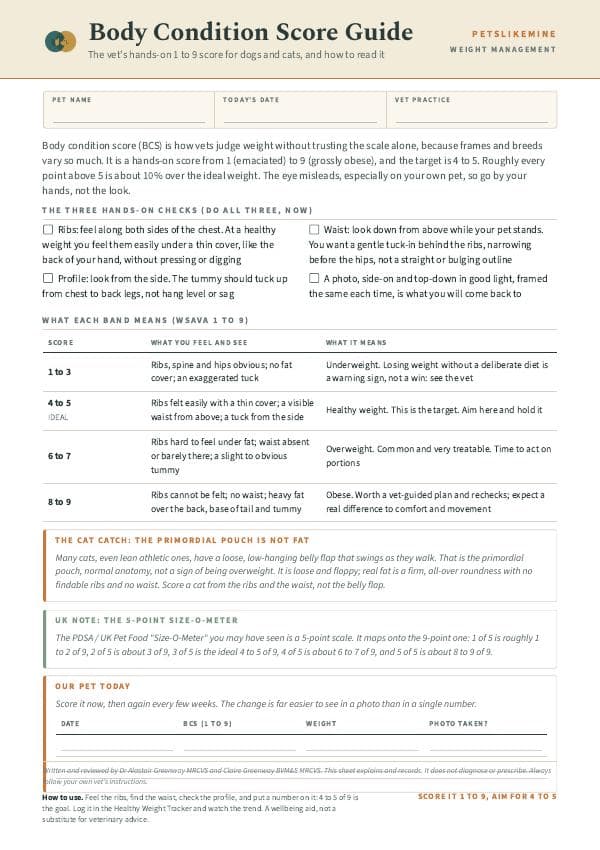
The reason "does she look fat?" is such a poor guide is that cats mislead the eye and the scale in equal measure. Frames vary, a long or plush coat hides a lot, and our own sense of "normal" drifts as a cat fills out. So we don't go by the look, we go by the hands. There are three quick checks, and you can do all three on your cat right now.
Feel for the ribs. Run your hands gently along both sides of her chest, behind the front legs, with light pressure. On a cat at a healthy weight you should be able to feel the ribs easily under a thin layer of cover, a bit like feeling the bones on the back of your hand. You shouldn't have to press or dig. If the ribs are hard to find under a soft padding, that's fat, not frame.
Find the waist. Look down at her from directly above while she's standing. You're looking for a gentle tuck-in behind the ribs, a slight narrowing before the hips, so her outline curves in at the middle rather than running straight or bulging outward. No waist, or a body that's wider at the tummy than the chest, points to too much weight.
Check the profile. Now look at her from the side. The line of the tummy should tuck up a little from the chest towards the back legs, not hang level or sag down. A gentle upward tuck is what you are after.
These three together separate a big-boned or long-coated cat from an overweight one far better than the bathroom scales can, because a number on its own tells you nothing about her frame. A 6kg cat with a large build can be perfectly lean, and a 5kg cat with a small frame can be carrying real excess.
The primordial pouch is not fat (the bit owners get wrong)
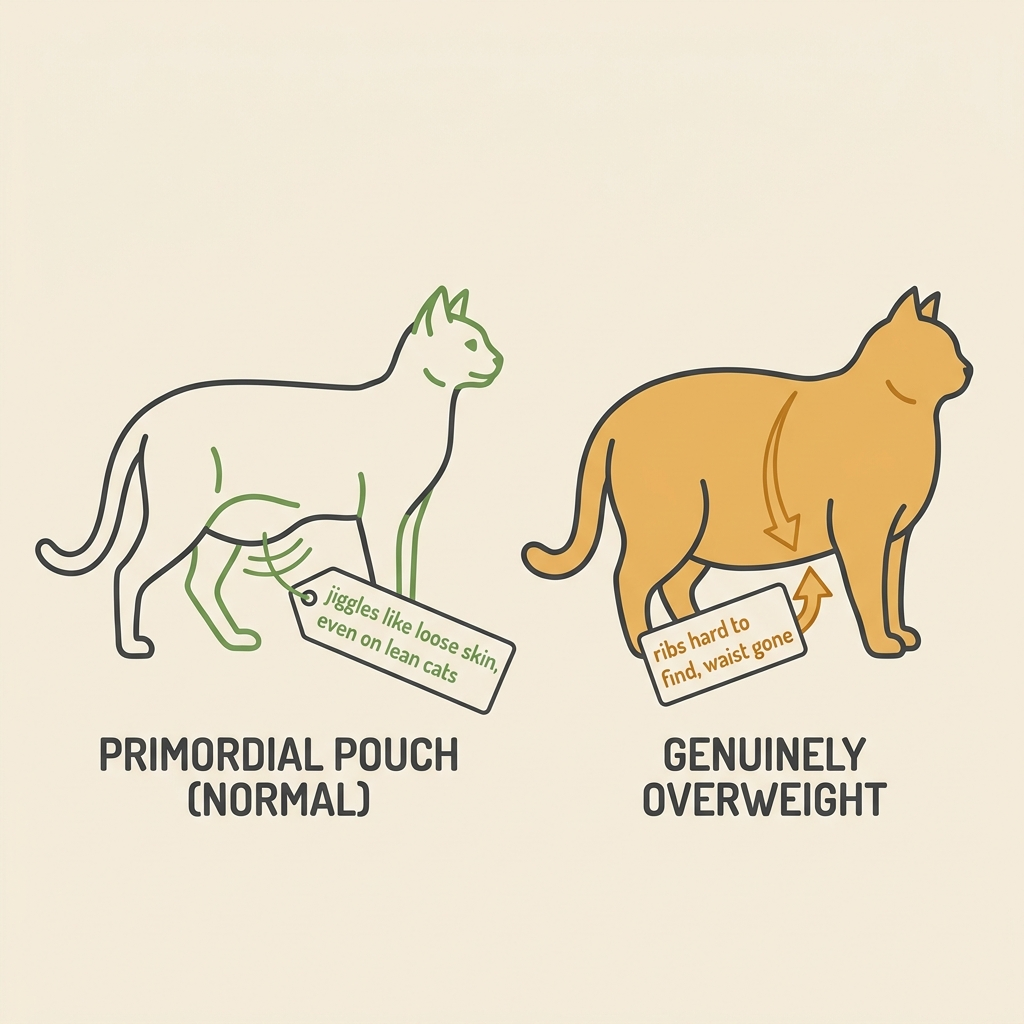
This is the one almost everyone gets wrong, so it gets its own section. Many cats have a loose, low-hanging flap of skin and a little fat along the belly, swinging just in front of the back legs. It's called the primordial pouch, and it's completely normal anatomy. It isn't a sign that your cat is overweight (Association for Pet Obesity Prevention, n.d.).
The pouch is there on purpose. You see it on lean, athletic cats, and you see an exaggerated version of it on big wild cats. The clue is in how it behaves. A primordial pouch is loose and floppy. It hangs and jiggles from side to side as your cat walks, like a half-empty bag, because it's mostly skin (VCA Animal Hospitals, n.d.).
Genuine fat behaves differently. It's a firm, all-over roundness rather than a loose swinging flap, the kind of fullness where you can't find the ribs and the waist has vanished entirely. So when you're deciding whether your cat is overweight, don't be fooled either way by the tummy. Score her from the ribs and the waist, not from the belly flap. A slim cat with a generous pouch is still a slim cat. A round cat with no findable ribs is still an overweight cat, pouch or no pouch.
Why cats drift heavy and hide it
If the check tells you she's carrying too much, the next thing to know is that it is not your fault, and there are good reasons cats end up here. Owners are often surprised, because they genuinely couldn't see it. Studies find that owners underestimate their cat's body condition so often that the misjudgement is itself a risk factor for the cat becoming overweight, and the round cat has been so normalised online that everyone's baseline has shifted heavier (Frontiers in Veterinary Science, 2019). Around 9 in 10 owners of an overweight pet think their pet is a normal weight, and one large survey found nearly half of cat owners rated an overweight or obese cat as "normal" (Association for Pet Obesity Prevention, 2021). When the bar has moved, a heavy cat looks ordinary.
On top of that, a cat's biology and lifestyle push in the same direction.
Neutering changes the maths. After being spayed or neutered, a cat needs noticeably fewer calories and often wants to eat more. The metabolic rate drops, particularly in females, and the appetite tends to climb (Larsen, 2017). If the food bowl stays the same, weight goes on, and it goes on fast. Cats can gain body fat within 8 to 12 weeks of neutering when food is left down all day. None of that is greed. It's hormones and metabolism doing exactly what they do.
Indoor life burns less. An indoor cat covers less ground, hunts nothing, and has more hours to fill, so a bit of boredom-grazing at the bowl adds up. Indoor-only cats are markedly more likely to be overweight than cats with outdoor access, and that risk shows up early in life (Rowe et al., 2015). A safe, comfortable indoor life is a good life. It just comes with fewer calories burned, which we have to feed around.
It creeps up, and the coat hides it. Cats gain slowly, a little at a time, and a coat smooths the change so the extra never announces itself. By the time you notice, the cat in your head and the cat on the sofa have quietly parted ways. This isn't a failure of attention. It's genuinely hard to see.
What too much weight actually costs her
It's worth being straight about why this matters, calmly and without scaremongering, because it's the reason the gentle effort ahead is worth making. An overweight cat is the single biggest candidate for feline diabetes, the same type-2-like diabetes driven by excess body fat that we see climbing in cats (Frontiers in Veterinary Science, 2026). She is also more likely to develop arthritis sooner and to move less because of it. Heavier cats carry significantly more joint disease, and the weight loads worn joints while the fat tissue itself adds low-grade inflammation. Beyond that, excess weight raises the risk to her heart and her urinary tract, and shortens and dulls the years she has, with less of the easy springing and exploring that make a cat a cat (Frontiers in Veterinary Science, 2026).
None of that is meant to frighten you. It's the "why it's worth doing" before the good news, which is that almost all of it is preventable and a lot of it is reversible. So let's talk about the safe way to start.
A "yes" is fixable, and the safe way is gentle
If the check came back "yes", here's the plain summary. It's not a crisis, it's not your fault, it's very treatable, and the prize is a cat who moves more easily within weeks, not a number on a chart years away.
The first practical step is to put a proper figure on it rather than guessing. Give her a full body condition score, which turns the rib, waist and profile check into a number out of 9 you can repeat, and weigh her so you have a starting weight to beat. Our body condition score guide walks you through the 1-to-9 method, and the Healthy Weight Tracker stores the score, the weight and a photo so you can watch the change over time, which is far easier to see in pictures than in a single figure. There is also a body condition score chart you can keep on the fridge, and a guide to weighing your cat at home when the scales feel like a wrestling match.
There's one red line for cats that matters more than any other, and it's the reason "feed less" needs care. Slimming a cat is slow and steady, never a crash diet, and her food is never withdrawn. Aim for gentle, gradual loss, roughly 0.5 to 1% of body weight a week, and watch that she is actually eating the new, smaller amount. An overweight cat who refuses to eat for 24 to 48 hours is an emergency, not a successful diet, because cutting calories too hard or letting a cat stop eating can trigger a dangerous fatty-liver illness within days. That's the whole reason we go slow. Our guide on why you must never crash-diet a cat covers the safe method in full, and it's the place to go before you change a single meal.
A leaner cat doesn't just move better. For a cat who's tipped into diabetes, reaching a healthy weight can markedly raise the odds of remission, which is about as good as the news gets. Slow is the safe way, and it's the way that lasts. Start with the score and the baseline, then let F7 show you how to take it off without ever putting her at risk.
References
- PDSA (2024). PAW Report: The Big Weigh In. People's Dispensary for Sick Animals.
- Association for Pet Obesity Prevention (APOP) (n.d.). How to Assess Your Cat's Body Condition Score (Cat BCS Guide).
- VCA Animal Hospitals (n.d.). What Is the Primordial Pouch?
- Frontiers in Veterinary Science (2019). Owner and Cat-Related Risk Factors for Feline Overweight or Obesity. Frontiers in Veterinary Science, 6:266.
- Association for Pet Obesity Prevention (APOP) (2021). 2021 State of U.S. Pet Obesity Survey.
- Larsen JA (2017). Risk of obesity in the neutered cat. Journal of Feline Medicine and Surgery, 19(8):779-783.
- Rowe E, et al. (2015). Risk factors identified for owner-reported feline obesity at around one year of age: Dry diet and indoor lifestyle. Preventive Veterinary Medicine, 121(3-4):273-281.
- Frontiers in Veterinary Science (2026). From pathogenesis to prevention: an update on the management of obesity and its associated comorbidities in cats. Frontiers in Veterinary Science.
Free downloads
Companion worksheets to put what you've read into practice. Free PDFs, print at home.
Keep track of how your pet is doing
The owners who cope best are the ones who notice changes early. A simple health log shows you what is working, and what is not, before the next vet visit.
Start tracking, freeYou're not doing this alone
Compare treatment journeys and talk to owners managing weight management. Free to join.
Join PetsLikeMine