

"He acts starving": handling begging and food obsession
Alastair Greenway
BVM&S MRCVS
"He acts like I never feed him" (you're not starving him)
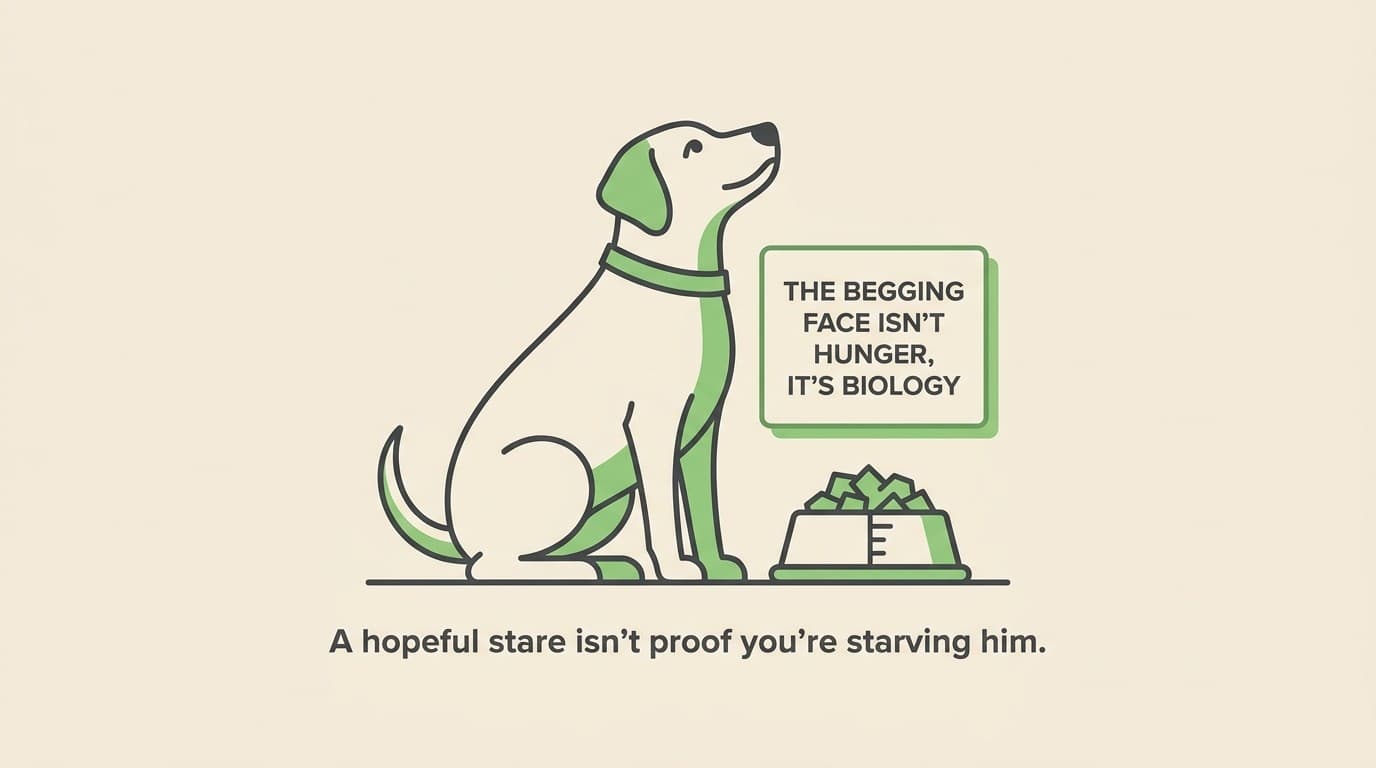
You measured the food. That was the right thing to do. And now there's a pet at your feet who bolts the smaller portion in seconds and spends the rest of the evening staring at you like you've forgotten he exists. The look is real, and it's genuinely persuasive. But it is not proof he's hungry, and it is absolutely not proof you're being cruel.
Here's what's usually going on. A meal that used to take a few minutes now disappears in moments, so the time he used to spend eating is suddenly free time, and he spends it the way he's learned works best, looking hopefully at the person who controls the bowl. The portion got smaller. The wanting did not.
Plenty of owners feel a pang of guilt at this point, and they shouldn't. Around half to 60% of UK dogs and cats are overweight or obese ``, which means most owners of an overweight pet are standing exactly where you are, holding the line against the same hopeful face. This is normal, not negligence. If anything, the begging is a sign the plan is working.
Why a dieting pet begs (the reflex is biology, not a love-meter)
It helps to understand the mechanism, because knowing what's going on is what makes it easier to hold firm.
Two things are happening, and they stack. The first is simple biology. Cutting calories really does increase food-seeking, hunger and begging. This isn't your pet being dramatic, and it isn't a flaw in your particular dog. It's a recognised hurdle that sinks weight-loss plans, which is exactly why the best vet diets are designed to keep a dieting pet feeling fuller, to take the edge off the begging and help owners stick with it (German, 2016). When food intake drops, the body asks for more.
The second thread is learning. Begging is a behaviour that gets rewarded, so it repeats. If staring at you, pawing, or sitting prettily by the cupboard has ever produced a morsel, even once, it's been filed away as a strategy that works. And here's the catch that trips up well-meaning owners: even a telling-off is attention, which to a sociable dog can be its own small reward. It doesn't need to pay off every time, just often enough.
For some dogs there's a third layer, and it's worth naming because it lifts a lot of guilt. In certain breeds, appetite is partly genetic. Researchers found a change in a gene called POMC in Labradors and flat-coated retrievers that is linked to greater food motivation, higher body weight and more body fat (Raffan, 2016). So if your Labrador acts permanently, cheerfully starving, that is not something you did. Some pets are simply built to be more food motivated, and it really isn't your fault.
One important exception. If the food obsession is sudden and dramatic rather than the slow background hum of a hungry dieter, especially alongside increased thirst, weight change or a pot belly, that deserves a vet visit rather than a feeding tweak, because a real shift in appetite can point to a medical cause such as diabetes or Cushing's. Our piece on whether a health problem could be behind the change walks through it. Everything else here assumes a healthy pet on a sensible diet, doing the normal dieter's begging.
Keeping them fuller for the same calories
You can't make the begging vanish, but you can take a lot of the sting out of it without adding a single calorie. The goal is satiety, feeling fuller, not more food. Here's what actually helps.
Split the day's ration into more, smaller meals. Feeding the same total amount across three or four meals instead of one or two shortens the long, empty stretches when the begging is worst. I'll be straight with you, the evidence on whether more frequent meals genuinely makes a pet feel fuller is mixed, so I won't oversell it. What it reliably does is break up the day and give your pet something to look forward to more often. The non-negotiable is that the total daily calories stay the same, five meals or one.
Make the food last. A bowl emptied in seconds barely registers as a meal. Slow feeders, puzzle feeders and foraging toys stretch a small portion into ten or fifteen minutes of work, which slows the eating down and helps a pet feel like they've had something (VCA, n.d.). For a food motivated dog this is transformative, the hunt becomes the entertainment.
Choose a ration that's more filling gram for gram. A diet that's higher in protein and fibre tends to be more satiating, so a pet eats less when later offered the chance (Weber, 2007). This is the real case for a dedicated weight-loss food, it keeps a dieter fuller on fewer calories and helps protect muscle. It's one option among several, not a must, and cutting back the food you have or switching to a diet food weighs it up.
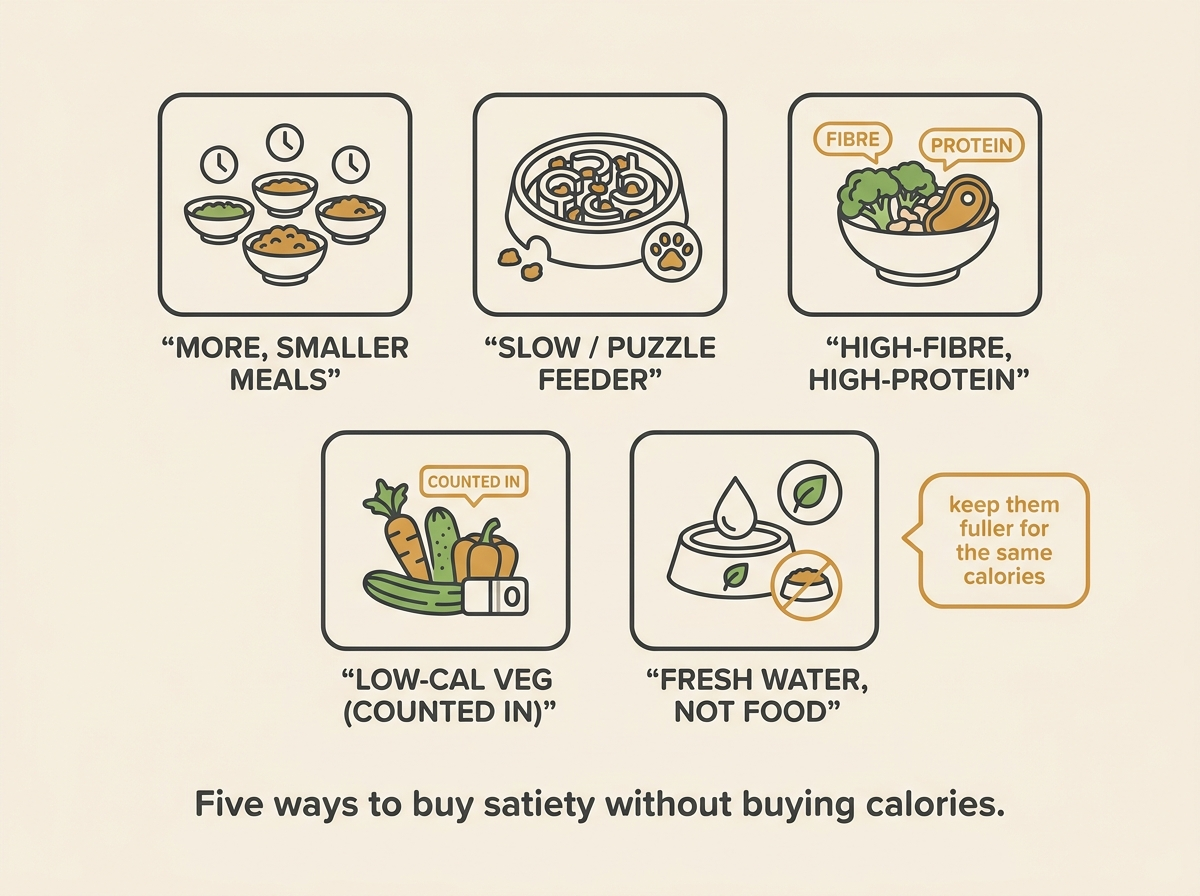
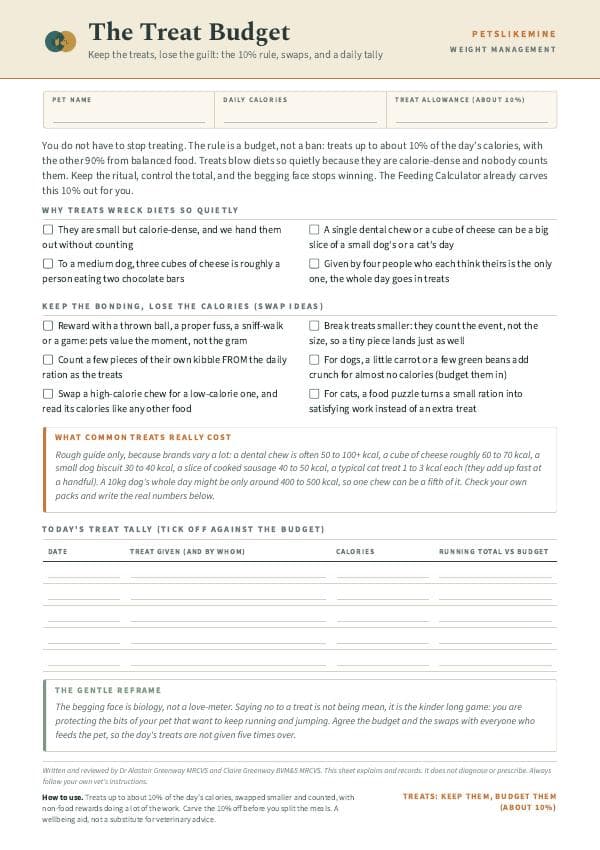
Bulk the bowl with low-calorie veg (dogs). A handful of green beans or a little carrot adds volume and crunch for almost no calories, so the bowl feels fuller. The rule is that this counts towards the treat allowance, so keep treats to no more than about 10% of the day's calories `` and budget the veg in, the way the treat budget lays out.
Offer water for the empty-bowl craving. Sometimes the lunge for the bowl is more about the ritual than real hunger, and a drink of cold, fresh water can take the edge off that craving (VCA, n.d.).
Feed at fixed times. A predictable routine teaches the body when food is coming, so it stops asking off-schedule. Random feeding does the opposite, it tells your pet that begging at any hour might just work, so every hour becomes worth a try (VCA, n.d.).
Reward without food, and hold the line (the guilt reframe)
Now the bit that's actually hardest, because it's emotional rather than practical.
Saying no to the begging face feels unkind in the moment. It isn't. It's the kinder long game. Every time you hold the line you're protecting the parts of your pet that want to keep running, jumping and getting on the sofa without help, and weight and arthritis spells out how much that mobility is worth, now, not in some distant future. You're not depriving him, you're trading a few seconds of a sad face for months of an easier body.
The single most useful mental shift is this, feed the feeder, not your eyes. Your pet's eyes will tell you he's starving. The scale will tell you the truth. So let the bowl, the routine and the numbers decide how much he eats, not the expression on his face.
And you don't have to stop giving, you just give something other than food. Swap the treat for a game, a proper fuss, a sniff-walk, or a brush. To a dog, the reward is the moment of connection, and a thrown ball lands just as well as a biscuit. Manage the environment, too. If the human table is the flashpoint, the simplest fix is to have your pet settle somewhere else while you eat, out of the kitchen, so the begging never gets started.
When your resolve wobbles, and it will, go and look at the trend. A logged line of weigh-ins heading the right way is proof you're not starving anyone, and that proof is what lets you hold firm through the hopeful stares. That's the whole point of tracking, it gives the kindness a number.
Dogs vs cats, and the one cat rule that overrides everything
Almost everything above is dog-shaped, and for dogs it really is mostly about guilt-relief and consistency. Hold the line, swap food for fuss, trust the scale, and the begging settles. Cats are different, and the difference is a safety one, so read this part carefully if you have a cat.
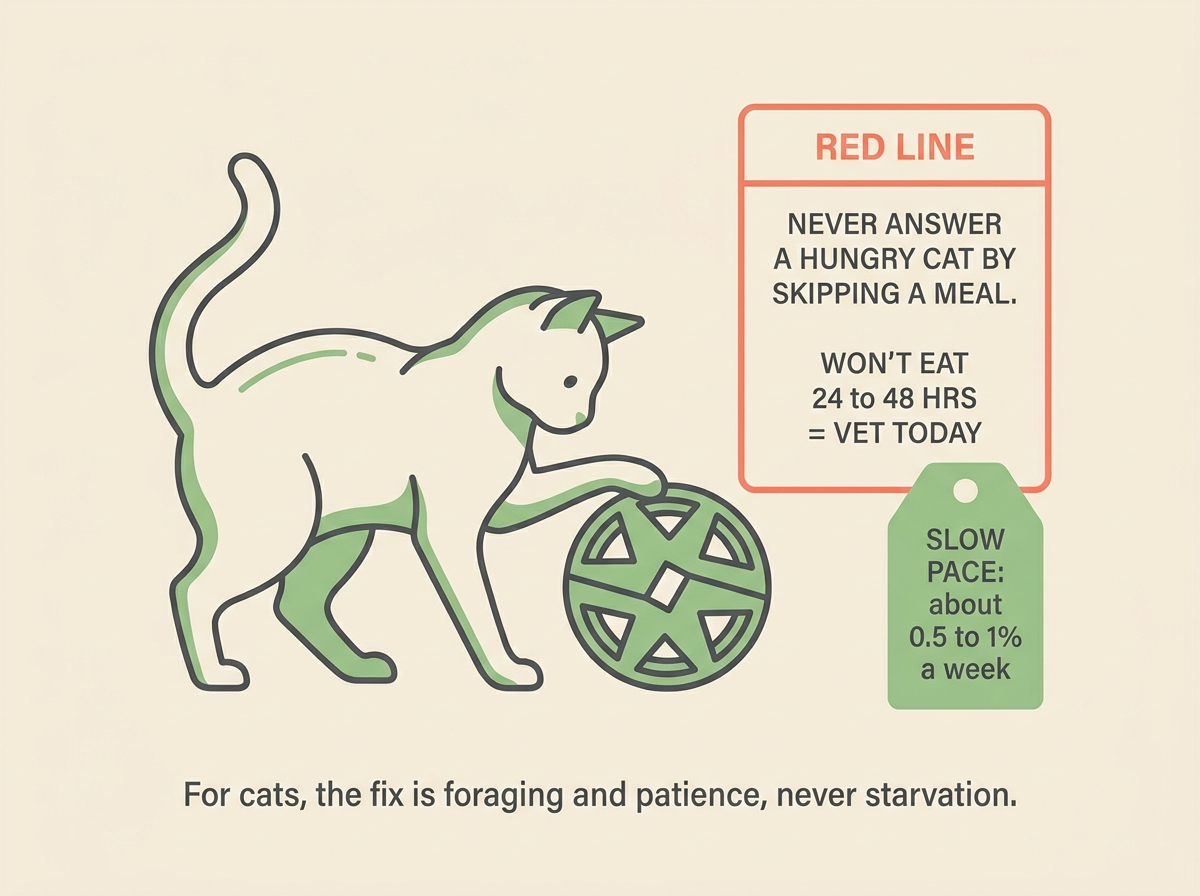
A cat that seems hungry must never be answered by cutting harder or skipping a meal. This is the line that doesn't bend. Over-restricting a cat, or letting a dieting cat stop eating, is exactly the pattern that risks hepatic lipidosis, a fatty liver condition that can turn life-threatening within days. So the safe way to slim a cat looks nothing like a crackdown. It's slow, about 0.5 to 1% of body weight a week ``, with food going in every single day, fed as small, measured meals.
The toolkit still applies, just with the safety framing on top. Food puzzles and foraging feeders are excellent for cats, they reduce inactivity and overeating and turn a small ration into satisfying work (Sadek, 2018). Frequent small meals suit feline grazing far better than one big bowl. And crucially, if your cat is fussy about a new diet food, the answer is a slower transition, not less food, our piece on crash-dieting a cat covers the safe method in full.
The red line, said plainly, an overweight cat that won't eat for 24 to 48 hours is an emergency, not a successful diet. That's a same-day vet call, not a sign the plan is finally working.
Next step
The begging eases once "starving" stops being a feeling and becomes a number you trust. So give it one.
Work out what your pet actually needs and budget the treats in, so you know the bowl is fair, our piece on how much to feed and the Feeding Calculator do it in a couple of minutes. Then log the weigh-ins with the Healthy Weight Tracker, because a trend heading the right way is the permission slip that lets you hold the line through the hopeful stares. And if you've got a cat, read the hepatic lipidosis rule before you cut anything at all. For a hand swapping treats for non-food rewards, the reward-without-food card is there to print and stick on the fridge.
References
- German AJ (2016). Weight management in obese pets: the tailoring concept and how it can improve results. Acta Veterinaria Scandinavica 58(Suppl 1):57.
- Raffan E, et al. (2016). A Deletion in the Canine POMC Gene Is Associated with Weight and Appetite in Obesity-Prone Labrador Retriever Dogs. Cell Metabolism 23(5):893-900.
- VCA Animal Hospitals (n.d.). Creating a Weight Reduction Plan for Dogs.
- Weber M, Bissot T, Servet E, Sergheraert R, Biourge V, German AJ (2007). A High-Protein, High-Fiber Diet Designed for Weight Loss Improves Satiety in Dogs. Journal of Veterinary Internal Medicine 21(6):1203-1208.
- Sadek T, Hamper B, Horwitz D, Rodan I, Rowe E, Sundahl E (2018). Feline feeding programs: addressing behavioural needs to improve feline health and wellbeing. Journal of Feline Medicine and Surgery 20(11):1049-1055.
Free downloads
Companion worksheets to put what you've read into practice. Free PDFs, print at home.
Keep track of how your pet is doing
The owners who cope best are the ones who notice changes early. A simple health log shows you what is working, and what is not, before the next vet visit.
Start tracking, freeYou're not doing this alone
Compare treatment journeys and talk to owners managing weight management. Free to join.
Join PetsLikeMine