

Haemangiosarcoma: The Hard Truth About the "Silent" Splenic Cancer
Alastair Greenway
BVM&S MRCVS
Haemangiosarcoma is a cancer that usually announces itself with a collapse, not a lump. A dog who seemed perfectly well in the morning is in an emergency room by the afternoon, and a scan has found a mass on the spleen. If that is roughly where you are, you deserve plain speaking rather than false comfort, because false comfort here would be its own kind of unkindness.
This is a serious cancer, and one of the hardest in this whole space to write about gently, because it tends to be both quiet and quick. Serious does not mean hopeless, though, and there are still real choices in front of you, several of them kind ones. This page covers what the cancer is, why it stays hidden and then strikes so suddenly, what the emergency surgery involves, and what the outlook really is, so that whatever you decide next, you decide it clear-eyed.
What haemangiosarcoma actually is
Haemangiosarcoma, often shortened to HSA, is a cancer of the cells that line blood vessels (Cornell University, 2024). Since blood vessels run everywhere, it can crop up almost anywhere, though it has favourite places. Far and away the commonest is the spleen, an organ tucked up near the stomach that stores and filters blood. After that come the right side of the heart, the liver, and the skin (Cornell University, 2024).
That blood-vessel origin explains nearly everything about how the cancer behaves. A tumour built from malformed blood vessels is, in effect, a fragile bag of blood. It can grow quietly for weeks or months, then tear, and a tear means a bleed. That single fact is why splenic haemangiosarcoma earns its grim nickname, the silent killer, and why it catches so many families completely off guard (AKC, 2023).
It turns up mostly in older, larger dogs, usually somewhere between about eight and twelve years old, and a handful of breeds are over-represented, among them German Shepherds, Golden Retrievers, Labradors, Boxers and Portuguese Water Dogs (Cornell University, 2024; AKC, 2023). If you own one of those breeds, please don't read that as a sentence. Most German Shepherds never get this. It just means it's a name worth knowing.
Why it's silent, then suddenly not
Owners find this the hardest part to make sense of afterwards. How could a dog who seemed completely well that morning be fighting for his life by the afternoon? It feels as though it came from nowhere. It didn't, and understanding why can take a little of the guilt away, because there was almost certainly nothing you missed.
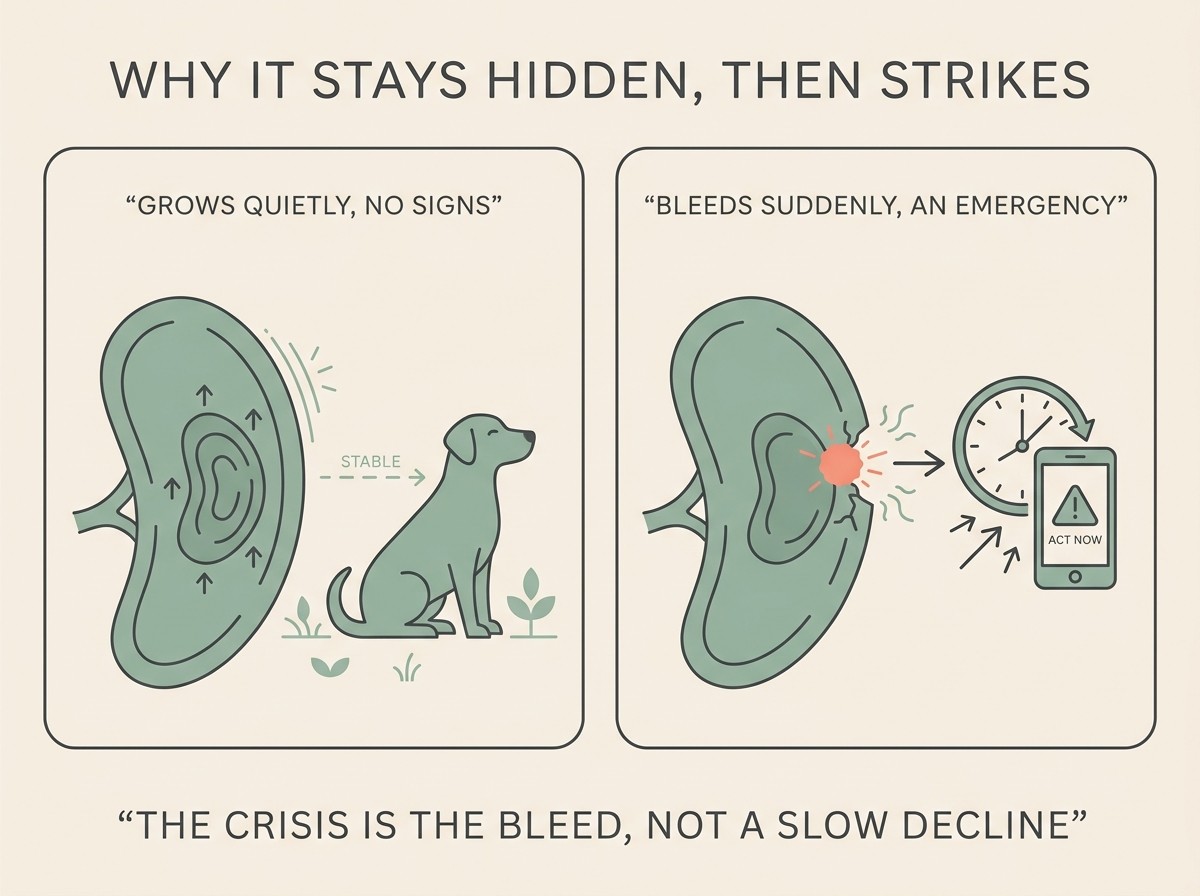
For most of its life, a splenic tumour causes no trouble you could possibly spot. It sits there, deep inside the belly where you can't feel it, growing slowly, while your dog eats, walks and plays as normal (Cornell University, 2024). Some dogs have nothing more than the odd off day: a bit of tiredness, slightly less interest in dinner, the sort of thing any older dog has and nobody would think twice about (Cornell University, 2024). No lump to find, no limp, no obvious sign. The cancer is genuinely hidden.
The crisis comes when the tumour bleeds. A blood-filled growth eventually develops a weak spot and tears, and blood leaks out into the abdomen (Cornell University, 2024). A small bleed can cause a brief wobble that seems to pass, which is why some dogs have a mysterious "funny turn" a week or two before the big one. A large bleed is a true emergency. The dog loses a lot of blood very fast into his own belly, and that is what causes the sudden collapse.
So the cancer didn't appear overnight. The bleed did. The tumour was there all along, quietly, and a quiet cancer is exactly the kind you can't catch early by watching. None of this is a failure of attention on your part.
If this is happening right now: a dog with a sudden collapse, pale or white gums, fast or laboured breathing, a swollen belly, or unexplained severe weakness needs an emergency vet immediately, not in the morning (Cornell University, 2024). Phone ahead and go. A bleeding spleen is one of the few cancers where the next hour genuinely matters. The call-now signs are covered in full in [cancer treatment emergencies].
The emergency, and the operation that often comes before the diagnosis
One thing surprises a lot of owners, and it's worth knowing because it shapes how fast everything moves. With a bleeding splenic mass, the surgery often happens before anyone can tell you for certain that it's cancer.
When a dog arrives collapsed and bleeding internally, the vet's first job is to stabilise him. If there's a mass on the spleen that's actively bleeding, the operation to remove the spleen (a splenectomy) is frequently the only thing that will stop the bleed and save his life that day. The trouble is that there's no way to be sure beforehand whether the mass is haemangiosarcoma or one of the more hopeful possibilities, and waiting for a definitive answer isn't an option while a dog is bleeding out.
The genuinely cruel bit is worth saying plainly. Not every bleeding splenic mass is cancer. A meaningful proportion turn out to be benign, a blood blister or a non-cancerous growth, and those dogs can go on to do well after the spleen is removed. But a large share are haemangiosarcoma, and you usually only find out which one you're dealing with several days later, once the removed spleen has been examined under the microscope (Cornell University, 2024). So many families face the surgery decision in the worst possible circumstances, at speed, at night, not knowing whether they're paying for a cure or for a few more weeks. There is no good way to dress that up. If that's where you are, the only fair thing to say is that choosing the surgery to stop your dog bleeding and buy time to decide is a reasonable, loving choice, and so is deciding that an emergency operation isn't right for your dog. Neither is wrong.
The prognosis, told straight
You came here for honesty, so here it is. Please take it gently, with a cup of tea and someone beside you if you can.
For splenic haemangiosarcoma that has not obviously spread, surgery to remove the spleen on its own typically buys a median survival of only around two months, often quoted as roughly 1.6 months in the largest studies (Wendelburg et al., 2015; Cornell University, 2024). Adding chemotherapy after surgery, usually a drug called doxorubicin, extends that to a median of around four to six months, but fewer than one in ten dogs are still alive a year after diagnosis (Cornell University, 2024). With no treatment at all, once the cancer has declared itself with a bleed, many dogs have only days to a couple of weeks (AKC, 2023).
There's a reason those numbers are so much shorter than for some other cancers. By the time a splenic tumour bleeds, it has very often already sent microscopic seeds elsewhere, most commonly to the liver, the lungs and the heart, even when scans look clear (Cornell University, 2024). The surgery removes the source, and chemotherapy slows the seeds, but neither reliably clears them. That is why this is a cancer we control briefly rather than cure.
A median is widely misunderstood, so it's worth saying what these figures are and aren't. The median is the midpoint, so half of dogs live longer than the number quoted, sometimes a good deal longer, and your dog is an individual rather than a statistic. How to read a survival figure properly, without being either crushed or falsely reassured, is set out in [reading a prognosis]. But this is also the cancer where candour cuts the other way, the one where we have to say clearly that the time really is short, so that you spend it well rather than chasing odds that mostly aren't there.
There's a sobering UK note worth adding, because the textbook figures come from specialist hospitals and don't always match real life. In a large study of dogs diagnosed with haemangiosarcoma in ordinary UK first-opinion practice, nearly half were put to sleep on the very day of diagnosis, and the overall median survival across the whole group was just nine days (Taylor et al., 2025). That isn't because UK vets give up. It's because so many dogs are only diagnosed at the point of a catastrophic bleed, when comfort, kindly and quickly given, is genuinely the most loving option on the table.
The skin form is a different, kinder story
Not all haemangiosarcoma is the splenic nightmare, and it would be unfair to let you leave thinking it is. When the cancer arises in the skin, the picture can be far more hopeful, and the difference is worth knowing.
There are really two skin versions, and they behave very differently. The first sits in the surface layer of the skin (the dermis) and is often caused by sun damage, so it tends to show up as a small red or purplish lump or patch on a thinly-haired, lightly-pigmented spot: the belly, the inner thigh, around the eyes, the kind of place that catches the sun (VSSO, 2024). This dermal, sun-related form is the good-news version. It spreads far less often, and for many dogs surgery alone is curative, with reported median survivals well over two years and sometimes far longer (VSSO, 2024). A dog whose haemangiosarcoma is one of these, caught early, has a genuinely different outlook from everything above.
The second skin version sits deeper, under the skin in the fatty layer (the subcutaneous or hypodermal form), and this one behaves more like its internal cousin, with a higher chance of spreading and a more guarded outlook that depends heavily on how early it's caught (VSSO, 2024). With a skin lump, then, the depth and the biopsy result matter enormously, and they're worth asking your vet about specifically. A small purple lump on a sun-exposed belly is a very different conversation from a deep one in the muscle.
Deciding, when none of the options is the one you want
Most cancer decisions in this space have a clear "more time" path, a clear "comfort" path, and time to weigh them. Haemangiosarcoma often robs you of the time, and that is perhaps the hardest thing about it. You may be deciding in an emergency room, exhausted and frightened, between a major operation with an uncertain payoff and saying goodbye. It's an awful position, and if you're in it, none of what follows is a test you can fail.
Broadly, three paths sit in front of you. You can choose the surgery to stop the bleed and the chemotherapy that follows, taking it as a way to buy good extra weeks to months rather than a cure, which suits families who want every reasonable bit of time and can manage the cost and the visits. You can choose the surgery alone, to stop a current bleed and have a little more time without the commitment of chemo. Or you can choose comfort care, deciding that an emergency operation and an uncertain few months aren't the right path for this dog, keeping him peaceful and pain-free, and letting him go kindly. That decision is walked through without any pressure either way in [whether to treat], and comfort-focused care is treated as the active, loving choice it is.
What I'd gently steer you away from is the guilt, in either direction. Putting an older dog through major surgery for a short, uncertain gain isn't selfish, and choosing not to isn't giving up. The kindest measure here is not how long, but how good the time is, and you can track that with a [quality-of-life score] rather than leaving it to a frightened gut feeling. Whatever you choose, you have not let your dog down.
If the decision in front of you is the last one, please know you don't have to face the rest of it alone. The [quality-of-life decision] is the gentlest place to go next, and from there our End-of-Life space holds everything else, the timing, the appointment itself, aftercare and grief, with the same care and none of the doom. Loving your dog all the way to the end, even when the end comes far too fast, is the whole of what matters.
References
- Cornell University, College of Veterinary Medicine, Riney Canine Health Center (2024). Hemangiosarcoma in Dogs (HSA as a highly malignant cancer of blood vessels most commonly affecting the spleen or heart of older, large-breed dogs, also liver and skin; little to no early signs or mild non-specific signs such as lethargy, weakness, exercise intolerance and decreased appetite; rupture causing collapse or severe weakness, rapid or difficult breathing, pale gums and sudden death; without chemotherapy an average survival of about two months, with post-surgery chemotherapy a median of four to six months, fewer than 10% alive at one year; skin-confined HSA may have a better prognosis and be treated with surgery alone; breeds including German Shepherds, Golden Retrievers and Labrador Retrievers).
- Wendelburg, K.M., Price, L.L., Burgess, K.E., et al. (2015). Survival time of dogs with splenic hemangiosarcoma treated by splenectomy with or without adjuvant chemotherapy: 208 cases (2001-2012). Journal of the American Veterinary Medical Association, 247(4), 393-403. (splenectomy alone median survival approximately 1.6 months; clinical stage strongly associated with outcome; modest survival prolongation with adjuvant chemotherapy)
- American Kennel Club (2023). Hemangiosarcoma in Dogs: Signs, Symptoms, and Treatment (the "silent killer" showing no symptoms until the tumour ruptures; the common splenic form presenting as sudden collapse with pale gums from internal bleeding; without treatment most dogs live only a few more weeks; predisposed breeds including Golden Retrievers, Portuguese Water Dogs, Boxers and German Shepherd Dogs).
- Veterinary Society of Surgical Oncology. Hemangiosarcoma (dermal HSA confined to the dermis behaving less aggressively than subcutaneous and visceral forms, with median survival times reported at 780-987 days, and longer again for ventral or solar-induced lesions at 1085 and 1549 days; dermal non-metastatic HSA prognosis generally excellent with surgery alone; subcutaneous/hypodermal form guarded and more variable, MST ranging from 8 months to over 3 years; splenic HSA median survival of 19-86 days with surgery alone, extending to 172-250 days with surgery plus doxorubicin, ~10% surviving beyond a year).
- Taylor, C., Barry, G.J., O'Neill, D.G., Guillén, A., Price, P.P., Labadie, J., & Brodbelt, D.C. (2025). Survival time and prognostic factors in dogs clinically diagnosed with haemangiosarcoma in UK first opinion practice. PLoS One, 20(6), e0316066. (overall median survival 9 days, 95% CI 5-15, in UK first-opinion practice; 48.3% not surviving beyond the day of diagnosis, euthanasia the mechanism of death in most at 92.3%; surgical excision the commonest treatment at 35.0%, chemotherapy uncommon at 5.3%)
Sister tool · Sightline
Track quality of life over time
Sightline, a separate ConciergeVet tool, runs a short adaptive weekly assessment with a quality-of-life focus mode built around exactly these frameworks, tracks a single composite score over time so you can see the trend rather than judge a single bad day, and produces a Sightline Report PDF you can bring to your vet.
A written log, or our printable quality-of-life sheet, does much the same job.
See how Sightline tracks quality of lifeFound a lump? Track it, and know when to act
A lump cannot be told apart by look or feel; only your vet sampling it can. The Lump & Bump Tracker records its size and how it changes, flags when it has crossed a line worth a vet visit, and builds a clean history to take in.
Open the Lump & Bump TrackerYou're not doing this alone
Compare treatment journeys and talk to owners managing cancer. Free to join.
Join PetsLikeMine