

Getting an indoor cat moving: play that burns calories
Alastair Greenway
BVM&S MRCVS
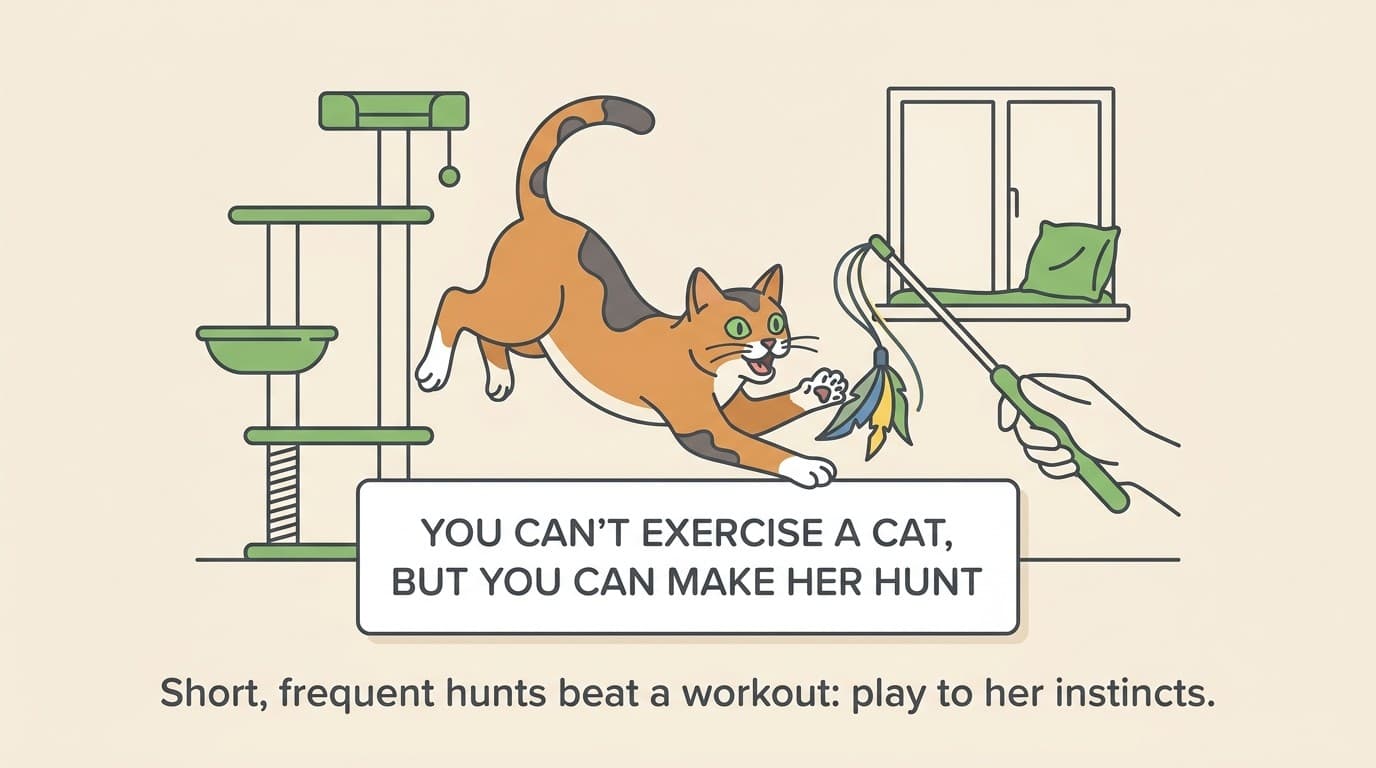
You can't exercise a cat, but you can make her hunt
"Your cat needs more exercise" is easy advice to give and almost impossible to act on. Cats don't go for walks. They won't run laps on cue. Nobody is putting a cat on a treadmill. So it lands as one of the more defeating things an owner gets told, because it sounds simple and feels impossible.
Swap it for something that actually fits a cat. You can't make a cat exercise, but you can make her hunt, and that changes everything. Your cat is a small predator, wired right down to her instincts to stalk, chase and pounce. Given the chance, a cat makes several hunting attempts every day, only about half of which end in a catch (Dantas et al., 2016). That is a busy, active life, and indoor living quietly removes all of it. Food arrives in a bowl for no effort, and the hunting she is built to do simply never happens. The activity didn't go anywhere. The reason for it did.
Give that instinct somewhere to go, through short bursts of play and a bit of foraging, and the movement looks after itself. You are not asking her to work out. You are letting her be a cat. That is better for her body, and for the bored, under-occupied side of her that can turn into pestering and over-eating. One thing up front, because it should put your mind at rest: the slimming itself comes mostly from her food, fed in the right amount, and we will come back to that. Getting her moving is about giving her a richer, more cat-shaped day, not about burning off dinner.
Short, frequent hunts: wand, chase and the laser rule
Cats don't hunt in one long session. They hunt in short, sharp bursts, several times a day, and that is exactly how to play with them. Two or three rounds of around 10 to 15 minutes, spread across the day, suit most cats far better than a single long stretch (VCA Animal Hospitals).
The best tool for this is an interactive wand or teaser toy, the kind with feathers, fur or something that skitters on a string. It lets you move the "prey" the way a real one would, so she gets the whole sequence: stalk, chase, pounce, grab. Drag it along the floor, flick it behind a chair, let it dart away and freeze. Cats are switched on by things that move unpredictably, that squeak or chirp, that behave like something alive and slightly out of reach. A toy that just sits there gets ignored, but a toy that runs away gets hunted.
Let her set the pace, and stop while she is still keen. That sounds backwards, but a cat who is allowed to "win" and then stops on a high stays interested for next time. Leave her wanting one more pounce, not worn out and bored of the game.
Laser pointers deserve a word, because they are brilliant and they come with one rule. The dot is fantastic for getting a cat to chase, sprint and turn at speed. The problem is that she can never actually catch a beam of light, so every hunt ends on nothing. Over time that can be frustrating, and laser play has been linked with more abnormal repetitive behaviours in cats, things like chasing shadows or fixating on lights, when it is used a lot (Kogan and Grigg, 2021). The fix is simple, and it keeps lasers on the menu. Always end the hunt on a real catch. Land the dot on a toy she can grab, or finish by tossing her a small toy or a treat counted from her daily ration, so the chase pays off with something solid. A reward she can chase or catch is a treat that does double duty, which is exactly the kind of swap in our guide to [the treat budget]. Never let the session just end on empty light.
Make her work for her food: puzzles, foraging and moving the bowl
Instead of putting her food in a bowl, make her work for it. This is the single best way to get an indoor cat moving, and it doubles as portion control, because the food is her normal measured ration, just delivered differently.
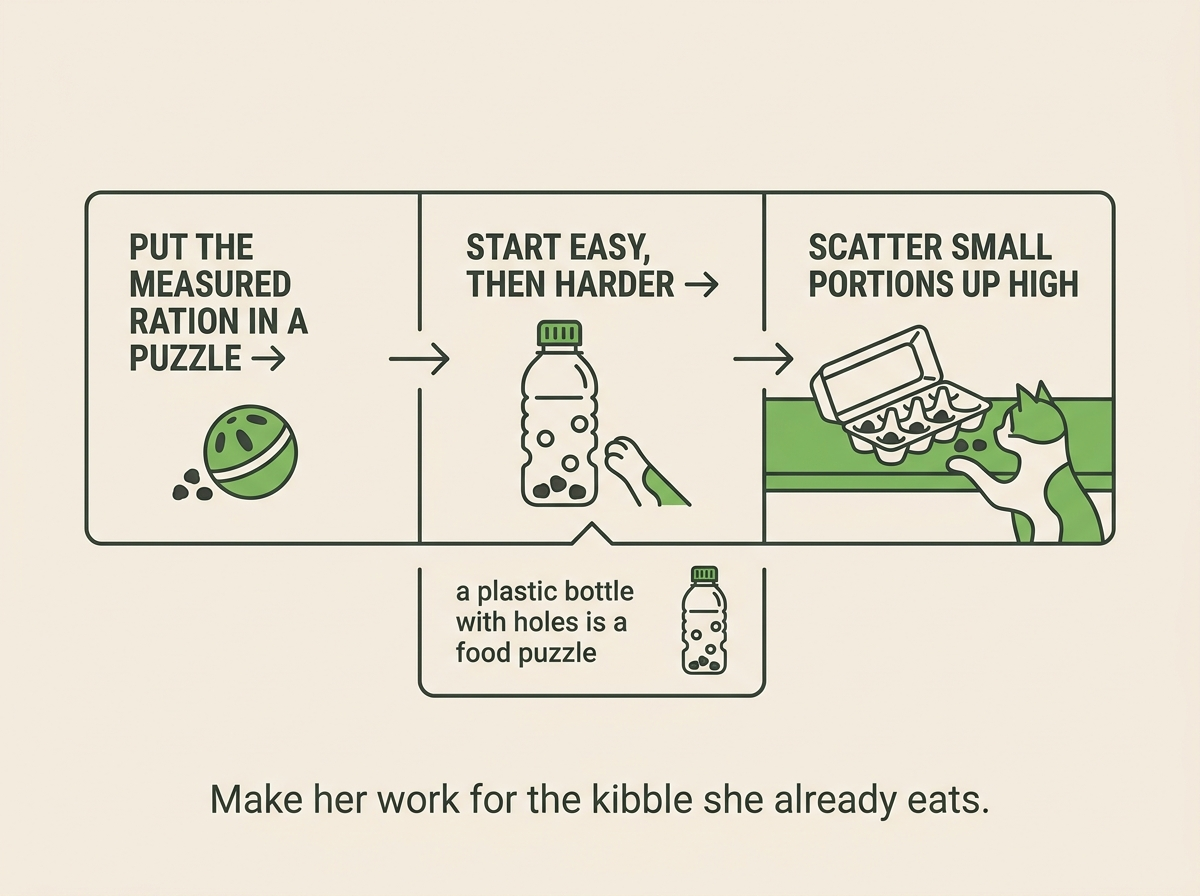
Food puzzles are the core of it. You put the day's food inside a puzzle and she has to bat, paw, roll or nose it out. There are two broad kinds. Mobile puzzles, things like balls, tubes and wobbly eggs, work for dry food and get her chasing them around the floor. Stationary puzzles, the ones with cups, wells or maze tracks she fishes food out of, work for dry food or wet (Dantas et al., 2016). You do not need to buy anything fancy. A plastic bottle with a few holes cut in it, an egg box, or a toilet-roll tube with the ends folded over all make perfectly good puzzles, and our [food-puzzle ideas card] has more you can make from the recycling.
When you begin, start easy. On day one, getting food out of the puzzle should be about as easy as getting it from the bowl, so she gets quick wins and doesn't give up and walk off (Dantas et al., 2016). Once she has the hang of it, make it gradually harder, fewer holes, more obstacles, a trickier design. This is not a gimmick. It is where real cats genuinely lose weight. In documented cases, cats moved onto food puzzles slimmed down noticeably, including an older cat that lost around 6% of its body weight over three and a half months and moved more easily as a result (Dantas et al., 2016).
Scatter feeding takes the same instinct further. Think of it as a treasure hunt: divide a portion of her ration into several small amounts placed around the home, on the floor, a shelf, a windowsill, and she searches, climbs and grazes through the day instead of gulping one big bowl (dvm360). Moving the bowl helps too. Put her food somewhere she has to travel and climb to reach, up onto a counter or a cat tree, so a meal comes with a bit of effort. If you have more than one cat, scattering and puzzling get trickier, because a slimming cat can simply eat the other cat's share, and our [multi-pet feeding plan] download sets out how to keep the portions separate.
Build up, not out: vertical space and climbing
Cats don't just move across a room. They move up it. A cat exercises in three dimensions, and a flat where everything happens at floor level gives her far less to do than one she can climb. Cat trees, a few sturdy shelves, a window perch and a high feeding spot turn an ordinary room into a climbing frame, and a window perch adds interest too, because watching birds and the street is hunting for the eyes.
Build this up kindly, though. A cat who is unfit, stiff or sore won't thank you for a tower she has to leap onto, and may simply not bother. Start low. Add steps, a ramp or an ottoman so she can get up in easy stages rather than one big jump, and never force her into a leap she is not comfortable with. As the weight comes off and she gets fitter, she will use the height on her own. If your cat is genuinely creaky or arthritic, read our guide on [slimming when exercise is limited], written for exactly that cat.
Play helps, but the bowl does the slimming
In cats, you cannot dial up exercise the way you can with a dog. You can't take a cat for a five-mile walk or send her running alongside a bike, and it is genuinely hard to increase how many calories a cat burns through activity (Cornell Feline Health Center). So as encouraging as a good play session is, the movement burns only a modest slice of the gap between what she eats and what she needs. The weight comes off, overwhelmingly, through the measured ration. Feed the right amount and she slims. Feed too much and all the wand games in the world won't fix it.
That is not a reason to skip the play, but a reason to be clear about what it is for. A hunted, properly occupied cat is less bored, and a less bored cat pesters the bowl and begs far less, so play is part of how you hold the line on portions, and a real help if her begging has become a battle of wills (more on that in [why does my cat act starving]). It protects her muscle as she slims, so the weight she loses is fat and not lean. And it lifts her mood and her welfare. So think of it this way: play for the cat she is, and feed for the cat you want her to be.
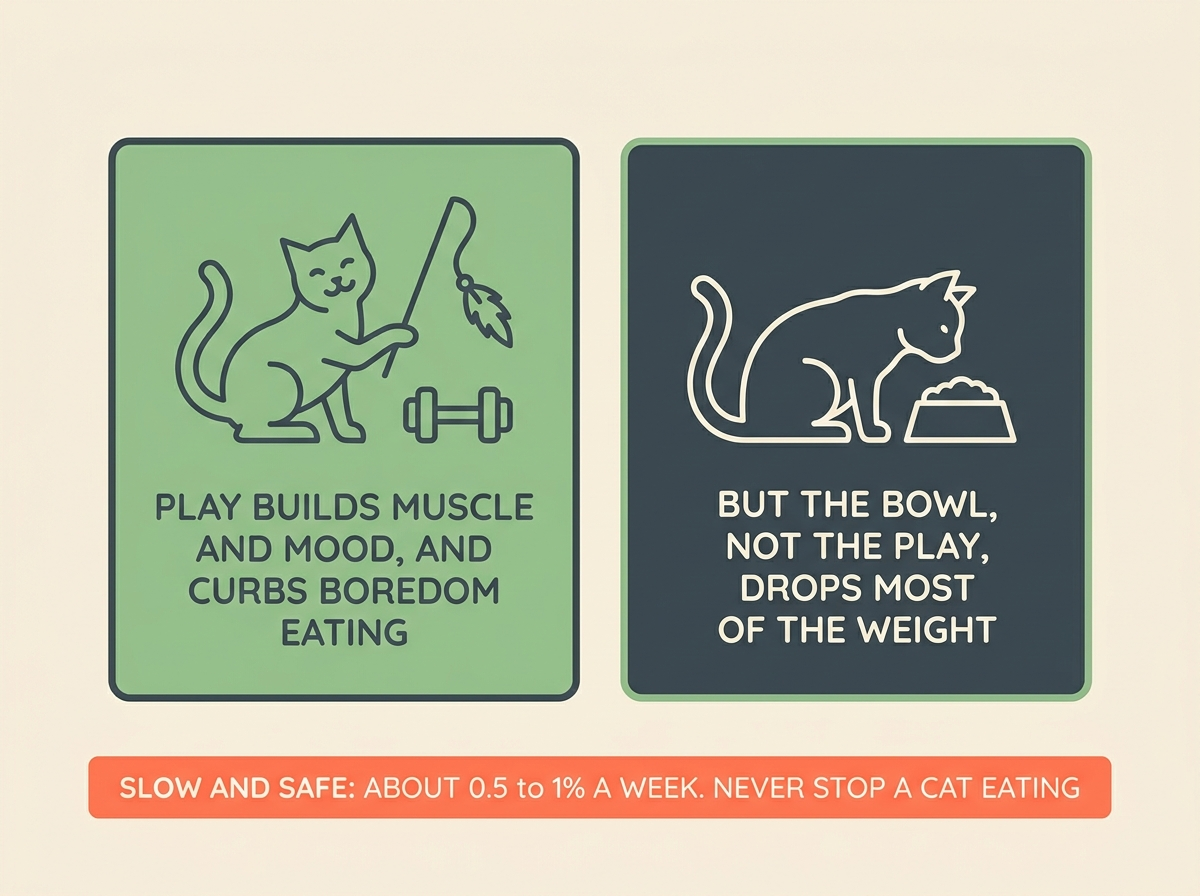
Which brings us to the safety line that sits under everything with cats. Feline weight loss has to be slow. Aim for around 0.5 to 1% of her body weight a week, no faster, and never let a dieting cat stop eating. A cat who comes off her food, even for 24 to 48 hours, is a genuine emergency, because of the risk of a serious liver condition called hepatic lipidosis. The food going in every day is non-negotiable. There is a whole guide on this, [never crash-diet a cat], and it is the most important thing to read alongside this one.
So where next? To get the ration right, the part that does the actual slimming, work it out with the [Feeding Calculator] and read [how much should I actually feed]. To go deeper on puzzles and foraging, see [slow feeding and foraging]. Keep an eye on the trend with the [Healthy Weight Tracker], which has a guardrail to stop a cat losing too fast. And if her weight is tangled up with her joints or her sugar, our [weight and diabetes] guide picks up the thread. If you are still not sure she really is carrying too much, and a round cat is so easy to read as just a big, cuddly one, start with [is my cat really overweight]. Get her hunting, feed her right, and you give her back the day she was built for.
References
- Dantas LM, Delgado MM, Johnson I, Buffington CAT. (2016). Food puzzles for cats: feeding for physical and emotional wellbeing. J Feline Med Surg. 18(9):723-732.
- VCA Animal Hospitals. Exercising Your Cat for Weight Loss.
- Kogan LR, Grigg EK. (2021). Laser Light Pointers for Use in Companion Cat Play: Association with Guardian-Reported Abnormal Repetitive Behaviors. Animals (Basel). 11(8):2178.
- dvm360. Feeding cats and feline obesity.
- Cornell Feline Health Center. Ask Elizabeth: Care of Obese Cats.
Keep track of how your pet is doing
The owners who cope best are the ones who notice changes early. A simple health log shows you what is working, and what is not, before the next vet visit.
Start tracking, freeYou're not doing this alone
Compare treatment journeys and talk to owners managing weight management. Free to join.
Join PetsLikeMine