

Your Cat Has Tested Positive for FIV or FeLV: What It Really Means
Alastair Greenway
BVM&S MRCVS
A positive FIV or FeLV result lands hard, and the worst-case picture is usually the first thing it brings to mind. So let us be clear up front: this is the start of a plan, not a reason to give up on your cat. Many cats with these viruses live happy, comfortable lives for years. This guide walks through what the result means and the calm first steps to take next.
What the result is, and isn't
When a vet tells you your cat has tested positive for one of the feline retroviruses, the mind tends to jump straight to the worst possible outcome. That is a completely understandable reaction, and a common one. But a positive screening result is not a death sentence, and it is not, on its own, a reason to put a cat to sleep. The international veterinary guidance on these viruses is explicit on this point: a diagnosis of retrovirus infection should not be the sole criterion for euthanasia (Little et al., 2020 AAFP Feline Retrovirus Testing and Management Guidelines).
What a positive result really gives you is information. Information lets you and your vet build a sensible management plan, watch for problems early, and protect any other cats you have. Plenty of cats carrying these viruses go on to live for many years and die, in the end, of something entirely unrelated. So before any big decisions are made, it is worth slowing down and looking properly at what you are actually dealing with.
FIV and FeLV are two different viruses
The first thing to be clear about is that FIV and FeLV are not the same thing. They are two distinct viruses, and although the in-clinic test kit usually screens for both at once (often from a single drop of blood), they behave very differently and carry very different outlooks. Knowing which one your cat has tested positive for matters enormously, so do ask your vet to confirm exactly which result came back positive.
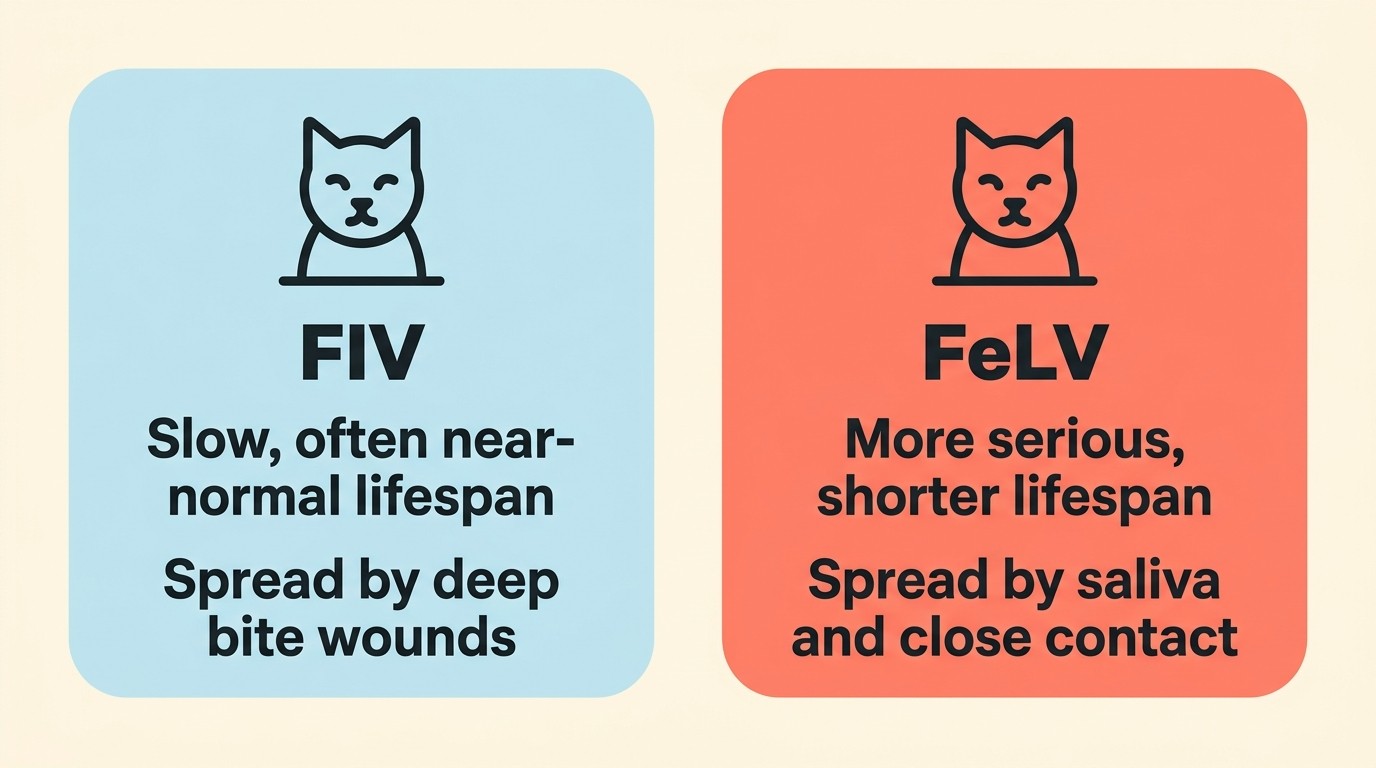
FIV (feline immunodeficiency virus) is, in some ways, the cat equivalent of HIV in people, though it cannot infect humans. It belongs to the same family of viruses (the lentiviruses) and it tends to work slowly. After infection there is often a brief acute phase, then a long quiet period that can last months to several years, during which the cat seems perfectly well; only later, in some cats, does the immune system gradually weaken enough to cause problems (Cornell Feline Health Center). The headline message is reassuring: cats with FIV commonly live average lifespans, provided they are not also infected with FeLV (Cornell Feline Health Center). In the shelter study summarised in the AAFP guidelines, FIV-infected cats had survival similar to uninfected cats (Little et al., 2020).
FeLV (feline leukaemia virus) is generally the more serious of the two. It can suppress the immune system, cause anaemia and trigger certain cancers, and it is one of the more common infectious causes of death in cats. The outlook depends heavily on how the cat's body handles the virus, but for cats that remain persistently infected, the median survival after diagnosis is around 2.5 years (Cornell Feline Health Center), and progressively infected cats in the AAFP-cited study had significantly shorter lifespans than FIV-infected or uninfected cats (Little et al., 2020). That said, more serious on average does not mean hopeless, and some cats whose immune systems keep the virus in check do very well.
How they spread is part of the story
The way each virus passes between cats tells you a lot about both the risk to other cats in your home and how your cat probably caught it.
FIV is mainly a fighting virus. The major route of transmission is through deep bite wounds that inject infected saliva under the skin (Little et al., 2020). It does not spread easily through the everyday, friendly contact of cats living peacefully together, such as sharing bowls or grooming each other. This is why free-roaming, unneutered male cats, the ones most likely to get into territorial fights, are the group most at risk (Cornell Feline Health Center). It also means that, with sensible management, an FIV-positive cat can often share a home with other cats at relatively low risk.
FeLV is a closer-contact virus. It is shed in saliva and other secretions and passes through prolonged, friendly contact: mutual grooming, sharing food and water bowls and litter trays, and from an infected mother to her kittens before or during nursing (Little et al., 2020; Cornell Feline Health Center). Bite wounds can transmit it too. Because the everyday social contact between housemate cats can spread FeLV, the situation for a multi-cat household is more complicated than with FIV, and there is a vaccine for FeLV (though no vaccine offers complete protection). We go into the practicalities of this in our guide to FeLV, its outlook and protecting other cats.
Confirm the result before any big decision
A positive on the quick in-clinic screening test is not always the final answer, and this catches a lot of owners off guard. False positives genuinely happen, and they happen most often in exactly the situation that brings many owners through our door: a healthy cat with no obvious risk factors.
The reason is statistical rather than a fault with the test. When a disease is uncommon in the population being tested, even a good test will throw up a noticeable number of positive results that turn out to be wrong. For FeLV in particular, where the true prevalence in healthy pet cats may be only a few percent or lower, studies have found that a substantial proportion of positive results from healthy cats were not confirmed on follow-up testing (Little et al., 2020; ABCD/Laboklin). Kittens under about six months can also give a misleading FIV result, and a kitten that received colostrum from an infected mother needs careful interpretation.
The practical takeaway is simple. If your cat is well and was at low risk, do not let a single screening result stampede you into a decision you cannot undo. Ask your vet about confirming the result with a different type of test, for example a PCR test that looks for the virus's genetic material, or an alternative antibody method (Little et al., 2020). A confirmed diagnosis puts you on solid ground. We explain the various tests, what each one actually detects, and when retesting is wise in our guide to FIV and FeLV testing.
What a confirmed positive means for daily life
Once a diagnosis is genuinely confirmed, life with a retrovirus-positive cat is, for the most part, surprisingly ordinary. These cats usually do not need daily medication. They eat the same good-quality food (your vet will likely advise against raw diets, since a weakened immune system copes less well with the bacteria raw food can carry). They play, sleep, purr and enjoy your company just as before.
What changes is the emphasis on vigilance and prevention. Because the immune system may be less robust, small illnesses can take a firmer hold, so the golden rule is to act early. A bout of gum inflammation, a snuffly nose, a wound, a change in appetite or weight, anything you might be tempted to wait out in another cat, deserves a prompt vet visit in a retrovirus-positive one. Most vets will also recommend a thorough health check roughly every six months rather than once a year, so problems are caught while they are still small (Cornell Feline Health Center; Little et al., 2020).
For other cats in your home, the right approach depends on which virus and on your particular set-up, and it is worth a proper conversation with your vet rather than a snap decision. We walk through living arrangements, risk reduction and quality-of-life monitoring in detail in our guide to living with an FIV-positive cat, and we cover the multi-cat household questions specific to FeLV in our guide to FeLV, its outlook and protecting other cats.
Calm first steps to take now
While you arrange to confirm the result and plan ahead with your vet, there are a handful of sensible, low-stress things you can do straight away.
Confirm the diagnosis. Talk to your vet about a confirmatory test before treating the screening result as final, especially if your cat is healthy and was low-risk.
Keep your cat indoors or safely contained. This protects other cats in your area from infection and protects your own cat from picking up new infections that its immune system would rather not face. A secure garden enclosure or supervised, harnessed outdoor time can give a contained cat fresh air without the risks.
Neuter, if it has not already been done. Neutering reduces roaming and fighting, which cuts the chance of your cat spreading the virus or catching other infections, and it removes the hormonal drive that pushes cats into the territorial scraps that spread FIV in the first place (Little et al., 2020).
Keep up routine veterinary care. Continue with parasite control and discuss the vaccination plan with your vet, who will tailor it to your cat's circumstances. Book in for those six-monthly health checks.
Treat any illness promptly. Do not adopt a wait-and-see attitude with a retrovirus-positive cat. Early treatment of minor problems is one of the most powerful things you can do for their long-term wellbeing.
Reduce stress. A calm, predictable home with good nutrition, enrichment and comfortable resting places genuinely helps an immune system that has its work cut out.
Realistic hope
It is honest to say that a confirmed FeLV diagnosis, in particular, can shorten a cat's life. But shorter on average still leaves room for many good months or years, and for FIV the outlook is often genuinely close to normal. The single biggest influence on how your cat fares is not the virus itself but the care that surrounds it: keeping them indoors and safe, feeding them well, catching illness early and giving them a low-stress life full of comfort and affection.
When you are ready for the next layer of detail, our guide to living with an FIV-positive cat, our guide to FeLV, its outlook and protecting other cats, and our guide to FIV and FeLV testing are there to walk you through each piece.
References
- Little S, Levy J, Hartmann K, Hofmann-Lehmann R, Hosie M, Olah G, St Denis K. 2020 AAFP Feline Retrovirus Testing and Management Guidelines. Journal of Feline Medicine and Surgery. 2020.
- Cornell Feline Health Center. Feline Leukemia Virus (FeLV). Cornell University College of Veterinary Medicine. 2024.
- Cornell Feline Health Center. Feline Immunodeficiency Virus (FIV). Cornell University College of Veterinary Medicine. 2024.
- Laboklin / European Advisory Board on Cat Diseases (ABCD). Feline leukaemia virus (FeLV) and feline immunodeficiency virus (FIV): important diseases and a challenging diagnosis. 2025.
Keep track of how your pet is doing
The owners who cope best are the ones who notice changes early. A simple health log shows you what is working, and what is not, before the next vet visit.
Start tracking, freeYou're not doing this alone
Compare treatment journeys and talk to owners managing immune & blood. Free to join.
Join PetsLikeMine