

Breaking the Cycle: Stress, Multi-Cat Tension and Preventing the Next Flare
Alastair Greenway
BVM&S MRCVS
A calm spell with feline idiopathic cystitis (FIC) can end without warning. You've had the diagnosis, you've fixed the litter trays, you've got more water into your cat, and for weeks things hold steady. Then a flare arrives, the 3am tray-watch starts again, there's a pink spot on the floor, and the worry creeps back that this is simply how it's going to be. This page is for the long game, when the recurring nature of FIC is wearing you down. It isn't the basic set-up (that's in [managing FIC with MEMO]) and it isn't getting through an acute episode (that's in [the FIC flare]). It's about why the flares keep returning, and the specific, often-missed work that genuinely stretches the gaps between them.
Why it keeps coming back
Start with the realistic picture, because false promises help nobody. FIC tends to recur. Across the studies, somewhere between half and two thirds of affected cats have more than one episode, with recurrence reported at around 65% over six months and still about 52% even when cats are followed for ten to sixteen years (He et al., 2022). Most cats fall into one of three patterns: a single self-limiting episode (roughly 80 to 90%), a frequently-recurring form (around 2 to 15%), and a persistent form (another 2 to 15%) (He et al., 2022). If your cat is in one of those last two groups, you are not doing something wrong. You have one of the cats whose dial sits higher.
The mechanism is worth understanding, because it takes the blame away and points at the fix. In susceptible cats, the stress-response system is wired to overreact, and stays that way even once the cat seems used to a situation, with an exaggerated surge of stress chemicals and a blunted, almost worn-out stress hormone response behind it (He et al., 2022). That over-tuned system is what irritates the bladder lining and lights up its nerves. So a flare isn't a fresh infection arriving, it's the same underlying sensitivity firing again. There's a loop that traps so many cats: the flare hurts, pain is itself a powerful stressor, and stress feeds the next flare. Break the loop, and the flares thin out. That's the whole job, and it's reachable.
Become a detective for your cat's triggers
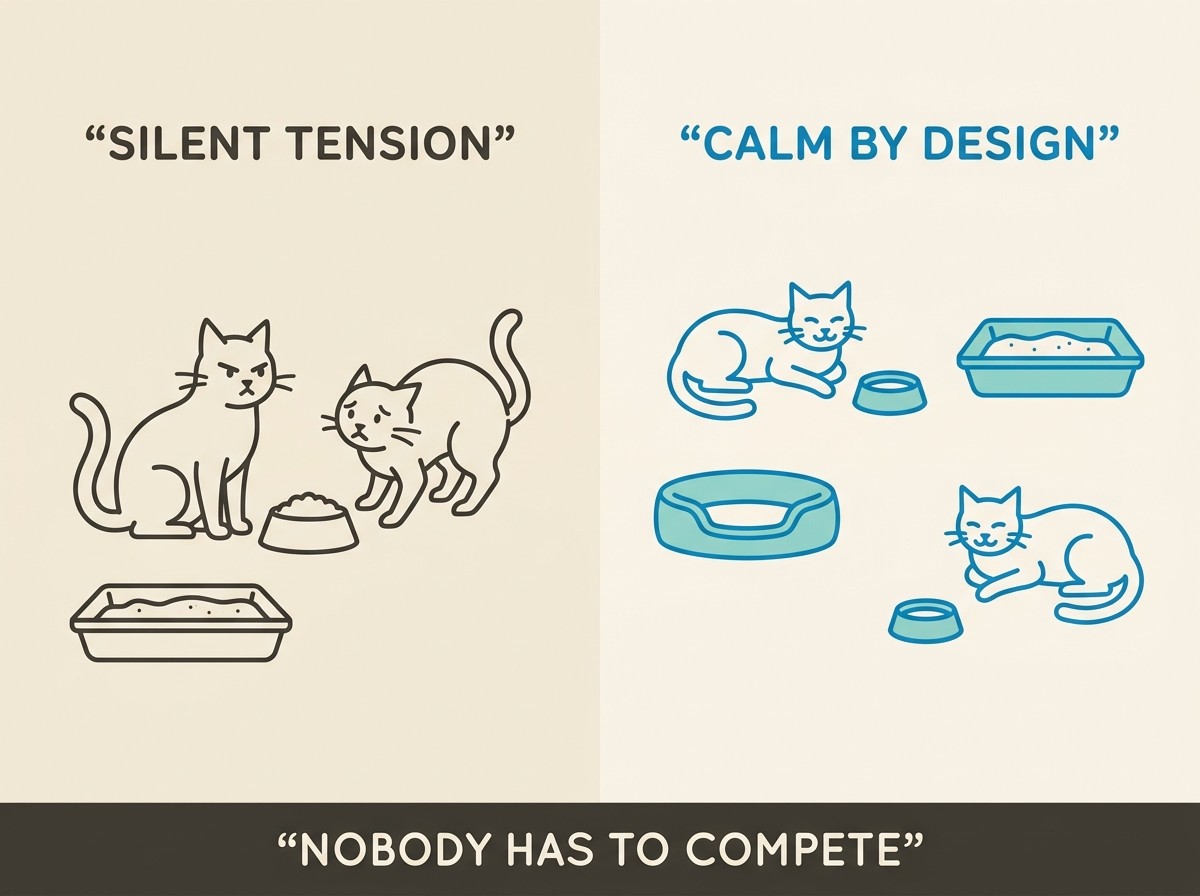
The other half of breaking the cycle is figuring out what sets your cat off, because the trigger list is individual. It helps enormously to know that change itself is the enemy. In a clever study that tracked cats through ordinary disruptions, unusual events in the household, a change of routine, a noisy day, the carer going away, raised the number of "sickness behaviours" in cats whether or not they had cystitis at all (Stella, Lord and Buffington, 2011). On the unsettled days, cats were markedly more likely to eat less, to skip the litter tray, and to wee or mess outside it. In other words, a sudden change in your cat's world reliably provokes the very signs you're trying to prevent, and that's true of cats in general, not just the sensitive ones.
So watch for the pattern. Common triggers are a house move, building work, a new pet or baby, a visitor staying, a change in your hours, a holiday with a different carer, even rearranged furniture or an empty food bowl at the wrong time. This is where the [FIC & Water tracker] earns its keep: log every flare with the date and what was going on around it, and over a few months the culprits usually reveal themselves. Some you can remove. Most you can soften by leaning hard on your cat's safe spaces and routine while the unsettling thing passes, and by introducing any unavoidable change as gradually as you can.
Levers that lower the baseline over time
A few things shift the underlying risk rather than just managing a single flare. Weight is a big one: in one matched study, cats described as obese were around seven times more likely to have FIC than lean cats, the largest effect of any factor the study measured (Lund et al., 2016). Helping an overweight cat slim down, carefully and with your vet's guidance, is a genuine long-term lever, and it pairs naturally with the shift to wet food in [water, diet and your cat's bladder]. Anxious temperament matters too: in the same study, being obese and being of a nervous disposition both held up as independent risk factors, with 44% of the FIC cats described as nervous against 25% of the cats without it (Lund et al., 2016), and a small 2025 study found that cats frightened of unfamiliar people had a higher rate of recurrence, with a similar hint for cats frightened of people they knew (Caudron et al., 2025). That's not a flaw in your cat, it's a reason to protect the predictable, low-threat home that lets a nervous cat relax, and for the few cats whose anxiety runs deep, a reason to ask about the calming aids and medication in [calming aids, pheromones and when medication has a role].
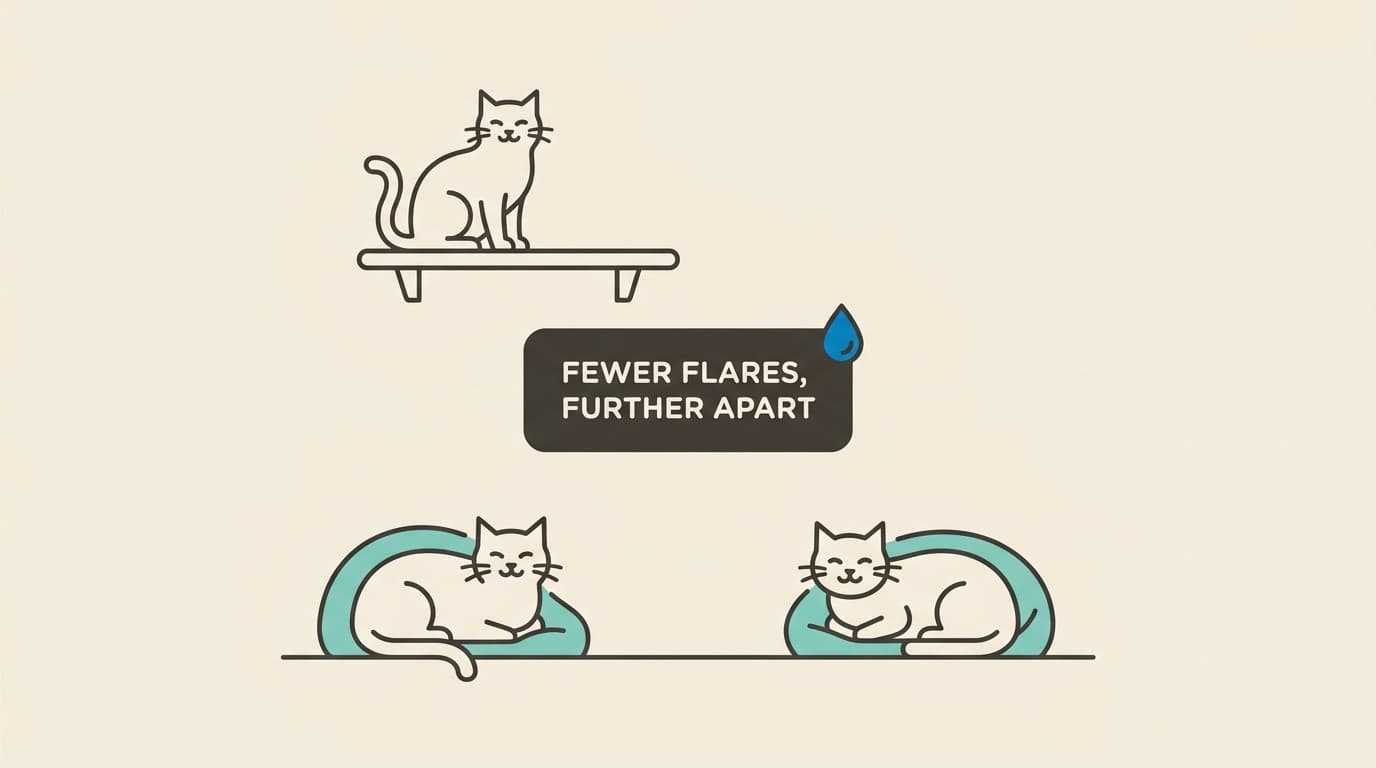
The reassuring evidence is that this work pays off. When researchers added structured environmental changes to the usual care of cats with recurrent cystitis and followed them for about ten months, only around 28% flared again, and the typical frequency of signs fell from weekly to never, with the cats also becoming measurably less fearful (Buffington et al., 2006). Fewer, milder, further apart, that's the realistic goal, and it's one you can actually watch happen on the tracker.
One thing overrides everything on this page, and it never changes. If your cat is male and he's straining and passing little or nothing, crying, restless, hiding, vomiting or off his food, he may be blocked, and that's a life-threatening emergency that can be fatal within about a day. It is not "just his cystitis again". Ring your vet or the out-of-hours service straight away, run him through the [Blocked-Cat triage] if you're unsure, and keep the [blocked-cat red-flags fridge card] where you'll see it. Breaking the cycle is the long, patient work between flares. It is never the answer to a cat who can't pass urine right now.
References
- He C, Fan K, Hao Z, Tang N, Li G, Wang S. *Prevalence, Risk Factors, Pathophysiology, Potential Biomarkers and Management of Feline Idiopathic Cystitis: An Update Review.* Frontiers in Veterinary Science, 2022;9:900847. doi:10.3389/fvets.2022.900847 / PMC9257190. (Recurrence ~65% at 6 months, ~61.5% over 0.5 to 138 months and ~52% over 10 to 16 years; non-obstructive FIC as a single self-limiting episode in 80 to 90%, frequently recurring in 2 to 15% and persistent in 2 to 15%; FIC occurs mostly in the "threatened" cat and persistent inter-cat conflict is associated with FIC; chronic stress with exaggerated catecholamine release and blunted cortisol response; multi-cat households, indoor confinement and obesity as risk factors.)
- Caudron M, Laroche P, Bazin I, Desmarchelier M. *Association between behavioral factors and recurrence rate in cats with feline "idiopathic" cystitis.* Journal of Veterinary Behavior, 2025;78:90-96. doi:10.1016/j.jveb.2025.02.005. (Cats presenting with fear of unfamiliar people had a higher risk of FIC recurrence, with a similar trend for fear of familiar people; identifying and treating fear- and anxiety-related problems may help reduce the recurrence rate.)
- Lund HS, Sævik BK, Finstad ØW, Grøntvedt ET, Vatne T, Eggertsdóttir AV. *Risk factors for idiopathic cystitis in Norwegian cats: a matched case-control study.* Journal of Feline Medicine and Surgery, 2016;18(6):483-491. doi:10.1177/1098612X15587955 / PMC11185226. (Obesity was the strongest risk factor, odds ratio ~7.03; 44% of FIC cats were described as nervous versus 25% of controls; FIC cats were more likely to live strictly indoors, 53% versus 35%, on univariable analysis.)
- Stella JL, Lord LK, Buffington CAT. *Sickness behaviors in response to unusual external events in healthy cats and cats with feline interstitial cystitis.* Journal of the American Veterinary Medical Association, 2011;238(1):67-73. doi:10.2460/javma.238.1.67. (Exposure to unusual external events significantly increased the total number of sickness behaviours regardless of disease status, including reduced food intake and elimination outside the litter box; routine changes provoke FIC-like signs in healthy cats and cystitis cats alike.)
- Buffington CAT, Westropp JL, Chew DJ, Bolus RR. *Clinical evaluation of multimodal environmental modification (MEMO) in the management of cats with idiopathic cystitis.* Journal of Feline Medicine and Surgery, 2006;8(4):261-268. doi:10.1016/j.jfms.2006.02.002. (Of 46 indoor cats with recurrent idiopathic cystitis followed for ~10 months after MEMO, only ~28% recurred, the median frequency of signs fell from weekly to never, and fearfulness and nervousness were significantly reduced.)
- Ellis SLH, Rodan I, Carney HC, Heath S, Rochlitz I, Shearburn LD, Sundahl E, Westropp JL. *AAFP and ISFM Feline Environmental Needs Guidelines.* Journal of Feline Medicine and Surgery, 2013;15(3):219-230. doi:10.1177/1098612X13477537. (The five pillars of a healthy feline environment, including a safe place and multiple, separated key resources; the basis for reducing inter-cat conflict by separating and multiplying resources.)
- International Cat Care (iCatCare / ISFM). *Feline idiopathic cystitis (FIC) in cats* (conflict with another cat in the household is the single commonest stressor in FIC cats; subtle, often silent inter-cat tension; FIC is not a bacterial infection and antibiotics are not appropriate; management is by reducing stress and increasing water, and it is managed rather than cured).
- Taylor S, Boysen S, Buffington T, Chalhoub S, Defauw P, Delgado MM, Gunn-Moore D, Korman R, et al. *2025 iCatCare consensus guidelines on the diagnosis and management of lower urinary tract diseases in cats.* Journal of Feline Medicine and Surgery, 2025;27(2). doi:10.1177/1098612X241309176. (MEMO, conflict minimisation and increasing water/dietary moisture as first-line management for FIC; antibiotics not indicated for sterile FIC.)
Free downloads
Companion worksheets to put what you've read into practice. Free PDFs, print at home.
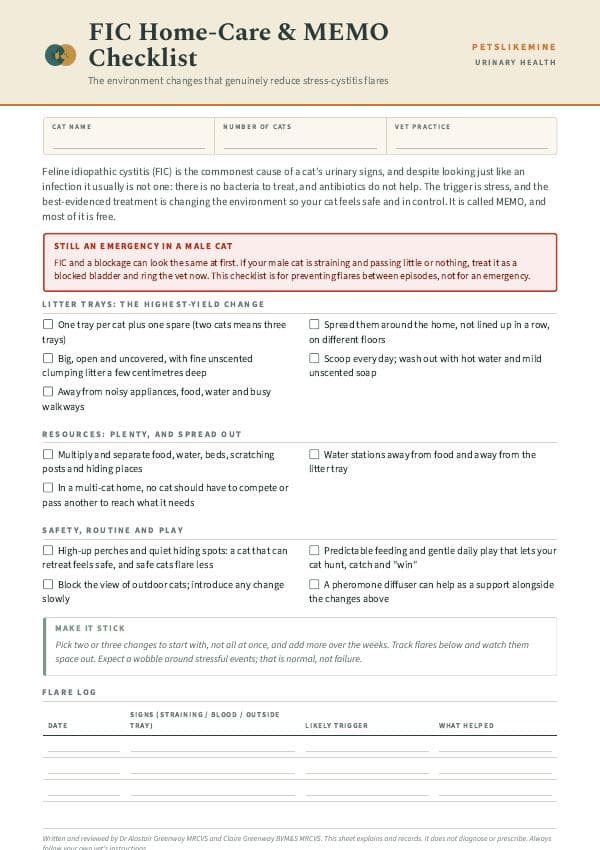
Keep track of how your pet is doing
The owners who cope best are the ones who notice changes early. A simple health log shows you what is working, and what is not, before the next vet visit.
Start tracking, freeYou're not doing this alone
Compare treatment journeys and talk to owners managing urinary health. Free to join.
Join PetsLikeMine