

Managing FIC with MEMO: The Environment Changes That Actually Work
Alastair Greenway
BVM&S MRCVS
"Reduce your cat's stress" and "enrich the environment" are the two instructions vets hand out most often for feline idiopathic cystitis (FIC), and they're also the two that make the least sense at home. She's a house cat, she sleeps eighteen hours a day, what on earth is stressing her, and how is moving a litter tray meant to help a sore bladder? It's a fair question, and most owners are left holding that vague advice with no idea what to do with it on a Tuesday evening.
So this page is the concrete version: the specific, do-this-this-week changes the evidence actually supports, why each one matters to a bladder, and how to make them stick without overhauling your whole house in a weekend. If you're not yet sure why stress and litter trays have anything to do with cystitis, start with [feline idiopathic cystitis: why stress gives your cat a sore bladder] and come back. This is the practical follow-on.
Why the environment is the medicine, not a soft add-on
It sounds too gentle to be a real treatment. It isn't. When researchers led by Tony Buffington took 46 indoor cats with recurrent idiopathic cystitis and added a structured set of environmental changes to their usual care, then followed them for about ten months, the results were striking. Only around 28% of the cats (13 of the 46) had any further flare, and the typical frequency of signs dropped from once a week to never. The cats were also measurably less fearful and less nervous, and had fewer of the tummy and breathing flare-ups that tend to travel with FIC (Buffington et al., 2006). They gave the approach a name: multimodal environmental modification, or MEMO. "Multimodal" simply means you change several things at once, because no single tweak is the magic bullet.
That study is why this matters more than the supplements on the shelf. When a 2025 systematic review weighed up everything commonly recommended for recurrent FIC, the two things that came out with the strongest supporting evidence were environmental modification and getting more water and moisture in, and the authors concluded those two, together, should be the primary treatment. By contrast, there was little evidence for pheromone diffusers (Macleod et al., 2025). In other words, the cheap, unglamorous changes are the ones with the science behind them, and they're the ones nobody bothers to package for you. That's what this page does.
The whole logic comes from the modern picture of FIC as a whole-cat stress sensitivity that surfaces in the bladder (the "Pandora syndrome" idea in [feline idiopathic cystitis: why stress gives your cat a sore bladder]). If stress fires the flare, then a home where your cat feels safe, in control and unbothered is, quite literally, treatment. The framework underneath everything below is the AAFP and ISFM "five pillars of a healthy feline environment": a safe place, multiple and separated key resources, the chance to play and hunt, gentle and predictable human contact, and respect for your cat's powerful sense of smell (Ellis et al., 2013). You don't need to memorise the five pillars. You just need the practical version of each, starting with the change that pays off fastest.
Start with the litter trays (the highest-yield change)
If you do nothing else this week, fix the trays. House-soiling and stress-linked illness like FIC are far more likely when a cat doesn't have toileting it actually likes (iCatCare). Here is the checklist, and why each line earns its place.
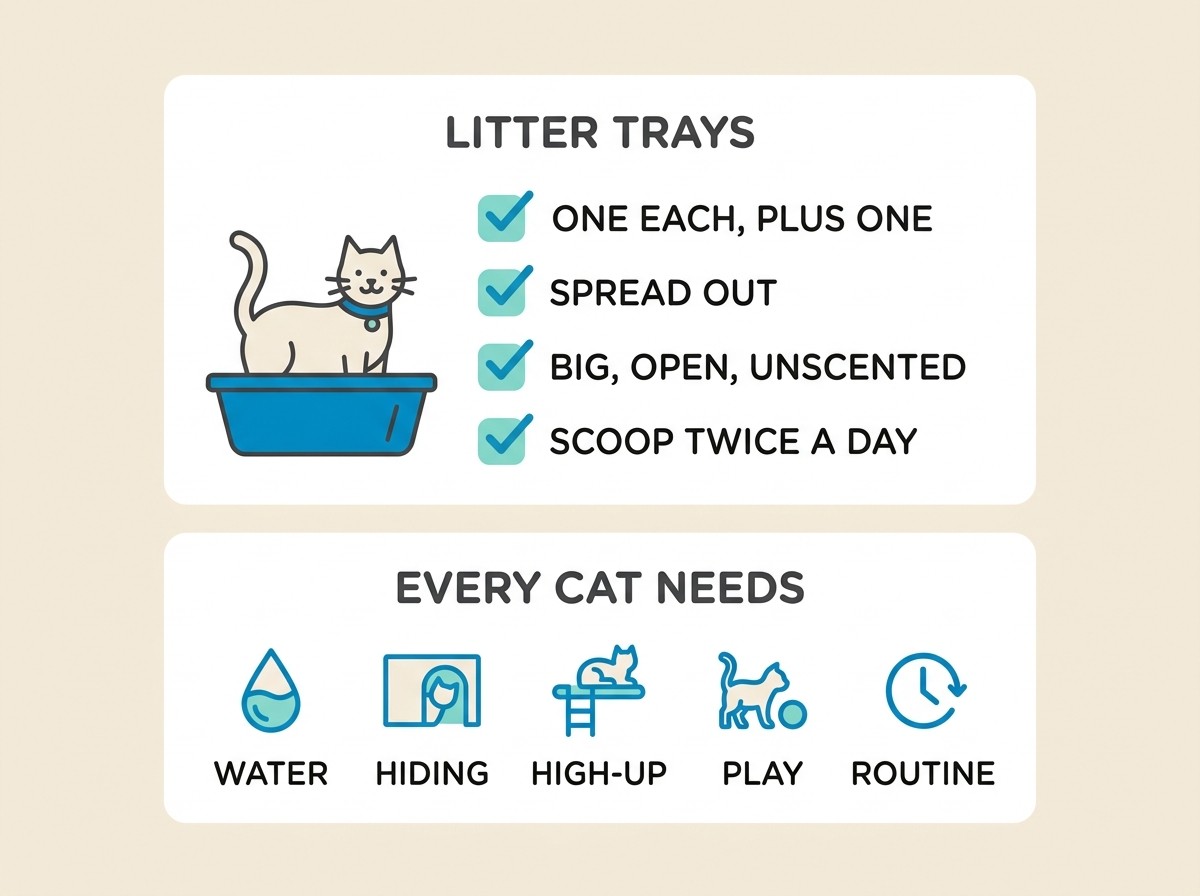
- One tray per cat, plus one spare. This is the "n+1" rule, the standard advice from feline-medicine guidance (iCatCare; AAFP/ISFM). One cat means two trays, two cats means three. A cat that's guarding, or simply finding one tray slightly grubby, always has a clean alternative it doesn't have to queue for or fight over.
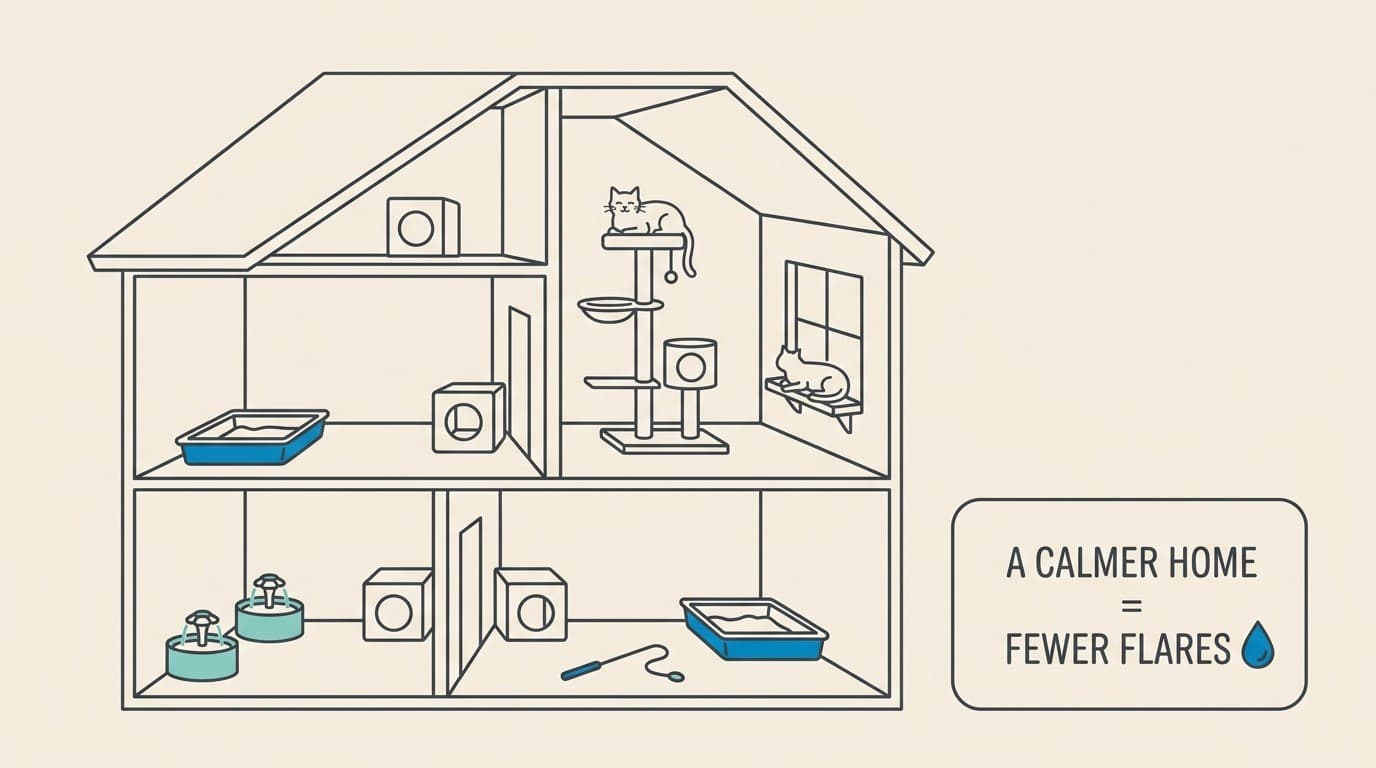
- Spread them around the home, not lined up in a row. Two trays side by side count as one location to a cat. Put them in different rooms, and on different floors if you have stairs, so your cat is never far from one and never has to run a gauntlet (past the dog, past another cat, past the noisy boiler) to reach it.
- Big, and bigger than you think. A tray should be at least one and a half times your cat's body length so they can turn around and dig comfortably. Most shop-bought trays are too small. A large, low-sided storage box often makes a far better litter tray than anything sold as one.
- Open, not hooded. Many cats dislike covered trays: they trap smells, they're cramped, and they let another cat ambush them at the only exit. If yours has a lid, try taking it off.
- Unscented, soft, clumping litter, filled a few centimetres deep. Most cats prefer a fine, sand-like clumping litter and dislike strong "fresh" fragrances, which are for your benefit, not theirs (iCatCare). A reasonable depth lets them dig and bury.
- Scoop at least twice a day, and clean it more often than you'd think. A FIC cat is fussier than most, so scoop solids and clumps at least twice daily and do a full empty-and-wash every couple of weeks for clumping litter (iCatCare). Wash with plain hot water, not strong-smelling disinfectant.
- Quiet, safe spots, away from food and water. Cats won't happily toilet next to where they eat, and they hate being startled mid-wee. Keep trays out of busy thoroughfares and away from washing machines and other things that lurch into life.
None of this is fussy for its own sake. A cat that finds the tray unpleasant holds on longer, wees less often and lets the urine sit and concentrate, which is exactly the irritation a sore bladder doesn't need. Get the trays right and you've often done the single most useful thing on this list.
Give every resource its own space, and plenty of it
The same principle that governs trays governs everything else your cat needs: food, water, beds, scratching posts, hiding places and lookout perches. The guidance is to provide them in multiple, separated locations so no cat ever has to compete for the things that keep it calm (Ellis et al., 2013). One food bowl and one water bowl in the kitchen is a single resource station, and in a cat's eyes a single point another cat can guard.
So spread them out: a couple of feeding spots, water in several quiet places away from the food and trays (the full water story, which is its own piece of real medicine, is in [water, diet and your cat's bladder]), beds in different rooms, and more than one scratching post, because scratching is how a cat marks territory and relieves tension. The aim is simple: your cat should never have to wait, queue or risk a confrontation to reach anything it needs. In a one-cat home this is easy. In a multi-cat home it's the difference between a calm cat and a quietly stressed one.
Build in height and hiding places
A cat that can get up high and tuck itself away feels safe, and a cat that feels safe flares less. "A safe place" is the first of the five pillars for a reason (Ellis et al., 2013).
Give your cat vertical space: a cat tree, a cleared shelf, the top of a wardrobe, a window perch. High vantage points let a cat survey its world and stay out of reach of anything that worries it, which is genuinely calming. And give it boxes and quiet retreats to disappear into, a cardboard box on its side, an igloo bed, the gap behind the sofa. The rule is that your cat should always have somewhere to go where it feels unseen and unbothered, and above all, where nobody, no child, no dog, no other cat, follows it in. A retreat your cat can be cornered in isn't a retreat.
Make life predictable, and let your cat hunt
Cats are creatures of routine, and unpredictability is a low-grade stressor that adds up. You can't make life perfectly regular, but you can smooth the edges: feed at roughly consistent times and keep the household rhythm as steady as you reasonably can. When change is unavoidable, a new baby, a house move, a visitor staying, building work, introduce it gradually wherever possible and lean harder on the safe spaces while it settles. Predictable, gentle human contact on your cat's terms (let it come to you, rather than the reverse) is itself one of the five pillars (Ellis et al., 2013).
Then there's play, which does more than burn energy. Short bouts of hunting-style play, a wand toy or feathers your cat can stalk, pounce on and "catch", let an indoor cat express the predatory behaviour it's wired for, and a cat that gets to be a cat is a more contented one (Ellis et al., 2013). A few minutes once or twice a day, ideally ending with a "catch" and a small food reward, beats a single long session. Food puzzles and scattering a portion of the daily ration for your cat to find work the same muscle and stave off the boredom that, in a sensitive cat, can tip into a flare.
Defuse the tension between cats (it's often silent)
If you have more than one cat, this is where a lot of hidden FIC stress lives, and it's easy to miss because cats rarely have stand-up fights. The tension is quiet: one cat blocking another's path to the tray, a hard stare across the room, one cat hogging the warm spot or the windowsill, another hanging back and waiting its turn for everything. You may have told yourself they "get on fine" because they're not fighting, when in truth one is living on edge.
The fix is mostly the "separated resources" work above, done deliberately: enough trays, beds, feeding spots, water and high perches, spread far enough apart, that no cat can control access to them. Make sure no cat ever has to pass a rival to reach the loo or the food. Blocking the view of neighbourhood cats through the window helps too, since an intruder patrolling the garden is a real stressor even through glass: close the curtains low down, or move a perch away from that window. Pheromone diffusers, which copy the scent-marks cats leave when they feel settled, are a reasonable extra support and respect the "sense of smell" pillar, though be aware the evidence for them is weak, so treat them as a small help around the edges rather than a fix (Macleod et al., 2025). We weigh up pheromones, calming supplements and, for the few cats who need it, medication in [calming aids, pheromones and when medication has a role], and dig deeper into multi-cat dynamics in [breaking the cycle: stress, multi-cat tension and preventing the next flare].
Make it stick, and watch it work
Here's the trap to avoid: don't try to do all of this in one frantic weekend. A sudden upheaval is itself stressful, which is the opposite of the point, and an exhausted owner who's bought three cat trees and rearranged the house tends to give up by month two. So pick two or three changes to start. The trays are almost always the right first move, with water a close second. Get those bedded in, then add the next thing. And be realistic about the timescale: this reduces the rate of flares over months, it isn't an off-switch. Expect a wobble around stressful events, a holiday, a houseguest, a change at home, and treat those as the moments to lean hardest on the safe spaces rather than as proof it isn't working.
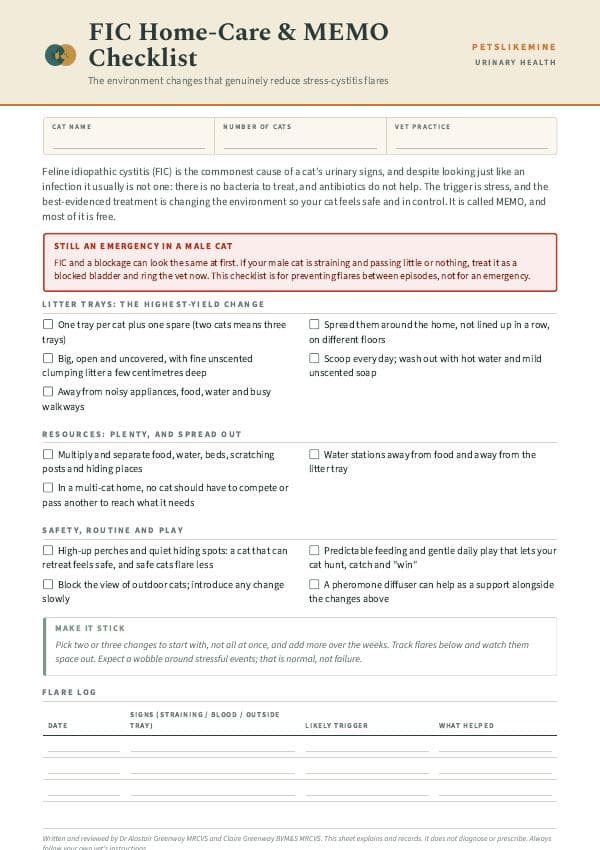
The reassuring part is that you can actually see this pay off, which most treatments don't let you do. Log your cat's flares and water intake on the [FIC Flare & Water-Intake tracker] and watch, over the months, as the episodes thin out and the gaps between them stretch. That pattern is genuinely motivating on the evenings you're scooping a third tray and wondering if any of it matters. If you'd like the whole thing on paper to work through and stick on the fridge, the [FIC home-care and MEMO checklist] download gathers every change above into one printable plan.
One last thing that overrides everything on this page, because it's the one true emergency in all of FIC. None of this is rescue treatment. If your cat is male and he's straining in the tray and passing little or nothing, crying, restless, hiding, vomiting or off his food, he may be blocked, and a blocked cat is a life-threatening emergency that can be fatal within about a day. Ring your vet or the out-of-hours service straight away, run him through the [Blocked-Cat triage] if you're unsure, and keep the [blocked-cat red-flags fridge card] somewhere you'll see it. Environment and water are how you prevent the next flare. They are never how you treat a cat who can't pass urine right now.
References
- Buffington CAT, Westropp JL, Chew DJ, Bolus RR. *Clinical evaluation of multimodal environmental modification (MEMO) in the management of cats with idiopathic cystitis.* Journal of Feline Medicine and Surgery, 2006;8(4):261-268. doi:10.1016/j.jfms.2006.02.002. (46 indoor cats with idiopathic cystitis followed for ~10 months; only 13 of 46 (28%) showed recurrence of clinical signs, the median frequency of signs fell from weekly to never, and there were significant reductions in fearfulness, nervousness and upper respiratory signs after MEMO added to usual care.)
- Macleod B, Laven LJ, Laven RA, Hill KE. *Understanding the current evidence base for the commonly recommended management strategies for recurrent feline idiopathic cystitis: a systematic review.* New Zealand Veterinary Journal, 2025. doi:10.1080/00480169.2025.2477542. (Systematic review; encouraging evidence for multimodal environmental modification and for therapeutic urinary foods, particularly when combined with increased dietary moisture, which together should be considered the primary treatment approach; little evidence to support feline facial pheromone.)
- Ellis SLH, Rodan I, Carney HC, Heath S, Rochlitz I, Shearburn LD, Sundahl E, Westropp JL. *AAFP and ISFM Feline Environmental Needs Guidelines.* Journal of Feline Medicine and Surgery, 2013;15(3):219-230. doi:10.1177/1098612X13477537. (The five pillars of a healthy feline environment: a safe place; multiple and separated key resources; opportunity for play and predatory behaviour; positive, consistent, predictable human-cat interaction; respect for the cat's sense of smell.)
- International Cat Care (iCatCare / ISFM). *Feline idiopathic cystitis (FIC) in cats* (FIC is not a bacterial infection and antibiotics are not appropriate; most cats improve with increased water intake and environmental enrichment to relieve stress and boredom).
- International Cat Care (iCatCare / ISFM). *Choosing a litter tray for your cat* and *Litter and litter trays* (the n+1 resource rule; large, open, unscented soft clumping litter; trays spread out, away from food/water and busy areas; scoop at least twice daily, more frequent cleaning for a cat with FIC).
- Taylor S, Boysen S, Buffington T, Chalhoub S, Defauw P, Delgado MM, Gunn-Moore D, Korman R, et al. *2025 iCatCare consensus guidelines on the diagnosis and management of lower urinary tract diseases in cats.* Journal of Feline Medicine and Surgery, 2025;27(2). doi:10.1177/1098612X241309176. (FIC is usually sterile and antibiotics are not indicated; MEMO and increasing water/dietary moisture are first-line management for FIC.)
- He C, Fan K, Hao Z, Tang N, Li G, Wang S. *Prevalence, Risk Factors, Pathophysiology, Potential Biomarkers and Management of Feline Idiopathic Cystitis: An Update Review.* Frontiers in Veterinary Science, 2022;9:900847. doi:10.3389/fvets.2022.900847 / PMC9257190. (FIC is the commonest cause of FLUTD at ~55-67% of cases; MEMO recommended as primary therapy, usually before drugs; the n+1 resource standard, daily scooping, larger boxes and increased water intake described.)
- Cornell Feline Health Center. *Feline Lower Urinary Tract Disease.* Cornell University College of Veterinary Medicine. (FIC is the most common diagnosis in cats with lower urinary tract signs; stress is an important factor and environmental enrichment and modification can reduce the severity and frequency of FIC episodes; provide an adequate number of litter boxes, usually one more than the number of cats, in quiet safe areas, kept clean; urethral obstruction is a true emergency and a fully blocked cat may die within 24 to 48 hours.)
- Cosford KL, Caney SMA. *Cat owners' perceptions of multimodal environmental modification advice for obstructive feline idiopathic cystitis.* Journal of Feline Medicine and Surgery, 2025 / PMC12639213. (Diet and water intake are the MEMO aspects most often emphasised to owners; litter management, private space, social interaction and natural behaviour are less consistently advised; owner-reported compliance with MEMO advice is high.)
Free downloads
Companion worksheets to put what you've read into practice. Free PDFs, print at home.
Keep track of how your pet is doing
The owners who cope best are the ones who notice changes early. A simple health log shows you what is working, and what is not, before the next vet visit.
Start tracking, freeYou're not doing this alone
Compare treatment journeys and talk to owners managing urinary health. Free to join.
Join PetsLikeMine