

The FIC Flare: Pain Relief, the First 48 Hours, and Watching for a Block
Alastair Greenway
BVM&S MRCVS
A flare tends to look the same each time. Your cat is in and out of the litter tray, squatting and straining, maybe leaving a pink-tinged spot on the floor, maybe weeing just outside the tray, maybe crying. For a cat with feline idiopathic cystitis (FIC), an episode like this is exhausting and upsetting, and it rarely picks a convenient moment. So here is the practical run-through for an acute flare: what genuinely helps in the first hours and days, what to leave well alone, and the one thing you must watch for that turns an ordinary flare into a true emergency.
Start with the reassuring part. FIC is the commonest cause of lower urinary signs in cats, making up somewhere between 55 and 67% of cases (He et al., 2022). It's a sterile, stress-linked inflammation of the bladder lining, not a bacterial infection, which is why antibiotics so often do nothing for it (more on that in [is it a UTI?] and [why stress gives your cat a sore bladder]). And most flares settle on their own. The evidence suggests acute episodes resolve within about 5 to 10 days whether or not the cat is treated (He et al., 2022). Treatment isn't about killing an infection that isn't there. It's about keeping your cat comfortable while the flare burns out, and shortening it where you can.
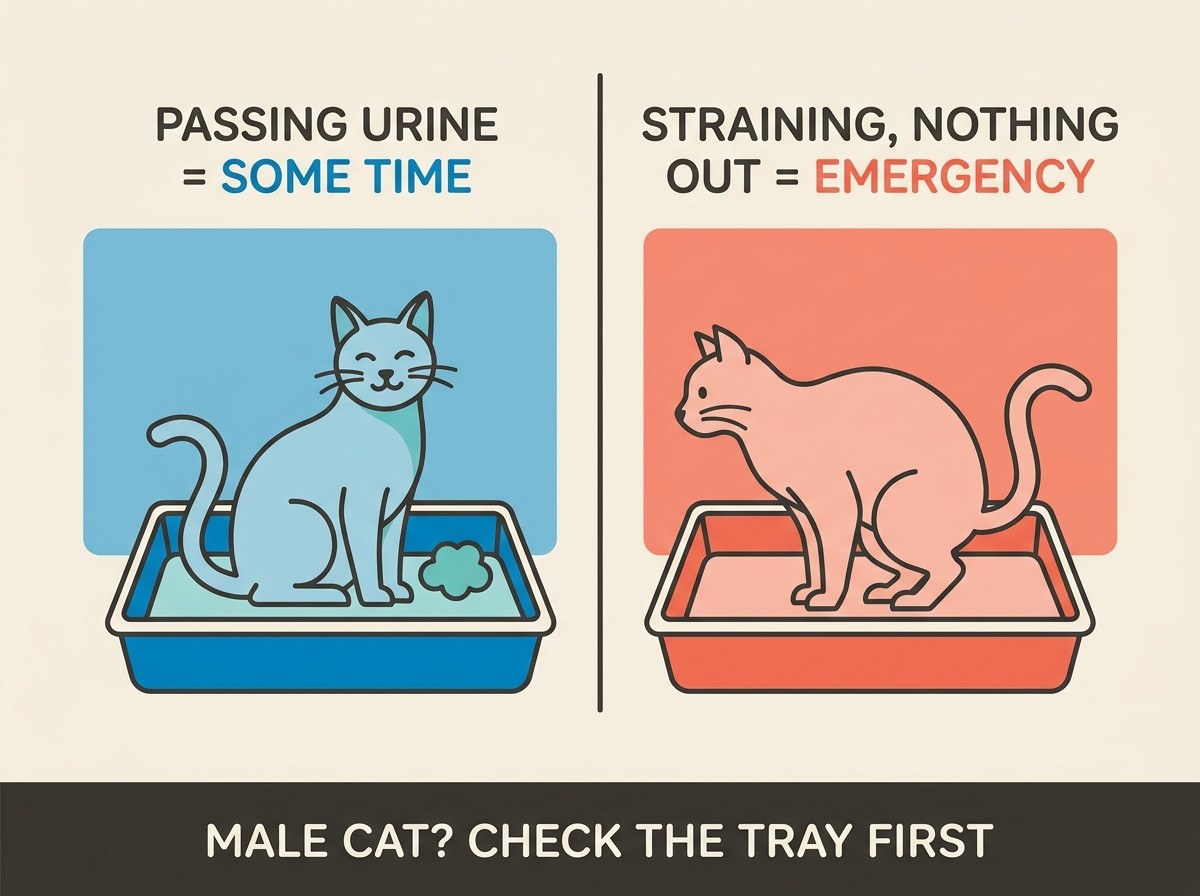
Before anything else: is your cat passing urine?
Check the tray first. This matters more than every other point on this page combined.
A cat with a flare who is still producing urine, even small amounts, has a sore bladder and some time. A male cat who is straining over and over and passing little or nothing is a different and far more dangerous situation. In a male cat, the same inflammation that causes a flare can swell and plug the narrow urethra so that no urine can get out at all. This is a urethral obstruction, and it's a true emergency. A fully blocked cat can die in less than 24 to 48 hours, because the backed-up urine poisons the blood and tips it into heart failure (Cornell Feline Health Center; AVMA). Male and neutered male cats are at far greater risk than females because their urethra is longer and narrower (Cornell Feline Health Center). And FIC is a leading cause of these blocks: in one case series of cats that obstructed, an idiopathic (FIC-type) cause accounted for just over half, with stones and gritty urethral plugs making up the rest (Today's Veterinary Practice).
So a male FIC cat is never just "having another flare" until you have confirmed urine is coming out.
Blocked-cat warning signs (go straight to a vet, tonight if needed)
If your cat, especially a male cat, shows any of these, treat it as an emergency and ring your vet or the out-of-hours service now. Do not wait until morning.
- Repeated trips to the tray with little or no urine produced
- Straining or crying in the tray, or crying when you lift him
- Restlessness, pacing or unable to settle
- Licking at the back end more than usual
- Being sick, going off food, or hiding away
- A hard, painful or distended belly
- Becoming wobbly, cold or collapsed (this is late and serious)
There's a genuinely reassuring side to this. A blocked cat who reaches the vet in time usually does very well. Survival to discharge after unblocking is well over 90% (Today's Veterinary Practice). The whole game is getting there in time. If you are unsure whether what you are seeing counts, run it through the [Blocked-Cat triage tool], and keep the [blocked-cat red-flags fridge card] somewhere visible. The full picture of what a block is and what happens at the vet is in [the blocked cat] and [what happens at the vet].
What actually helps in the first 48 hours
For a cat who is passing urine, this is where you can make a real difference while the flare settles.
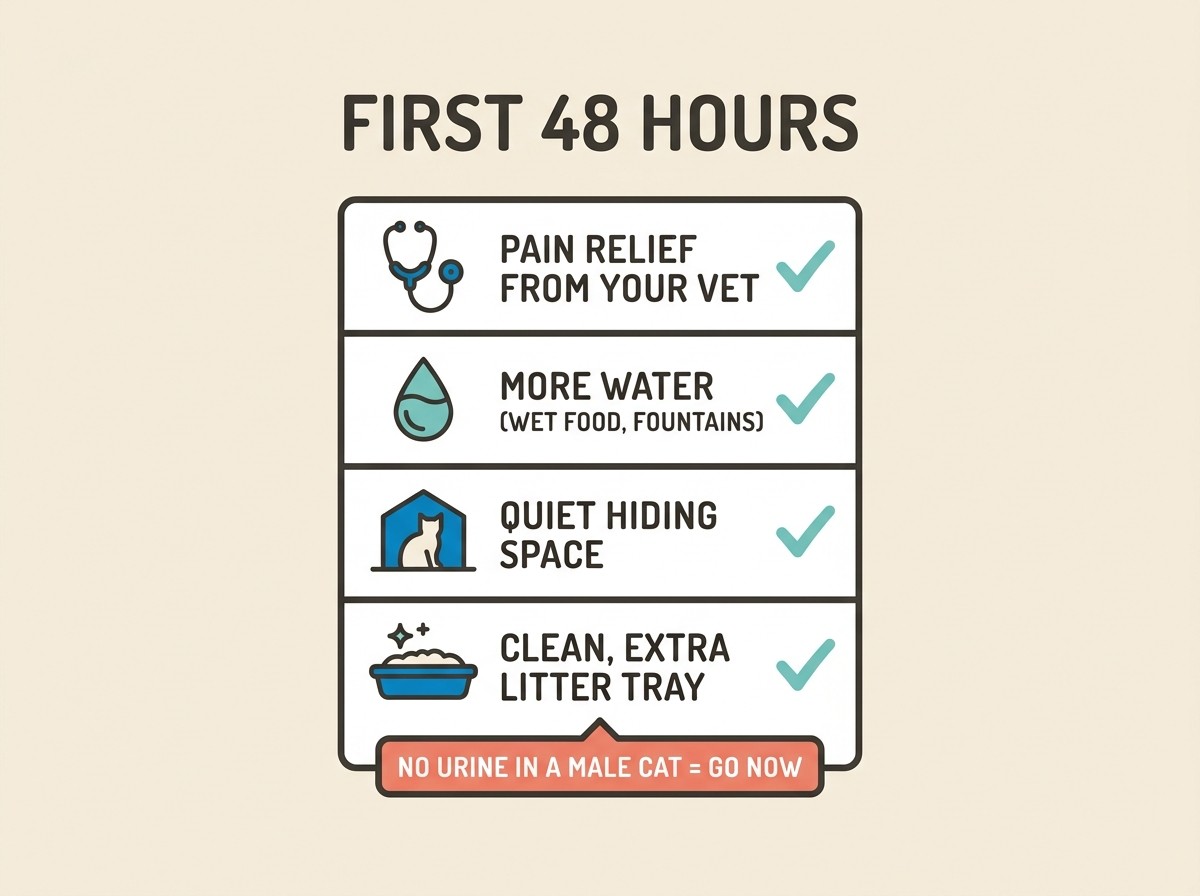
Pain relief is the priority, and it comes from your vet. FIC genuinely hurts, and the pain feeds the cycle: a sore bladder makes a stressed cat, and a stressed cat makes a sorer bladder. Breaking that loop early is the single most useful thing medicine offers in a flare. A commonly used option is buprenorphine, an opioid that's squirted onto the gums (the oral transmucosal route, where it's absorbed through the lining of the mouth rather than swallowed), is well tolerated in cats, and is typically given for a few days during an acute episode (He et al., 2022; Stathopoulou et al., 2018). Anti-inflammatories such as meloxicam are sometimes used, but the trial evidence for them in FIC is weak, with no clear benefit over a placebo, and they have to be used cautiously in cats because of the risk to the kidneys and gut (He et al., 2022). So ring your vet for pain relief at the start of a flare rather than toughing it out, and let them choose the drug.
Never reach for human painkillers. This isn't a cautious footnote, it's a life-or-death rule. Paracetamol is extremely toxic to cats, and even part of a single tablet can cause severe poisoning and death, because cats can't break it down safely (International Cat Care; MSD Veterinary Manual). Ibuprofen is dangerous too: cats are poisoned at roughly half the dose that affects a dog, and even a single tablet can be enough (VCA Animal Hospitals; MSD Veterinary Manual). There's no safe home painkiller for a cat. Cranberry products are no help either, because there's no infection for them to act on.
Get more water through the bladder. Diluting the urine soothes the inflamed lining and is real medicine, not a throwaway tip (He et al., 2022). In a flare, lean on wet food, add a little extra water to meals, and put fresh water in a few places away from the food and tray. The full set of tactics is in [water, diet and your cat's bladder], and you can track intake in the [FIC & Water tracker].
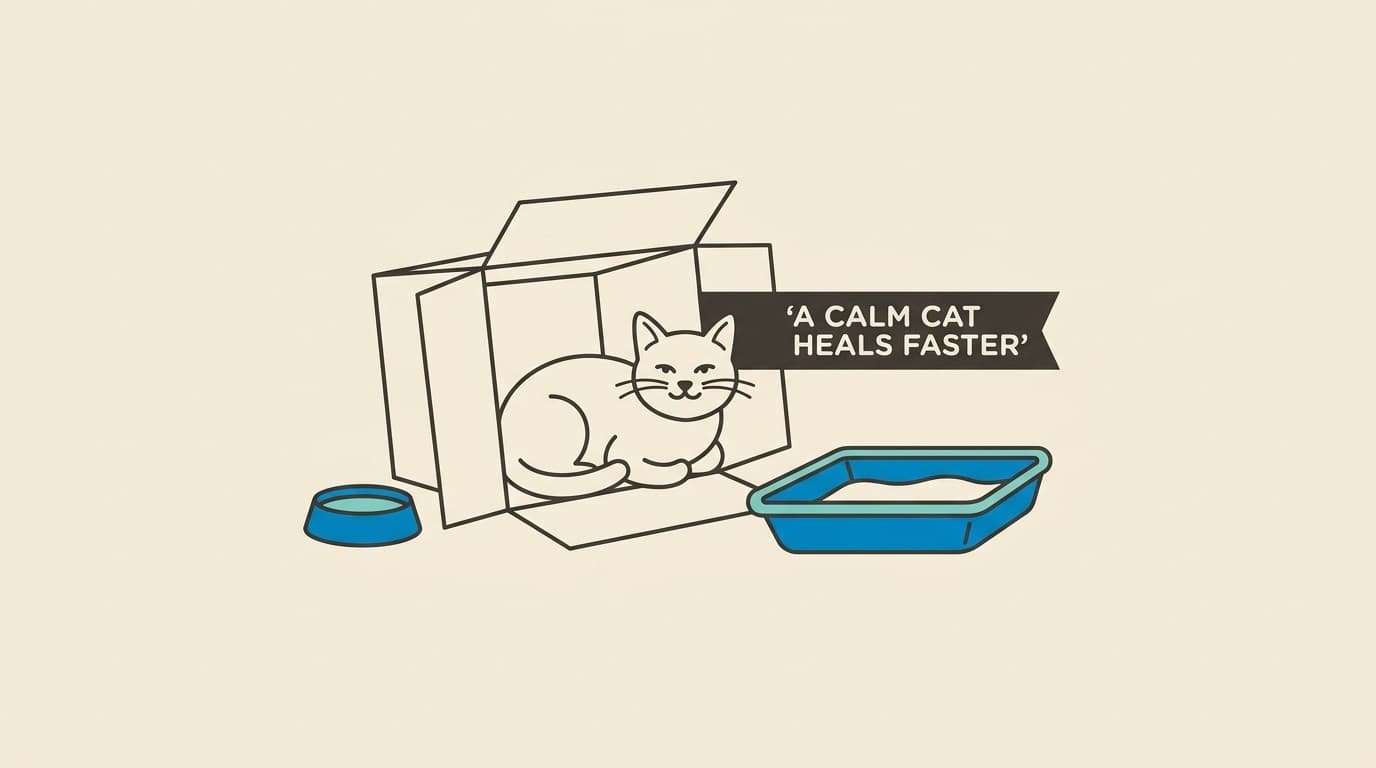
Lower the stress, fast. A flare is your cat telling you the dial is turned up. Give your cat somewhere quiet and safe to hide, a cardboard box on its side in a calm room is perfect, and ease off on whatever the trigger might have been: visitors, a new pet, building work, a change of routine, or a tom cat hanging around the garden (Today's Veterinary Nurse). Keep the litter trays spotless and add an extra one nearby so your cat never has to choose between holding on and a long walk to a dirty tray. The longer-term version of this is the MEMO approach in [managing FIC with MEMO].
Do not punish accidents. A cat weeing on the bathmat during a flare is not being naughty. It often means the tray has become associated with pain, or your cat is simply desperate. Telling them off adds stress and makes the next flare more likely.
When a flare needs the vet even without a block
Not every flare can be ridden out at home. Book a same-day appointment, even for a cat passing urine, if any of these apply:
- Your cat seems genuinely unwell, flat, off food, or in obvious distress
- The signs have not eased at all after 2 to 3 days, or are getting worse
- This is the first time you have seen these signs (FIC is a diagnosis of exclusion, so the first episode needs stones, crystals and a true infection ruled out, see [getting the diagnosis])
- There is a lot of fresh blood, rather than a pink tinge
- It is a male cat and you have any doubt at all about whether urine is coming out
Once the flare settles
Most flares fade within a week or so, and the day-to-day signs ease before that with good pain relief and a calm home. When this one passes, log what happened in the [FIC & Water tracker]: the date, how long it lasted, and anything that might have set it off. Over months, those notes are how you and your vet see flares becoming shorter, milder and further apart, which is the realistic and reachable goal with FIC. Stretching out the gaps is covered in [breaking the cycle], and the calming aids and medicines that help some recurrent cats are in [calming aids, pheromones and when medication has a role].
For now, the order of priorities in a flare stays simple: check that urine is coming out, ring your vet for pain relief, get water in, and bring the stress down. And if it is a male cat passing nothing, none of the rest matters. That is an emergency, and it is time to go.
References
- He C, Fan K, Hao Z, Tang N, Li G, Wang S. Prevalence, risk factors, pathophysiology, potential biomarkers and management of feline idiopathic cystitis: an update review. *Frontiers in Veterinary Science* 2022;9:900847.
- Taylor S, Boysen S, Buffington T, Chalhoub S, Defauw P, Delgado MM, Gunn-Moore DA, Korman R, et al. 2025 iCatCare consensus guidelines on the diagnosis and management of lower urinary tract diseases in cats. *Journal of Feline Medicine and Surgery* 2025;27(2).
- Cornell Feline Health Center. Feline lower urinary tract disease.
- American Veterinary Medical Association. Feline lower urinary tract disease (FLUTD).
- Today's Veterinary Practice. Feline urethral obstruction: diagnosis and management.
- International Cat Care. Paracetamol poisoning in cats.
- MSD Veterinary Manual. Toxicoses from human analgesics in animals.
- VCA Animal Hospitals. Ibuprofen poisoning in cats.
- Stathopoulou TR, Kouki M, Pypendop BH, Johnston A, Papadimitriou S, Pelligand L. Evaluation of analgesic effect and absorption of buprenorphine after buccal administration in cats with oral disease. *Journal of Feline Medicine and Surgery* 2018;20(8):704-710.
- Today's Veterinary Nurse. Nutrition and behavior therapy for feline idiopathic cystitis.
Keep track of how your pet is doing
The owners who cope best are the ones who notice changes early. A simple health log shows you what is working, and what is not, before the next vet visit.
Start tracking, freeYou're not doing this alone
Compare treatment journeys and talk to owners managing urinary health. Free to join.
Join PetsLikeMine