

Getting the Diagnosis: Why FIC Is What's Left When Everything Else Is Ruled Out
Alastair Greenway
BVM&S MRCVS
A lot of FIC stories share the same confusing moment. The vet runs the tests, comes back with "good news, nothing grew, no stones", and then in the same breath calls it idiopathic cystitis. If nothing showed up, how is that a diagnosis? It can land like a shrug, or like the tests failed and you're no closer to an answer.
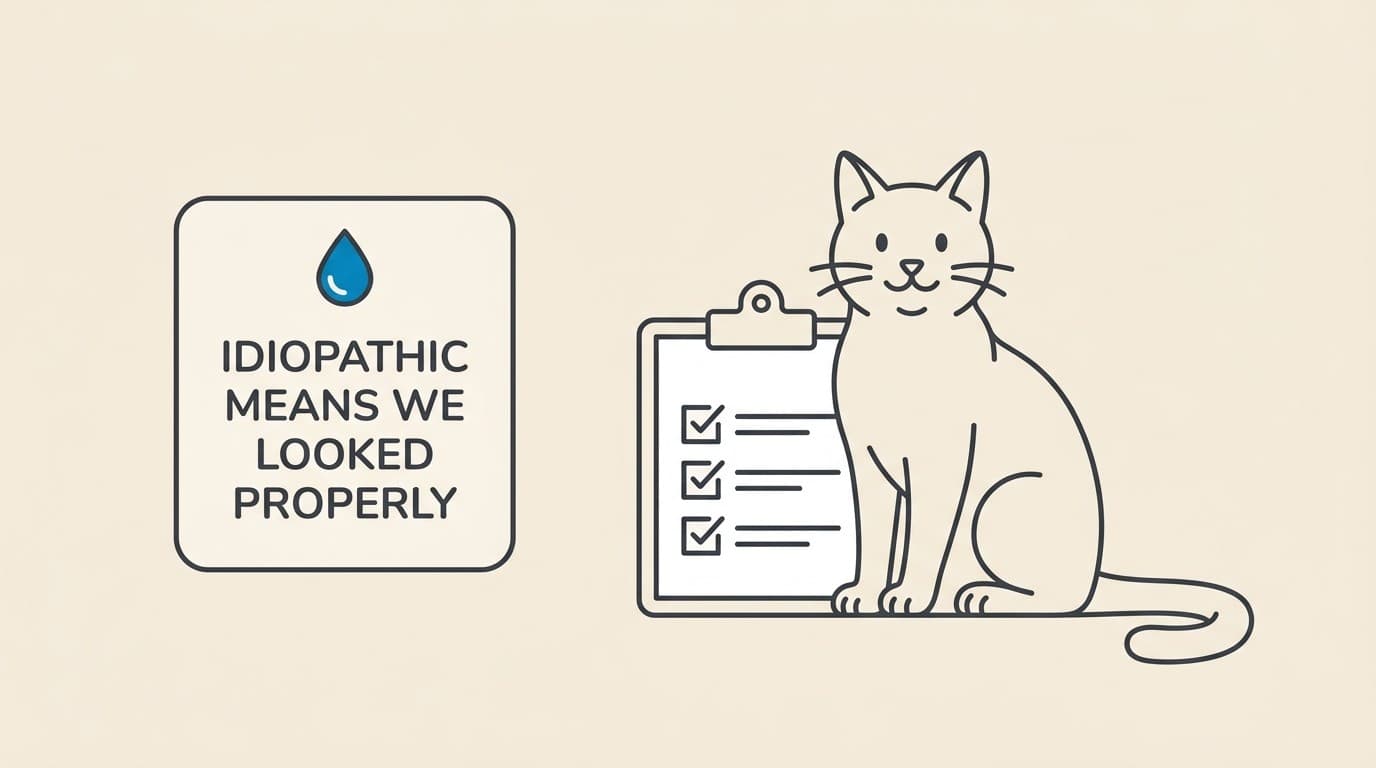
It's neither. Feline idiopathic cystitis is what's called a diagnosis of exclusion, and the word "idiopathic" doesn't mean "we gave up". It means "we looked properly, and the things we could see and treat aren't there". The 2025 international feline lower urinary tract guidelines put it plainly. There's no single test that lights up and says "this is FIC", so the diagnosis is reached by ruling out the other causes that look identical (Taylor et al., 2025; Today's Veterinary Practice). In a young cat with these signs, a clear urine result isn't a dead end. It's most of the answer.
Why the signs alone can't tell anyone what it is
The frustrating thing about lower urinary signs in cats is that they all look the same. A cat with idiopathic cystitis, one with bladder stones, one with a urethral plug and the rare cat with a genuine infection can all walk in straining, bleeding a little, going to the tray over and over and weeing in the wrong place. The signs tell your vet the bladder is upset. They don't tell anyone why.
That's the whole reason for testing. Your vet is sorting your cat into one of a handful of buckets, because the buckets are treated completely differently. Stones might need a special diet or surgery. A true infection needs the right antibiotic. Idiopathic cystitis needs neither, and instead needs more water and a calmer home (we cover the why of that in [feline idiopathic cystitis: why stress gives your cat a sore bladder]). Get the bucket wrong and you treat the wrong thing, which is how cats end up on repeat courses of antibiotics that were never going to help. Most cats with these signs turn out to be in the FIC bucket, and the testing is how your vet confirms it.
What the vet is actually ruling out, and how
The work-up is really a short checklist of "is it one of these instead?", roughly in the order it usually happens.
The history and a hands-on exam. Your vet asks about your cat's age, sex, how long the signs have lasted, whether they've happened before, and what your cat's world is like, then feels the tummy, partly to check the bladder isn't dangerously full and firm, which in a male cat is what turns a check-up into an emergency (more on that below). The story matters more than people expect, and points a stressed young indoor cat and a thin, thirsty senior down very different paths before a single test is run.
A urine test (the central one). This does most of the sorting. Your vet checks how concentrated the urine is, looks under the microscope for blood, protein and crystals, and looks for the signs of infection. In a cat with idiopathic cystitis, the urine typically shows inflammation and often a little blood, but no infection and no significant stones or crystals (Taylor et al., 2025). That "inflamed, but sterile and stone-free" picture isn't nothing. It's the fingerprint of FIC.
A urine culture, where it's warranted. A culture tries to grow bacteria from the urine over a few days, and it's the only way to truly confirm or rule out an infection. The most reliable sample comes straight from the bladder with a fine needle (a quick procedure called cystocentesis), so it isn't muddied by bacteria from the fur or the tray (Weese et al., 2019). Because a genuine bacterial infection is uncommon in otherwise-healthy young cats (well under one in ten), a culture isn't always run first time round, but it becomes important in older cats and in any cat whose signs keep coming back (Weese et al., 2019; Today's Veterinary Practice).
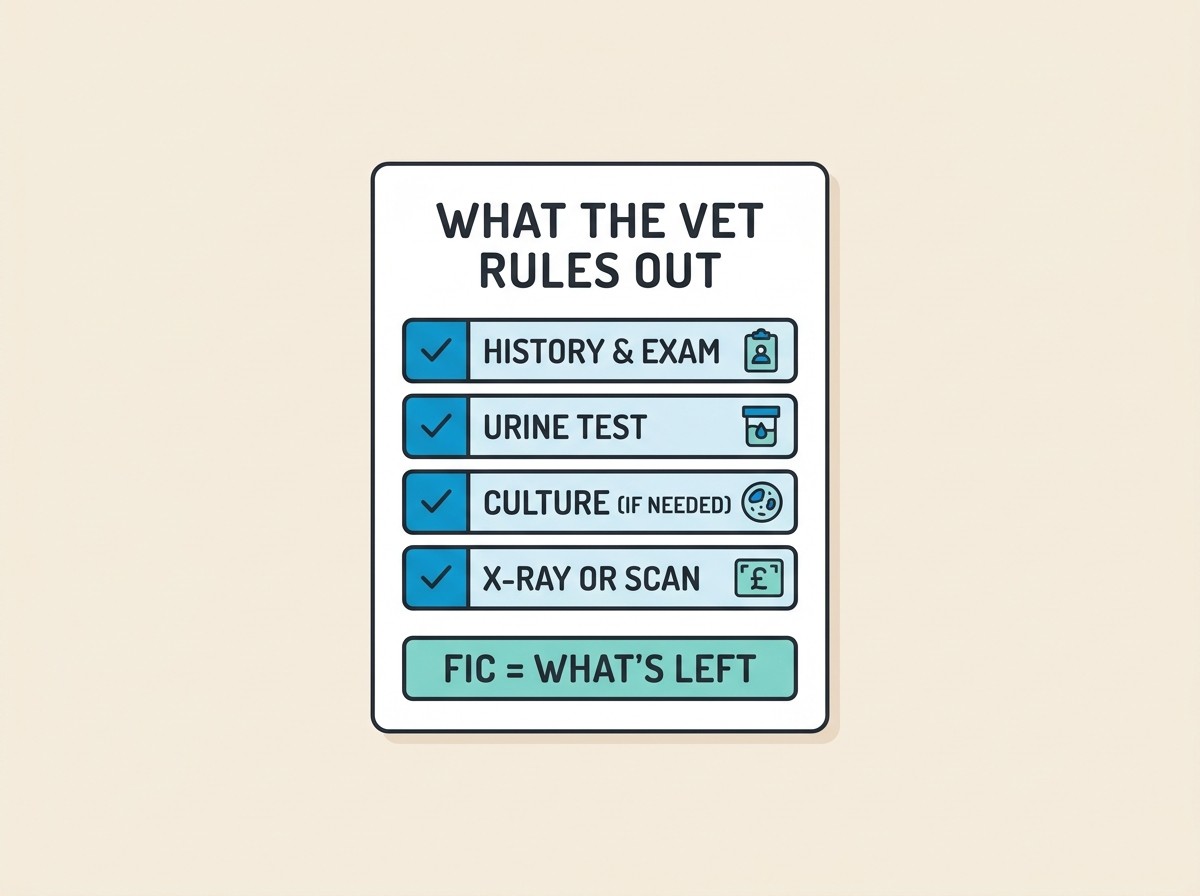
Imaging, to look for stones and anything structural. An x-ray catches most bladder stones, one of the commonest things to mimic FIC, and an ultrasound scan goes further, picking up stones that don't show on x-ray, thickened bladder walls, polyps and the rare growth. For a young cat with a first, mild, settling episode, a urine test and an x-ray are often enough; repeated or stubborn signs earn a scan (Taylor et al., 2025; Today's Veterinary Practice).
Bloodwork, when the picture calls for it. In an older cat, or one that's drinking more or losing weight, your vet will usually add a blood test to check the kidneys and screen for diabetes and an overactive thyroid, all of which change the odds (Taylor et al., 2025).
How age and sex tip the odds before the tests come back
Your vet is playing the probabilities from the moment your cat walks in, because the likely cause shifts with age. In cats under about ten, idiopathic cystitis is far and away the commonest cause of these signs at roughly 55 to 63% of cases, with stones next at around 15 to 22% and a genuine bacterial infection rare, often under 1%; most affected cats are first hit between about two and seven years old (Today's Veterinary Practice). Flip to a cat over ten and true infections become more likely, so a senior cat earns a wider work-up including the urine culture. "It's probably just FIC" is a younger cat's answer, not an older one's. It's also why a thirsty, weight-losing older cat belongs with our [kidney disease] guidance rather than here. The bladder is not the kidney, and that picture points higher up the system.
Sex matters too, less for the diagnosis than for the danger. A male cat's narrow urethra means the same inflammation and grit that causes a flare can plug it completely, so the work-up in a straining male cat always carries that question in the background.
When "idiopathic" doesn't stay idiopathic
Two things are worth being straight about, because they're where this diagnosis gets misunderstood. The first is that idiopathic cystitis tends to recur, and that's part of the pattern, not a sign the diagnosis was wrong. A flare usually settles within about five to ten days whether or not it's treated, and in one long German study around 58% of cats had more than one episode over the years that followed (Kaul et al., 2020; Kim et al., 2022). A "right" diagnosis and a recurring problem sit together fine, which is why the long game is fewer, milder flares rather than a one-off cure (we get into that in [breaking the cycle: stress, multi-cat tension and preventing the next flare]).
The second is more important, and it's why a good vet doesn't just rubber-stamp every recurrence as "the cystitis again". A cat can have a different cause behind different episodes. In that same study, fourteen cats (about 14%) turned out to have a different cause of their signs at different times, and the authors concluded that a thorough investigation should be done at every relapse because you cannot assume the cause is the same each time (Kaul et al., 2020). So if your cat's signs change, worsen, or come back after a long gap, that's a reason to look again, not to reach for the leftover medicine. Re-testing a settled, classic case every time usually isn't needed, but a change in pattern earns another look.
The one thing that can't wait for a diagnosis
Everything above is the calm, considered work-up of a cat who is uncomfortable but stable. One exception overrides all of it. If your cat, especially a male cat, is straining in the tray and passing little or nothing, crying, vomiting, hiding or off his food, that may be a urethral blockage, and a blocked cat is a life-threatening emergency that can be fatal within about a day. That doesn't wait for an appointment or a culture, and it is not constipation or "just his cystitis playing up". Ring your vet or the out-of-hours service now, tonight. If you're unsure, run him through the [Blocked-Cat triage], read [is this an emergency? the blocked-cat signs you must not wait on], and keep the [blocked-cat red-flags fridge card] somewhere visible.
For the stable cat, though, that "nothing grew, no stones" result is genuinely good news. The treatable mechanical causes have been excluded, and you're left with the manageable, mostly-free levers of more water and a calmer home. A good next step is to read [managing FIC with MEMO: the environment changes that actually work] and start logging flares and water on the [FIC & Water tracker], so that if the pattern ever shifts, you and your vet catch it early.
References
- Taylor S, Boysen S, Buffington T, et al. 2025 iCatCare consensus guidelines on the diagnosis and management of lower urinary tract diseases in cats. J Feline Med Surg. 2025;27(2):1098612X241309176.
- Diagnosing and Managing Feline Lower Urinary Tract Disease. Today's Veterinary Practice. (FIC 55-63%, urolithiasis 15-22%, urethral plugs 10-21%, UTI <1-8%, neoplasia <1-2% in cats under 10; FIC typical age 2-7 years; minimum work-up = urinalysis with sediment + survey radiography, culture and ultrasound added in cats >=10 years; FIC is a diagnosis of exclusion.)
- Weese JS, Blondeau J, Boothe D, et al. International Society for Companion Animal Infectious Diseases (ISCAID) guidelines for the diagnosis and management of bacterial urinary tract infections in dogs and cats. Vet J. 2019;247:8-25. (Primary bacterial UTI is rare in cats, particularly young cats; should not be diagnosed without a positive culture from a cystocentesis-collected sample.)
- Kaul E, Hartmann K, Reese S, Dorsch R. Recurrence rate and long-term course of cats with feline lower urinary tract disease. J Feline Med Surg. 2020;22(6):544-556. (Recurrence 58.1%; 14/101 cats [13.9%] had different FLUTD causes at different episodes; median observation 38 months; "a thorough investigation should be performed at every relapse as it cannot be presumed that the cause of FLUTD is the same at different episodes".)
- Kim Y, Kim H, Pfeiffer D, Brodbelt D. Prevalence, Risk Factors, Pathophysiology, Potential Biomarkers and Management of Feline Idiopathic Cystitis: An Update Review. Front Vet Sci. 2022;9:900847 / PMC9257190. (FIC 55-67% of FLUTD; diagnosis of exclusion; self-limiting episodes resolve in ~5-10 days irrespective of therapy.)
Keep track of how your pet is doing
The owners who cope best are the ones who notice changes early. A simple health log shows you what is working, and what is not, before the next vet visit.
Start tracking, freeYou're not doing this alone
Compare treatment journeys and talk to owners managing urinary health. Free to join.
Join PetsLikeMine