

Calming Aids, Pheromones and When Medication Has a Role
Alastair Greenway
BVM&S MRCVS
By the time most owners go looking for a calming product, they've already done the hard, unglamorous work. The litter trays are spread around the house, there's a water fountain, you've carved out hiding places, and you've tried to keep your cat's days calm and predictable. It has helped, mostly. But your cat still has the odd flare, and somewhere in a 3am tray-watch the question surfaces: isn't there a tablet for this? A spray? Something that just takes the edge off?
The answer is yes, sort of, with an important caveat. There are calming aids, supplements and, for some cats, prescription medicines that have a role in feline idiopathic cystitis (FIC). But none of them is a substitute for the environment work, and the evidence for most of them is thinner than the marketing suggests. This article walks through what each one actually does, what the science says, and where medication genuinely earns its place, so you can have a clear-eyed conversation with your vet rather than chasing the next promising-looking product.
A quick anchor before we go on. Most cats with lower urinary signs have FIC, a stress-linked, sterile problem rather than an infection (Taylor et al. 2025, iCatCare consensus guidelines). So everything here is aimed at calming an over-tuned stress system and soothing a sore bladder, not at killing bacteria. If you're new to that idea, start with our article on why FIC isn't an infection, then come back.
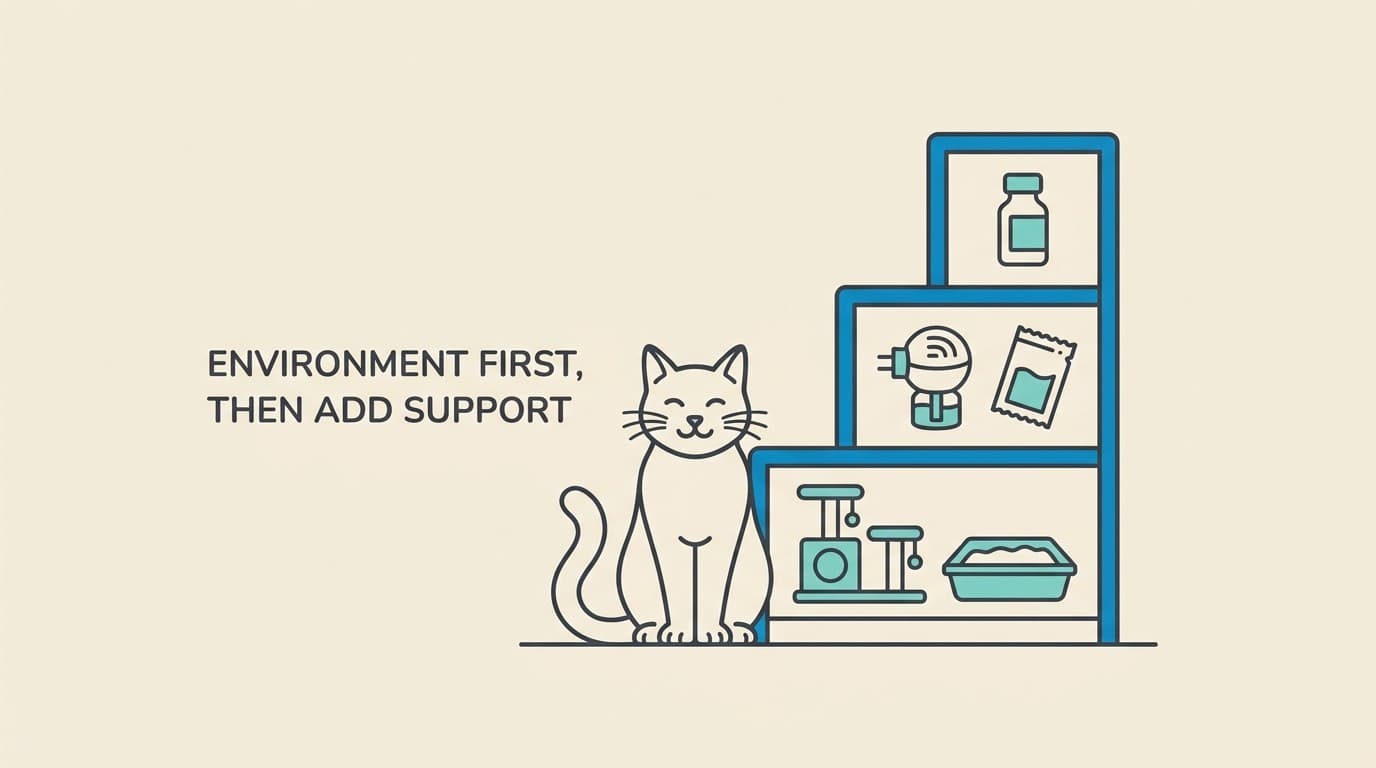
First principle: nothing replaces the environment
Before we talk about any product, here is the single most important point. Multimodal environmental modification (MEMO), the litter-tray rules, the water, the hiding places, the routine, is the only approach shown to reduce FIC flares across the board, and it's now the standard of care for the condition (Taylor et al. 2025). A 2025 systematic review of everything tried for recurrent FIC found genuinely encouraging evidence for MEMO and very little for most of the add-ons (Macleod et al. 2025, systematic review, NZ Vet J).
So think of everything below as a layer you add on top of a solid environment, never instead of it. As the guidelines put it, because FIC has so many moving parts, any single product is unlikely to work on its own, but it may help as part of the bigger picture (Taylor et al. 2025). If the environment isn't yet sorted, that's where your effort and money go first. Our MEMO guide and the FIC home-care checklist download are the place to start.
Pheromones: low-risk, modest evidence
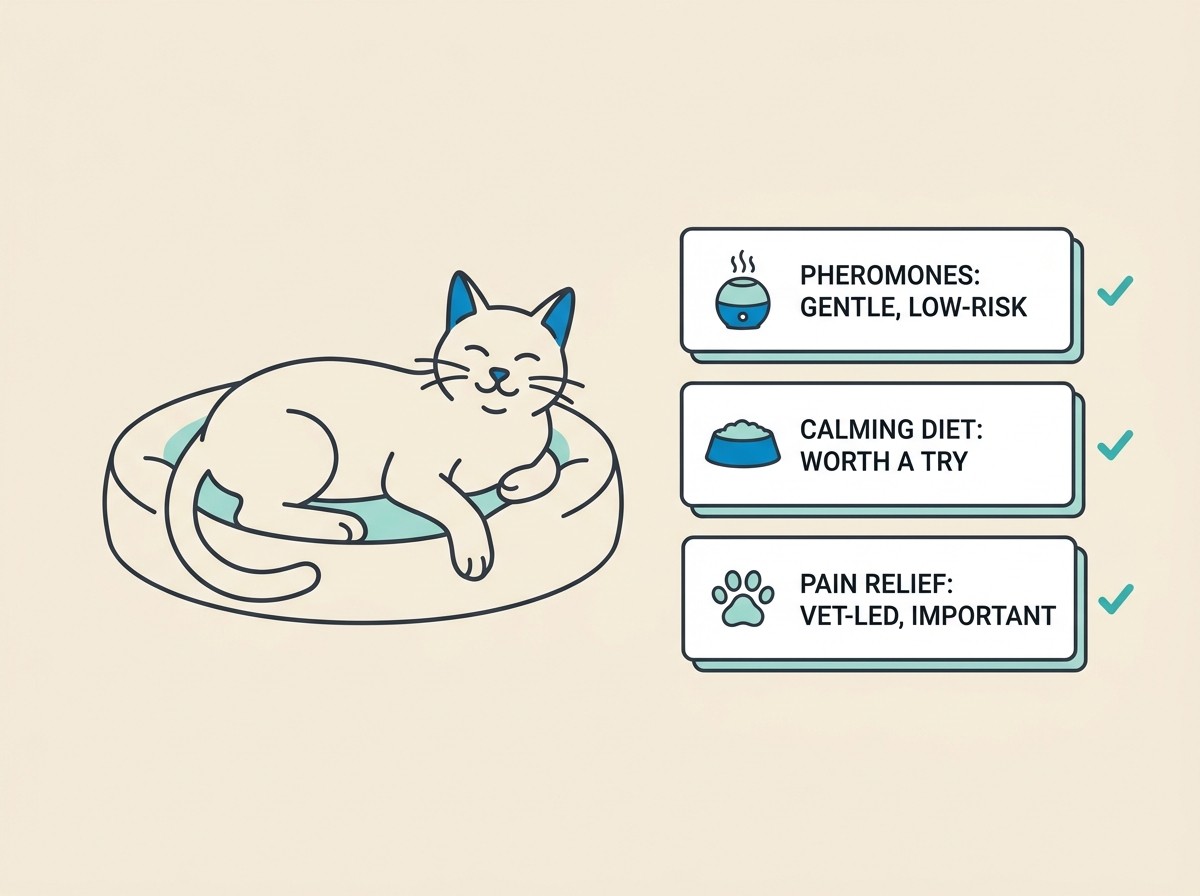
Synthetic feline facial pheromone (you'll know it as Feliway) is the most familiar calming aid, a plug-in diffuser or spray that mimics the "this place is safe" scent marks a content cat leaves when it rubs its cheeks on the furniture. The theory is lovely and the product is very safe. The evidence, though, is modest. The one published trial specifically in FIC cats was tiny, just 12 cats with 9 completing, and found no statistically significant difference between the pheromone and a dummy diffuser, though slightly more owners felt their cat seemed better on it (Gunn-Moore and Cameron 2004, J Feline Med Surg). The 2025 systematic review reached the same conclusion: little hard evidence to support it for FIC (Macleod et al. 2025).
That doesn't make it useless. Pheromones have better evidence for easing stress in other situations, such as a stay in hospital, and because they're cheap and carry essentially no downside, they're a reasonable thing to try as part of the wider plan. Just keep your expectations realistic: a diffuser is a gentle nudge, not a treatment, and it won't rescue a cat whose litter trays are wrong or whose home feels unsafe.
Calming supplements: alpha-casozepine and tryptophan
Two nutraceuticals come up again and again, often built into "stress" or "urinary stress" diets. Alpha-casozepine (sold as Zylkene, and the active ingredient in some calming foods) is a fragment of milk protein thought to act gently on the same calming receptors that anti-anxiety drugs target. In a placebo-controlled study of anxious cats, it produced a real improvement in fearfulness and anxiety scores over about eight weeks (Beata et al. 2007, J Vet Behav). L-tryptophan is an amino acid the body uses to make serotonin, the brain's "settle down" chemical, and it's often combined with alpha-casozepine in the same diet.
For FIC specifically, the evidence is encouraging but thin. The 2025 guidelines note that diets supplemented with alpha-casozepine and tryptophan have been studied in only small numbers of FIC cats, with fewer cats having a recurrence in one short, non-randomised study, and that there's no good long-term recurrence data yet (Taylor et al. 2025). In plain terms: there's a plausible mechanism and some promising early signs, the products are safe, and a stress-targeted urinary diet can be a sensible single change to try, especially as it doubles up with the water-and-dilution benefit of a wet urinary food (see our water and diet article). But it isn't a proven cure, and it works best as one piece of a calmer life, not as the whole plan.
A word on the wider supplement shelf, because the internet is full of it. Cranberry, D-mannose and other human "UTI" remedies target a bacterial infection your cat almost certainly doesn't have, so skip them. Glycosaminoglycan supplements (marketed to "repair" the bladder lining) sound logical, but controlled trials haven't shown them to beat a placebo for FIC, so they're not something to rely on (He et al. 2022, review, Frontiers in Veterinary Science).
Pain relief: the underrated one
This one often gets skipped, and shouldn't. FIC genuinely hurts, the bladder lining is inflamed and raw, and the 2025 guidelines are emphatic that it's a painful condition and pain relief should be prioritised (Taylor et al. 2025). Good analgesia during a flare doesn't just make your cat more comfortable, it helps break the stress-pain-stress loop that keeps the flare going.
This is firmly a vet's call, not a cupboard job. Never give your cat human painkillers: paracetamol is lethal to cats, and ibuprofen and aspirin are dangerous too. Your vet has cat-safe options, and may reach for one if your cat is sore. The bigger point is that if your cat is clearly in pain during a flare, asking your vet about pain relief is one of the most useful things you can do, and it's covered more fully in our article on the FIC flare and the first 48 hours.
When prescription medication has a role
For most cats, environment plus the gentle layers above is enough to make flares less frequent and less severe. But a smaller group has severe, frequent, miserable FIC that keeps flaring despite a genuinely good environment, and for those cats, prescription medication can change things. The key is sequence: these drugs come after the environment work, not instead of it, and they're reserved for the cats that truly need them (Taylor et al. 2025).
Amitriptyline is the best-studied option, an older medicine that calms anxiety, dampens pain signals and relaxes the bladder. The evidence has a clear, important shape. Used short-term during an acute flare, it doesn't help and may even bring the next flare on sooner, so it's the wrong tool for a one-off episode (Kraijer et al. 2003, J Feline Med Surg; Kruger et al. 2003, JAVMA). But used long-term in cats with severe recurrent disease that hasn't responded to anything else, it can genuinely help: in one study of 15 such cats, 9 were still free of signs after a year (Chew et al. 1998, JAVMA). It can cause drowsiness, weight gain and less grooming, needs monitoring, and must be tapered off slowly rather than stopped suddenly (He et al. 2022). So it's a considered, long-haul choice for the refractory cat, not a quick fix.
Fluoxetine (the cat version of Prozac) is sometimes used where anxiety is a big driver, and it's been shown to reduce stress-related urine spraying, though it can occasionally cause urine retention, which needs watching in a cat with urinary disease (Taylor et al. 2025).
Gabapentin deserves a mention because it's used a lot. It's excellent for taking the fear out of vet visits and car journeys, and a single dose before an appointment measurably lowers stress in anxious cats (van Haaften et al. 2017, JAVMA). On the strength of that, and its pain-relieving effect, most vets reach for it in FIC too, around three-quarters use it for flares (Krause et al. 2024, J Feline Med Surg). The caveat is that no study has yet tested gabapentin specifically for FIC, so it's used on good reasoning rather than direct proof. That's fine, plenty of sensible medicine works that way, but it's worth knowing the difference when you discuss it.
One thread runs through all of these: behaviour medicines work best in parallel with the environment changes, and for the trickier cats it's well worth getting a veterinary behaviourist involved to tailor the plan (Taylor et al. 2025). Medication that quietens a cat's anxiety while you keep improving its world is doing exactly the right job.
A sensible order to try things
If you're staring at all of this wondering where to begin, here's a reasonable sequence to discuss with your vet. Get the environment genuinely right first, that's the foundation and the bit with the best evidence. Add the low-risk layers next: a pheromone diffuser, perhaps a calming urinary diet, and proper pain relief during flares. If, despite all that, your cat is still having frequent, severe episodes, that's the point at which prescription medication earns its place, with your vet, and ideally a behaviourist, choosing the right drug for your particular cat.
None of this is a cure, and it's worth saying again that this isn't your fault. FIC is a sensitive cat in an imperfect world, and your job isn't to fix it overnight but to stack the odds, calmer environment, more water, less pain, and the right support, so the flares come less often and matter less when they do. Log them on the FIC & Water tracker and you'll start to see that happening, which is its own quiet reassurance at 3am.
If your cat is a male and you ever see him straining and passing little or nothing, stop reading and treat it as an emergency, that can be a life-threatening blockage rather than a flare (see our blocked-cat emergency article and the Blocked-Cat triage tool). For everything else, you're playing a long game, and it's one you can win.
References
- Taylor S, Boysen S, Buffington T, Chalhoub S, Defauw P, Delgado MM, Gunn-Moore D, Korman R, et al. 2025 iCatCare consensus guidelines on the diagnosis and management of lower urinary tract diseases in cats. *Journal of Feline Medicine and Surgery*. 2025. doi:10.1177/1098612X241309176.
- Macleod B, Laven LJ, Laven RA, Hill KE. Understanding the current evidence base for the commonly recommended management strategies for recurrent feline idiopathic cystitis: a systematic review. *New Zealand Veterinary Journal*. 2025;73(4):233-245. doi:10.1080/00480169.2025.2477542.
- Gunn-Moore DA, Cameron ME. A pilot study using synthetic feline facial pheromone for the management of feline idiopathic cystitis. *Journal of Feline Medicine and Surgery*. 2004;6(3):133-138. doi:10.1016/j.jfms.2004.01.006.
- Beata C, Beaumont-Graff E, Diaz C, et al. Effect of alpha-casozepine (Zylkene) on anxiety in cats. *Journal of Veterinary Behavior*. 2007;2(2):40-46. doi:10.1016/j.jveb.2007.02.002.
- Chew DJ, Buffington CA, Kendall MS, DiBartola SP, Woodworth BE. Amitriptyline treatment for severe recurrent idiopathic cystitis in cats. *Journal of the American Veterinary Medical Association*. 1998;213(9):1282-1286.
- Kraijer M, Fink-Gremmels J, Nickel RF. The short-term clinical efficacy of amitriptyline in the management of idiopathic feline lower urinary tract disease: a controlled clinical study. *Journal of Feline Medicine and Surgery*. 2003;5(3):191-196. doi:10.1016/S1098-612X(03)00004-4.
- Kruger JM, Conway TS, Kaneene JB, Perry RL, Hagenlocker E, Golombek A, Stuhler J. Randomized controlled trial of the efficacy of short-term amitriptyline administration for treatment of acute, nonobstructive, idiopathic lower urinary tract disease in cats. *Journal of the American Veterinary Medical Association*. 2003;222(6):749-758.
- van Haaften KA, Forsythe LRE, Stelow EA, Bain MJ. Effects of a single preappointment dose of gabapentin on signs of stress in cats during transportation and veterinary examination. *Journal of the American Veterinary Medical Association*. 2017;251(10):1175-1181.
- Krause LR, Li E, Lilly ML, et al. Survey of veterinarians in the USA to evaluate trends in the treatment approach for non-obstructive feline idiopathic cystitis. *Journal of Feline Medicine and Surgery*. 2024;26(8). doi:10.1177/1098612X241260716.
- He C, Fan K, Hao Z, Tang N, Li G, Wang S. Prevalence, risk factors, pathophysiology, potential biomarkers and management of feline idiopathic cystitis: an update review. *Frontiers in Veterinary Science*. 2022;9:900847. doi:10.3389/fvets.2022.900847.
Keep track of how your pet is doing
The owners who cope best are the ones who notice changes early. A simple health log shows you what is working, and what is not, before the next vet visit.
Start tracking, freeYou're not doing this alone
Compare treatment journeys and talk to owners managing urinary health. Free to join.
Join PetsLikeMine