

FHO or Total Hip Replacement: How Vets Choose Between Them
Alastair Greenway
BVM&S MRCVS
Once a young dog has moved past the windows for preventive hip surgery, or has already developed arthritis in the joint, two surgical routes usually remain on the table: total hip replacement and femoral head ostectomy. They sound like two answers to the same problem, but they aim at quite different goals, and this guide is about choosing wisely between them.
If your dog is still young enough that prevention is on the table, or you want the full mechanics of each operation, please read the companion piece first. Our deep-dive guide to hip dysplasia and its surgical options explains what the condition is, why a loose joint drives arthritis at two distinct life stages, how it is diagnosed, and exactly how each procedure works step by step. This article assumes you already understand the basics and focuses on one thing only: how a surgeon, sitting with you and the radiographs, decides which of these two operations suits your particular dog.
What each operation actually does
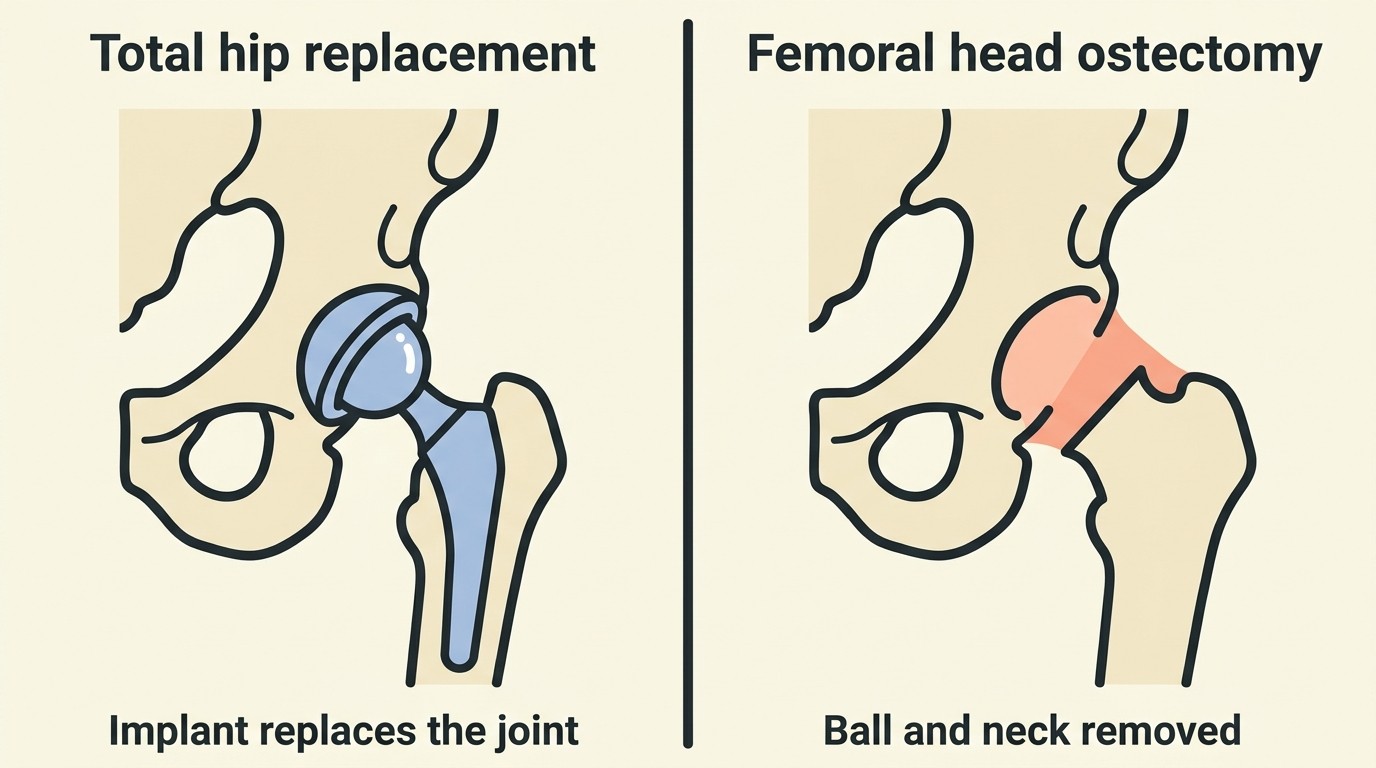
Total hip replacement (THR) does what the name suggests. The surgeon removes the diseased ball and socket and replaces both with manufactured implants, typically metal and a hard-wearing polyethylene (plastic) cup. The American College of Veterinary Surgeons describes the goal as restoring near-normal, comfortable range of motion, and the evidence base behind it is the strongest of any hip dysplasia procedure. When it goes well, a THR aims to give a dog a hip that is, for practical purposes, a healthy hip again.
Femoral head ostectomy (FHO), sometimes written as femoral head and neck ostectomy, takes a very different approach. Rather than rebuilding the joint, the surgeon removes the femoral head (the ball) altogether. The painful bone-on-bone contact is gone, and over the following weeks the body lays down fibrous tissue where the joint used to be, forming what vets call a false joint or pseudarthrosis. The result can be truly pain-free, but the mechanics are altered and the function is less predictable than a replacement. Think of FHO as a salvage procedure: a reliable way to take pain out of a joint when rebuilding it is not the right choice.
We do not re-tread the surgical mechanics here because the companion guide covers them thoroughly. What matters for your decision is that THR aims to restore a near-normal joint, while FHO removes the joint and asks the body to compensate.
What really drives the decision
It would be tidy if one operation were simply better. It is not that simple, and any surgeon who tells you otherwise is overselling. Here is how the real factors stack up, drawn from the orthopaedic literature and the way specialists frame the choice in clinic.
Your dog's size and weight. This is the single biggest lever. THR is generally the preferred route for larger, heavier dogs, which is precisely the population most affected by hip dysplasia. FHO, by contrast, has traditionally been considered most reliable in smaller, lighter dogs. The American College of Veterinary Surgeons gives a rough working threshold of dogs under around 27 to 32 kg (the page cites under 60 to 70 lbs) as the better-suited FHO candidates, and Cornell's Riney Canine Health Center notes outcomes are particularly good in dogs under roughly 18 kg (under 40 lbs). The picture has shifted, though: more recent literature, as summarised by Today's Veterinary Practice, reports that some larger dogs do well after FHO too, where older studies were more pessimistic about dogs over 20 kg. But a heavier dog asking a false joint to carry it is a bigger ask than a replaced joint doing the same job, which is why size still tips most large-breed cases towards THR when it is affordable and available.
Your dog's activity demands. A working gundog, an agility prospect, or simply a young, athletic dog that lives to run is a different proposition from a steady companion that pootles round the park. THR is designed to support an active life. The American College of Veterinary Surgeons is blunt that FHO dogs should keep to a relatively restricted lifestyle of lead walks and house-and-garden activity, and are not well suited to being athletic dogs who hunt, do agility or run distances with their owners. For a young large-breed dog whose owners want an active future, that distinction often settles it.
Your budget and insurance. There is no kind way to say this: the two operations sit in very different price brackets, and we set out the numbers below. For many families this is decisive, and that is entirely legitimate. A pain-free dog after an affordable FHO is a far better outcome than a THR that never happens.
Whether you can reach a specialist centre. THR is a precision implant procedure performed only at specialist orthopaedic referral centres by surgeons who do it regularly. FHO is more widely available and can be performed competently in many first-opinion and referral settings. If the nearest centre offering THR is hours away, or waiting lists are long and your dog is in pain now, practical access becomes part of the conversation.
Complicating factors in your particular dog. Existing severe muscle wastage, certain shapes of the upper femur, previous surgery on the joint, body condition, temperament and how realistically you can manage a structured recovery all feed in. Your surgeon weighs these on the radiographs and on the examination table, which is why a guide like this can frame the choice but never make it for you.

Recovery and outcomes, without the spin
This is where owners are most often misled, in both directions, so it is worth being precise.
FHO outcomes depend heavily on you. The operation itself is the easy part. What turns a removed femoral head into a comfortable, functional false joint is diligent rehabilitation: early and consistent use of the limb, controlled lead exercise, physiotherapy and, above all, keeping weight off the joint by keeping your dog lean. The American College of Veterinary Surgeons notes that it commonly takes six weeks or longer before owners see clear improvement, and that many dogs retain some degree of lameness even when they are comfortable. The picture from the literature is more two-sided than owners expect. Owner satisfaction after FHO is routinely high, often above 90 per cent, yet objective gait analysis tells a more sobering story, with Today's Veterinary Practice citing figures where only around 20 per cent of FHO limbs achieved satisfactory objective function and around 42 per cent were unsatisfactory on those stricter measures. In plain terms: most owners are pleased, but the leg rarely works exactly like a normal leg, and a dog that does not get committed rehab tends to do worse.
THR aims higher and usually reaches it, but it is major surgery. A total hip replacement carries a quoted success rate in the region of 90 to 95 per cent, and pain-free outcomes across published series cluster in the 91 to 100 per cent range. That is an excellent record. It comes with a structured, disciplined recovery: the American College of Veterinary Surgeons describes roughly eight weeks of restricted activity, with healing confirmed by examination and repeat imaging before normal life resumes. And it carries a small but real complication rate. Reported figures sit somewhere between 5 and 22 per cent depending on the series and how complications are counted. A large multicentre survey run through the British Veterinary Orthopaedic Association registry recorded a surgeon-reported complication rate of 9.4 per cent and an owner-reported rate nearer 20 per cent, while 82 per cent of owners rated the outcome as very good. The possible complications, dislocation of the new hip, infection, loosening of the implant over time, nerve injury or fracture of the femur, are uncommon individually but serious when they happen, and they are part of informed consent.
It is also worth knowing what the head-to-head evidence does and does not say. A 2022 Veterinary Evidence knowledge summary set out to answer whether dogs are in less pain after THR than after FHO, and concluded that the current literature is too limited and too inconsistent in how it measures pain to declare a clear winner on pain alone. The fair reading is that both operations can deliver a pain-free dog; they differ most in function, predictability and the demands they place on recovery, not necessarily in whether the joint hurts afterwards.
What it costs
UK prices vary by centre, by the size of your dog and by what the quote includes, so treat these as ranges to discuss locally, not fixed prices.
Total hip replacement is the larger investment. As a guide, the Royal Veterinary College quotes around £6,500 per hip for an average-sized dog including initial assessment and imaging, and other specialist centres such as Moores Orthopaedic Clinic quote from roughly £7,400, with figures across UK referral centres broadly landing in the region of £6,500 to £8,500 per hip. Quotes usually fold in the consultation, radiographs, surgery, a short hospital stay and a course of post-operative medication, but always check.
Femoral head ostectomy is considerably cheaper, with UK quotes commonly in the region of £1,500 to £3,000 per hip depending on your dog's size and where it is done. For many families, that gap is the deciding factor, and there is no shame in it.
If your dog is insured, check your policy limits carefully, including any per-condition or annual caps and whether hip dysplasia is excluded as pre-existing if signs began before cover started. These decisions are easier made before you are standing at the consulting room desk.
One more point affects the maths. Hip dysplasia is very often bilateral, meaning both hips are affected, even if only one is causing trouble today. Many dogs ultimately need the second hip addressed as well, so it is sensible to plan and budget as though both hips may eventually be involved rather than assuming a single operation will be the end of it. There is one important caveat your surgeon will raise: revising a disappointing FHO to a THR later is generally discouraged, because operating on a hip that has already had its femoral head removed makes the replacement technically harder and raises the complication risk. That is one reason the first choice deserves careful thought rather than treating FHO as a cheap trial run.
How a surgeon weighs it, and what to ask
When a good orthopaedic surgeon sits with you, they are balancing one question: can we justify and afford rebuilding this joint, or is the wiser path to take the pain out and rehabilitate hard? A large, active young dog with supportive insurance and a specialist centre within reach leans strongly towards THR. A smaller, lighter dog, a tighter budget, or limited access to a referral centre makes FHO a very reasonable and often excellent choice, provided everyone commits to the rehabilitation. There is rarely a single right answer, only the right answer for your dog and your circumstances.
Worth asking your vet or orthopaedic specialist:
- Given my dog's size, weight and activity, which operation do you actually recommend, and why?
- How many of this procedure do you (or the centre you would refer me to) perform each year?
- What does the full cost cover, and what happens if there is a complication?
- What does the recovery ask of me, week by week, and can I realistically commit to it?
- Are both hips likely to need surgery, and if so, over what timeframe?
- What does keeping my dog lean and well-conditioned change about the outcome?
That last point matters more than any other single thing you can control. Whichever route you choose, a lean, well-muscled dog does better, which is one reason our guide to conservative management for a young dysplastic dog is worth reading alongside this one, even if surgery is the plan. And if you are uncertain whether your dog has truly passed the preventive windows, our guide to surgery options by age will help you place your dog on that timeline before you commit to either of these routes.
References
- American College of Veterinary Surgeons. Canine Hip Dysplasia. ACVS Small Animal Topics. 2024.
- Today's Veterinary Practice. Hip Dysplasia: Navigating Surgical Options and Timing. Today's Veterinary Practice. 2022.
- Cornell University College of Veterinary Medicine, Riney Canine Health Center. Canine Hip Dysplasia (CHD). Cornell University. 2023.
- Veterinary Evidence. Are dogs with hip dysplasia in less pain after total hip replacement than femoral head ostectomy? Veterinary Evidence. 2022.
- Forster KE, Wills A, Torrington AM, et al. Complications and owner assessment of canine total hip replacement: a multicenter internet based survey. Veterinary Surgery. 2012.
- British Veterinary Association. Hip Dysplasia Scheme (BVA/Kennel Club). BVA Canine Health Schemes. 2024.
- Royal Veterinary College. Hip Replacements: Veterinary Orthopaedic Surgery. RVC Small Animal Referrals. 2025.
Keep track of how your pet is doing
The owners who cope best are the ones who notice changes early. A simple health log shows you what is working, and what is not, before the next vet visit.
Start tracking, freeYou're not doing this alone
Compare treatment journeys and talk to owners managing hip dysplasia. Free to join.
Join PetsLikeMine