

Feline Idiopathic Cystitis: Why Stress Gives Your Cat a Sore Bladder
Alastair Greenway
BVM&S MRCVS
A cat that keeps getting "urine infections" the antibiotics never quite fix is one of the odder problems we see, because the usual logic doesn't apply. There is no infection to treat. The vet starts talking about stress, litter trays and water bowls rather than handing over a pill. And it keeps coming back. It is genuinely confusing, and after a few rounds it is exhausting too.
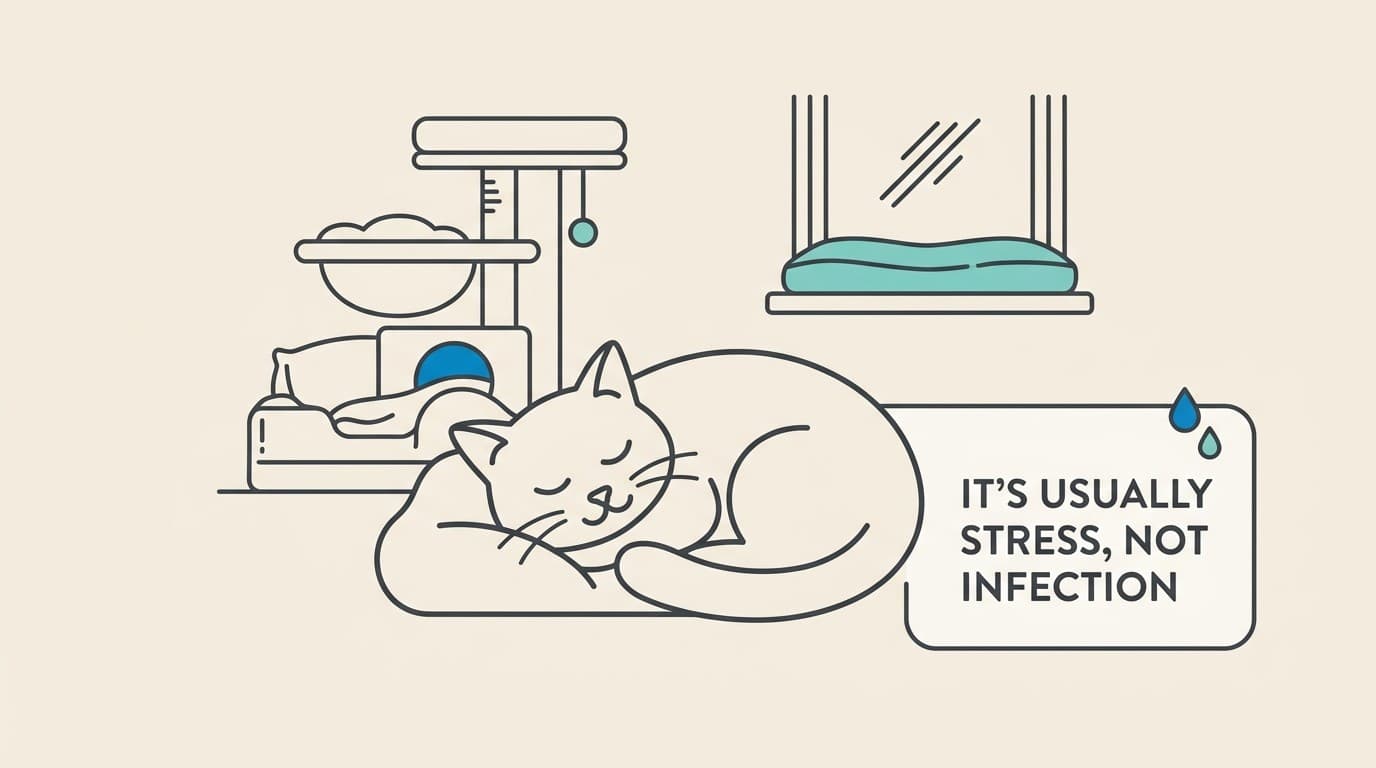
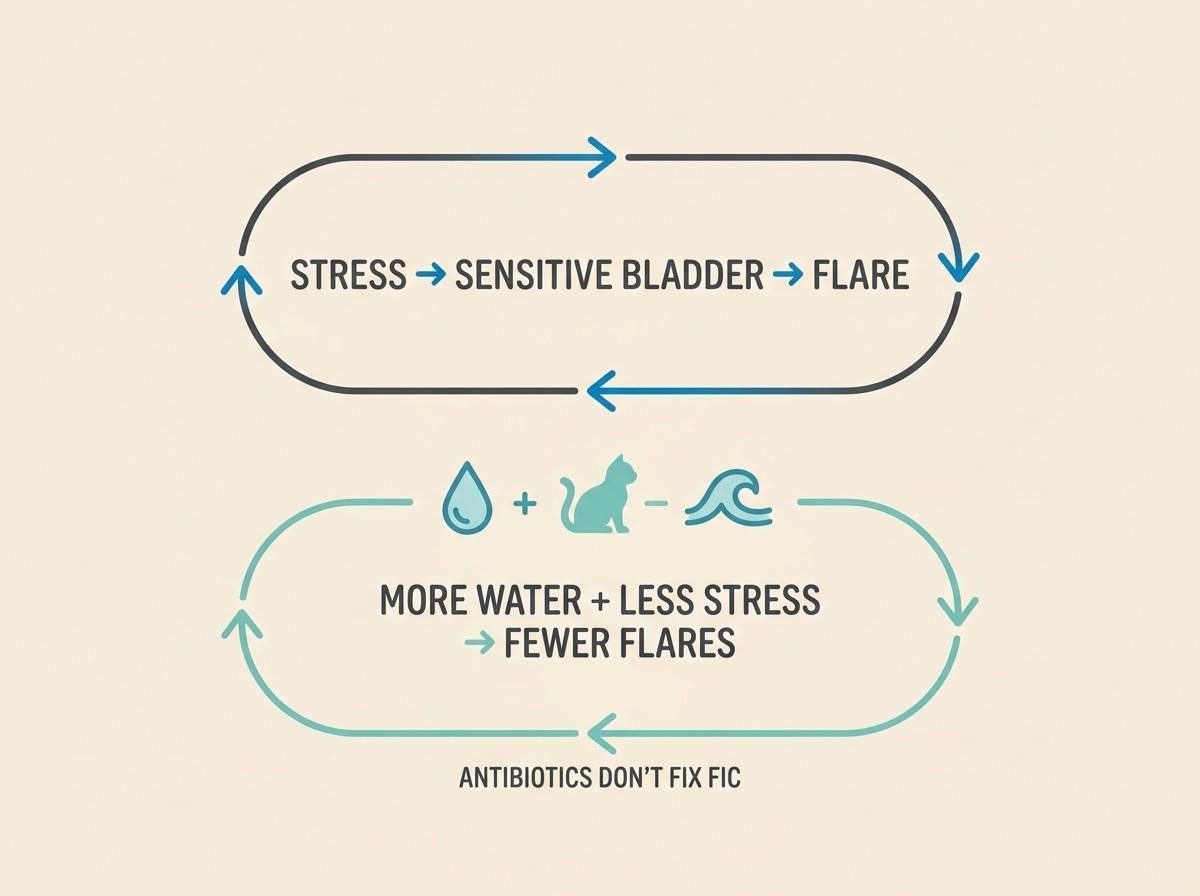
Feline idiopathic cystitis (FIC for short) is the single commonest reason a cat shows lower urinary signs, and despite looking exactly like a urine infection, it usually isn't one. There are no bacteria to kill. The lining of the bladder is inflamed and sore, and the thing that tips it over is stress. So the fix isn't antibiotics. It's reducing what your cat finds stressful and getting more water through the bladder.
That is not a soft, hand-waving answer. It is the answer with the best evidence behind it, and once you understand why, the whole thing starts to make sense.
How common is it, and why it gets mislabelled
Lower urinary signs affect roughly 1 to 3% of cats a year and are among the commonest reasons a cat is taken to the vet. Depending on the study, somewhere between about 4.5 and 8% of cats seen in general practice are there for these urinary signs (Heseltine, 2019). When vets work out what is actually causing them in cats under about ten years old, idiopathic cystitis comes out on top: most studies put it at somewhere between 55 and 65% of cases, well ahead of bladder stones and urethral plugs (Heseltine, 2019; He et al., 2022). In other words, most cats with lower urinary signs have idiopathic cystitis, a stress-linked, sterile problem, not an infection.
The reason it gets called a "UTI" so often is simple. The signs are identical to what you would imagine an infection looks like: straining, blood in the wee, going over and over to the tray and producing only a little, weeing outside the tray, and obvious discomfort. So the cat gets a course of antibiotics, the flare settles a few days later (because these flares mostly settle on their own), everyone assumes the antibiotics worked, and then it comes back. The antibiotics were never doing anything. There was nothing for them to treat.
What's actually going on: Pandora syndrome, plainly
The surprising bit is that the problem isn't really a bladder problem at all.
In susceptible cats, the body's stress-response system is wound a little too tight, set that way early in life, sometimes before they were even born (He et al., 2022). One knock-on effect is that the protective lining of the bladder is thinner and more fragile, so the bladder wall is more easily irritated and the nerves in it are more easily triggered. When something stressful happens, a house move, a new cat, building work, a change in routine, even boredom, that over-tuned stress system fires, and in these cats it shows up as a painful, inflamed bladder.
Because the underlying sensitivity is whole-cat rather than bladder-only, the same cats often flare in other ways too. The vets who first mapped this out, led by Tony Buffington, proposed calling it "Pandora syndrome" precisely because it isn't confined to one organ (Buffington, Westropp and Chew, 2014). Studies have shown that cats prone to idiopathic cystitis also tend to have more tummy upsets, vomiting, over-grooming or skin flares, and behaviour changes, and that these "sickness behaviours" flare up when something unsettling happens in their world (Stella, Lord and Buffington, 2011). It is one sensitivity that surfaces in several places. The bladder is just where you notice it.
Why it looks so like an infection (and how vets tell the difference)
The signs that send you to the vet are doing their best to fool everyone. Most cats in a flare show some mix of blood in the urine, straining, frequent tiny wees and weeing in the wrong place. In one detailed series, around 83% had visible blood and the great majority were straining and going far too often (Defauw et al., 2011). None of that, on its own, tells you whether there are bacteria involved.
What does tell you is a urine test. In a young or middle-aged cat with these signs, the urine usually shows inflammation and often a little blood, but no infection and no significant crystals or stones. That "nothing grew, no stones" result isn't a dead end or a failed test. It is the diagnosis. Idiopathic cystitis is what's left once the treatable mechanical causes, stones and a genuine bacterial infection, have been ruled out, which is exactly why your vet wants a urine sample before reaching for anything. We cover what that work-up looks like, and why "idiopathic" means "we looked properly", in [getting the diagnosis: why FIC is what's left when everything else is ruled out].
The reassuring news, and the realistic news
The genuinely reassuring part comes first. Most FIC flares settle within about five to seven days, and they tend to do that whether or not the cat has had any specific treatment (He et al., 2022; Grauer, 2013). In one detailed study the typical flare lasted around six and a half days (Defauw et al., 2011). So a flare, in itself, is usually self-limiting. Pain relief from your vet makes that week far more comfortable and is well worth having, but the bladder lining does repair itself.
The realistic part is that idiopathic cystitis tends to come back. In that same study, 56% of the cats relapsed after their first presentation (Defauw et al., 2011), and other work puts the recurrence rate anywhere from around 50 to 65%, depending on how long the cats were followed (He et al., 2022). So the realistic goal isn't a one-off cure. It is fewer flares, milder flares, and longer gaps between them, until for many cats the problem fades into the background. That is a reachable goal. We talk through the longer game in [breaking the cycle: stress, multi-cat tension and preventing the next flare].
What actually helps
The treatment that works is mostly about your cat's world and water bowl, not the medicine cabinet. The big three are these.
More water. Dilute urine is less irritating to a sore bladder, and getting more water in is the single cheapest and most effective lever you have. Shifting some or all of the diet to wet food is the simplest way to do it, with fountains and several water stations helping too. This matters enough to have its own piece, [water, diet and your cat's bladder], and you can track your cat's intake on the [FIC & Water tracker]. Increasing water intake is real medicine here, not a throwaway tip.
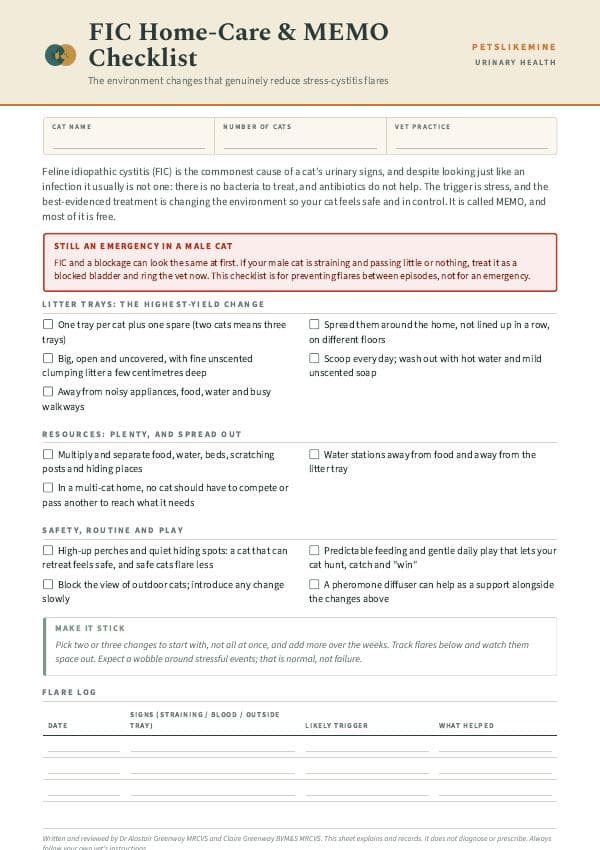
Less stress, through the environment. This is the treatment with the strongest evidence behind it. When vets added structured environmental changes (known as multimodal environmental modification, or MEMO) to usual care, cats had significantly fewer urinary flares, and were less fearful and nervous too (Buffington et al., 2006). The practical, do-this-today version, litter trays, hiding places, routine and play, is set out in [managing FIC with MEMO: the environment changes that actually work] and on the [FIC home-care and MEMO checklist] download.
Pain relief in a flare. Because a flare genuinely hurts, your vet will usually prescribe pain relief for the bad days. There is more on the first 48 hours of a flare, and what to watch for, in [the FIC flare: pain relief, the first 48 hours, and watching for a block].
Pheromone diffusers and certain calming supplements can help as supports, and for a small number of cats with severe, frequent flares there is a place for specific anti-anxiety or nerve-pain medication. We weigh those up in [calming aids, pheromones and when medication has a role]. What is not on the list is antibiotics. There are no bacteria to kill in idiopathic cystitis, so antibiotics don't help, and modern guidance is clear that they shouldn't be used for it (Taylor et al., 2025; He et al., 2022). If your cat is being put on repeat courses for recurring "cystitis", it is worth a calm conversation with your vet about whether a urine culture has confirmed an actual infection. Most of the time it hasn't, and [why your cat probably hasn't got a UTI] explains why that is good medicine, not neglect.
The one warning you must carry: the male-cat caveat
Set against all the reassurance above is one exception, and it matters more than anything else on this page.
In a male cat, the inflammation and gritty debris of FIC can plug his narrow urethra and stop urine getting out altogether. Male cats have a long, narrow urethra, which is why blocks happen almost only in them, and FIC sits underneath a large share of these blocks (Cornell Feline Health Center). Not every male FIC cat will ever block, and many never do, but a meaningful minority do, so the risk is real and worth taking seriously. A blocked cat is a life-threatening emergency that can be fatal within about a day (Cornell Feline Health Center), and it is the one thing about FIC you cannot wait on.
So learn this rule and don't unlearn it. If your male cat is straining in the tray and passing little or nothing, crying, restless, hiding, vomiting or off his food, treat it as an emergency and ring your vet or the out-of-hours service now, tonight. It is not constipation, and it is not "just his cystitis playing up". Run him through the [Blocked-Cat triage] if you are unsure, read [is this an emergency? the blocked-cat signs you must not wait on], and keep the [blocked-cat red-flags fridge card] somewhere you'll see it. A female cat almost never blocks, but the signs of a flare are still worth a prompt, non-emergency vet visit.
One last boundary worth knowing, because it sends owners the wrong way. If your cat is drinking a lot more, losing weight and is on the older side, that points upstream to the kidneys rather than to the bladder, and belongs with the [kidney disease] space, not here. Idiopathic cystitis is a younger-cat, bladder-level problem.
The bottom line
Feline idiopathic cystitis is frustrating, it recurs, and it is absolutely not your fault. But it is genuinely manageable. The bladder is sore because your cat is a sensitive soul whose stress shows up there, and the levers that calm it, more water, a less stressful home and pain relief when it flares, are mostly free and within your control. Most cats do really well once those changes are in place.
A good next step is to pick one thing to start today: get a fountain or a second water bowl down, or read [managing FIC with MEMO] and choose two changes from it. Log the flares and the water on the [FIC & Water tracker] so you can watch the pattern thin out over the months. And keep that one warning in your back pocket, because for a male cat, straining and producing nothing is the emergency you act on straight away.
References
- Heseltine J. Diagnosing and Managing Feline Lower Urinary Tract Disease. Today's Veterinary Practice. 2019 (Sep/Oct).
- He C, Fan K, Hao Z, Tang N, Li G, Wang S. Prevalence, Risk Factors, Pathophysiology, Potential Biomarkers and Management of Feline Idiopathic Cystitis: An Update Review. Front Vet Sci. 2022;9:900847. doi:10.3389/fvets.2022.900847.
- Buffington CAT, Westropp JL, Chew DJ. From FUS to Pandora syndrome: where are we, how did we get here, and where to now? J Feline Med Surg. 2014;16(5):385-394. doi:10.1177/1098612X14530212.
- Buffington CAT, Westropp JL, Chew DJ, Bolus RR. Clinical evaluation of multimodal environmental modification (MEMO) in the management of cats with idiopathic cystitis. J Feline Med Surg. 2006;8(4):261-268. doi:10.1016/j.jfms.2006.02.002.
- Stella JL, Lord LK, Buffington CAT. Sickness behaviors in response to unusual external events in healthy cats and cats with feline interstitial cystitis. J Am Vet Med Assoc. 2011;238(1):67-73. doi:10.2460/javma.238.1.67.
- Defauw PAM, Van de Maele I, Duchateau L, Polis IE, Saunders JH, Daminet S. Risk factors and clinical presentation of cats with feline idiopathic cystitis. J Feline Med Surg. 2011;13(12):967-975. doi:10.1016/j.jfms.2011.08.001.
- Grauer GF. Current Thoughts on Pathophysiology and Treatment of Feline Idiopathic Cystitis. Today's Veterinary Practice. 2013.
- Cornell Feline Health Center. Feline Lower Urinary Tract Disease. Cornell University College of Veterinary Medicine.
- Taylor S, Boysen S, Buffington T, et al. 2025 iCatCare consensus guidelines on the diagnosis and management of lower urinary tract diseases in cats. J Feline Med Surg. 2025;27(2). doi:10.1177/1098612X241309176.
Free downloads
Companion worksheets to put what you've read into practice. Free PDFs, print at home.
Keep track of how your pet is doing
The owners who cope best are the ones who notice changes early. A simple health log shows you what is working, and what is not, before the next vet visit.
Start tracking, freeYou're not doing this alone
Compare treatment journeys and talk to owners managing urinary health. Free to join.
Join PetsLikeMine