

Feeding a Pet With Cancer: Appetite, What to Feed, and the "Sugar" Myth
Alastair Greenway
BVM&S MRCVS
After a cancer diagnosis, food is often the first place owners want to act. Three questions come up almost every time: are they eating enough, is there a special diet I should be on, and should I cut the carbs because I read that sugar feeds cancer. Food is one of the few parts of all this that genuinely sits in your hands, so it carries a lot of weight, and the internet is happy to fill the silence with confident advice that contradicts itself page to page.
What follows is the version we give in the consulting room. For most pets with cancer, the best thing you can do with food is also the plainest: keep enough good food going in. You don't need a magic recipe, an expensive prescription, or a war on sugar. You need calories and protein, in something your pet will actually eat. Nearly everything else is detail hung off that one point.
Eating matters more than what they eat
Weight loss and muscle wasting are common in pets with cancer, and they matter clinically. In one study of 100 dogs seen at an oncology service, 23% had already lost more than 10% of their body weight by the time they arrived, and 15% had clinically relevant muscle wasting (Michel et al., 2004). Cats hide it even better and slip in condition more quietly. At its worst this becomes cancer cachexia, a wasting that keeps stripping muscle and weight even when a pet seems to be eating reasonably, driven by the way the disease shifts the body's metabolism (Saker, 2014).
None of that is cosmetic. Malnutrition is linked to a poorer response to treatment, shorter remission, more complications, and a worse quality of life overall (Saker, 2014). A pet who is eating well and holding their weight has more in reserve, whether you've chosen treatment or comfort-focused care. That's why "is your pet eating?" is among the first questions we ask, and why keeping the calories in beats almost any clever dietary tweak.
Extra weight isn't helpful either, so if your pet is overweight, the aim is to hold steady rather than pile more on (Tufts Petfoodology, 2017). But the more common worry by far is the pet who is losing condition, and there the priority is simple: get good food in.
The "sugar feeds cancer" myth, debunked
This is the one that sends owners into a spin, so let's meet it head on. You'll have read that sugar, or carbohydrate, feeds cancer, and that a low-carb or no-carb diet will "starve" the tumour. It sounds logical, and there is a grain of real science under it: in a test tube, many cancer cells do lean heavily on glucose for energy.
The trouble is that this lab observation has never been shown to translate into a real benefit for a living pet. The veterinary nutrition team at Tufts puts it plainly: "improved survival or remission duration for pets being fed low carbohydrate diets has yet to be proven in dogs or cats" (Tufts Petfoodology, 2017). In a pet who isn't diabetic, the body holds blood glucose within a narrow range whatever's in the bowl, so cutting carbs cannot starve a tumour of sugar. The related belief that grains are uniquely bad has no good evidence behind it either (Tufts Petfoodology, 2017).
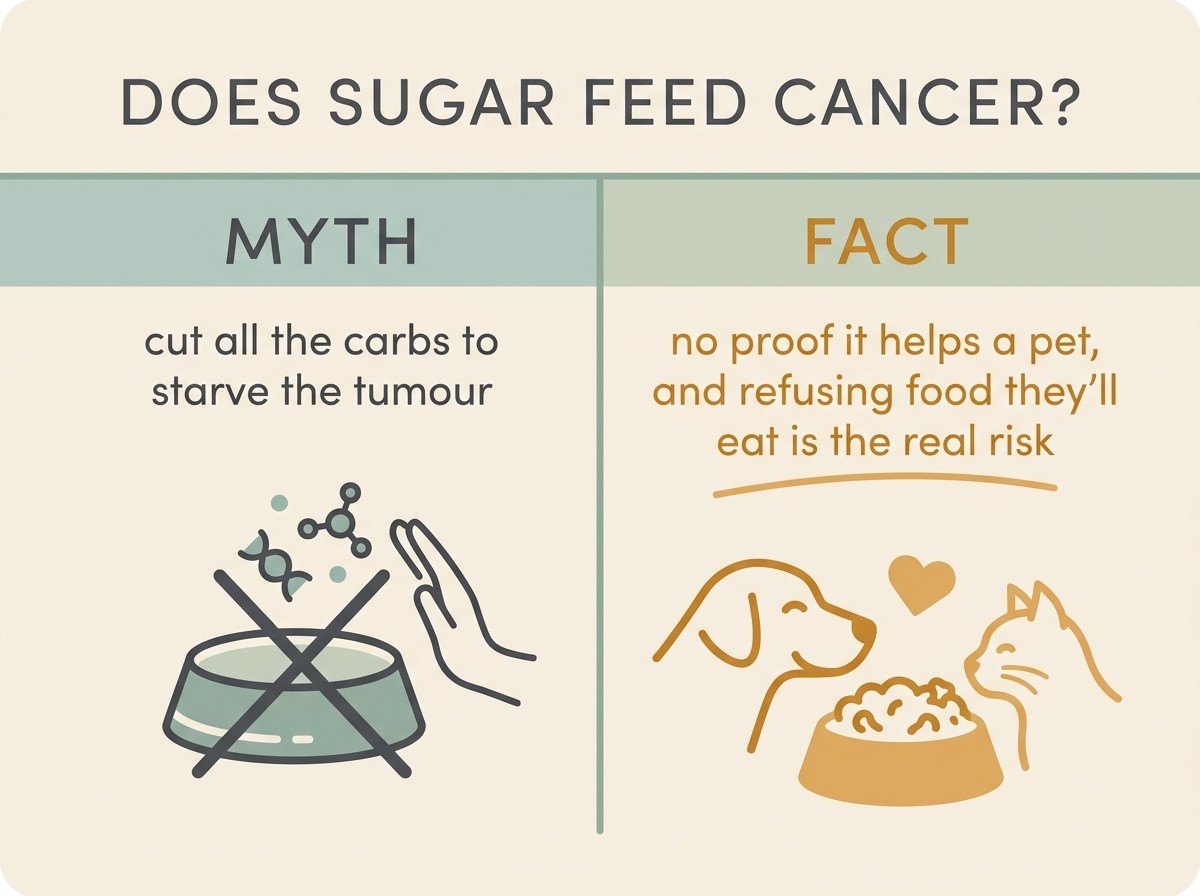
And this is where the theory does actual harm. A sick pet will often happily eat exactly the foods a strict low-carb diet rules out, so refusing what they like in the name of starving the cancer can tip an already-fragile pet into eating less, or nothing. You'd be trading a real risk of weight loss for a benefit that's only theoretical. Feed a good, balanced diet by all means. Just don't let "no sugar" become the rule that stops your pet eating.
Myth: "Sugar and carbs feed cancer, so a no-carb diet will starve the tumour." Fact: Some cancer cells use a lot of glucose in the lab, but no study has shown that cutting carbs helps a real dog or cat live longer or better, and a non-diabetic pet keeps its blood sugar steady regardless. Refusing palatable food to "starve" cancer risks the one thing that genuinely matters: weight loss (Tufts Petfoodology, 2017).
What to actually feed
If your pet is eating well and holding their weight, you may not need to change a thing. A cancer diagnosis is not in itself a reason to switch foods (Tufts Petfoodology, 2017). When appetite is the problem, the goal is a complete, balanced diet, with enough protein and calories, that your pet will genuinely eat. Palatable beats theoretically perfect every time.
A handful of things reliably help tempt a reluctant eater:
- Warm it up. Gently warming food, to no more than body temperature, lifts the smell and makes it far more appealing, which matters because pets eat largely with their noses.
- Make it smelly and tasty. Strong-smelling favourites, a topping of something they love, or a switch to a richer, more aromatic food can all coax a flagging appetite. Fat and protein are natural palatability boosters (Saker, 2014).
- Small and often. Several small meals through the day are usually easier to manage than one or two big ones, especially if there's any nausea (Saker, 2014).
- Hand-feed, and keep it calm. A little hand-feeding, somewhere quiet and pleasant, can restart a stalled appetite. If your pet went off their food on a day they felt sick, they can associate a particular bowl or food with feeling unwell, so offering something different, or in a glass or china dish rather than metal, sometimes breaks the aversion (Saker, 2014).
- Don't fret over "complete and balanced" for a day or two. If the choice is between a few days of their favourite roast chicken and not eating, feed the chicken. For anything longer than that, a complete diet matters, and a home-cooked plan needs designing properly or deficiencies creep in fast (Tufts Petfoodology, 2017).
There's no single best brand or recipe here. The right food is the one that gets eaten.
When the appetite needs a hand
Sometimes tempting food isn't enough, and that's where your vet can genuinely help. A poor appetite is often driven by nausea, and treating the nausea can turn things around on its own, so prescription anti-sickness medication is frequently the first and most useful step.
Beyond that, there are licensed appetite stimulants. Mirtazapine is widely used in both dogs and cats, with the bonus of an anti-nausea effect, and for cats there's a transdermal version you rub onto the ear rather than fighting a tablet in (Clark, 2022). Capromorelin (sold as Entyce) is a newer option that works on the body's own hunger signal, the first medicine of its kind approved specifically for stimulating appetite in dogs, also used off-label in cats (Clark, 2022; Today's Veterinary Practice, 2019). That mix of appetite and anti-sickness effect is exactly why these can help a pet on chemotherapy (Clark, 2022).
So you don't have to win the food battle on willpower and warm chicken alone. If your pet's appetite is sliding, that's worth a call, because the earlier you reach for these tools the easier it is to stay ahead of weight loss.
One important caution: raw food during chemo
This one comes with a clear warning. If your pet is on chemotherapy, raw meat diets are a genuine risk rather than a wellness choice. Chemotherapy can knock down the white blood cells that fight infection, sometimes sharply, leaving your pet far less able to cope with the bacteria that raw meat, eggs and unpasteurised milk routinely carry, things like Salmonella, Listeria, E. coli and Campylobacter (Tufts Petfoodology, 2017). As Tufts spells out, "pets undergoing common types of chemotherapy are particularly at risk" (Tufts Petfoodology, 2017).
Freezing or freeze-drying doesn't make raw food safe (Tufts Petfoodology, 2017), and the risk isn't only to your pet: these bacteria can spread to the people in the house too, which matters all the more if anyone is very young, elderly, pregnant or themselves immunosuppressed (AVMA, 2024). For a pet going through cancer treatment, well-cooked or commercially complete food is the safer bowl. If you currently feed raw and want to keep something close to it, have that conversation before your pet's next treatment, not after.
When not eating is a red flag
A quiet day with a smaller appetite, especially in the few days after a chemo dose, is usually nothing to panic about. But there's a line. A pet who won't eat at all for more than a day, or who goes off their food and is also being sick, seems hot or feverish, or is unusually flat, needs a vet the same day, not in the morning. In a pet on chemotherapy, that combination can be the first sign of a serious infection while the white cells are low, and it counts as an emergency. We set out exactly what those call-now signs look like in a separate piece, because it's the part you most need to be sure of.
For everything short of that, the message is steadier and kinder than the internet would have you believe. Forget the war on sugar. Keep good, tasty food going in, lean on your vet for anti-sickness and appetite help the moment you need it, skip the raw food while your pet's on treatment, and treat every meal your pet enjoys as exactly what it is: a good day, banked.
References
- Michel, K.E., Sorenmo, K., & Shofer, F.S. (2004). Evaluation of body condition and weight loss in dogs presented to a veterinary oncology service. Journal of Veterinary Internal Medicine, 18(5), 692–695. (PubMed: https://pubmed.ncbi.nlm.nih.gov/15515586/) (of 100 dogs, 23% had lost >10% of body weight and 15% had clinically relevant muscle wasting (BCS ≤1); figures are from this single 100-dog study)
- Saker, K.E. (2014). ACVN Nutrition Notes: Practical Approaches to Feeding the Cancer Patient. Today's Veterinary Practice, July/August 2014.
- Clinical Nutrition Team, Cummings School of Veterinary Medicine at Tufts University (2017). Feeding Pets with Cancer (Petfoodology).
- Clark, M. (2022). Medications Used to Stimulate Appetite in Dogs & Cats. Clinician's Brief, last updated December 2022.
- Johannes, C.M., & Musser, M.L. (2019). The Use of Capromorelin for the Clinical Problem of Inappetence. Today's Veterinary Practice, July/August 2019. (capromorelin oral solution, Entyce, FDA-approved May 2016 for appetite stimulation in dogs; not FDA-approved in cats at time of writing)
- American Veterinary Medical Association (2024). Raw or undercooked animal-source protein in cat and dog diets (AVMA policy). (policy revised 2024)
Sister tool · Sightline
Track quality of life over time
Sightline, a separate ConciergeVet tool, runs a short adaptive weekly assessment with a quality-of-life focus mode built around exactly these frameworks, tracks a single composite score over time so you can see the trend rather than judge a single bad day, and produces a Sightline Report PDF you can bring to your vet.
A written log, or our printable quality-of-life sheet, does much the same job.
See how Sightline tracks quality of lifeFound a lump? Track it, and know when to act
A lump cannot be told apart by look or feel; only your vet sampling it can. The Lump & Bump Tracker records its size and how it changes, flags when it has crossed a line worth a vet visit, and builds a clean history to take in.
Open the Lump & Bump TrackerYou're not doing this alone
Compare treatment journeys and talk to owners managing cancer. Free to join.
Join PetsLikeMine