

Exercising an overweight dog safely: start slow
Alastair Greenway
BVM&S MRCVS
Start with what they get back
Think of the bit of the day your dog has quietly been getting less of. The walk you turn round early because they flag halfway. The way they used to bounce at the lead, or scrabble into the boot without a second thought, or take the stairs two at a time. That is the prize here, and it is a present-tense one. This isn't about a longer life in some abstract future. It's about your dog moving more easily in the next few weeks, on the walk you both already do.
So let's get one thing out of the way first, because it tends to sit on owners like a weight of its own. Around half of UK dogs are carrying more than they should, with the PDSA's most recent welfare report putting it at roughly 46% of dogs (PDSA, 2024). The gain creeps up a few hundred grams at a time, and almost nobody clocks it on their own dog until someone points it out. You are not a bad owner. You're a normal one, doing a normal thing about it.
Movement is not the engine of weight loss, it's the passenger that gets a more comfortable ride as the weight comes off. The food does most of the slimming (more on that below). Exercise earns its place for fitness, muscle, mood and for making the whole plan stick, but you do not have to march the weight off a dog who finds marching hard. You start gently, you build, and the movement gets easier as the scale goes down. That order takes the pressure off.
The ramp: short and flat first, build duration before intensity
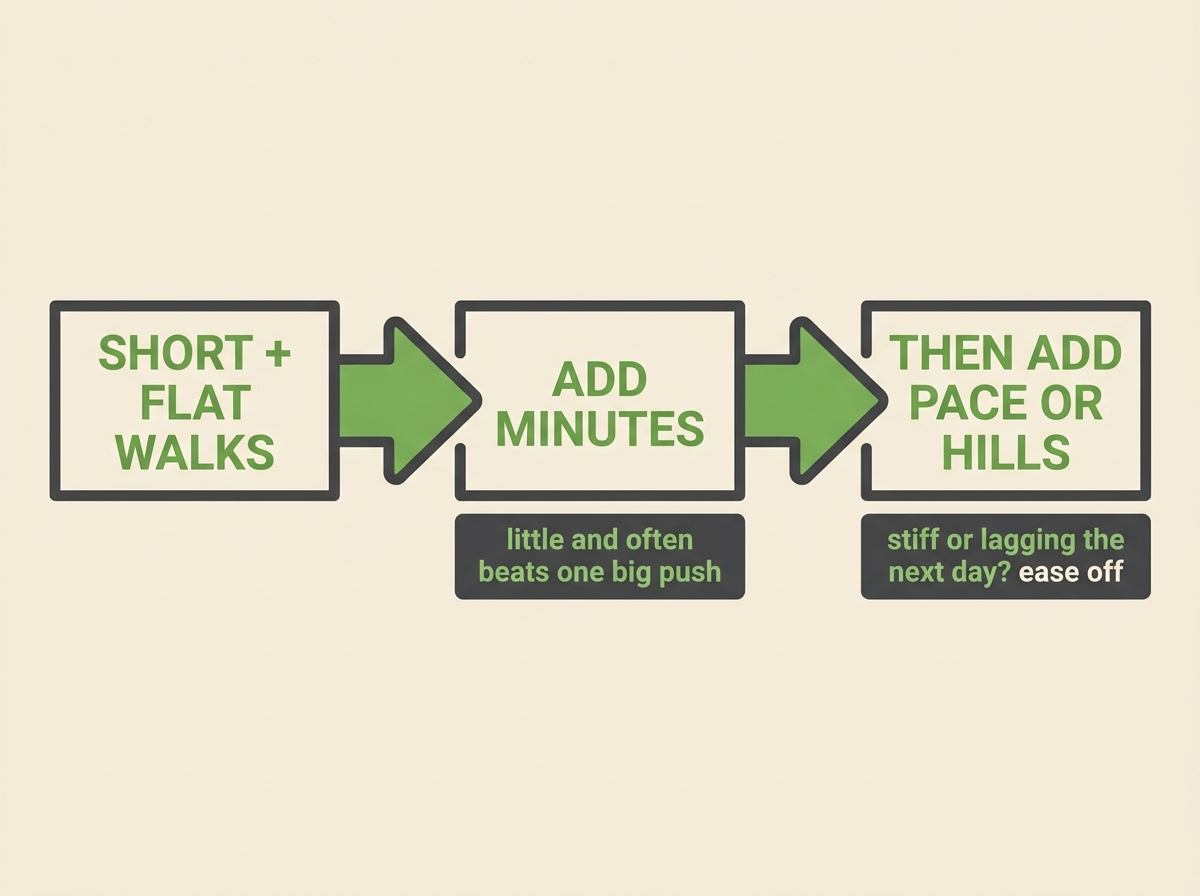
The single most useful rule for starting an unfit, overweight dog is this. Build minutes before you build effort. Duration before intensity, every time.
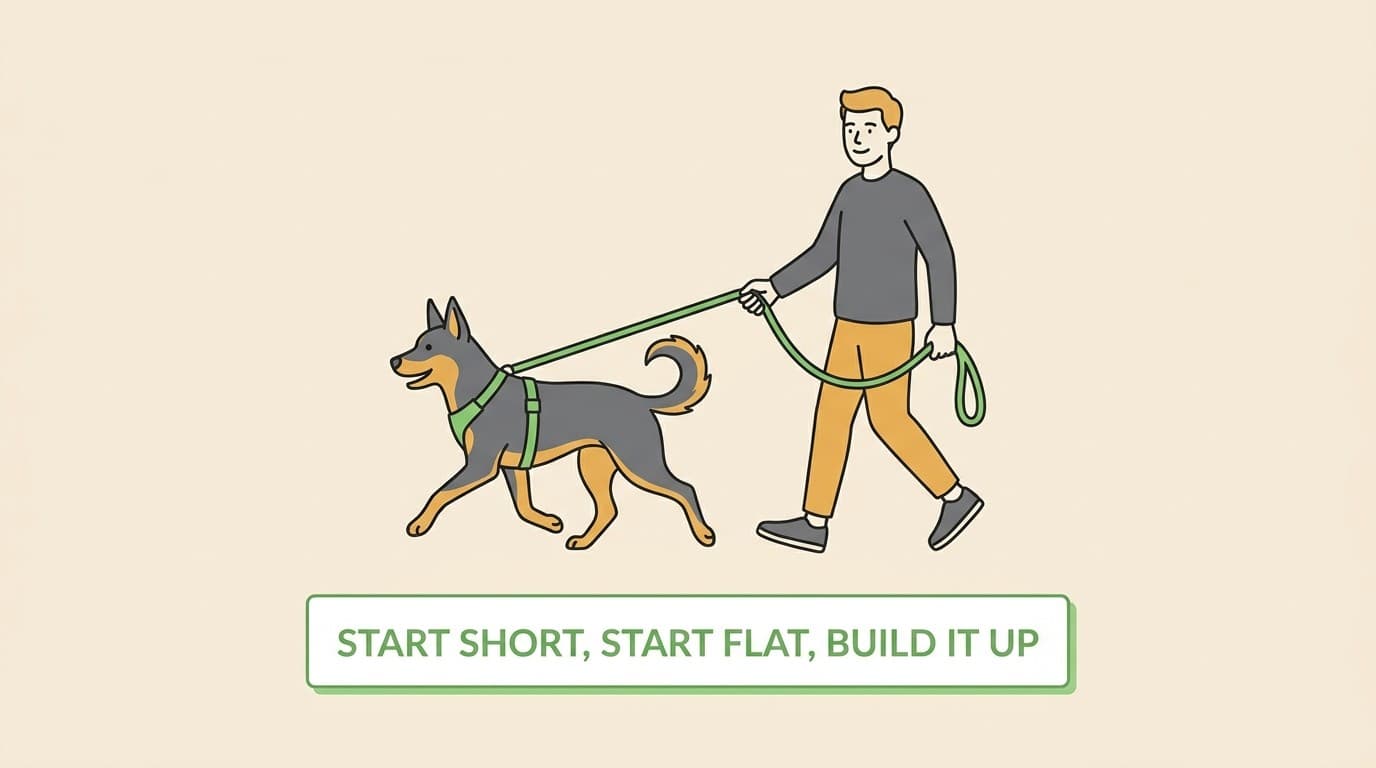
That means starting on the flat, on the lead, for less than you think. If your dog currently manages one long, reluctant walk a day, you are better off breaking it into several short ones. Little and often beats one big push, because the big push is exactly what leaves a heavy, unconditioned dog stiff and sore the next morning and unwilling to go out at all.
A reasonable starting shape, and please read this as an estimate rather than a prescription, looks like a few short flat walks a day of around five to ten minutes each. Then you add a few minutes per week to one or two of them, keeping the ground flat and the pace easy, before you ever add a hill or a faster clip. The hills, the longer loop, the bit of off-lead trot, those are the reward for a body that has been gradually conditioned to take them, not the place you start.
Your dog will tell you if you have overcooked it, and the signal comes the day after, not the day itself. Watch for next-morning stiffness, a slow start, lagging behind on a walk they managed fine last week, or a reluctance to get up. That is the sign you went a notch too far. Back off to the last comfortable level, hold there for a few days, and build again more slowly. Nobody gets fit by being sore. Gradual wins, and it happens to be the pace the weight wants too. A safe rate of loss for a dog is about 1 to 2% of body weight a week (AAHA, 2021), and a body losing weight at that gentle clip copes with a gently rising exercise load far better than one being crash-marched.
Read the real limits: heat and breathing, joints, the heart
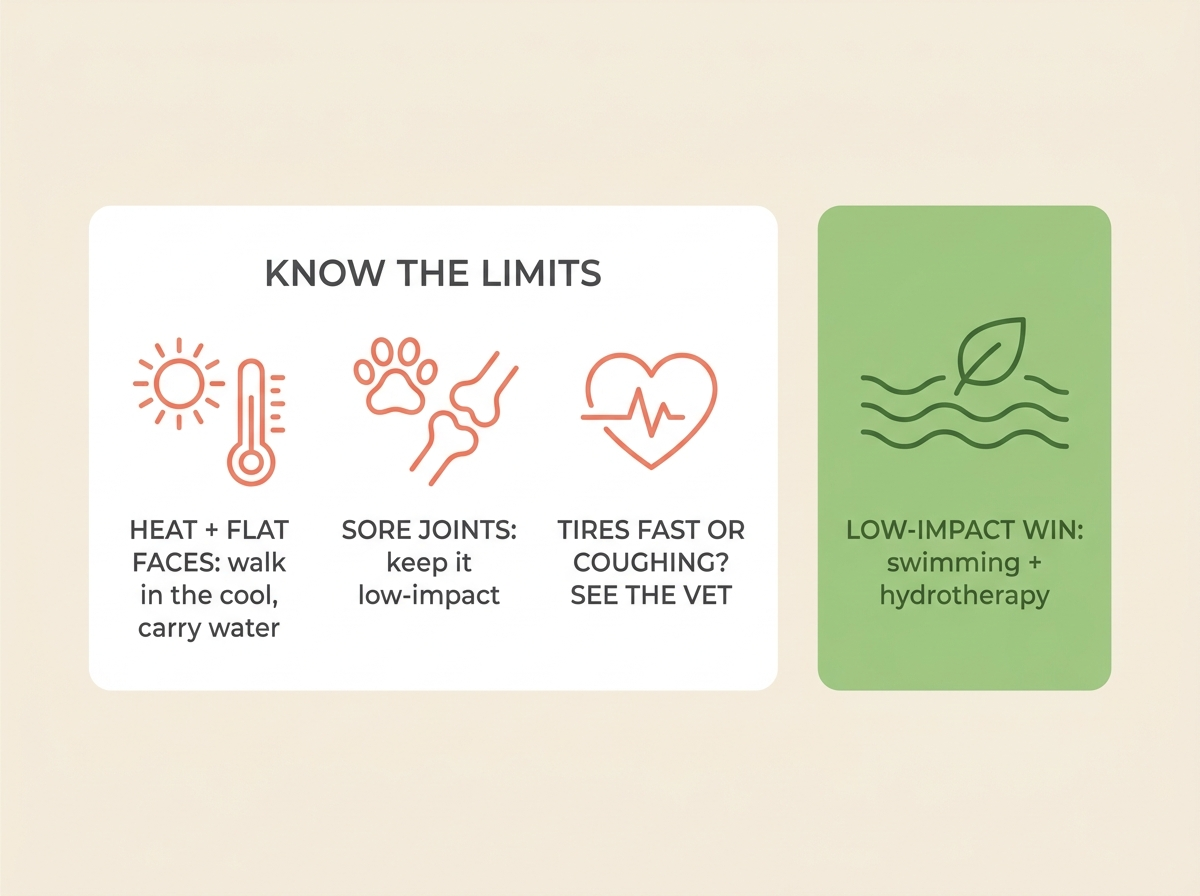
Most overweight dogs can build up to comfortable exercise safely. A few have real limits that you need to see coming, because pushing past them is where gentle exercise turns into a problem. There are three to know.
Heat and breathing. An overweight dog overheats more easily than a lean one, and a flat-faced (brachycephalic) dog overheats fastest of all. The RVC's VetCompass work found that flat-faced breeds carry around twice the odds of heat-related illness compared with a longer-muzzled dog like a Labrador, and that being big for the breed, which includes carrying excess weight, lifted the risk by around half again (Hall et al., 2020). Put those two together in a pug or a French bulldog who is also overweight and you have a dog who can get into trouble on a warm-day walk that a leaner, longer-nosed dog would shrug off. The fix is simple and not at all alarmist. Walk in the cool of early morning or late evening, carry water, keep it short when it's warm, and stop the moment the panting turns hard and frantic rather than easy and rhythmic. Heavy, distressed, noisy breathing on gentle exercise is a stop sign, not a fitness milestone.
Sore joints. If your dog is stiff, slow to rise, or already known to have arthritis, the worst thing you can do is force-march them. Worn joints need joint-kind movement, which is little, often, low-impact and on forgiving ground, not a long road slog or a hard run after a ball. The good news is that taking the weight off is one of the kindest things you can do for an arthritic joint, and it works through the food as much as the lead. If this is your dog, the Arthritis and Osteoarthritis space and our Weight and arthritis article are written for exactly this, and so is M3 on slimming when movement is limited.
The heart. Carrying excess weight makes the heart work harder. In a study of obese dogs, every one of them showed some degree of diastolic dysfunction, the heart's filling phase struggling under the load, and well over half were running raised blood pressure (Partington et al., 2022). For most dogs this quietly improves as the weight comes off. But it means a dog who tires unusually fast, coughs, or struggles to breathe on gentle, flat exercise is not unfit and in need of more walking. That dog needs a vet check before you build the exercise up, because those signs can point at the heart itself rather than at condition.
Low-impact options: swimming and hydrotherapy
When normal walking is limited, by sore joints, by a lot of excess weight, by age, the answer is not no exercise. It's a different kind. Water is the standout.
Swimming and professional hydrotherapy, whether an underwater treadmill or a pool, let a dog do real aerobic work while the water takes a large share of the weight off the joints. For an arthritic or a very overweight dog, that is close to ideal, because they get the cardiovascular and muscle benefit without the impact their joints would hate on the pavement. It is genuinely one of the best tools for a dog who can't yet manage much walking.
A few caveats, because water is not automatically safe. Not every dog swims well, and an unfit or flat-faced dog can tire quickly and is at real risk of taking in water, so this is supervised work, never a dog left to it. A paddle in the garden pool is not the same thing as a structured session, and the safe route into proper hydrotherapy is a qualified practitioner, ideally on a referral from your vet, who can pitch the workload correctly and keep your dog safe in the water. Done that way, it's an excellent low-impact engine.
And low-impact does not have to mean a facility. A long, slow sniff-walk where your dog reads every lamppost is gentle exercise and good for them mentally too, gentle play counts, and so does making them work a bit for their food. There's more on that in M4 on slow feeding and foraging.
The bowl does most of the work
You will not walk this weight off your dog. The food does the heavy lifting, and the lead is the adjunct.
This isn't a hunch, it's what the research shows. In a controlled trial, dogs put on dietary calorie restriction lost a median of around 10% of their starting body weight, while a programme based on increasing activity produced only around 2%, and the authors were blunt that advising owners to up their dog's activity simply was not enough to drive weight loss on its own (Chapman et al., 2019). Canine Arthritis Management, a UK charity, puts it more plainly still. "Exercise is not a big fat burner, so reducing calorie intake is more effective at shifting weight" (Canine Arthritis Management, n.d.).
Read that the right way round and it's liberating. It means you can start slimming your dog through the bowl right now, before they are moving freely, and the movement gets easier as the weight comes off. The owner of a sore, stiff or unfit dog does not have to solve the chicken-and-egg of "exercise it off" before anything can happen. You change the portions today, the weight starts to shift, and the walks get easier on their own.
And to be completely clear about what "the bowl" means, because this is where the food brands and the supplement sellers muddy the water. It means a calorie deficit on the food you already own. You measure what's going in, you cut it back to the right amount, and you carve out a small treat budget so the treats don't undo it. It does not mean buying a special metabolism-boosting food that promises results without smaller portions. That promise steers you off the one lever that actually works. If you want the exact amount for your dog, our Feeding Calculator turns their target weight into grams of their current food in about ten seconds, and F1 on how much to actually feed walks through why the side of the bag tends to over-feed.
None of which makes exercise pointless, and it's worth saying so clearly. Exercise builds fitness, it preserves muscle while the fat comes off so your dog ends up lean and strong rather than just smaller, it lifts mood, and it makes the whole plan stick. It is the adjunct that makes the diet work, not a waste of effort. Knowing which is which is exactly what lets you start safely with a dog who finds moving hard.
Where to go next
The order is food first, movement alongside, both gentle. Here's where to go for each part.
For the lever that actually shifts the weight, start with the Feeding Calculator to get the grams right, read F1 on why the bag over-feeds, and log every weigh-in on the Healthy Weight Tracker so you can watch the trend and, frankly, watch the walks getting easier as the line comes down.
For a dog whose joints or age make movement hard, the Arthritis and Osteoarthritis space and its Mobility Check tool are the next stop, along with M3 on slimming when exercise is limited and M4 on slow feeding and foraging for gentle, food-based activity. If your dog is flat-faced or you've noticed noisy or laboured breathing, the Breathing space is written for that airway, and the heat advice above is doubly worth taking to heart.
Start short, start flat, build the minutes before the effort, and let the bowl do the heavy lifting. The dog who's been hanging back on the walk is the one you get back.
References
- PDSA (2024). PDSA Animal Wellbeing (PAW) Report 2024.
- American Animal Hospital Association (AAHA) (2021). 2021 AAHA Nutrition and Weight Management Guidelines for Dogs and Cats.
- Hall EJ, et al. (2020). Dogs Don't Die Just in Hot Cars — Exertional Heat-Related Illness (Exertional Hyperthermia) Is a Greater Threat to UK Dogs. Animals 10(8):1324.
- Partington C, et al. (2022). The effect of obesity and subsequent weight reduction on cardiac structure and function in dogs. BMC Veterinary Research 18:351.
- Chapman M, et al. (German AJ) (2019). Evaluation of neutering and physical activity interventions on weight loss in dogs: an open-label randomised controlled trial. The Veterinary Journal 243:65–73.
- Canine Arthritis Management (n.d.). Weight Management.
Keep track of how your pet is doing
The owners who cope best are the ones who notice changes early. A simple health log shows you what is working, and what is not, before the next vet visit.
Start tracking, freeYou're not doing this alone
Compare treatment journeys and talk to owners managing weight management. Free to join.
Join PetsLikeMine