

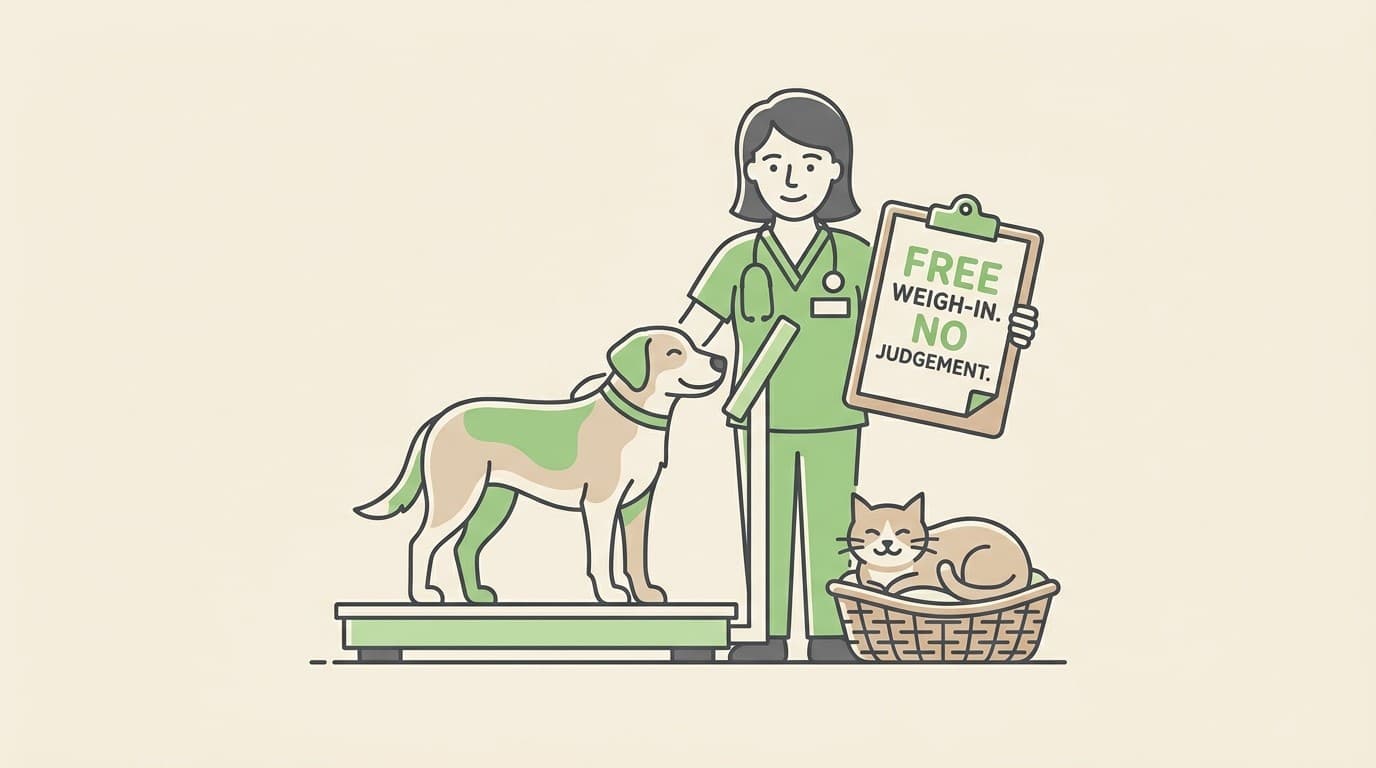
Doing it with your vet: weight clinics and weigh-in check-ins
Alastair Greenway
BVM&S MRCVS
Someone at your practice has mentioned they run a "weight clinic" or a "nurse clinic", and you'd like to know what that actually means before you book. Does it cost anything? Do you have to go? And the question most people are too polite to ask out loud: is it just a way to sell you a bag of expensive diet food?
The short answer is that a weight clinic is one of the most useful and least intimidating things your practice offers. It's there to support you, not to judge you or sell to you. Let's walk through exactly what happens.
What a weight clinic actually is (and that it's usually free)
Most UK veterinary practices run a nurse-led weight clinic (Vet Help Direct, 2022). It's a series of relaxed appointments with a veterinary nurse whose whole job, in that room, is to help your pet reach a healthy weight. They weigh your pet, help you set a sensible target, build a plan around the food you already feed, and then see you regularly to keep it on track.
The weigh-ins themselves are usually free, though it's worth checking with your own practice when you ring, because arrangements vary. Why so many practices don't charge is simple. These clinics work, and a pet that reaches a healthy weight needs the vet less. The clinic is support, and not a sales funnel.
Let's settle the worry that brings most people up short. Nothing about a weight clinic should be a negative experience, and no one is there to judge you (Vet Help Direct, 2022). Your nurse has seen this hundreds of times. Around half to 60% of UK dogs and cats are overweight or obese (PDSA, 2023; APOP, 2022), so if your pet is carrying a bit too much, your pet is in the majority. This is common, very fixable, and walking through the door is the hard part done.
What the clinic gives you is the structure that makes a diet actually stick. A target to aim for, a plan to follow, and a date in the diary to weigh in. That last bit matters more than almost anything else, and we'll come to why.
What happens at the first visit
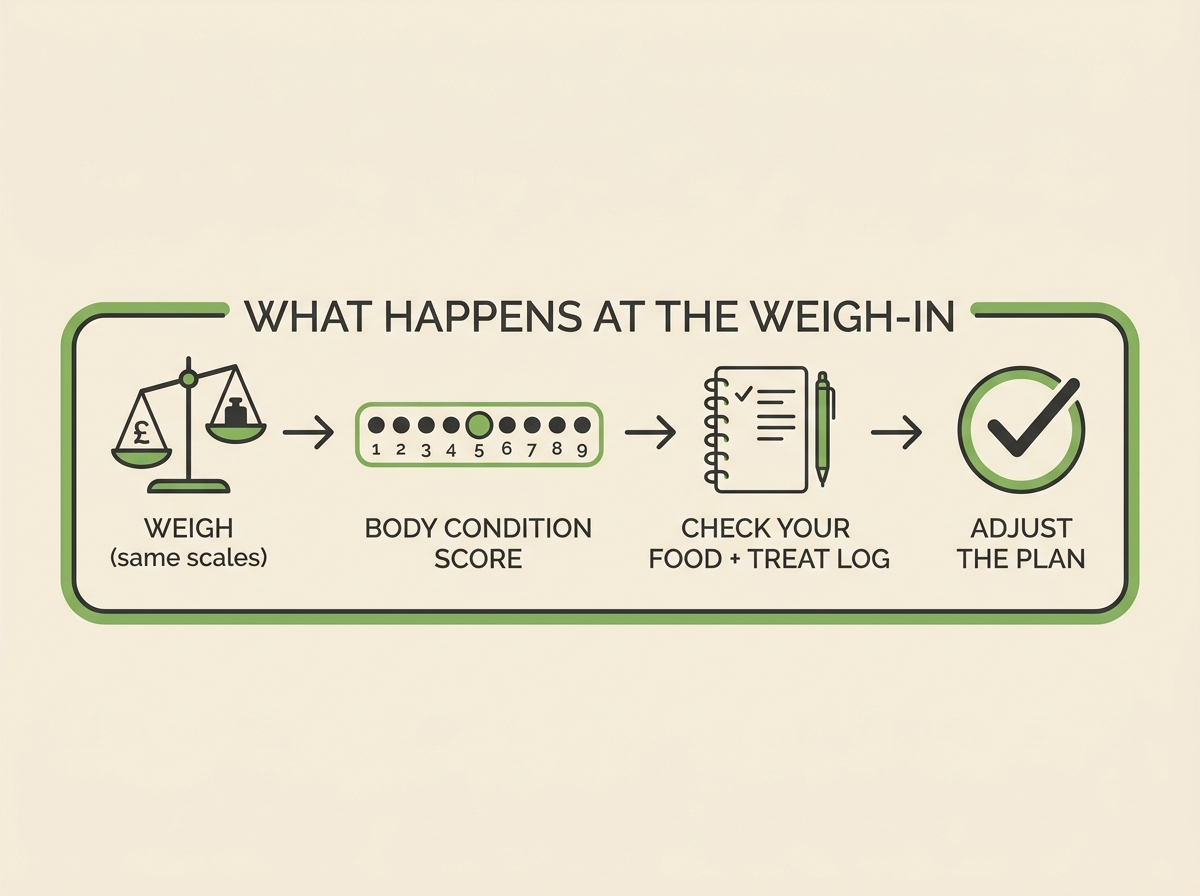
The first appointment is longer than the rest, because it sets everything up. Expect roughly the following.
An accurate baseline weight, on the practice's proper walk-on scales rather than your bathroom set or a guess. This is the number every future weigh-in is measured against, so it needs to be done properly and on the same scales each time.
A hands-on body condition score. Your nurse will feel along your pet's ribs, waist and tummy and put a number on it, usually on a 1 to 9 scale where 4 to 5 is ideal (Vet Help Direct, 2022). It's the same check you can learn to do at home (see our guide to scoring your dog or cat), and it matters because the scales alone don't tell the whole story. Breeds vary hugely, so what the body is actually carrying is the real measure.
Often some tape-measure work and photos too. Many clinics record the waist, chest and neck, and take a photo from the side and from above (Vet Help Direct, 2022). Don't be self-conscious about the pictures. A few weeks on, a side-by-side photo shows the change far more clearly than a number on a chart ever does.
A proper review of everything your pet eats. This is why it helps so much to bring your food and treat log. Only about 3% of cat owners and 16% of dog owners weigh their pet's food (APOP, 2025), so for most of us the daily total is a genuine mystery. Your nurse isn't there to tut at the dental chew or the corner of toast. They simply can't help you find the spare calories if they can't see them, and the begging is biology, not a character flaw on anyone's part.
A medical rule-out. Before anyone blames the bowl, a good clinic checks there isn't a health reason behind the weight, an underactive thyroid in dogs or Cushing's, for instance (see whether a health problem could be behind the gain). It works the other way too. If your pet has been losing weight without you trying, that's a warning sign to get checked, not a win (see when slimming is a warning sign).
And finally, the plan itself. Together you'll agree a realistic target weight and a calorie or portion plan to get there. Expect a sensible pace, not an overnight transformation. A common target is around a 15% weight reduction over about five months (Vet Help Direct, 2022). Slow is both safer and far more likely to last, and for cats especially it's the only safe way, at roughly 0.5 to 1% of body weight a week (AAHA, 2021). We'll never crash-diet a cat, and your nurse will protect against over-restriction (see the hepatic lipidosis rule).
The check-in visits: why regular weigh-ins are the engine
If the first visit builds the plan, the check-ins are what make it happen. They're the most important part of the whole thing.
A check-in is short and routine. Your pet is weighed on the same scales, re-scored, often re-photographed, and the ration is adjusted as your pet shrinks (AAHA, 2021). That last point matters, because a lighter pet needs fewer calories, so the amount that was a deficit a month ago slowly becomes "just enough" if nobody changes it. Best practice is to recheck the weight and body condition at least once or twice a month, and it can take several monthly rechecks to settle on the right long-term ration (AAHA, 2021).
Now for why the weigh-in is the engine. The hardest part of any weight-loss plan isn't the first week of enthusiasm, it's keeping going. Long-term monitoring is the most difficult stage, and owner non-adherence, all of us quietly drifting off the plan, is a major reason weight-loss programmes fail (AAHA, 2021). That isn't a criticism. It's a fact about being human and living with a pet who has learned exactly which face to pull at six o'clock.
A booked weigh-in is the cheap lever that holds the line against all of that. Knowing there's a date in the diary, and a friendly nurse who'll see the number, is often the difference between sticking to the plan and letting it slide. That accountability is the single biggest thing the clinic gives you, and it's free.
Bring your food and treat log to every visit, not just the first. Calorie creep is sneaky. A slightly heavier scoop, a new chew, the kids or a neighbour topping the bowl up, and the maths quietly drifts. Your nurse can spot in the log what's hard to see day to day.
The diet question: support, not a sales pitch
Let's go straight at the worry we started with, because it stops some owners booking at all.
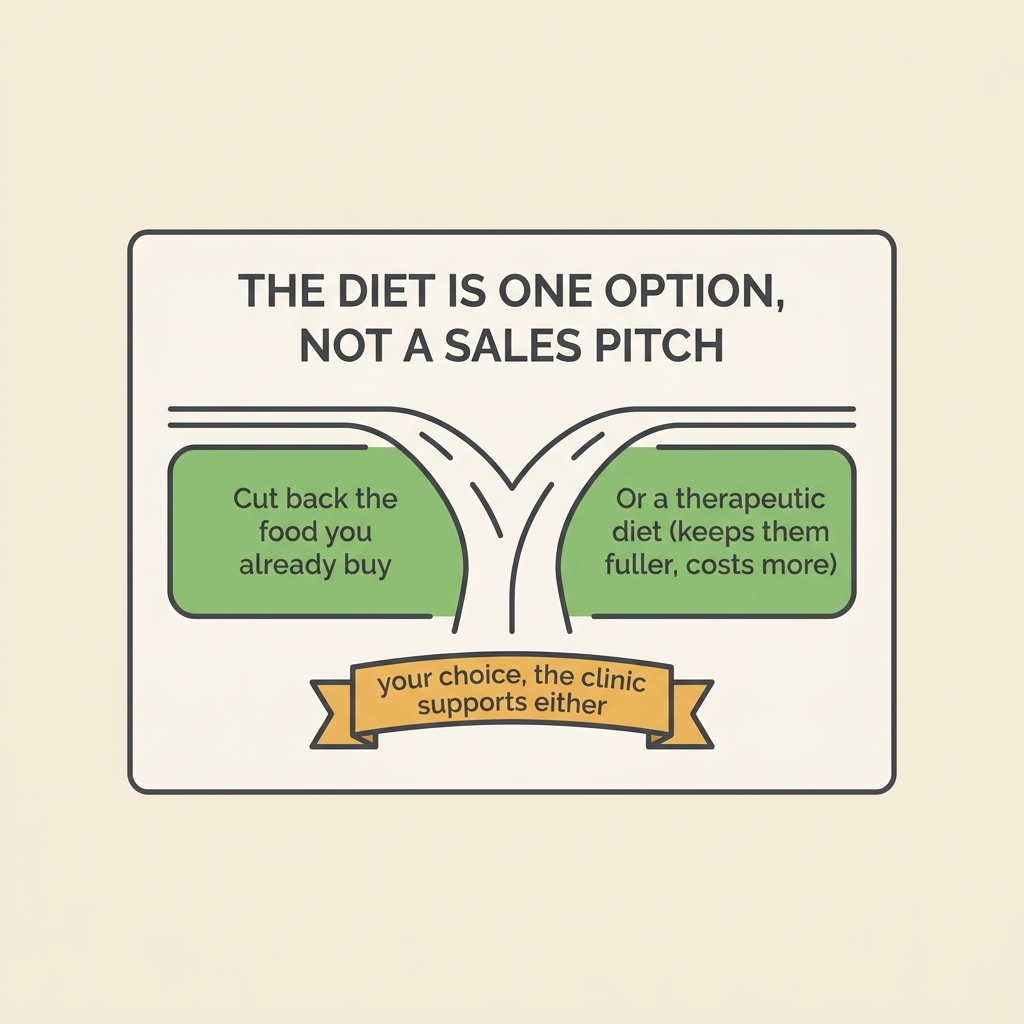
A therapeutic weight-loss diet is one option a clinic can offer. These foods are designed to keep a dieter feeling fuller and to protect muscle while the fat comes off, usually through higher protein and fibre, which is a genuine, evidence-based help for some pets (AAHA, 2021). The catch is cost. They're more expensive than standard food, and for many households that matters.
This is the part the food brands structurally can't say, and we can, because we don't sell a diet. You very often don't need a special diet at all. For a great many pets, the answer is simply to measure and gently cut back the food you already buy, with the treats budgeted in. A good clinic will support that choice just as readily, and help you work out the right grams of your current food. The therapeutic diet is one tool on the shelf, not the price of admission.
You are not obliged to buy anything to be welcome at the weigh-in. If a diet food genuinely suits your pet and your budget, it's a reasonable option to discuss. If it doesn't, the clinic is still yours to use. The weigh-in, the target and the accountability are the valuable part, and they cost nothing.
Make the clinic and your home tracker work together
The clinic gives you a monthly anchor. The professional weigh-in on accurate scales, the hands-on body condition score, the medical rule-out and the expert eye on your log. What it can't do is sit with you the other 29 days, and that's where your home tracking earns its keep.
Think of the two as a pair. Use the Healthy Weight Tracker to keep the trend and your body-condition photos between visits, so you can watch the line move rather than fret over a single daily number. Use the Feeding Calculator to turn the calorie target your nurse agreed into grams of the exact food in your cupboard. Then walk into each weigh-in with your numbers ready, so the appointment confirms what you already half-know rather than starting from scratch. The clinic anchors the plan, the tools carry it between visits, and together they make each weigh-in count.
The next step is small. Ring your practice and ask whether they run a free weight clinic, and book the first appointment. Then, before you go, start a food and treat log, write down everything your pet eats for a few days, the meals, the chews, the scraps, all of it, and bring it with you. That single sheet of paper is what turns the first visit from a guess into a plan.
References
- Vet Help Direct (2022). What happens in a pet weight loss clinic?
- PDSA (2023). PDSA Animal Wellbeing (PAW) Report 2023.
- Association for Pet Obesity Prevention (APOP) (2022). 2022 Pet Obesity Prevalence Survey.
- Association for Pet Obesity Prevention (APOP) (2025). 2025 Pet Obesity and Nutrition Survey.
- American Animal Hospital Association (AAHA) (2021). 2021 AAHA Nutrition and Weight Management Guidelines for Dogs and Cats.
Keep track of how your pet is doing
The owners who cope best are the ones who notice changes early. A simple health log shows you what is working, and what is not, before the next vet visit.
Start tracking, freeYou're not doing this alone
Compare treatment journeys and talk to owners managing weight management. Free to join.
Join PetsLikeMine