

Urinary Tract Infections in Dogs: When Antibiotics Are, and Aren't, the Answer
Alastair Greenway
BVM&S MRCVS
A dog squatting every few minutes, leaving little puddles where she never used to, with maybe a pink tinge in her wee, is the classic picture of a urinary tract infection, and a UTI is a fair first guess. It's often the correct one too. Unlike cats, where "UTI" is usually the wrong label (most feline urinary signs are stress-driven cystitis, not infection, which we untangle in "is it a UTI?"), dogs genuinely do get bacterial bladder infections, and they're common. So this is the rare urinary page where the answer to "does my pet need antibiotics?" might actually be yes.
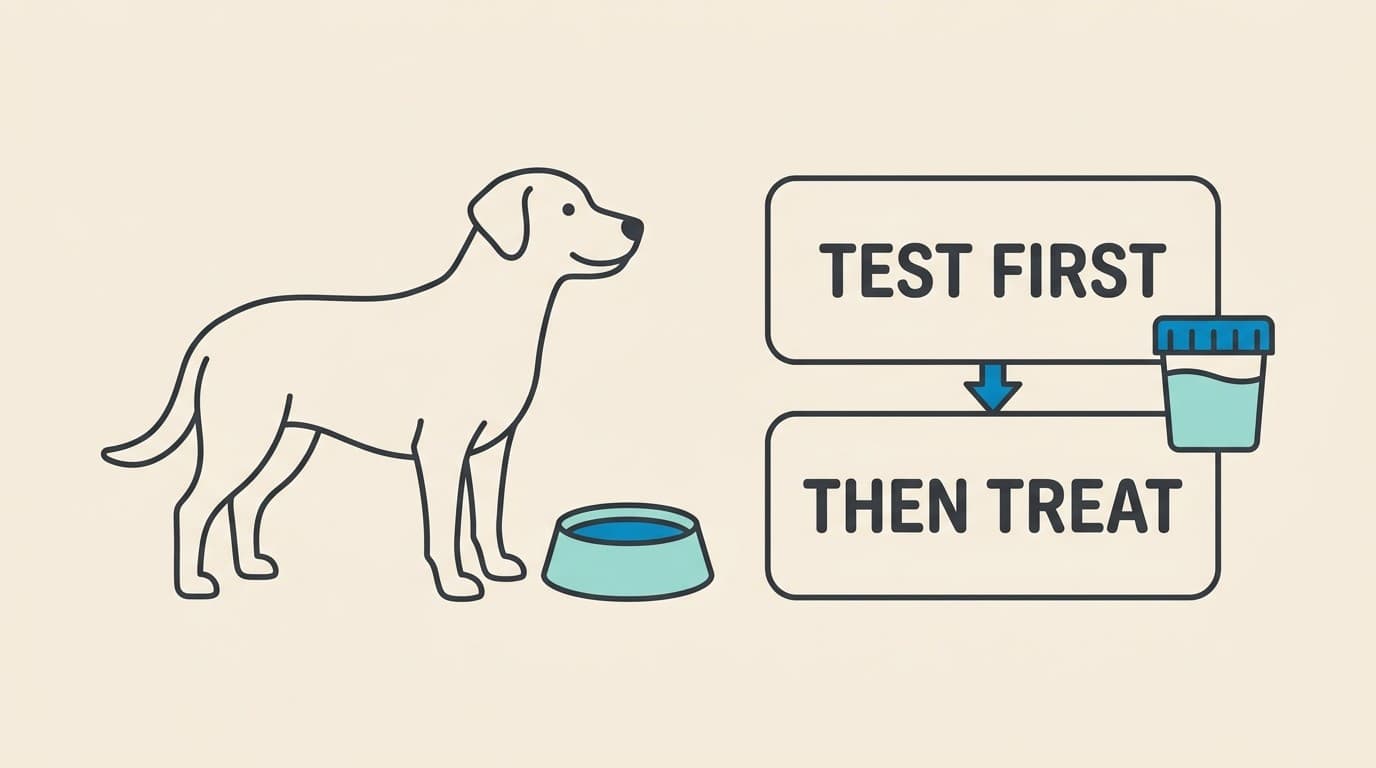
But "common" and "often simple" are not the same as "always needs a pill", and that gap is where a surprising amount of good and bad medicine lives. Some dogs are handed antibiotics they don't need. Some are given a fortnight's course when a few days would do. And some get the same short course over and over for a problem that was never going to be fixed that way. This article is the realistic version: when antibiotics are the right call, when they aren't, and why your vet reaching for a urine pot before the prescription pad is a sign of good practice, not foot-dragging.
How common are they, and which dogs get them
Bacterial cystitis (an infection of the bladder) is genuinely common in dogs. A widely quoted figure is that around 14% of dogs will have a urinary tract infection at some point in their lives, which is one reason it's among the more frequent reasons a dog ends up at the vet for a urinary problem (Ling, 1984; Cornell Riney Canine Health Center). Female dogs are affected more often than males, for a simple anatomical reason: a bitch's urethra is shorter and sits closer to the back end, so bacteria from the skin and faeces have a shorter trip to the bladder (MSD Veterinary Manual; Cornell Riney Canine Health Center).
The usual culprit is a gut bacterium called Escherichia coli (E. coli), which lives harmlessly around the bottom and occasionally travels up the wrong tube; it's the single most common cause, behind roughly half of canine UTIs, with Staphylococcus, Proteus, Streptococcus and Klebsiella making up much of the rest (MSD Veterinary Manual). The signs are the body's way of complaining about an irritated, inflamed bladder: weeing little and often, straining, an obvious effort to pass just a few drops, blood in the urine, accidents in a previously clean dog, licking at the back end, and sometimes urine that smells stronger than usual (Cornell Riney Canine Health Center; MSD Veterinary Manual). Most of these dogs are otherwise bright and well in themselves, which is part of what marks a simple bladder infection out from something more serious.
Why "test first, treat second" is good medicine, not a delay
This is the part that catches owners out, because it runs against the human instinct of "infection, so antibiotics, now". The current expert guidance, from the International Society for Companion Animal Infectious Diseases (ISCAID), is built around confirming there's actually an infection to treat before treating it (Weese et al., 2019, The Veterinary Journal).
There are two good reasons. The first is that the signs of a bladder infection (straining, blood, frequency) are not unique to infection. Bladder stones, crystals, an anatomical quirk, even a tumour in an older dog, and in a leaking spayed bitch the weak-bladder-neck problem we cover in "is it incontinence or something else?", can all look identical from the outside. Antibiotics do nothing for any of those, so reaching for them blindly can mask the real problem and delay the right fix. The second reason is bigger than your dog: handing out antibiotics that aren't needed, or the wrong one, helps drive antibiotic resistance, which is one of the genuine threats facing both pet and human medicine. Using these drugs carefully (the principle of antimicrobial stewardship) is something every responsible vet now takes seriously (Weese et al., 2019).
So a good work-up means a urinalysis to look for the tell-tale signs of infection (white blood cells, red blood cells, bacteria), and in many cases a urine culture, which grows any bacteria present and tests which antibiotic will actually kill them. The gold-standard sample is taken by a quick needle draw straight from the bladder, called a cystocentesis, because it skips the contamination a caught or floor sample picks up on the way out (Weese et al., 2019; MSD Veterinary Manual). We walk through how to help your vet get a good sample in "how to describe urinary signs to your vet, and how to collect a urine sample". This isn't your vet being slow. It's the difference between guessing and knowing.
When antibiotics ARE the answer (and for how long)
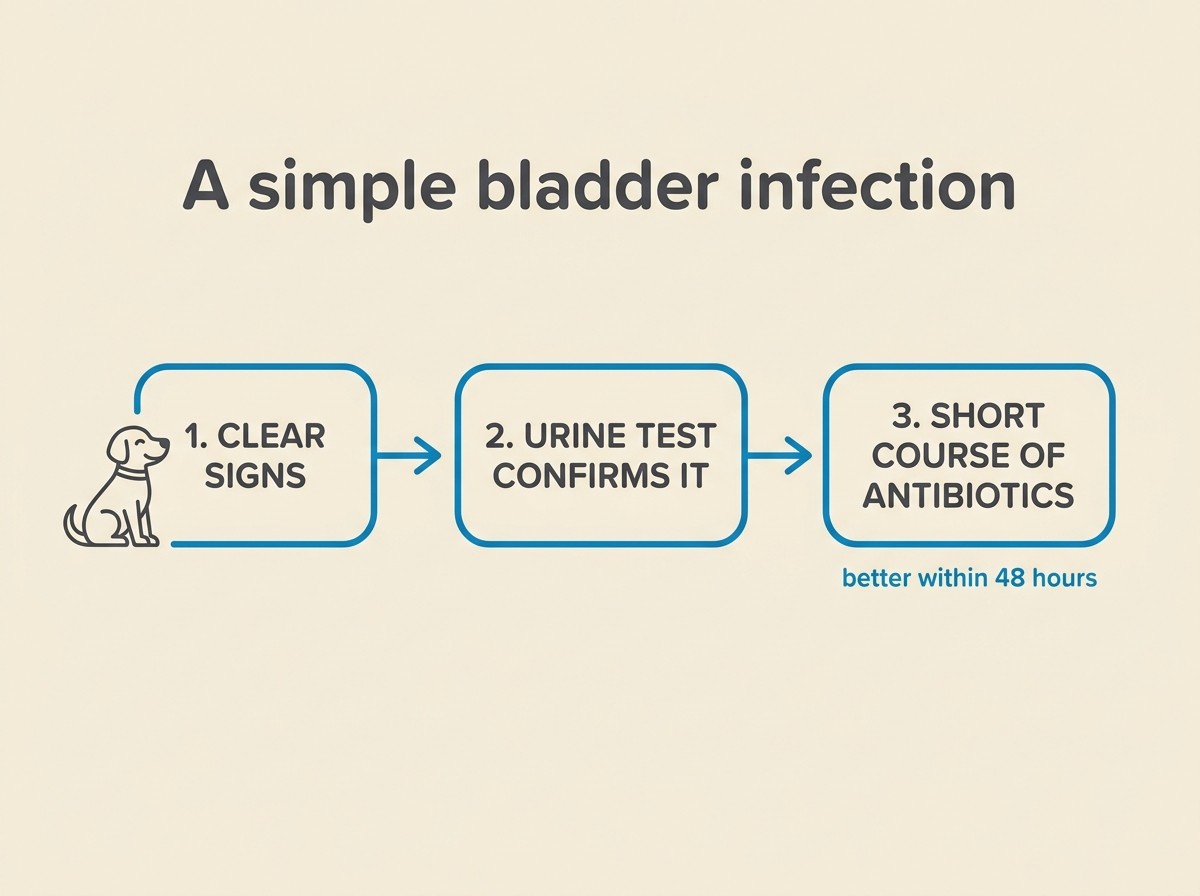
When a dog has clear urinary signs and a urine test that backs up a bacterial infection, antibiotics are exactly the right treatment, and they usually work well. This is the situation ISCAID calls sporadic bacterial cystitis: an isolated infection in an otherwise healthy dog, the everyday "she's got a UTI" most owners picture (Weese et al., 2019).
Two things about the prescription are worth knowing, because they've both changed in recent years. Start with the choice of drug. The recommended first-line antibiotics are amoxicillin or a trimethoprim-sulfonamide combination, simple, long-established drugs rather than the big-gun broad-spectrum ones, which are deliberately held in reserve (Weese et al., 2019). The second point surprises a lot of people: the course is short. Modern guidance recommends only three to five days of treatment for a simple bladder infection, not the ten-to-fourteen-day courses that used to be routine (Weese et al., 2019). The shorter approach has held up in testing too: a randomised trial in female dogs found that a three-day course of trimethoprim-sulfamethoxazole worked no worse than a much longer beta-lactam course (Clare et al., 2014, Journal of Veterinary Internal Medicine). So if your dog is on a sensible short course, that's current best practice, not a corner being cut. You should see her starting to settle within a couple of days; if she isn't clearly more comfortable in about 48 hours, tell your vet, because that's a signal the bug or the drug needs rethinking (Weese et al., 2019).
When antibiotics are NOT the answer
This is the half the "dog UTI" internet tends to skip, and it matters.
Signs without a confirmed infection. If the urine test doesn't actually show an infection, antibiotics won't help, because there's nothing for them to kill. The straining and blood are coming from something else (stones, inflammation, anatomy), and that something else is what needs sorting.
Bacteria without any signs. Sometimes a urine sample taken for another reason grows bacteria in a dog who has no urinary symptoms at all. This is called subclinical bacteriuria, and the current advice is, in most cases, to leave it alone. ISCAID states plainly that treating it "is rarely indicated and is discouraged", because the bacteria are sitting there causing no harm, and treating them simply breeds resistance without making the dog any better (Weese et al., 2019). In one study of healthy female dogs, around 9% had bacteria in their urine, and none of them went on to develop signs of cystitis over the three-month follow-up (Wan et al., 2014, Journal of the American Veterinary Medical Association). It feels counter-intuitive to find a "bug" and not treat it, but in an otherwise well dog that restraint is the right call.
The same short course, again and again, for a recurring problem. If your dog keeps getting infections, repeatedly reaching for the same antibiotic without asking why is a trap, and it's the cue to dig deeper rather than re-prescribe.
When it keeps coming back: the recurrent-UTI work-up
A handful of dogs get infection after infection, and the right response is not a longer or stronger antibiotic but a proper investigation into the underlying reason. Vets define a recurrent UTI as three or more infections within twelve months (Weese et al., 2019; Today's Veterinary Practice). The first job is to work out what kind of recurrence it is, because the urine culture tells you: a relapse is the same bug returning (which hints something is sheltering it inside the bladder), while a reinfection is a different bug (which points to something letting bacteria in), and either way it's usually counted within six months of stopping treatment (Today's Veterinary Practice). Older terms like "complicated UTI" have largely been dropped in favour of looking for the specific cause, because nobody could agree on what "complicated" meant (Weese et al., 2019).
The things that drive recurrence are well known, and finding one often solves the problem for good:
- Bladder stones, which act as a permanent hiding place for bacteria; struvite stones in dogs are frequently tangled up with infection, which is one reason stone type matters so much (see "bladder stones in cats and dogs").
- An anatomical quirk, classically a recessed or "hooded" vulva that traps moisture and bacteria, or in a young dog an abnormally positioned ureter (an ectopic ureter).
- Incomplete bladder emptying or urine pooling, which leaves a stagnant reservoir for bacteria to multiply in.
- An underlying illness that lowers the body's defences, in particular Cushing's disease (overactive adrenal glands) and diabetes, which both genuinely raise the risk of real infections, especially in older dogs (Today's Veterinary Practice). If your dog also seems to be drinking and weeing much more than usual, that's a flag to look beyond the bladder, which leads neatly to the next point.
Getting to the bottom of recurrence usually means a urine culture every time, blood tests, imaging of the bladder by ultrasound or X-ray, and sometimes a look inside with a camera (Weese et al., 2019; Today's Veterinary Practice). It's more effort than another five-day course, but it's the only route that actually stops the cycle.
Two things to keep in mind
First, rule out the medical before you blame the dog. A house-trained dog who suddenly starts having accidents indoors is far more likely to have a bladder problem than to be "being naughty", and the kind thing, and the right thing, is to get the urine checked before reaching for the training manual. We sort medical from behavioural in "weeing in the house: telling a medical problem from marking and behaviour".
Second, the bladder is not the kidneys. A bladder infection makes a dog uncomfortable, not unwell in herself. If your dog is drinking a lot more, losing weight, off her food or generally flat, especially an older dog, that picture points higher up the urinary tract or beyond it, towards kidney disease or another systemic illness, and it needs a different and more urgent look. We draw that line in "bladder or kidneys? when urinary signs point higher up", and if it's the kidney picture, our kidney disease space is where to head next.
The practical takeaway is a calm one. If your dog has the classic signs, book a vet visit with a fresh urine sample if you can manage one, expect a test before a tablet, and expect a short course that works quickly if a simple infection is confirmed. You can keep a simple log of her signs, her drinking and any accidents on the FIC & Water-Intake tracker so you and your vet can spot a pattern early, which is exactly what turns a string of "another UTI" visits into a proper diagnosis.
References
- Weese, J. S., Blondeau, J., Boothe, D., Guardabassi, L. G., Gumley, N., Papich, M., Jessen, L. R., Lappin, M., Rankin, S., Westropp, J. L., & Sykes, J. (2019). International Society for Companion Animal Infectious Diseases (ISCAID) guidelines for the diagnosis and management of bacterial urinary tract infections in dogs and cats. *The Veterinary Journal*, 247, 8–25. (open-access PDF: https://www.vdl.ndsu.edu/wp-content/uploads/2022/02/ISCAID-Urinary-Guidelines-2019.pdf)
- Clare, S., Hartmann, F. A., Jooss, M., Bachar, E., Wong, Y. Y., Trepanier, L. A., & Viviano, K. R. (2014). Short- and long-term cure rates of short-duration trimethoprim-sulfamethoxazole treatment in female dogs with uncomplicated bacterial cystitis. *Journal of Veterinary Internal Medicine*, 28(3), 818–826.
- Wan, S. Y., Hartmann, F. A., Jooss, M. K., & Viviano, K. R. (2014). Prevalence and clinical outcome of subclinical bacteriuria in female dogs. *Journal of the American Veterinary Medical Association*, 245(1), 106–112. (PubMed: https://pubmed.ncbi.nlm.nih.gov/24941394/)
- Ling, G. V. (1984). Therapeutic strategies involving antimicrobial treatment of the canine urinary tract. *Journal of the American Veterinary Medical Association*, 185(10), 1162–1164.
- Cornell University College of Veterinary Medicine, Riney Canine Health Center. Urinary tract infections.
- Bacterial Cystitis in Small Animals. *MSD Veterinary Manual* (Merck Veterinary Manual).
- Urinary Tract Infections in Dogs. *Today's Veterinary Practice*.
Keep track of how your pet is doing
The owners who cope best are the ones who notice changes early. A simple health log shows you what is working, and what is not, before the next vet visit.
Start tracking, freeYou're not doing this alone
Compare treatment journeys and talk to owners managing urinary health. Free to join.
Join PetsLikeMine