

My Spayed Dog Is Leaking Urine: Urethral Sphincter Incontinence Explained
Alastair Greenway
BVM&S MRCVS
A damp patch on her bed, a faint smell of urine in the mornings even though she's just been out, the odd wet spot on your own duvet: these are the signs that bring a lot of owners in to us. It's natural to wonder whether she's ageing fast, whether she's poorly, or whether she's somehow doing it on purpose.
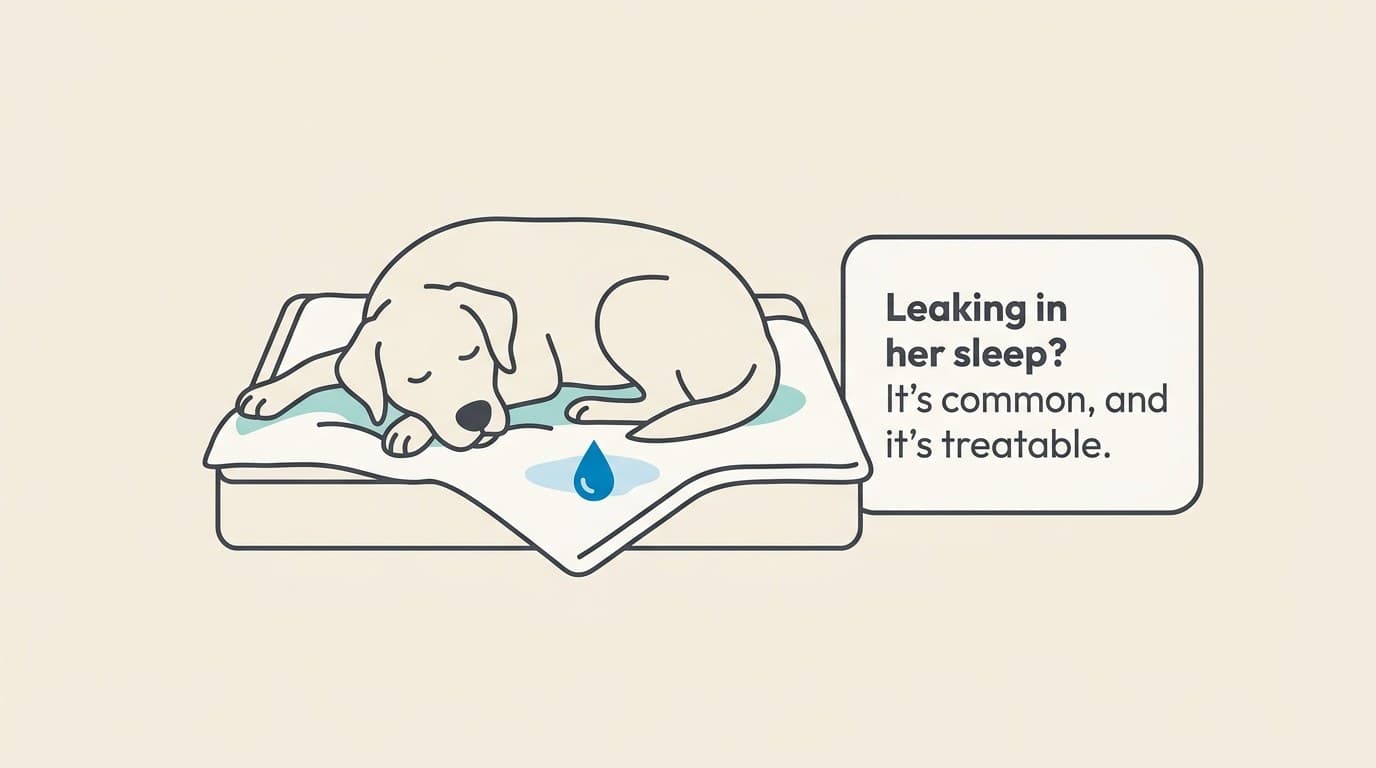
She isn't. If your spayed dog is leaking urine, especially while she's asleep or lying down, the commonest explanation is a weak bladder-neck muscle, a condition vets call urethral sphincter mechanism incompetence (USMI). It's common, it's not her fault, she's not being lazy or dirty, and in the large majority of dogs it's very treatable, usually with one medicine given once a day.
What's going wrong inside
To hold urine in, your dog relies on a ring of muscle that keeps the exit from the bladder, the bladder neck and upper urethra, squeezed shut between toilet trips. In USMI, that closing pressure drops, so the seal isn't quite tight enough. Urine then leaks out passively, a little at a time, without your dog even being aware of it. That's why you so often find it where she's been lying. When she's relaxed or asleep, the muscle tone falls further and the dribble shows up as a wet patch underneath her.
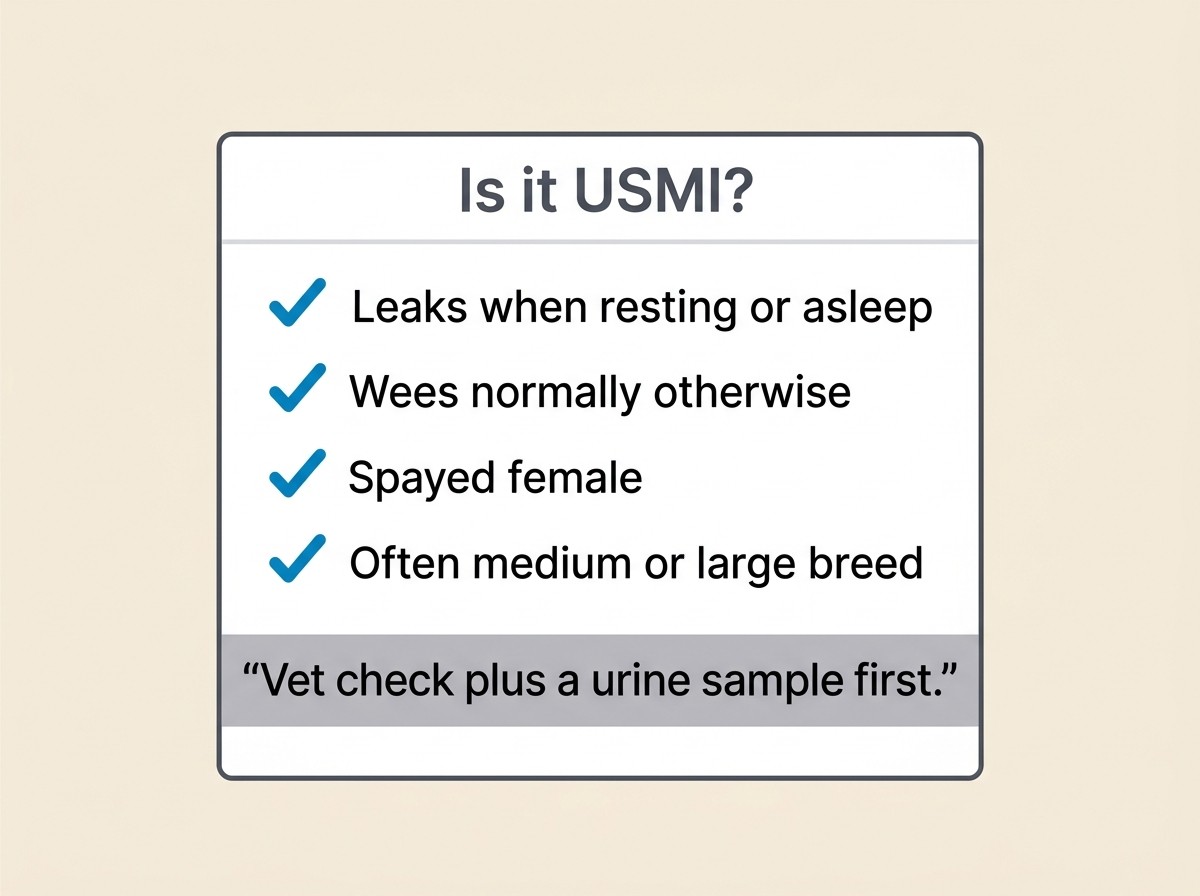
The give-away that points to USMI rather than something else is exactly that pattern: leaking while she's resting or sleeping, in a dog who otherwise squats and passes urine completely normally when she's awake. She isn't straining, she isn't going more often, and she isn't obviously uncomfortable. The bladder fills as usual; it's just that some escapes when she's off guard.
So why does the muscle weaken? It's strongly linked to spaying. Removing the ovaries lowers a dog's oestrogen, and oestrogen helps keep the urethral tissues toned and the seal effective. When that hormonal support falls away, the sphincter in susceptible dogs gradually becomes less competent. USMI is described in the 2024 ACVIM consensus statement as the most common functional urine-storage disorder in dogs, and it's usually, though not always, tied to the hormone changes that follow neutering (Kendall et al., 2024, Journal of Veterinary Internal Medicine).
One detail is worth holding on to, because it spares a lot of unnecessary guilt: this often doesn't appear straight after the operation. In a large referral study, the median time from spaying to the start of leaking was around 3.7 years (Byron et al., 2017, Journal of Veterinary Internal Medicine). So a dog spayed as a youngster may be middle-aged before the first damp patch turns up, which is part of why the connection isn't always obvious.
Which dogs are most prone
USMI can affect any spayed female, but some dogs are more prone than others.
- Size matters most. It's most common in medium and large breeds, particularly dogs over about 20kg. The 2024 ACVIM consensus puts the prevalence of acquired incontinence at somewhere between 3% and 20% in spayed females, and the larger your dog the higher the risk: in one referral study the leaking dogs were significantly heavier than the continent ones (Kendall et al., 2024; Byron et al., 2017). So a spaniel, retriever, boxer or Old English Sheepdog is more likely to be affected than a small terrier.
- Certain breeds carry extra risk. A large UK study of bitches in first-opinion practice found higher rates of early-onset incontinence in breeds including the Irish Setter, Dalmatian, Hungarian Vizsla, Dobermann, Weimaraner and English Springer Spaniel (Pegram et al., 2019, Journal of Small Animal Practice). The ACVIM consensus names a similar set of larger breeds as predisposed, the Old English Sheepdog, Dobermann, Boxer, Giant Schnauzer and Rottweiler among them (Kendall et al., 2024).
- Spaying is the main trigger. In that same UK study, neutered bitches had around twice the risk of leaking compared with entire bitches (Pegram et al., 2019).
A quick, candid word about that last point, because it matters and it's easily misread. Spaying brings real benefits: it removes the risk of a life-threatening womb infection (pyometra) and greatly reduces the risk of mammary cancer. Incontinence is a recognised but manageable trade-off, not a reason to regret neutering your dog. There is some evidence that spaying very early, before around six months, carries a somewhat higher risk of early-onset leaking, and that delaying the operation a little can lower it, especially in larger breeds (Pegram et al., 2024, PLOS One; Pegram et al., 2019). That's useful for planning a future puppy's neutering with your vet. It is not a verdict on a decision you've already made for the dog in front of you. You did the right thing for her, and this is fixable.
Ruling out the things that look similar
Leaking urine isn't always USMI, so your vet will want to check a few other possibilities before settling on it. This is sensible, not a delay, because the treatment is different for each, and it's why the first step is almost always a urine sample. The main mimics are:
- A urinary tract infection. Dogs, unlike cats, genuinely do get bacterial bladder infections, and they can cause leaking, accidents and frequent squatting. A simple urine test sorts this out, and if there's an infection it's treated on its own merits. (For more on this, and on why your dog might have a real UTI when your cat almost certainly doesn't, see the article on whether it's a UTI.)
- Bladder stones or crystals. These irritate the bladder and can cause dribbling, blood or straining. (See the article on bladder stones in cats and dogs.)
- Drinking and weeing far more than usual. If your dog has suddenly become very thirsty and is producing large volumes, that's a different problem, one that can point to conditions such as diabetes, Cushing's disease or kidney disease, and it needs investigating in its own right rather than being treated as simple leaking. (See the article on when urinary signs point higher up, to the kidneys.)
- A leak that's been there since puppyhood. If a young dog has dribbled urine since she was a pup, the likeliest cause is a birth defect called an ectopic ureter, where one of the tubes carrying urine from the kidney empties in the wrong place and bypasses the bladder's seal altogether. It's the commonest congenital cause of incontinence in young dogs, it's far more common in females (who are diagnosed with it many times more often than males), and it usually needs imaging to diagnose and a different sort of treatment, often a minimally invasive laser procedure or surgery rather than a tablet (Kendall et al., 2024; American College of Veterinary Surgeons). So the age at which leaking starts is a genuine clue, and worth mentioning to your vet.
The point of the urine sample is to catch a treatable infection early and to make sure you're not putting a dog with stones or undiagnosed diabetes on the wrong medicine. (For how to collect a clean sample at home, see the urine sample collection guide.)
What treatment can do
Here's the part that tends to lift the worry, because the outlook for USMI is genuinely good.
The standard treatment is a once-daily medicine called phenylpropanolamine, which gently increases the tone in the bladder-neck muscle and restores the seal. It works well: across reported cases, somewhere between roughly 75% and 90% of treated bitches become continent or nearly so (Today's Veterinary Practice). In a blinded, placebo-controlled trial, around 86% of dogs on phenylpropanolamine had no episodes of involuntary leaking by day 28, compared with about a third of dogs on a dummy treatment (Scott et al., 2002, Journal of Small Animal Practice). For many owners, that means going from a daily wet bed to a dry one.
If phenylpropanolamine doesn't suit your dog, or doesn't quite do the job on its own, there are good alternatives. An oestrogen-based medicine called oestriol (sold as Incurin in the UK) tops up the hormone the sphincter is missing and helps a similar proportion of dogs, in the region of nine in ten in some reports (Today's Veterinary Practice). Sometimes the two are combined. For the small number of dogs who don't respond to medication, there are further options at referral level, so a stubborn leak is rarely the end of the road. (The medicines, how to give them, the dosing and what to try when the first one isn't enough are covered in detail in the article on treating incontinence.)
It's also worth setting a realistic expectation. The aim is good control and a dry bed, which is achievable for most dogs, rather than a permanent cure of the underlying weakness. USMI is usually managed for life with a daily medicine, much as you'd manage any long-term condition, and most dogs do very well on it.
Living with it while you sort it out
While you're waiting for your appointment or settling into treatment, a few practical things make life easier for both of you, and protect her skin:
- Washable, absorbent bedding and a waterproof cover under it, so a leak means a quick wash rather than a ruined mattress.
- Keep her skin clean and dry. Urine left on the skin and coat can cause soreness and scalding, so wiping the area with warm water and drying it gently helps, especially overnight. (Bedding, skin care and night-time tips are covered in the article on living with a leaky dog.)
- Let her empty her bladder last thing. A final trip out before bed means there's less in the tank overnight, which is when leaks are most likely.
- Don't tell her off. This is the one that matters most. She has no idea it's happening and no control over it, so a cross word only frightens a dog who has done nothing wrong. If you've felt a flash of irritation at another wet patch, that's human and understandable. It just isn't something she can help.
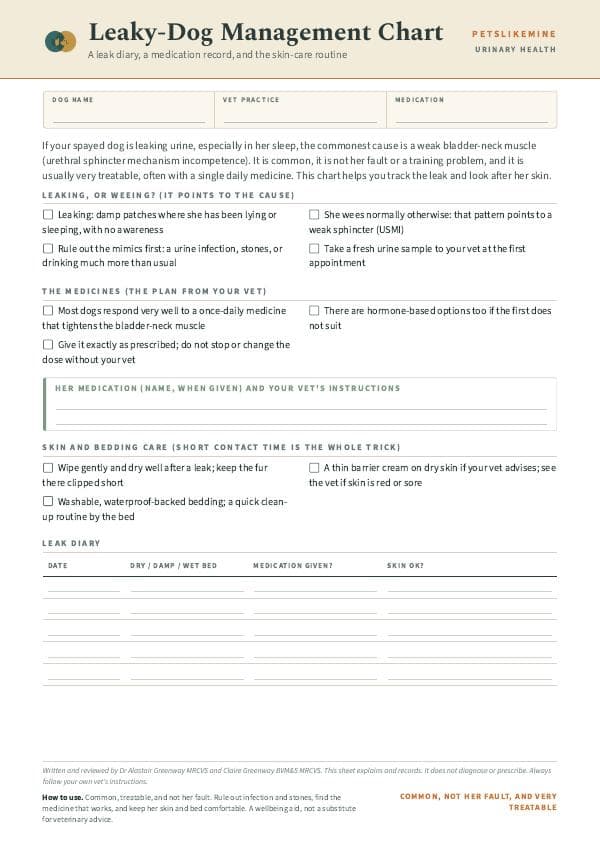
You might find it useful to keep a simple log of how often she's leaking and how she responds once treatment starts, so you and your vet can see the pattern and check the medicine is doing its job. (You can use the general urinary log in the FIC & Water tracker for this.) Many owners are surprised by how quickly the wet mornings stop once the right medicine is on board.
The next step is straightforward: book a vet visit, take a fresh urine sample with you if you can, and expect a good outcome. A dry bed is a realistic goal, and most dogs get there.
Cross-links for the integrator: D2 (treating incontinence), D3 (ruling out infection, stones and behaviour), D4 (living with a leaky dog), F4 ("Is it a UTI?"), S1 (bladder stones), O3 (bladder or kidneys), the FIC & Water tracker tool, the urine sample collection how-to download, and the dog incontinence management and medication chart download.
References
- Kendall, A., Byron, J. K., Westropp, J. L., et al. (2024). ACVIM consensus statement on diagnosis and management of urinary incontinence in dogs. *Journal of Veterinary Internal Medicine*, 38(2), 878-903.
- Byron, J. K., Taylor, K. H., Phillips, G. S., & Stahl, M. D. (2017). Urethral sphincter mechanism incompetence in 163 neutered female dogs: diagnosis, treatment, and relationship of weight and age at neuter to development of disease. *Journal of Veterinary Internal Medicine*, 31(2), 442-448. (PubMed: https://pubmed.ncbi.nlm.nih.gov/28256023/)
- Pegram, C., Brodbelt, D. C., Diaz-Ordaz, K., et al. (2019). Associations between neutering and early-onset urinary incontinence in UK bitches under primary veterinary care. *Journal of Small Animal Practice*, 60(12), 723-733. (open access: https://pmc.ncbi.nlm.nih.gov/articles/PMC6916619/)
- Pegram, C., Diaz-Ordaz, K., Brodbelt, D. C., et al. (2024). Later-age neutering causes lower risk of early-onset urinary incontinence than early neutering, a VetCompass target trial emulation study. *PLOS ONE*, 19(7), e0305526.
- Royal Veterinary College / VetCompass. Early neutering of bitches increases incontinence risk, study finds.
- Scott, L., Leddy, M., Bernay, F., & Davot, J. L. (2002). Evaluation of phenylpropanolamine in the treatment of urethral sphincter mechanism incompetence in the bitch. *Journal of Small Animal Practice*, 43(11), 493-496. (PubMed: https://pubmed.ncbi.nlm.nih.gov/12463265/)
- Today's Veterinary Practice. Urethral Incompetence in Dogs: Updates in Management.
- Incurin (estriol) 1 mg tablets, summary of product characteristics, MSD Animal Health UK.
- American College of Veterinary Surgeons. Ectopic Ureter.
Free downloads
Companion worksheets to put what you've read into practice. Free PDFs, print at home.
Keep track of how your pet is doing
The owners who cope best are the ones who notice changes early. A simple health log shows you what is working, and what is not, before the next vet visit.
Start tracking, freeYou're not doing this alone
Compare treatment journeys and talk to owners managing urinary health. Free to join.
Join PetsLikeMine