

Can Dogs Get Blocked Too? Urethral Obstruction in Male Dogs
Alastair Greenway
BVM&S MRCVS
Most of this section is about cats, and for good reason: the blocked male cat is the classic urinary emergency, the one owners most often miss. But male dogs can block too, and if you've got one squatting over and over, lifting his leg and producing nothing, or crying when he tries to go, you need a straight answer to one question. Can it happen to dogs?
Yes, it can. It's less common than in cats, but a male dog who genuinely cannot pass urine is in exactly the same danger, and the clock runs just as fast. So here is the dog version of the warning the rest of this section gives: what a block is in a dog, why it's almost always a stone, and why a dog who's straining and passing nothing needs a vet now, not in the morning.
How a dog gets blocked, and why it's nearly always a stone
A urethral obstruction means the urethra, the narrow tube that carries urine out of the body, gets plugged so urine can't escape. The first big difference from cats matters most. In a blocked cat, the culprit is usually a soft, gritty plug of crystals and inflammatory gunge that leaks from an irritated bladder, often on the back of feline idiopathic cystitis rather than a true stone. In a dog, that soft-plug story barely happens. When a dog blocks, it's nearly always a solid stone (a urolith) that has slipped out of the bladder and jammed in the urethra. Bladder stones, urethral stones and cancer are the most common causes of urinary obstruction in dogs (Texas Veterinary Medical Foundation).
Why a stone jams in a male when it would have flushed straight out of a female comes down to plumbing. Small stones flow with the urine into the narrow urethra and become lodged, and this happens more often in male dogs because their urethra is much longer and narrower (VCA Animal Hospitals). Male dogs carry one more trap. A small bone called the os penis sits inside the penis, and the urethra runs through a groove in it where it can't stretch. Stones often become stuck in the urethra behind this bone, where it narrows as it passes through the os penis (American College of Veterinary Surgeons). That fixed, bony pinch-point is why a stone that's grumbled away in the bladder for weeks can suddenly become an emergency the day it decides to move.
This is also why the stone type matters. Calcium oxalate stones cause urethral obstruction more readily than struvite, with one 2025 analysis of canine uroliths finding stones lodged in the urethra in 40% of dogs with calcium oxalate stones versus 17% of those with struvite (Pulido Vega et al., Journal of Veterinary Internal Medicine, 2025). And the type decides the plan: struvite stones can often be dissolved with a special diet over a few weeks, while calcium oxalate stones can't be dissolved at all and have to be removed (MSD Veterinary Manual). Knowing which kind your dog forms shapes everything that follows [link to S1, Bladder stones in cats and dogs].
The other causes, mostly in the older boy
Stones are the headline, but two other things can block an older, entire (unneutered) male dog, and they need a different plan. Start with the prostate: a male dog's urethra runs straight through the prostate gland, so when it enlarges it can squeeze the urethra closed just after it leaves the bladder, usually a partial obstruction and occasionally a complete one (Texas Veterinary Medical Foundation). An enlarged prostate is common in older unneutered dogs, so a middle-aged or older entire male who's straining deserves a prostate check.
Then there's a tumour. Transitional cell carcinoma (or urothelial carcinoma) is the most common cancer of the canine urinary bladder, and because it often sits where the bladder meets the urethra, it can narrow and eventually block the urethra as it grows (Griffin et al., Veterinary Sciences, 2018). Its signs look just like a stone or an infection, which is why a dog with stubborn urinary signs that don't add up needs proper imaging, not another guess at antibiotics. It's the least common of the three, and most blocking dogs have a stone. The point is just that "my dog can't wee" always earns a real diagnosis, never an assumption.
Why it's an emergency, the same as in a cat
Whatever the cause, the danger of a complete block is identical across cats and dogs, because the problem is mechanical. The kidneys keep making urine, but with no way out it backs up under pressure all the way to the kidneys, and the body's waste products and salts climb to toxic levels in the blood. Complete obstruction causes a build-up of waste (uraemia) within roughly 36 to 48 hours, leading to depression, vomiting, dehydration and, untreated, death within about 72 hours (MSD Veterinary Manual).
The single most dangerous change is a rising blood potassium, normally cleared in the urine, which can disturb the heart's rhythm when it climbs, and a bladder with nowhere to drain can stretch so far that it ruptures into the abdomen (American College of Veterinary Surgeons). Dogs with a complete urethral obstruction will die within days if it isn't relieved (ACVS). The phrase to hold on to is the same one the cat articles use: this is measured in hours, not days. That's the whole reason you don't wait it out.
The signs, and the one question that decides everything
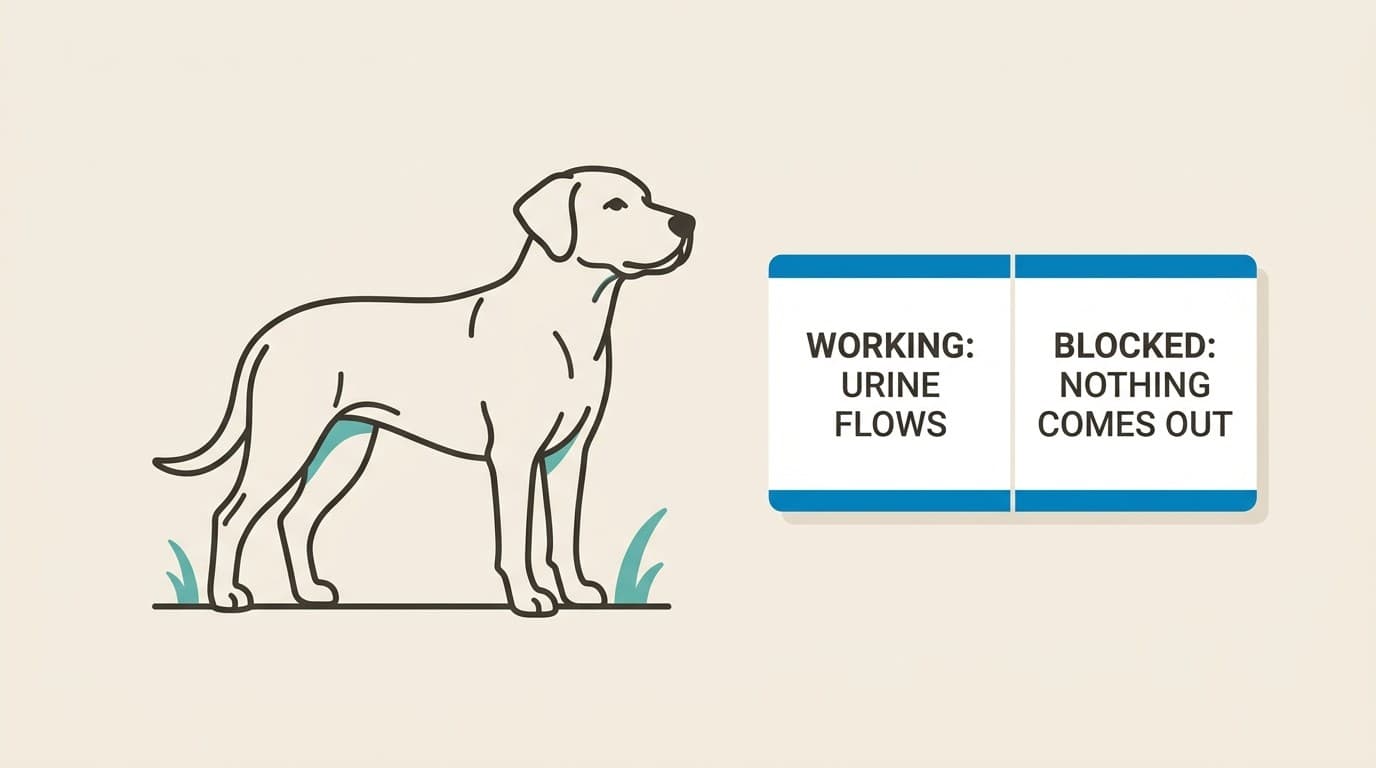
The make-or-break question in a dog is exactly the one it is in a cat. Is he actually passing urine, or just trying to? A dog producing a normal stream has some time. A dog straining over and over and producing little or nothing may be blocked, and that's the line that turns "book an appointment" into "go now".
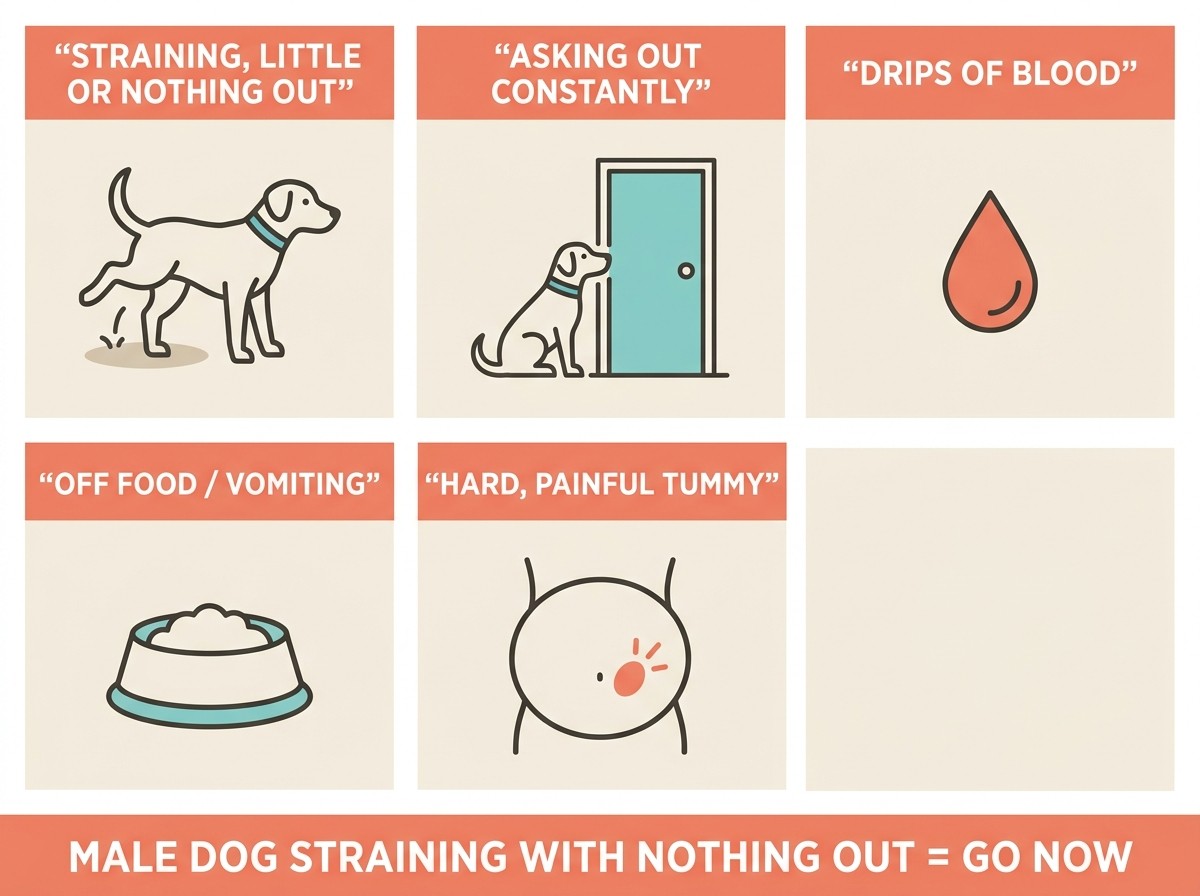
Watch for:
- Straining or posturing repeatedly with little or no urine coming out, or only a few drops or dribbles.
- Crying or obvious discomfort when he tries to go, asking to go out far more often, restlessness or pacing.
- Blood in the urine, or drips of blood from the penis.
- Going off his food, vomiting, lethargy as the blood chemistry turns toxic.
- A hard, tense, painful tummy (the over-full bladder), and later, collapse.
These signs, the repeated unproductive squatting and the small amounts or none at all, are the classic picture (Texas Veterinary Medical Foundation). Any of them in a male dog should be treated as a possible blockage. Don't assume it's constipation, and don't assume it's a simple urine infection, because those are the two things owners most often mistake it for, and both assumptions cost time the dog doesn't have. If he's straining and passing nothing, ring your vet or the out-of-hours emergency service now, tonight if it's night. On the way in, keep him calm and never give human painkillers. Ibuprofen and paracetamol are poisonous to dogs, and ibuprofen in particular damages the kidneys, which is the last thing a dog with a blocked bladder needs (VCA Animal Hospitals).
What the vet does, briefly
At the practice, a block is relieved with the dog sedated or anaesthetised for comfort. For a stone, the vet usually passes a urinary catheter and, where possible, flushes the stone backwards into the bladder so urine can flow again (MSD Veterinary Manual). The stone is then dealt with afterwards: removed by opening the bladder (a cystotomy), or, for the right type, dissolved on a diet. Most dogs stay in for one to four days on a drip, with pain relief and daily bloodwork, until the kidney and potassium values come back to safe (Texas Veterinary Medical Foundation).
For a dog who keeps blocking on stones, a urethrostomy can largely remove the risk by creating a new, permanent opening further back, behind the troublesome os penis where the urethra is wider, so a future stone has room to pass (American College of Veterinary Surgeons). For a repeat blocker that's a protective choice, not a last resort. The cause shapes the rest: a prostate block is treated by neutering and treating the prostate, and a tumour gets a cancer plan, which is exactly why the right diagnosis comes first.
The bit you can actually do something about
The hopeful part is the same lever that runs through this whole space. Because a dog's block is nearly always a stone, and stones form when minerals get too concentrated in the urine, the most useful thing you can do to prevent one is dilute him out. More water through the bladder means more dilute urine, fewer crystals and stones, and a stone that never forms can never block. Shifting some of his diet to wet food, keeping fresh water easy to reach, and following the right prevention diet for his stone type are the everyday habits that stop a future stone becoming the emergency this article describes. The full lifelong plan is in our diet-and-water guide for stone-forming pets [link to S5, Diet and water for a stone-forming pet], and you can log his water intake and any urinary signs in the FIC & Water tracker [link to the FIC & Water tracker] so you and your vet can watch the pattern.
If you're ever staring at your dog straining over a dry patch and unsure how worried to be, don't talk yourself out of acting. The Blocked-Cat and Straining-Pet triage [link to F2, Is this an emergency, and the Blocked-Cat triage tool] will sort his signs into "go now", "today" or "watch" in under a minute, and it works for dogs too. For how a stone turns into a block in both species see our bridge article [link to S4, When a stone causes a blockage], and for the cat version this section mostly covers, the blocked-cat anchor [link to B1, The blocked cat]. It's worth printing the blocked-cat emergency red-flags fridge card [link to the blocked-cat emergency red-flags fridge card download] with your clinic and out-of-hours numbers on it, because the signs are the same in your dog, and there's never a prize for waiting.
References
- American College of Veterinary Surgeons (ACVS). Urinary Obstruction in Dogs.
- MSD / Merck Veterinary Manual. Urethral Obstruction in Small Animals.
- MSD / Merck Veterinary Manual. Urolithiasis in Dogs.
- VCA Animal Hospitals. Bladder Stones in Dogs.
- VCA Animal Hospitals. Ibuprofen Poisoning in Dogs.
- Texas Veterinary Medical Foundation (TVMF). Urinary Obstruction in Dogs: Causes, Signs, and Treatment.
- Pulido Vega D, Motteau-Lévêque M, Maurey C, Mortier J. In Vivo Radiographic Characteristics Associated With the Mineral Composition of Calcium Oxalate, Struvite, and Cystine Lower Urinary Tract Uroliths in Dogs. *Journal of Veterinary Internal Medicine*. 2025;39(6):e70252. doi:10.1111/jvim.70252.
- Griffin MA, Culp WTN, Rebhun RB. Lower Urinary Tract Neoplasia. *Veterinary Sciences*. 2018;5(4):96. doi:10.3390/vetsci5040096.
Keep track of how your pet is doing
The owners who cope best are the ones who notice changes early. A simple health log shows you what is working, and what is not, before the next vet visit.
Start tracking, freeYou're not doing this alone
Compare treatment journeys and talk to owners managing urinary health. Free to join.
Join PetsLikeMine