

Dissolving Struvite Stones with Diet, and When Surgery Is Needed Instead
Alastair Greenway
BVM&S MRCVS
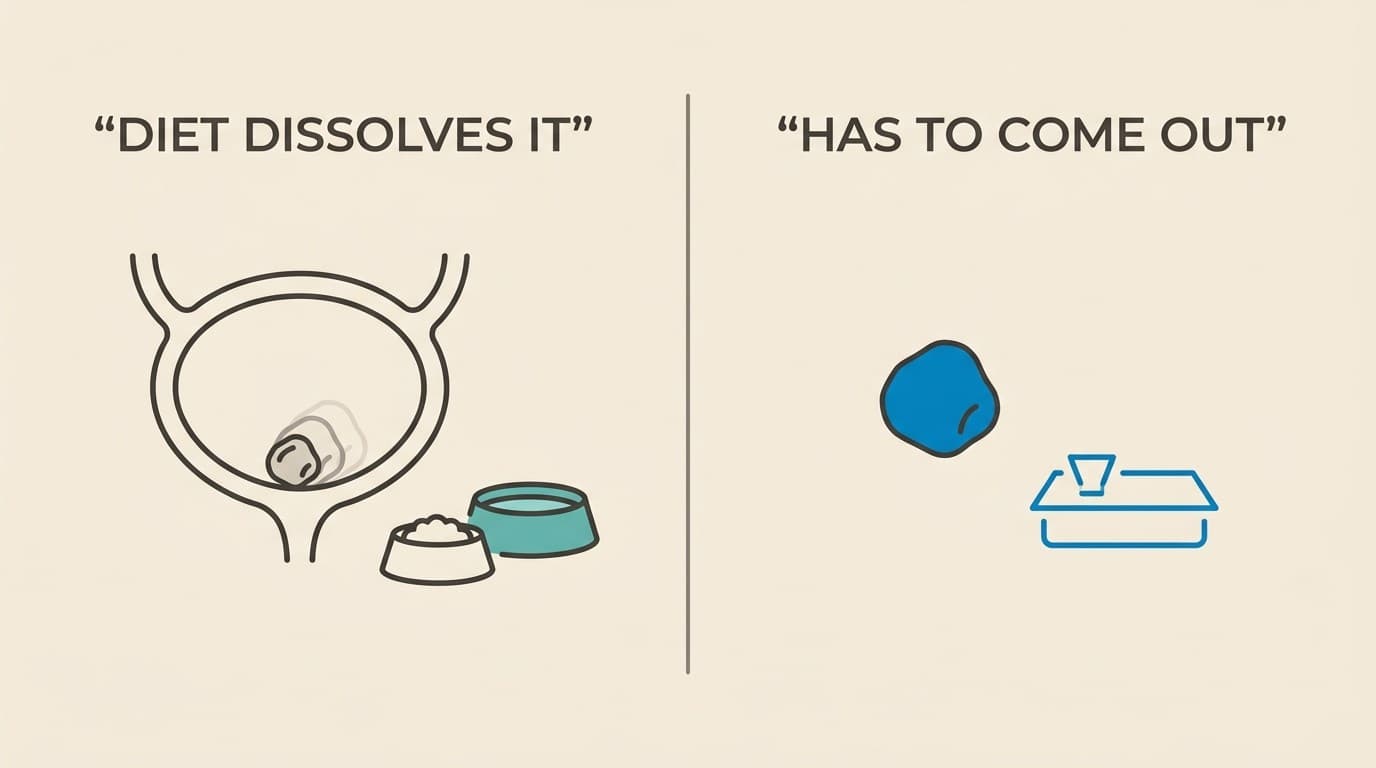
Struvite is the one common bladder stone that you can often make disappear without surgery. On the right diet it melts away over a few weeks, with your pet at home eating their dinner the whole time. No anaesthetic, no incision, no recovery cone. That's a very different conversation from the one owners of calcium oxalate stones have, and it's why the first thing your vet wants to know is the type of stone (we explain the two main types, and why the difference decides everything, in the bladder-stones section anchor).
Dissolution isn't a magic wand, though, and it isn't always the right call. This article covers how it works, how long it takes, what monitoring it needs, and the situations where removing the stone is the better choice.
Why struvite gives way when other stones don't
Struvite stones are made of minerals (magnesium, ammonium and phosphate) that stay solid only when the urine is concentrated and not too acidic. A dissolution diet changes both: these therapeutic foods are restricted in protein, phosphorus and magnesium and formulated to produce a more acidic, more dilute urine, which makes it a less welcoming place for struvite and starts to dissolve the stone that's already there (VCA Animal Hospitals). Layer by layer, the stone gives its minerals back and shrinks.
This is the standard of care for struvite. The expert consensus is that bladder struvite should be medically dissolved rather than cut out wherever it's feasible, because it works well for both the sterile and the infection-related forms and avoids the risks and cost of surgery (ACVIM Small Animal Consensus Recommendations on the Treatment and Prevention of Uroliths, Lulich et al. 2016, J Vet Intern Med). Calcium oxalate, urate and cystine stones don't respond to a simple diet change, which is why "a urinary diet for stones" is a phrase to be wary of: the diet that dissolves struvite is not the diet that prevents oxalate.
Cats and dogs: is there an infection to treat?
This is the one big way struvite behaves differently in cats and dogs, and it changes the plan.
In cats, struvite almost always forms in sterile urine, with no bacterial infection involved (MSD Veterinary Manual). So for most cats, dissolution is purely a diet job: feed the right food, get more water in, and wait. No antibiotics are needed, and giving them wouldn't help.
In dogs, it's usually the reverse. Most canine struvite forms as a complication of a bladder infection, caused by bacteria that make an enzyme called urease (VCA Animal Hospitals). The urease splits urea in the urine and pushes the pH up, and that alkaline, ammonia-rich environment is exactly what struvite needs to crystallise. So in a dog, dissolving the stone means tackling the diet and the infection together. Your dog will be on antibiotics for the whole dissolution period, not just a quick course, because as the stone dissolves, bacteria trapped inside it are released back into the bladder (VCA Animal Hospitals). Stop too soon and you simply feed the next stone. Your vet will usually culture the urine to pick the right antibiotic and confirm the infection has cleared.
How long it takes, and what monitoring looks like
Dissolution is a "few weeks" job, not a "few days" one, and patience is part of the treatment. In cats, small sterile struvite can dissolve in as little as one to two weeks, and most within about two to four weeks on a proper dissolution diet (Today's Veterinary Practice; MSD Veterinary Manual, above). In dogs, where there's usually an infection to clear too, it tends to take longer: some are stone-free in two weeks, others take up to twelve (VCA Animal Hospitals). Sterile struvite, the kind cats nearly always have and dogs occasionally do, dissolves fastest, usually in under two to five weeks (ACVIM consensus, Lulich et al. 2016).
The monitoring is the part owners underestimate, so build it in from day one:
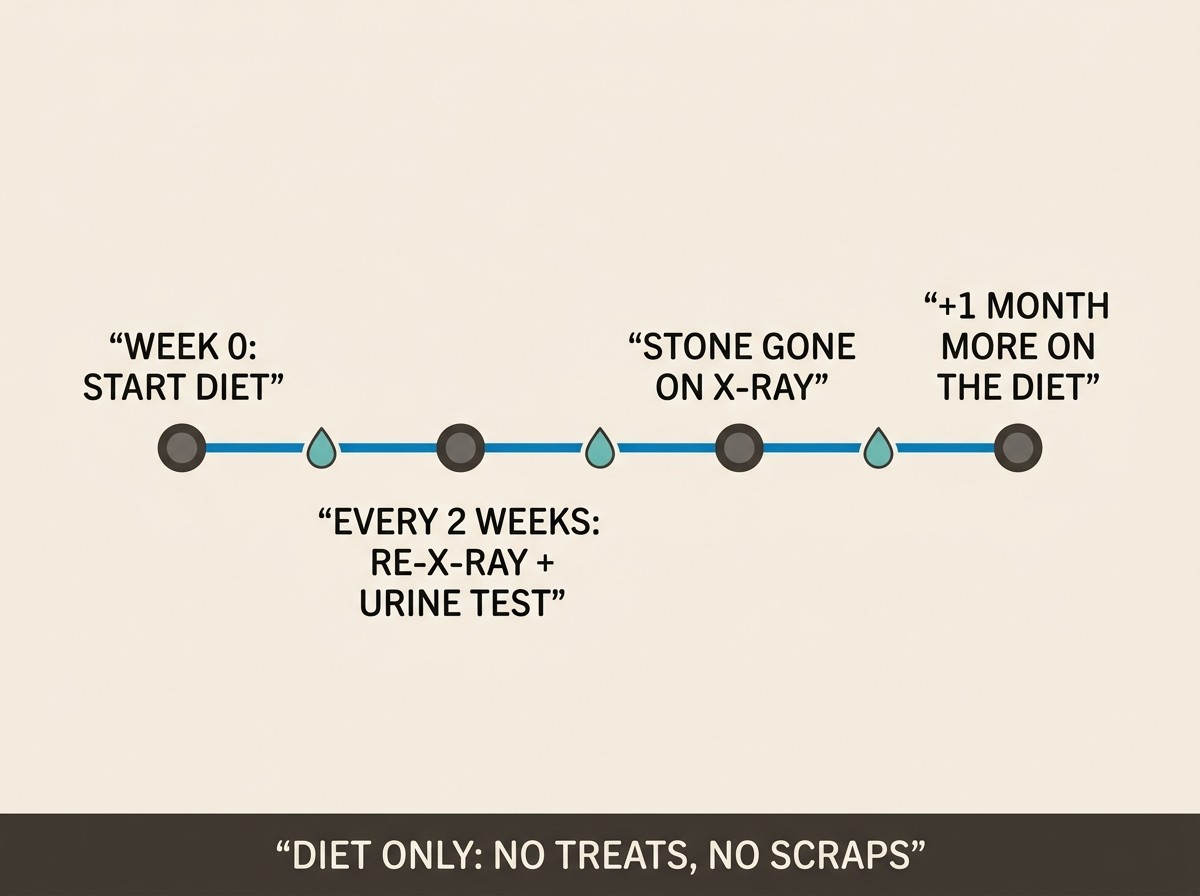
- The diet has to be the only thing your pet eats. No treats, no scraps, no other pet's food, no flavoured medications, because anything else dilutes the effect. In a multi-pet home that means separate feeding, which is a faff but non-negotiable.
- Recheck X-rays and a urine test roughly every two weeks. Your vet re-images the bladder to confirm the stone is shrinking (MSD Veterinary Manual). This is how you know it's working, and how you catch the stones that turn out not to be struvite.
- Keep feeding the diet past the finish line. Once the stone is gone on X-ray, the diet carries on for at least another month, because crystals too small to see can otherwise seed a new stone (Today's Veterinary Practice).
A useful checkpoint: if a stone hasn't made clear progress after two to four weeks of a diet your pet is genuinely sticking to, it probably isn't pure struvite, and should be removed another way (MSD Veterinary Manual). That's not a failure. It's the monitoring sparing your pet a treatment that was never going to work.
When removal is the better choice
Dissolution is the first choice for struvite, but not always the right one. Your vet will lean towards removing the stone when:
- Your pet won't eat the diet, or can't be kept on it alone. The diet only works if it's the whole diet, so a cat who refuses it, or a home where strict separate feeding isn't realistic, makes dissolution unreliable (ACVIM consensus, Lulich et al. 2016).
- The stone is too big, or there are too many. A urolith filling most of the bladder can't be properly "bathed" in the modified urine, so removal is faster and more certain (ACVIM consensus).
- In a dog, the infection can't be controlled. If the infection driving the stone can't be brought under control, dissolution stalls and removal becomes the sensible route (ACVIM consensus). The same goes if you simply need it sorted quickly, since dissolution means weeks of strict feeding and repeat visits (VCA Animal Hospitals).
- There's a real obstruction risk, especially in a male. This is the one true safety caveat. A male cat or male dog has a long, narrow urethra, and a shrinking stone can occasionally slip out of the bladder and lodge there on the way out, a life-threatening blockage (we cover exactly how in the article on when a stone causes a blockage). Reassuringly, the consensus panel notes that obstruction during dissolution hasn't actually been reported in the published literature (Lulich et al. 2016), so it's not a reason to rule dissolution out, just a reason your vet weighs it more carefully in males. If a pet on a dissolution plan starts straining and passing little or nothing, treat it as the emergency it is and ring your vet straight away (the Blocked-Cat / Straining-Cat triage will sort the signs in under a minute).
What "removal" actually means now
If removal is the plan, "surgery" isn't the only option, and the picture is gentler than many owners fear. Open surgery (a cystotomy, opening the bladder to lift the stones out) is still common and effective, though it carries an operation's usual drawbacks, including some post-operative soreness and a small chance a tiny stone is left behind. For the right patient there are also minimally invasive options that avoid opening the bladder, with quicker recovery and fewer complications: small stones can be flushed out under anaesthetic (voiding urohydropropulsion) or retrieved with a tiny basket passed up a cystoscope (Today's Veterinary Nurse). One safety line matters, though: these techniques only suit small stones, and flushing is not done in male cats, whose urethra is too narrow and who would be put at risk of a blockage. It's worth asking whether a less invasive route is possible before assuming a full operation is the only way.
After the stone is gone: don't stop there
Whichever path your pet takes, dissolving or removing the stone is only half the job. Struvite comes back if the conditions that made it are still there, so in dogs the answer is preventing the urinary infections that drive it, and in any pet it's keeping the urine dilute. Getting more water through the bladder remains the cheapest, most powerful lever you have, and many pets stay on a preventive diet long-term.
So once the crisis is sorted, the focus shifts to that lifelong plan, set out fully in the diet-and-water article for stone-forming pets and the stone-prevention diet-and-water worksheet. Logging your pet's water intake and any urinary signs in the FIC & Water tracker lets you and your vet watch the pattern over months and catch a recurrence while it's still small enough to dissolve. A stone you melt away at home beats one you have to operate on, and the question to take to your vet is simple: do we know this is struvite, and is dissolution safe and realistic for my pet?
References
- Lulich JP, Berent AC, Adams LG, Westropp JL, Bartges JW, Osborne CA. ACVIM Small Animal Consensus Recommendations on the Treatment and Prevention of Uroliths in Dogs and Cats. *Journal of Veterinary Internal Medicine*. 2016;30(5):1564–1574.
- MSD / Merck Veterinary Manual. Urolithiasis in Cats.
- Today's Veterinary Practice. Feline Struvite & Calcium Oxalate Urolithiasis.
- VCA Animal Hospitals. Struvite Bladder Stones in Dogs.
- Today's Veterinary Nurse. Noninvasive Methods for Removing Cystoliths in Small Animals.
Keep track of how your pet is doing
The owners who cope best are the ones who notice changes early. A simple health log shows you what is working, and what is not, before the next vet visit.
Start tracking, freeYou're not doing this alone
Compare treatment journeys and talk to owners managing urinary health. Free to join.
Join PetsLikeMine