

Getting the thyroid diagnosis right: the tests, and the traps
Alastair Greenway
BVM&S MRCVS
If your dog has slowed down, put on weight without eating more, and started losing coat in a tidy, symmetrical, non-itchy pattern, hypothyroidism is a fair thing to suspect. It's a real disease, and once it's confirmed it's one of the most satisfying conditions in practice to treat. The catch is the word "confirmed". Hypothyroidism is genuinely over-diagnosed in dogs, because a long list of everyday things can drag a thyroid blood result down in a dog whose thyroid is working perfectly well. So a single low number is the start of the conversation, not the end of it.
This article is the nuts-and-bolts companion to the bigger-picture piece on the under-active thyroid (the over-diagnosed, very-treatable one): what each blood test actually does, why no single result diagnoses the disease, and the traps that catch dogs out. For a lighter, plain-English tour of all the hormone blood tests, the funnel explainer on the hormone blood tests covers the same ground.
First, who the test is even for
Thyroid testing is only meant to be run on a dog that already looks like it might be hypothyroid. That's the single most important rule, because testing a dog without suggestive signs, or "screening" a well or unwell dog out of curiosity, is one of the surest ways to land a wrong diagnosis (Heseltine, Today's Veterinary Practice). The dog this test belongs to is usually middle-aged, can be any breed (a few, such as Golden Retrievers and Dobermanns, are reported more often), and shows the slowed-down, weight-gaining, cold-seeking, coat-losing picture (Heseltine, Today's Veterinary Practice; Merck Veterinary Manual). If that isn't your dog, an odd thyroid number found by chance is far more likely to be a red herring than a diagnosis.
The three tests, and what each one can and can't do
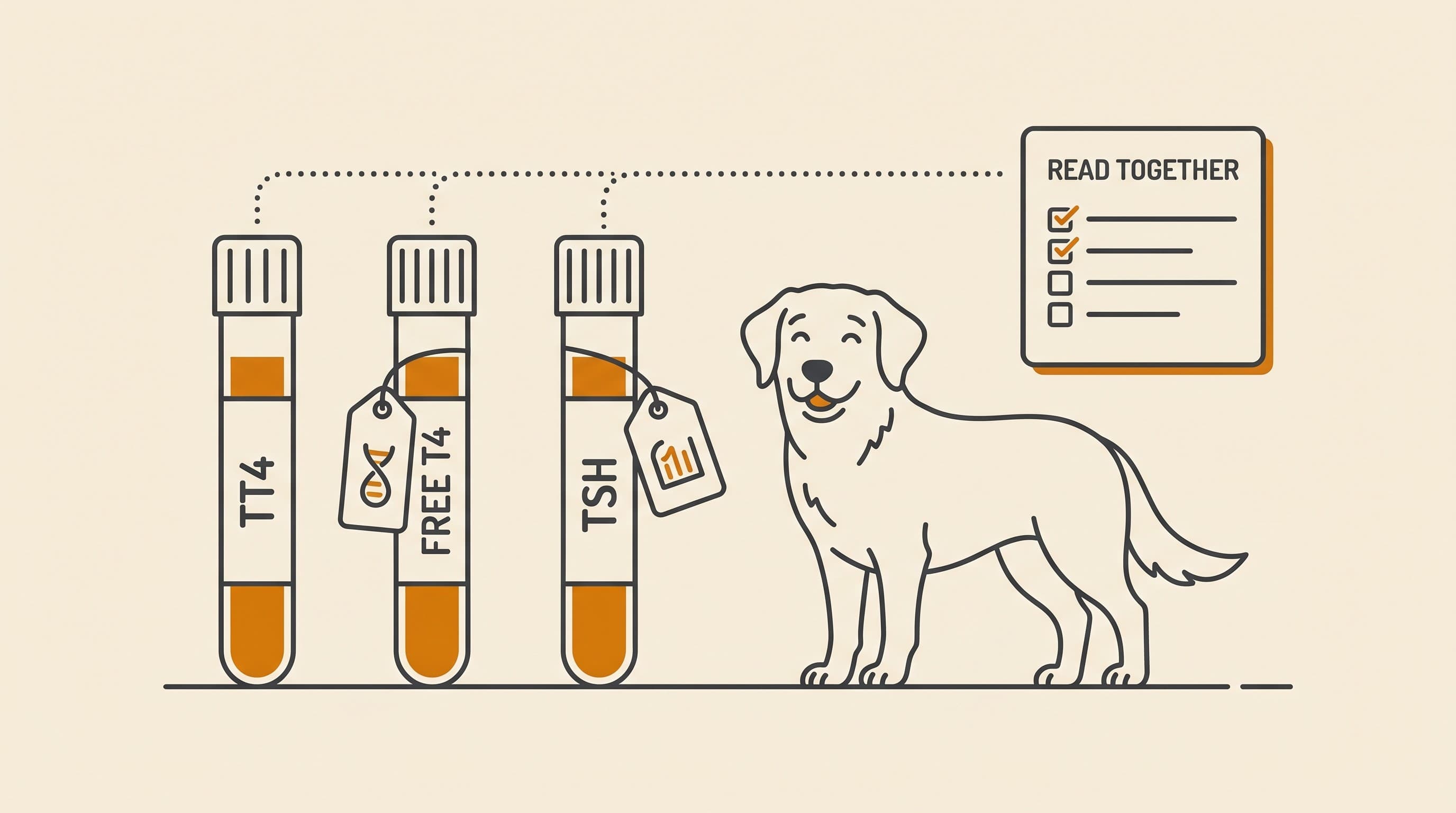
There are three results your vet is likely to look at. They work as a team precisely because each one has a blind spot.
Total T4 (TT4) is the usual first test, and it's a good screen. It's very sensitive, meaning roughly 89 to 100% of truly hypothyroid dogs have a low result, so a clearly normal TT4 makes hypothyroidism unlikely and is genuinely reassuring (Heseltine, Today's Veterinary Practice). But it's not specific. A low TT4 on its own does not diagnose hypothyroidism, because so many non-thyroid things lower it (Heseltine, Today's Veterinary Practice; Clinician's Brief). This is the number people misread more than any other.
Free T4 by equilibrium dialysis (fT4ed) is the more accurate single measure of thyroid function. The dialysis step separates the active, unbound hormone from blood proteins and from any thyroid autoantibodies, and it's generally less affected by other illness and by medication than total T4 is, which is why the "premium" panels include it when there's a confounder in play (Michigan State University VDL; Clinician's Brief). It's a sharper tool, but as you'll see, it isn't bullet-proof.
TSH (the pituitary's "work harder" signal) is useful when it's high, fitting the pattern of an under-active gland being pushed. The trap is the other direction: a normal TSH does not rule hypothyroidism out. In roughly a fifth to two-fifths of confirmed cases the TSH is still normal (reported as about 13 to 40%), so TSH must never be the lone test (Heseltine, Today's Veterinary Practice; Clinician's Brief; Cornell AHDC).
Put together, the diagnosis your vet is really looking for is a low TT4 and a low fT4 with a raised TSH, in a dog whose signs fit. The recommended panel to catch almost every case is total T4 plus TSH plus free T4 by equilibrium dialysis, and a panel where all three come back normal effectively rules the disease out (2023 AAHA Selected Endocrinopathies; Michigan State University VDL). Just as importantly, a single borderline-low hormone, or a lone raised TSH, is not enough on its own (Michigan State University VDL). The traps below exist precisely because people read one number in isolation.
Trap one: a dog that's ill for some other reason
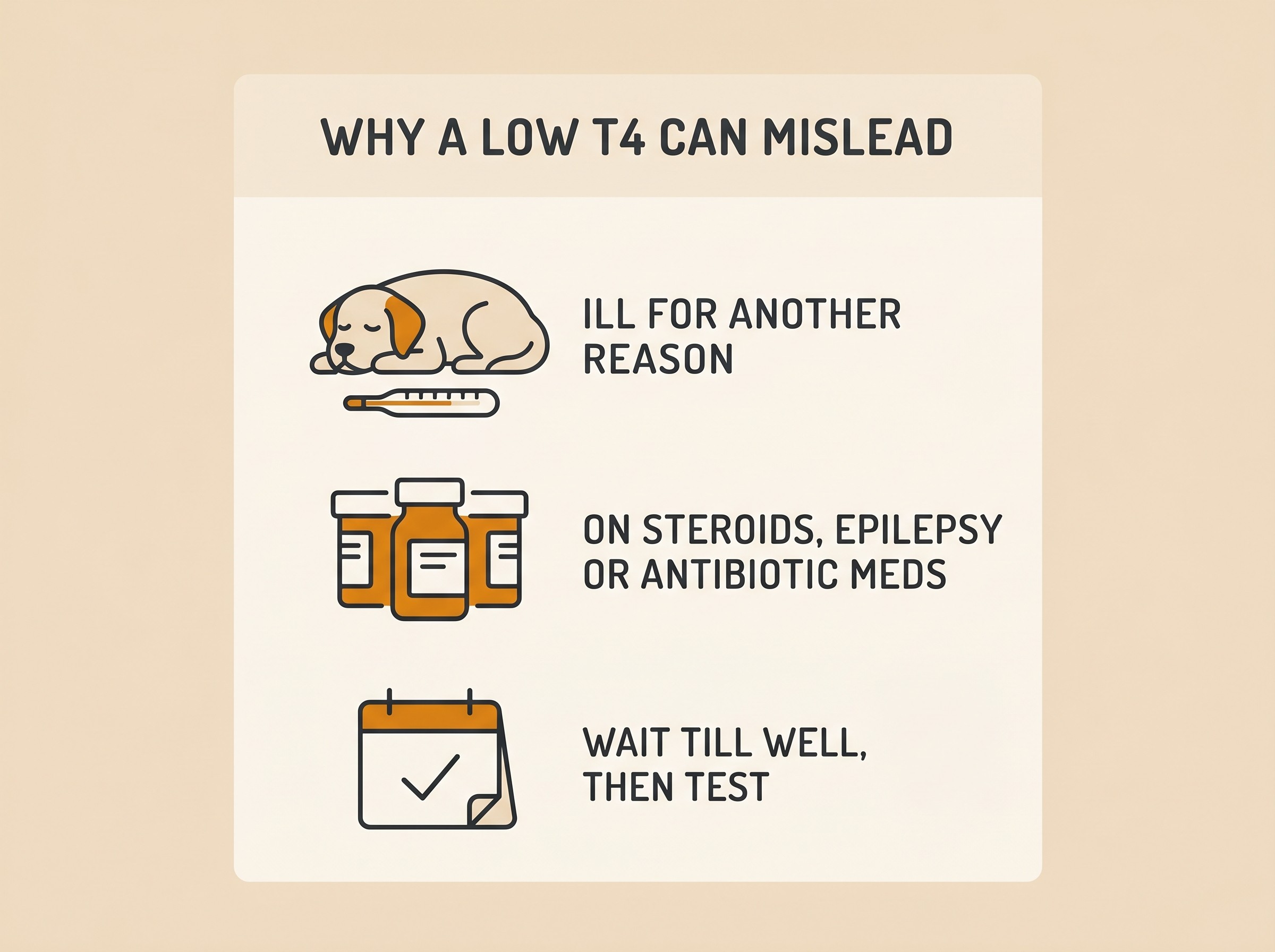
This is the big one. A dog that is poorly for any non-thyroid reason can show low thyroid blood results without having thyroid disease at all. It's called non-thyroidal illness, or "euthyroid sick syndrome", and it's so common that it and true hypothyroidism are the two most frequent thyroid-test patterns vets see in dogs (Merck Veterinary Manual). The body quietly turns the thyroid axis down while it deals with the real problem.
Illnesses especially likely to pull the numbers down include Cushing's disease, diabetes, Addison's, kidney or liver disease and infection, and broadly, the sicker and the more long-standing the illness, the lower the TT4 goes, with up to around 35% of euthyroid dogs with non-thyroidal illness showing a low TT4 at the higher end (Bolton et al. 2025, Frontiers in Veterinary Science). The effect is gentler in short, acute illness than in chronic illness, so the timing of the sample matters as much as the fact of it (Corsini et al. 2024, Journal of Veterinary Internal Medicine).
Here's the part that surprises most people, including some vets: even free T4 by equilibrium dialysis isn't immune. In a 2025 study of euthyroid dogs with non-thyroidal illness, when the TT4 was low, the fT4ed was also below range in about 59% of them, and the authors judged its ability to rule out hypothyroidism in an ill dog "low and clinically unacceptable" (Bolton et al. 2025, Frontiers in Veterinary Science). The lesson isn't to reach for a fancier test. It's that the real fix is not to test the thyroid while the dog is unwell. The practical rule is to wait until your dog has been well for a few weeks first, commonly about 2 to 4 weeks after an illness has resolved (Corsini et al. 2024, Journal of Veterinary Internal Medicine).
Trap two: medications that lower thyroid results
Several common drugs can produce a falsely low thyroid result in a dog with a normal gland, and the effects reverse once the drug is stopped, so your vet needs to know everything your dog is taking (Bolton & Panciera 2023, Journal of Veterinary Internal Medicine). The three an owner most needs to recognise are steroids, phenobarbital and a particular type of antibiotic.
Steroids (glucocorticoids) suppress the thyroid axis. At higher, immunosuppressive doses both TT4 and fT4 fall, usually with the TSH staying normal, so the picture can mimic hypothyroidism but with a tell-tale normal TSH, and the numbers drift back towards baseline within roughly a week or more of stopping (Bolton & Panciera 2023, Journal of Veterinary Internal Medicine). The body's own excess cortisol in Cushing's does the same thing, one more reason the two conditions tangle together. If your dog is on long-term steroids for skin or allergy problems, our Allergies and Skin guidance on long-term steroids is the natural companion read, and never stop long-term steroids abruptly, as they always need to be tapered under your vet.
Phenobarbital, the common epilepsy drug, increases how fast the body clears T4 when given long term, lowering TT4 and fT4 and sometimes nudging TSH up a little. Values normalise roughly 4 to 6 weeks after stopping, and testing is best left until at least 6 weeks after the drug is discontinued (Bolton & Panciera 2023, Journal of Veterinary Internal Medicine; Clinician's Brief). This overlap is common, so many phenobarbital dogs end up looking "hypothyroid" on paper when they aren't. If your dog is managed for seizures, our Epilepsy space has more on phenobarbital.
Potentiated (trimethoprim) sulphonamide antibiotics are a different and important case. Rather than just disturbing the test, they genuinely reduce hormone production, causing a true but reversible hypothyroidism, with low TT4 and fT4 and a genuinely raised TSH, so the pattern looks "real" (Bolton & Panciera 2023, Journal of Veterinary Internal Medicine; Clinician's Brief). The reassuring half is that it gets better once the antibiotic is stopped, usually within about 3 to 4 weeks, occasionally longer (Bolton & Panciera 2023, Journal of Veterinary Internal Medicine). The advice is the same as for the others: don't test the thyroid while your dog is on it.
The general rule: where possible, don't run thyroid tests on a dog while it's taking a drug known to interfere, because the result can't be trusted and risks a lifetime of unnecessary medication. If the drug can't be stopped, a premium panel with free T4 by equilibrium dialysis and TSH, read alongside the clinical picture, is the better compromise (Michigan State University VDL; Bolton & Panciera 2023, Journal of Veterinary Internal Medicine).
One more result you might see: TgAA
If your lab report mentions a thyroglobulin autoantibody (TgAA) test, here's what it does and doesn't mean. It's a marker of autoimmune (lymphocytic) thyroiditis, the commonest underlying cause of canine hypothyroidism, found in roughly 35 to 50% of hypothyroid dogs (Clinician's Brief). But a positive TgAA is not, by itself, a diagnosis. A dog can be TgAA-positive with completely normal thyroid hormones and feel entirely well, and fewer than about 20% of such dogs develop clinical hypothyroidism within a year, though they're worth monitoring because they are predisposed (Clinician's Brief; Michigan State University VDL). So if you see it flagged, read it as "the immune process is there", not "your dog needs the tablet today".
Why all this care actually matters
It can feel like a lot of caution over a cheap, safe tablet. But the cost of getting it wrong is real. If a healthy-thyroid dog is labelled hypothyroid, it's committed to lifelong thyroxine it doesn't need, and the actual reason it felt off, the other illness or the drug effect, goes unspotted and untreated (Bolton & Panciera 2023, Journal of Veterinary Internal Medicine). That's exactly why the standard of care is the whole panel read against the clinical picture, not a lone low TT4.
So if your dog has a single odd result and your vet wants to wait a few weeks, repeat the test, or run the fuller panel before starting treatment, that isn't them being slow. It's them getting it right. The genuinely good news is that when the picture does line up and the diagnosis is real, treatment is straightforward and the response is usually excellent, which is what the next piece, on levothyroxine for life, is all about. The coat changes that often bring these dogs in are covered in the thyroid and the skin, which links across to our Allergies and Skin guide on hair loss without itching.
References
- Heseltine J. "Canine Hypothyroidism: Diagnosis and Treatment." Today's Veterinary Practice.
- Merck Veterinary Manual — "Hypothyroidism in Animals."
- Bugbee A. "Canine Hypothyroidism" (Diagnose & Treat). Clinician's Brief, updated June 2025.
- McLewee N, Lathan P. "Medications That Suppress Thyroid Function." Clinician's Brief.
- Michigan State University Veterinary Diagnostic Laboratory — "Thyroid Function in Dogs."
- Cornell University Animal Health Diagnostic Center — "Canine Thyroid Testing."
- 2023 AAHA Selected Endocrinopathies of Dogs and Cats Guidelines — Canine Hypothyroidism: Diagnostic Testing and Monitoring. DOI: 10.5326/JAAHA-MS-7368.
- Bolton TA, Marino CL, Derré MG, Moore GE, Piccione J, Delovio ML. "Free thyroxine measured by chemiluminescence and equilibrium dialysis is frequently below the reference interval in known euthyroid dogs with nonthyroidal illness syndrome." Front Vet Sci 2025;12:1657215.
- Corsini A, Del Baldo F, Lunetta F, et al. "Total thyroxine, triiodothyronine, and thyrotropin concentrations during acute nonthyroidal illness and recovery in dogs." J Vet Intern Med 2024;38(3):1345–1352.
- Bolton TA, Panciera DL. "Influence of medications on thyroid function in dogs: An update." J Vet Intern Med 2023;37(5):1626–1640.
Keep track of how your pet is doing
The owners who cope best are the ones who notice changes early. A simple health log shows you what is working, and what is not, before the next vet visit.
Start tracking, freeYou're not doing this alone
Compare treatment journeys and talk to owners managing hormone health. Free to join.
Join PetsLikeMine