

Diagnosing Cushing's: the testing maze (and the over-testing trap)
Alastair Greenway
BVM&S MRCVS
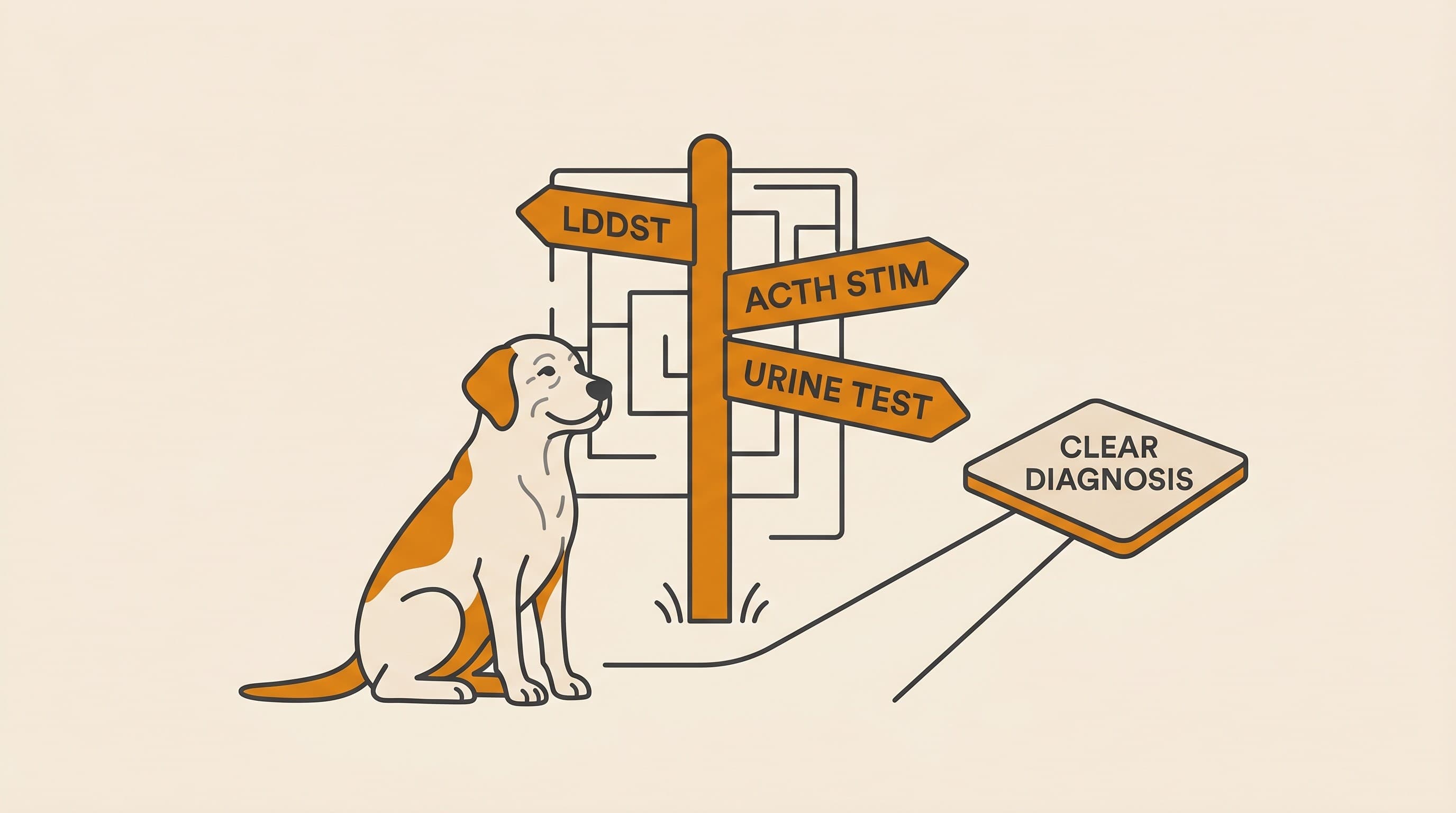
If your vet has mentioned Cushing's and then started talking about a morning of blood tests, a urine sample, maybe a scan, you'd be forgiven for thinking they're being indecisive. They're not. Cushing's is one of the few conditions in dogs where there genuinely isn't a single clean blood test that settles it. The diagnosis is built deliberately, from several pieces that all have to point the same way.
Once you understand why it's staged, you can tell the difference between a vet being careful and a vet stalling. There's also a trap hiding in here, the over-testing trap, and knowing about it protects your dog from being put on lifelong medication they may not need. Let's walk through it calmly.
Why there's no single test
Cushing's disease (the vets call it hyperadrenocorticism) means the body is making too much cortisol, the stress hormone, for too long. The problem is that cortisol is supposed to go up and down through the day, and it shoots up whenever a dog is stressed, excited or unwell for any reason. So a one-off "high cortisol" reading tells you almost nothing on its own.
Every test used to diagnose Cushing's can throw up a false positive (saying yes when the answer is no) and a false negative (saying no when the answer is yes) (ACVIM 2012; Today's Veterinary Practice). That isn't a flaw in your particular vet's lab. It's true of the whole pituitary and adrenal system, everywhere, and recognising it is one of the things that separates a confident diagnosis from a guess (Today's Veterinary Practice).
So a proper Cushing's diagnosis isn't "the test came back positive". It's the clinical signs, the physical examination, and the routine blood, urine and hormone results all agreeing with each other (Today's Veterinary Practice). A positive hormone test by itself does not confirm Cushing's (Today's Veterinary Practice). When all of it lines up, your vet can be genuinely confident. When it doesn't, the right move is to wait, repeat, or look elsewhere, and that is good medicine, not indecision.
The over-testing trap (the one to know about)
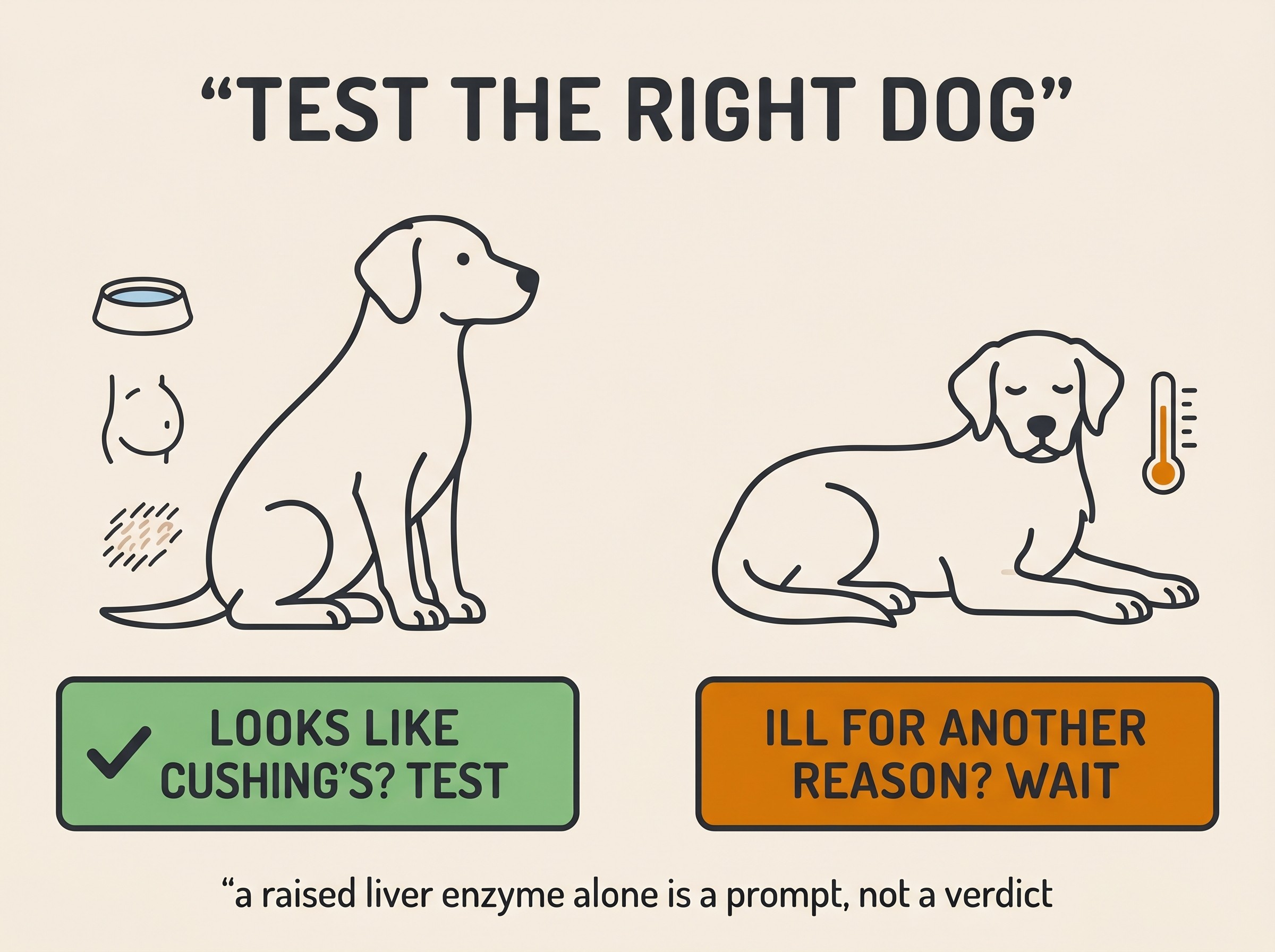
Because the signs of Cushing's are so common, drinking more, a pot belly, a thinning coat, panting, and because a raised liver enzyme called ALP shows up on routine bloods so often, it's tempting to run a Cushing's test on almost any older dog "to be thorough". That is exactly the wrong instinct.
Testing a dog that's actually ill for some other reason, or one that's stressed or excited on the table, produces false-positive results (Today's Veterinary Practice). For that reason the consensus among specialists is to run these tests only in dogs that genuinely show the clinical signs of Cushing's (ACVIM 2012), and to postpone testing if a dog has another serious illness going on until that illness is sorted (AAHA 2023). A raised liver enzyme on its own is a prompt to think about Cushing's, not a reason to test for it.
This isn't a theoretical worry. In a 2025 survey across several European countries, around 60% of primary-care vets said they would run Cushing's screening tests even when a dog had no supportive clinical signs, just some abnormal blood results (Carvalho et al. 2025). That's a survey of what vets say they'd do, not a measure of dogs misdiagnosed, so don't read it as "most Cushing's diagnoses are wrong". But it tells you the temptation to over-test is real and widespread.
So the right first question is never "what does the blood test say?". It's "does this dog actually look like Cushing's?". If your vet pauses, declines to test a poorly dog, or wants to recheck before committing, they're protecting your dog from a false alarm. That matters, because a dog wrongly diagnosed can be started on lifelong medication it doesn't need, with real risks of its own.
The three screening tests, in plain words
If your dog does look the part, your vet picks one of three screening tests to ask the first question: is this Cushing's at all? Each has a personality.
The low-dose dexamethasone suppression test (LDDST) is the one most vets reach for first (AAHA 2023). It's a half-day in the clinic: a blood sample, a tiny injection of a steroid called dexamethasone, then two more samples a few hours apart. In a normal dog that steroid switches cortisol production off for a while. A Cushing's dog can't switch off properly. It's the most sensitive screen, meaning it rarely misses true cases, but it's also the most easily thrown off by stress or other illness, so it gives more false positives (Today's Veterinary Practice). Reported sensitivity runs roughly 85 to 100%, with specificity quoted across a wide 44 to 73% range (Today's Veterinary Practice). The spread in those numbers is the reality, so be wary of anyone quoting a single neat figure.
The ACTH stimulation test is quicker and tends to give fewer false positives, but it misses more true cases, especially the adrenal-tumour kind (Today's Veterinary Practice). It's a baseline sample, an injection that prods the adrenal glands, then one more sample about an hour later. Its real strengths are two specific jobs: confirming the steroid-induced kind of Cushing's (more on that below), and monitoring treatment later on (AAHA 2023). If the LDDST comes back unclear but suspicion is still high, this is often the next step (AAHA 2023).
The urine cortisol to creatinine ratio (UCCR) is the gentle one: a urine sample, no needles. It's best thought of as a rule-out test. A normal (low) result makes Cushing's unlikely and is genuinely reliable for excluding it (Today's Veterinary Practice). But a high result does not confirm anything, because so many other illnesses and plain stress push it up (ACVIM 2012). One useful tip if your vet uses this test: collect the urine at home and bring it in, because a sample taken in the clinic reads significantly higher thanks to the stress of being there (Vet Clin Pathol literature). Quieter dog, truer number.
Working out which kind it is
Confirming Cushing's is only half the job. There are two kinds, treated differently, so once the diagnosis is settled your vet may run a second round of tests to find out which your dog has.
Around 80 to 85% of cases are pituitary-dependent, driven by a tiny, usually benign growth on the pituitary gland at the base of the brain that keeps telling the adrenals to overproduce. The remaining 15 to 20% are adrenal-dependent, caused by a growth on one of the adrenal glands themselves (ACVIM 2012). The adrenal kind turns up more often in larger dogs, over about 20 kg, while the pituitary kind is commoner in small breeds (Today's Veterinary Practice).
To tell them apart, vets use some combination of an abdominal ultrasound, a measurement of the dog's own ACTH hormone, and the suppression pattern from that LDDST (ACVIM 2012). On the ultrasound, two normal or evenly enlarged adrenal glands fit the pituitary kind, whereas one enlarged gland with a shrunken partner fits an adrenal tumour (Today's Veterinary Practice). A normal or high ACTH level points to the pituitary kind, a low one to an adrenal tumour (Today's Veterinary Practice). Conveniently, the LDDST sometimes answers both questions at once: if cortisol suppresses at certain points in the test, that pattern confirms the pituitary kind and no further test is needed, though a failure to suppress doesn't distinguish the two (AAHA 2023).
You don't need to memorise any of this. The point is simply that the second round of tests has a clear purpose: it changes what treatment your dog gets.
One last check before you test: the steroid question
There's one scenario that catches people out. If your dog is already on steroids in any form, tablets, or even eye, ear or skin preparations, or injections, tell your vet before any Cushing's testing. Steroid medication can cause its own version of Cushing's that looks identical from the outside but behaves completely differently on a test (AAHA 2023).
The giveaway is the ACTH stimulation test. In the steroid-induced kind both the before and after cortisol readings come back very low, almost flat, the opposite of the exaggerated response you'd see with the natural form (AAHA 2023; MSD Veterinary Manual). That distinction matters, because the fix is completely different: you never treat it with the usual Cushing's drugs, you carefully taper the steroids back down, and you never stop them abruptly. We cover this fully in our article on steroid-induced (iatrogenic) Cushing's, but the headline is simple: mention any steroids first.
The takeaway
A confident Cushing's diagnosis is built slowly, from the clinical picture, the bloods and urine, and a positive hormone test all agreeing. That layered approach is a feature, not your vet dragging their feet, and it's the thing that stops a single number committing your dog to medication for life.
The reassuring part is that there's no rush. Cushing's develops slowly, your dog isn't in danger during the work-up, and there is real time to get the diagnosis right (Today's Veterinary Practice). If something doesn't add up, the careful answer is to wait or repeat, not to push on. Once you do have a clear diagnosis, our guide to treating Cushing's with trilostane walks through the next decision, including the important truth that not every dog needs treating straight away. In the meantime, logging your dog's drinking on the Thirst & Wee tracker, and reading "Cushing's explained" for the full picture of what marked thirst looks like, gives your vet exactly the real-world evidence that makes a diagnosis solid.
References
- Behrend EN, Kooistra HS, Nelson R, Reusch CE, Scott-Moncrieff JC. Diagnosis of Spontaneous Canine Hyperadrenocorticism: 2012 ACVIM Consensus Statement (Small Animal). J Vet Intern Med. 2013;27(6):1292–1304. DOI: 10.1111/jvim.12192
- 2023 AAHA Selected Endocrinopathies of Dogs and Cats Guidelines — Canine Hypercortisolism: Diagnostic Testing and Monitoring. American Animal Hospital Association.
- Carvalho MF, Leal RO, Golinelli S, et al. Diagnosis of naturally-occurring Cushing's syndrome by primary care veterinarians in selected European countries. J Vet Intern Med. 2025;39(1):e17166. DOI: 10.1111/jvim.17166
- The Diagnosis of Canine Hyperadrenocorticism. Today's Veterinary Practice.
- Cushing's Disease in Dogs Part 2: Diagnostic Approach. Today's Veterinary Practice.
- Canine Hyperadrenocorticism: Challenges Establishing the Diagnosis. Today's Veterinary Practice.
- Cushing Disease (Pituitary-Dependent Hyperadrenocorticism) in Animals. MSD Veterinary Manual.
- Urine cortisol:creatinine ratio diagnostic-performance literature (samples collected in hospital significantly higher than home-collected). Vet Clin Pathol / J Vet Intern Med.
Keep track of how your pet is doing
The owners who cope best are the ones who notice changes early. A simple health log shows you what is working, and what is not, before the next vet visit.
Start tracking, freeYou're not doing this alone
Compare treatment journeys and talk to owners managing hormone health. Free to join.
Join PetsLikeMine