

Diabetes insipidus: the water diabetes that is not about sugar
Alastair Greenway
BVM&S MRCVS
If your pet has just been told they have "diabetes insipidus", the most reassuring thing to know is this: it's not the sugar diabetes you have probably heard of. That one shared word makes it sound alarming, but it's a completely different disease, with a different cause, a different test and a different treatment. It's also rare, so most pets who drink and wee a lot don't have it at all. This piece untangles the two, explains the "water hormone" in plain terms, and shows you where diabetes insipidus sits in the bigger picture.
Two diseases, one confusing word
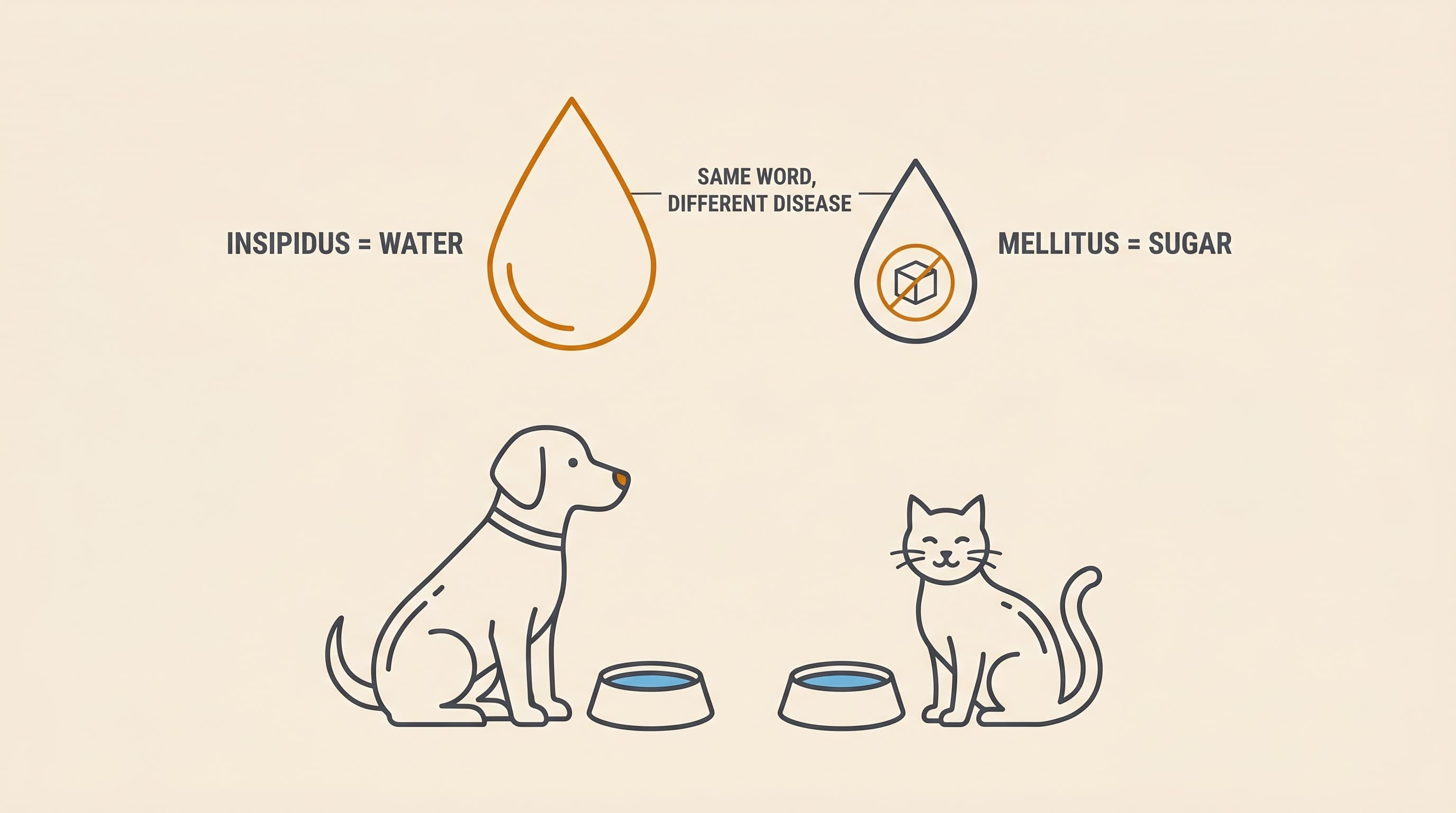
Diabetes mellitus, the "sugar" kind, is a problem of the pancreas and insulin, and of blood sugar getting out of control. Diabetes insipidus has nothing to do with sugar or insulin at all. It's a problem of water balance, where the body can't hold on to water properly and the kidneys pour out enormous volumes of very dilute urine (VCA, Diabetes Insipidus in Dogs). The pet then has to drink heavily just to keep up.
The two diseases share only the old word "diabetes", which comes from the Greek for "to siphon", because both make a pet pass a lot of urine. The Latin tags are what separate them: "mellitus" means honey-sweet (the sugar in the urine), and "insipidus" means tasteless (no sugar in it). That's the whole link, an old naming quirk and nothing more (VCA, Diabetes Insipidus in Dogs).
This mix-up isn't just a curiosity, and it isn't only owners who fall for it. In a survey of more than 1,000 people living with diabetes insipidus, around 80% said their condition had been confused with diabetes mellitus, sometimes dangerously (Working Group renaming position statement, 2022). In 2022 an international group of endocrine societies even proposed renaming the human condition, to "arginine vasopressin deficiency" and "arginine vasopressin resistance", specifically to stop it being mistaken for sugar diabetes (Arima et al. 2022). That's a human-medicine move, so your vet will still say "diabetes insipidus", but it tells you something useful: even the doctors agreed the name causes trouble.
The water hormone, in plain terms
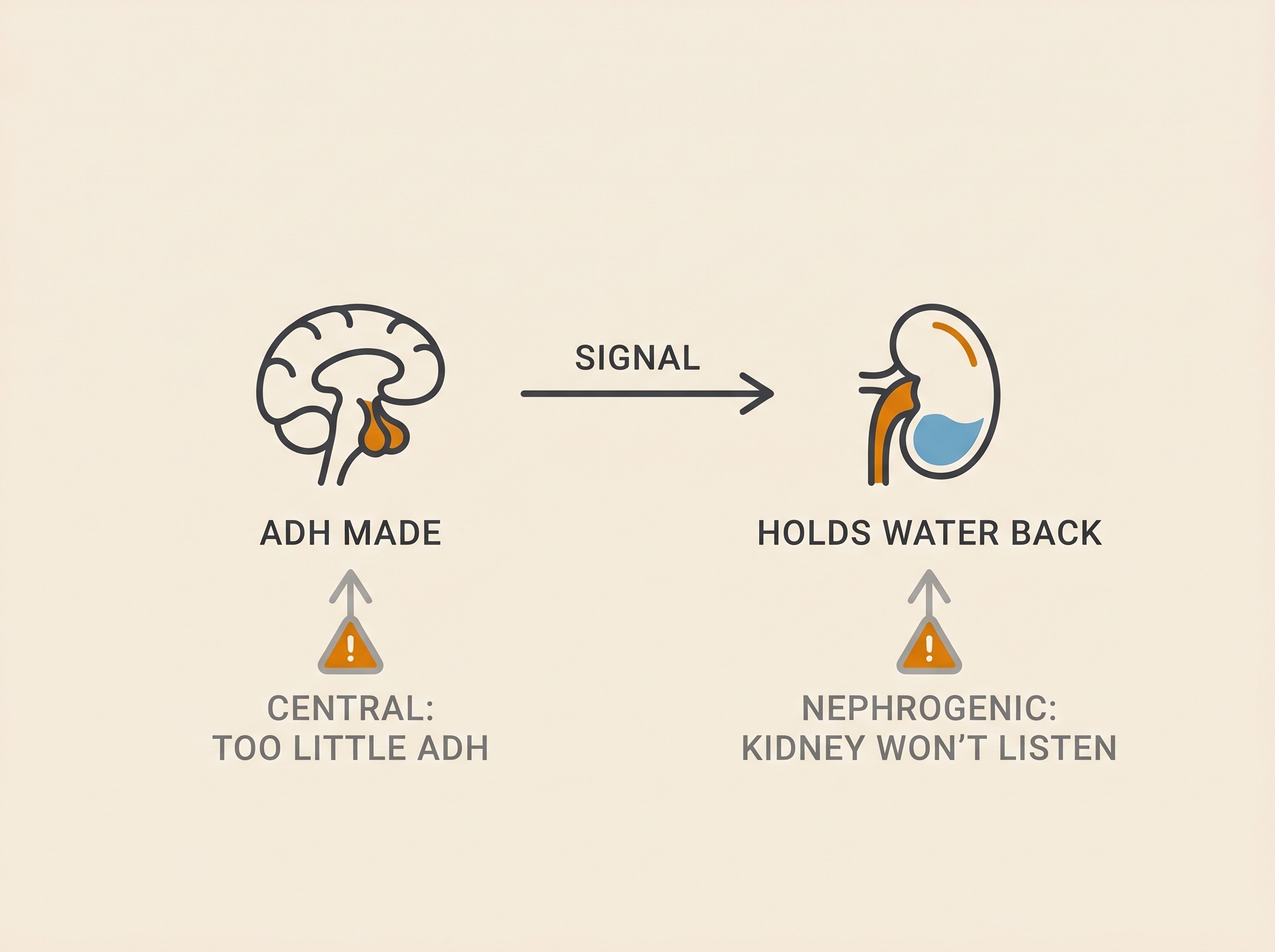
To make sense of diabetes insipidus, it helps to know about one hormone. Your pet's body has a chemical messenger called antidiuretic hormone, also known as ADH or vasopressin. It's made in the brain, stored in the pituitary gland (a tiny gland just beneath the brain), and released into the bloodstream when the body needs to conserve water. It travels to the kidneys and tells them to reabsorb water rather than flush it away, which is how a healthy pet makes a smaller volume of more concentrated urine (Flynn et al. 2025).
Diabetes insipidus is what happens when that system breaks down, and it can break in two places.
- Central diabetes insipidus is when the brain and pituitary don't make enough ADH. The signal simply isn't being sent. It can follow a head injury, a tumour or cyst near the pituitary, or a birth defect, and quite often no cause is ever found (Flynn et al. 2025; VCA, Diabetes Insipidus in Dogs).
- Nephrogenic diabetes insipidus is when there's plenty of ADH, but the kidneys don't listen to it. The message is sent, the kidneys ignore it. This kind can be present from birth, triggered by certain drugs, or driven by other illness (Flynn et al. 2025; VCA, Diabetes Insipidus in Dogs).
The distinction matters because it changes the treatment completely, as we'll come to.
What it looks like at home
The hallmark of diabetes insipidus is dramatic drinking and weeing, far beyond a bit thirsty on a hot day. Pets pass huge volumes of very pale, watery, almost colourless urine, and drink heavily to replace it (VCA, Diabetes Insipidus in Dogs). In the only published series of cats with central diabetes insipidus, the cats were drinking between 190 and 250 ml per kilogram per day before treatment (Aroch et al. 2005). For context, the usual flag for "drinking too much" in dogs and cats is roughly more than 100 ml per kg per day (Langston, Today's Veterinary Practice), so these are extreme numbers, often several times normal.
A safety point follows from this. A pet with diabetes insipidus genuinely can't conserve water, so if their water is taken away (other than during a carefully supervised hospital test) they can dehydrate very quickly, with a dangerous rise in blood sodium (VCA, Diabetes Insipidus in Dogs; Flynn et al. 2025). So the rule at home is simple and absolute: always leave fresh water freely available, around the clock. Never restrict it to cut down the mess.
If you want to put a number on the thirst before your vet visit, the Thirst & Wee tracker keeps a running log of water intake in ml per kg per day plus a urination record, and the "Is my pet drinking too much?" measuring card is a printable companion. Bringing real figures to the appointment helps, whatever the eventual cause.
Why diabetes insipidus is the last name on the list
Here's the reality. Drinking and weeing a lot is a common complaint, and there are more than 30 recognised causes of it (WSAVA approach to PU/PD; Langston, Today's Veterinary Practice). Diabetes insipidus is one of the rarest. It's genuinely uncommon in dogs, and in cats the central form has only ever been reported in a handful of cases (VCA, Diabetes Insipidus in Dogs; Aroch et al. 2005).
So please don't reach for this diagnosis first. A thirsty, heavily-weeing pet is far more likely to have one of the common causes your vet checks for early: chronic kidney disease, diabetes mellitus, or Cushing's disease in dogs, and kidney disease, diabetes mellitus or an overactive thyroid in cats (Langston, Today's Veterinary Practice). Some causes are urgent in their own right, including a womb infection (pyometra) in an unspayed female, or a high blood calcium, which is exactly why a vet visit comes before any guesswork (Langston, Today's Veterinary Practice). Our "drinking gallons" starting guide, the Diabetes space for the sugar kind, and the kidney pages in urinary-health will help you and your vet narrow it down.
That's why diabetes insipidus is what's called a diagnosis of exclusion, reached only after blood and urine tests have ruled the common causes out (VCA, Diabetes Insipidus in Dogs). One early clue is the urine itself: in diabetes insipidus it's extremely dilute, with a very low specific gravity, around or below 1.005 to 1.006 in the feline cases (Aroch et al. 2005). That points towards diabetes insipidus, but it isn't proof on its own, because a couple of other conditions can do the same thing.
Confirming it, safely
The traditional definitive test is the modified water deprivation test. Water is withheld under close hospital supervision to see whether the pet can concentrate its urine, and then desmopressin (a synthetic version of ADH) is given. A pet with central diabetes insipidus can't concentrate when deprived but then can once given desmopressin; a pet with the nephrogenic kind can't concentrate even after desmopressin (Aroch et al. 2005; Flynn et al. 2025).
It's informative, but it carries real risk, including severe dehydration and a dangerous rise in blood sodium, so it has to be done in the practice, never at home (Flynn et al. 2025). For that reason many vets now prefer a gentler approach first: a trial of desmopressin, watching whether the heavy drinking falls away. A clear, sustained drop in drinking, often described as roughly halving, supports central diabetes insipidus and is safer and easier than water deprivation (dvm360; Aroch et al. 2005). The exact response your vet looks for can vary, so let them interpret it.
Treating it: two diseases, two answers
Treatment follows the type.
Central diabetes insipidus, the short-of-ADH kind, is treated by replacing the missing hormone with desmopressin (DDAVP). It can be given as drops into the eye, as tablets, or by injection, and the response can be striking (VCA, Diabetes Insipidus in Dogs; Aroch et al. 2005). In the feline series, oral desmopressin brought water intake down from those 190 to 250 ml per kg per day figures to a far more manageable range, and the urine became properly concentrated again, though the dose had to be tuned to each cat (Aroch et al. 2005). Those numbers are illustrative from the literature, not a prescription. Your vet sets the dose and route, and watches for over-treatment, which can make the body hold on to too much water (Flynn et al. 2025).
Nephrogenic diabetes insipidus, the kidneys-won't-listen kind, doesn't respond to desmopressin, because the hormone is already there. It's managed differently, with a thiazide diuretic such as hydrochlorothiazide alongside a low-salt diet, which, perhaps surprisingly, reduces the urine volume, plus treating any underlying cause (VCA, Diabetes Insipidus in Dogs; Flynn et al. 2025).
Either way, and it's worth repeating because it's the one rule that really matters at home, your pet must always have free access to water (VCA, Diabetes Insipidus in Dogs).
A diabetes insipidus diagnosis is an unusual one, but a manageable one, and the heavy drinking is usually something treatment can ease a great deal. The next step is a conversation with your vet about which type your pet has and which treatment fits, and the Thirst & Wee tracker is a simple way to show them, week by week, whether it's working.
References
- Aroch I, Mazaki-Tovi M, Shemesh O, Sarfaty H, Segev G. "Central diabetes insipidus in five cats: Clinical presentation, diagnosis and oral desmopressin therapy." Journal of Feline Medicine and Surgery 2005;7(6):333–339. DOI: 10.1016/j.jfms.2005.03.008
- Flynn K, Hatfield J, Brown K, Vietor N, Hoang T. "Central and nephrogenic diabetes insipidus: updates on diagnosis and management." Frontiers in Endocrinology 2025;15:1479764. DOI: 10.3389/fendo.2024.1479764
- Arima H, Cheetham T, Christ-Crain M, et al. "Changing the Name of Diabetes Insipidus: A Position Statement of the Working Group for Renaming Diabetes Insipidus." 2022.
- "Diabetes Insipidus in Dogs." VCA Animal Hospitals.
- Langston C. "A Stepwise Diagnostic Approach to Polyuria and Polydipsia." Today's Veterinary Practice.
- "Approach to Polyuria and Polydipsia in the Dog." WSAVA 2008 (VIN).
- dvm360. "Practical Matters: Desmopressin is safer than water deprivation to identify the cause of polyuria and polydipsia in dogs."
Keep track of how your pet is doing
The owners who cope best are the ones who notice changes early. A simple health log shows you what is working, and what is not, before the next vet visit.
Start tracking, freeYou're not doing this alone
Compare treatment journeys and talk to owners managing hormone health. Free to join.
Join PetsLikeMine