

What a dental costs in the UK (and why quotes vary)
Alastair Greenway
BVM&S MRCVS
You asked for a rough idea of what a dental would cost, and the estimate came back at something like £300 to over £1,000. Maybe you rang round two or three practices and got numbers that didn't seem to describe the same procedure at all. One quoted £250, another £700, and now you're sitting there wondering whether the higher one is fleecing you or the cheaper one is cutting a corner you can't see. It's an uncomfortable place to be, because a dental isn't optional in the way a fancy collar is. Your pet's mouth hurts, or it's heading that way, and the price tag has just become the thing standing between her and feeling better.
So let me take the mystery out of it. I'm going to give you honest UK ranges, explain in plain terms what you're actually paying for, show you why two quotes for "a dental" can differ by hundreds of pounds without either practice doing anything wrong, and, most importantly, walk you through how to compare like for like so you can tell a fair quote from a false economy. And because I'm a vet before I'm anything else, I'll be straight with you at the end about what to do if the cost genuinely feels out of reach, because a painful mouth is not something to leave untreated for want of a payment plan.

Why there's no single price for "a dental"
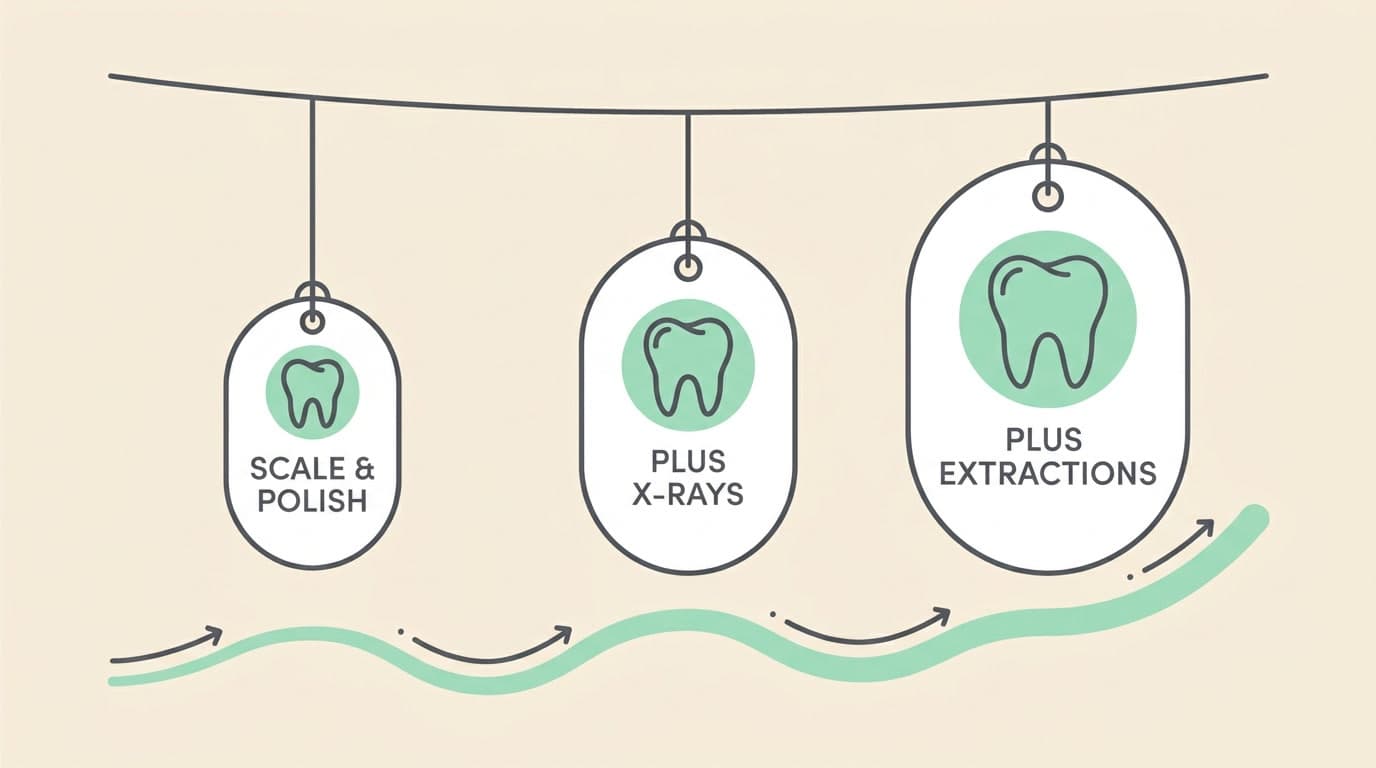
Here's the first thing to understand, because it dissolves a lot of the confusion. "A dental" isn't one fixed procedure with one fixed price, the way an MOT is. It's a base procedure, the general anaesthetic and the scale and polish, with a variable amount of diagnosis and treatment stacked on top of it depending on what's actually wrong in the mouth. And nobody, not even your vet, fully knows how much is wrong until your pet is asleep and every tooth has been x-rayed and probed.
That's genuinely different from most things you pay a professional to do. When a plumber quotes to fit a tap, they can see the tap. When we quote for a dental, we're quoting for a procedure whose scope only becomes clear halfway through it. The estimate you're given up front is a considered best guess based on a conscious look in the consulting room, and a good practice will quote you a range precisely because they're being honest that the final figure depends on findings they can't see yet. A single confident number would actually be less trustworthy, not more.
So when you compare quotes, you're not comparing a fixed product. You're comparing what each practice has assumed will be needed, what they include as standard, and how they've priced their time and their kit. Once you see the parts, the differences stop looking sinister.
The honest ranges (and yes, these are estimates)
Let me give you real numbers, with a clear caveat: these are practical UK ranges for 2025 to 2026, gathered from published practice prices and cost surveys, not a quote for your pet. They vary a lot by region, by the size of your animal, and by the individual practice, so treat them as a map, not a price list.
A scale and polish under general anaesthetic, no extractions. For a dog, this typically lands somewhere around £250 to £600, with national averages reported in the region of £270 to £475 (Vet Cost Index, 2026; NimbleFins, 2026). For a cat, it's often a little lower, roughly £200 to £450 (Vet Cost Index, 2026). That figure usually bundles the anaesthetic, the monitoring, the clean itself and the recovery.
Dental x-rays. Intra-oral radiography commonly adds something in the order of £60 to £200, depending on how many views are needed (Vet Cost Index, 2026). Many practices now include full-mouth x-rays in the base price of a dental rather than listing them separately, which is one big reason two quotes can look so different before a single tooth is touched.
Extractions. This is the part that moves the total most. A simple, single-rooted extraction might add roughly £30 to £80 a tooth, while complex extractions, or a mouthful of them, can carry the total to somewhere around £600 to £1,200 or more (Vet Cost Index, 2026). A cat with several resorptive lesions, or an older dog whose mouth has never been treated, can genuinely need a lot of teeth out, and each one takes surgical time.
Put those together and you can see how the same practice, quoting honestly, arrives at "£300 to over £1,000". The bottom of that range is a straightforward clean on a fairly healthy mouth. The top is a clean plus x-rays plus a significant number of extractions, which is a substantial piece of oral surgery, not a tidy-up.
Why two quotes vary so much
If you've collected a few numbers and they're miles apart, it's almost never because one practice is greedy and another is a bargain. It's because they're quietly different procedures, or the same procedure priced for a different setting. These are the levers that move the price.
Whether x-rays are included. This is the big one. A quote that assumes full-mouth radiography as standard will look dearer than one that doesn't, but they aren't the same job. X-rays are how we find the disease that lives below the gumline, where the eye can't reach, and a large share of painful dental disease is only visible on them. A "scale and polish" with no x-rays is a cosmetic clean, not a diagnostic dental, and I've explained exactly why that matters in [why dental x-rays matter]. When you compare two quotes, this single question, are x-rays in or out, explains most of the gap.
Extractions found on the day. Because nobody knows the full picture until your pet is asleep and x-rayed, the estimate has to allow for teeth that turn out to need removing. Some practices quote a lean base price and add extractions as they go. Others quote a fuller range up front to prepare you for the likely total. The second looks more expensive on paper and is often the more honest number, because it isn't setting you up for a shock at collection.
Anaesthetic and theatre time. A dental is charged, in large part, for time under anaesthetic. A quick clean on a young mouth uses far less anaesthetic, monitoring and surgical time than two hours of careful extractions on a complicated one. Longer time asleep, safely managed, costs more, and it should, because it's more of the expensive, skilled part of the procedure.
Monitoring, fluids and safety. A practice that includes intravenous fluids, a dedicated nurse watching the anaesthetic throughout, blood-pressure and temperature support and pre-anaesthetic bloods will price higher than one offering a barer service. Those things aren't padding. They're the measures that lower anaesthetic risk, and they're a large part of why a modern dental is as safe as it is. When you see a higher quote, it's worth asking what safety is built into it before you assume it's simply dearer.
Your pet's size and species. A Great Dane needs more anaesthetic drug, more monitoring and more of everything than a Chihuahua, so size feeds into the price. Cats and small dogs often sit at the lower end for a straightforward clean, but a cat with resorption or gingivostomatitis can need extensive, fiddly surgery that pushes the total right up.
Where you are, and who owns the practice. Region matters a great deal. Published median dental prices run from around £175 to £185 in some areas up to £320 in London, £420 in Edinburgh and nearly £500 in parts of the country with higher costs (Vet Cost Index, 2026). City-centre premises with high rents and wage bills cost more to run, and that flows into the bill. Corporate-owned groups and independent practices can also price differently, though neither is reliably cheaper across the board. The point isn't to hunt for the lowest sticker, it's to know that a higher local price often reflects the cost of running a practice in that area, not a markup on your pet.
Why the cheapest quote can cost you more
I want to be careful here, because "you get what you pay for" can sound like a line to justify a bigger bill. It isn't. It's a genuine warning about a specific trap, and the trap is the quote that's cheaper because it leaves out the x-rays.
Picture it. Two quotes, one noticeably cheaper. The cheaper one is a scale and polish with no radiography. Your pet has it done, the visible teeth come up clean and shiny, and everyone feels reassured. But the abscess at the root that never showed on the crown is still there. The resorbing tooth is still there. The bone loss went unmeasured. A few months on, your pet is off her food or pawing at her face, and now she needs a second general anaesthetic and a second procedure to deal with what should have been found the first time. Two anaesthetics, two bills, and months of pain in between, to save the cost of the x-rays once. That's the maths the cheaper quote quietly hides.
The same logic is why I'd steer you firmly away from the conscious "anaesthesia-free" cleans offered by some groomers and pet shops. They look cheaper still, and gentler, but they only ever reach the visible crown, they can't touch the disease below the gumline, and by making a diseased mouth look clean they can delay the treatment that would actually help. On top of that, done by a non-vet in the UK, they're unlawful. I've set out why in full in [anaesthesia-free "cleaning": why the RCVS says no]. The cheapest option in the whole field is also the one that treats nothing.
So the real question isn't "which quote is lowest?" It's "which quote is for a complete dental?" A complete dental, done to the guideline standard, means a general anaesthetic, full-mouth x-rays, probing and charting of every tooth, scaling above and below the gumline, treatment or extractions where the x-rays show they're needed, and a polish (Niemiec et al., 2020). Compare two quotes that both describe that, and you're comparing like for like. Compare a complete dental against a bare clean, and you're comparing a diagnosis against a wash and brush-up.
How to compare quotes fairly
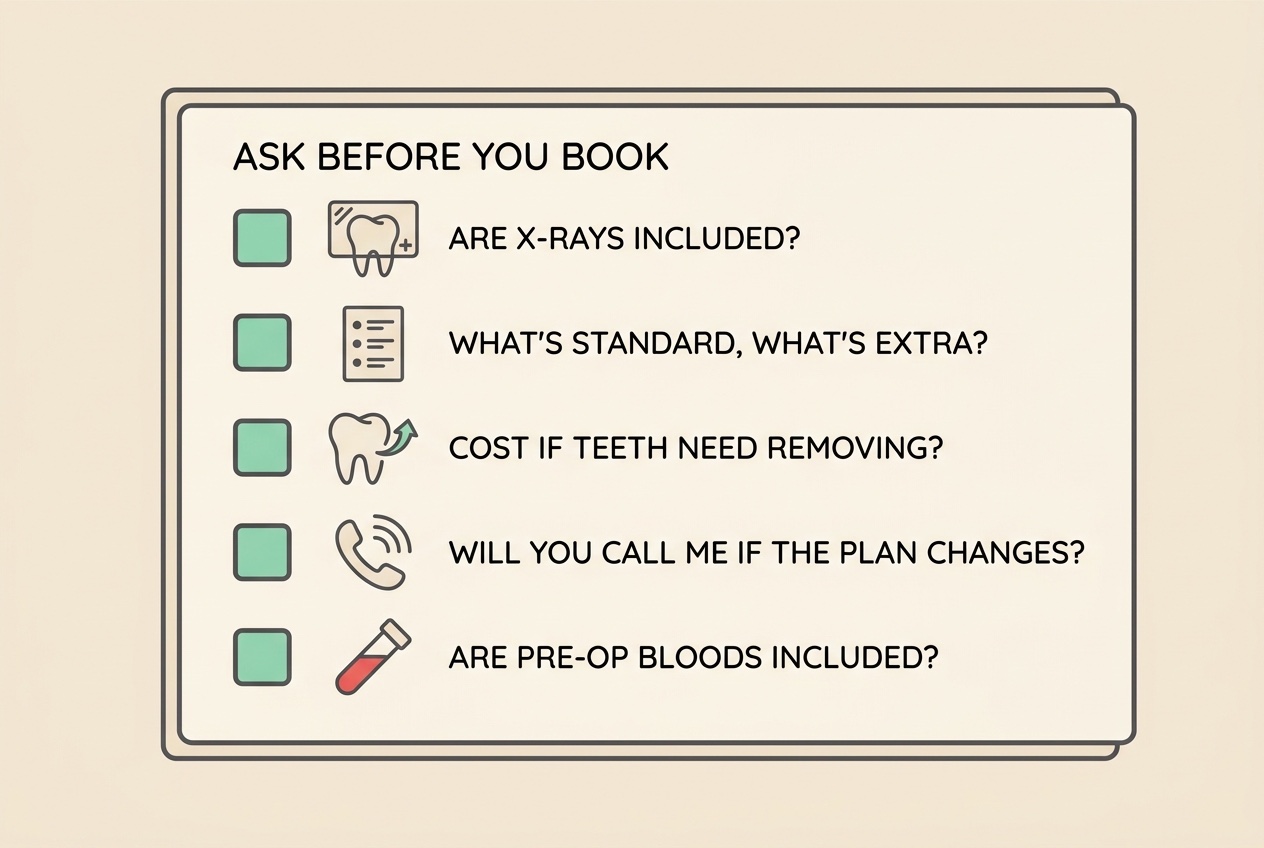
You don't need to become a dental expert to make a good decision. You need a short list of questions, and the willingness to ask them plainly. Any decent practice will be glad you did.
- Does this include full-mouth dental x-rays? The most important question of the lot. If one quote does and another doesn't, they aren't the same procedure.
- What's included as standard, and what's charged on top? Ask specifically about anaesthetic, monitoring, intravenous fluids, pre-anaesthetic bloods and the polish. A low headline price with everything added separately can end up dearer than a fuller one.
- What happens, and what does it cost, if you find teeth that need removing? This is the variable that moves the bill most, so get a feel for the per-tooth or per-time charge before the day, not after.
- Will I get a call during the procedure if the plan changes? A good practice will ring you before doing significant extra work, so the final bill is never a surprise.
- Are pre-anaesthetic bloods included or extra, and are they advised for my pet? Especially relevant for older animals.
There's a helpful tailwind here, too. Following the Competition and Markets Authority's investigation into vet services, UK practices are being required to publish clearer pricing, including for a routine scale and polish, and to set out what is and isn't included, along with who owns the practice (CMA, 2026). That makes comparing on your own terms easier than it used to be, so it's worth a look at each practice's website before you ring round. Just remember that a published scale-and-polish price is the base clean, not the whole dental, and it won't include the extractions that decide most bills.
When the cost genuinely feels out of reach
Now the part I care about most, and the one line in this whole article I'd underline if I could. Cost is a real pressure, and I'm not going to pretend otherwise, but the price of a dental must never simply become the reason a painful, infected mouth goes untreated. A mouth in that state doesn't stay still. It hurts, day in and day out, it can seed infection, and it quietly wears down a pet who's written off as "just getting old". If the number in front of you feels impossible, the answer is almost never "do nothing". It's to have a frank conversation about the options, because there are more of them than most owners realise.
Staging the work. For a big treatment plan, some practices can prioritise the most painful teeth first and phase the rest, spreading both the cost and the anaesthetic load. It isn't always the right call clinically, but it's worth asking whether it is for your pet.
Payment plans. Many practices offer instalment arrangements or work with third-party pet finance to spread a bill over months rather than demanding it in one go (ManyPets, 2026). If money is the barrier, ask at the desk before you decline treatment, not after.
Insurance, read properly. If you're insured, the accident-or-illness distinction and a couple of easy-to-miss clauses decide whether a dental is covered, and a surprising number of claims are lost to a missed annual-check condition rather than to the disease itself. It's worth ten minutes to read your policy the right way, and I've walked through exactly how in [does pet insurance cover a dental?].
Charitable help. If you're on a low income or receiving certain benefits, charities such as the PDSA, the RSPCA and Blue Cross provide reduced-cost or subsidised veterinary treatment, dental work included, for those who qualify. Eligibility is usually tied to where you live and the benefits you receive, so check each charity's current criteria.
Whatever route fits, the thing to hold onto is that the conversation is worth having out loud with your vet. We would far rather help you find a way to treat a sore mouth than watch it go untreated because the first number felt too big to say yes to. So if a quote has stopped you in your tracks, don't quietly shelve the dental. Ring the practice back, tell them plainly that cost is the sticking point, and ask what can be done. That single phone call is the next step, and it's very often the start of a plan.
References
- Competition and Markets Authority (CMA). CMA concludes market investigation with major reforms to veterinary sector. GOV.UK, 2026.
- Vet Cost Index. How much does pet dental treatment cost in the UK? (accessed 2026)
- NimbleFins. How much does it cost to clean a dog's teeth? (accessed 2026)
- ManyPets. Our ultimate guide to cleaning your pet's teeth: how to do it and how much it costs. (accessed 2026)
- Niemiec B, Gawor J, Nemec A, et al. World Small Animal Veterinary Association (WSAVA) Global Dental Guidelines. Journal of Small Animal Practice, 2020;61(7):E36-E161.
Free downloads
Companion worksheets to put what you've read into practice. Free PDFs, print at home.
Sister directory · PetCare Atlas
See what a scale and polish costs
PetCare Atlas, our sister directory, publishes an indicative UK price range for a dental scale and polish, and says what is usually included. It is a guide for planning. Your own practice gives the real quote.
See dental prices on PetCare Atlas →Keep track of how your pet is doing
The owners who cope best are the ones who notice changes early. A simple health log shows you what is working, and what is not, before the next vet visit.
Start tracking, freeYou're not doing this alone
Compare treatment journeys and talk to owners managing teeth & mouth. Free to join.
Join PetsLikeMine