

Cushing's, Thyroid Disease and the Gallbladder Link
Alastair Greenway
BVM&S MRCVS
Your dog has Cushing's disease, or an underactive thyroid, and now a scan has found a gallbladder mucocoele, and you are wondering whether the two are connected. Or perhaps it is the other way around: a mucocoele turned up first, and your vet has recommended testing for Cushing's, and you are not sure why a gallbladder problem should lead to a hormone test. Either way, you have spotted something real. These conditions genuinely are linked, and understanding the connection helps you see why your vet is joining dots that might otherwise seem unrelated.
This piece explains the link between the hormonal conditions and the gallbladder, and, along the way, clears up a separate but related source of confusion: why a dog with Cushing's so often has a raised ALP on the blood test that has nothing directly to do with the gallbladder at all. Both threads matter, because both explain results and recommendations that can otherwise feel mystifying. As always, the specifics for your dog belong to your vet; this is the map of why these things travel together.
The endocrine-gallbladder connection
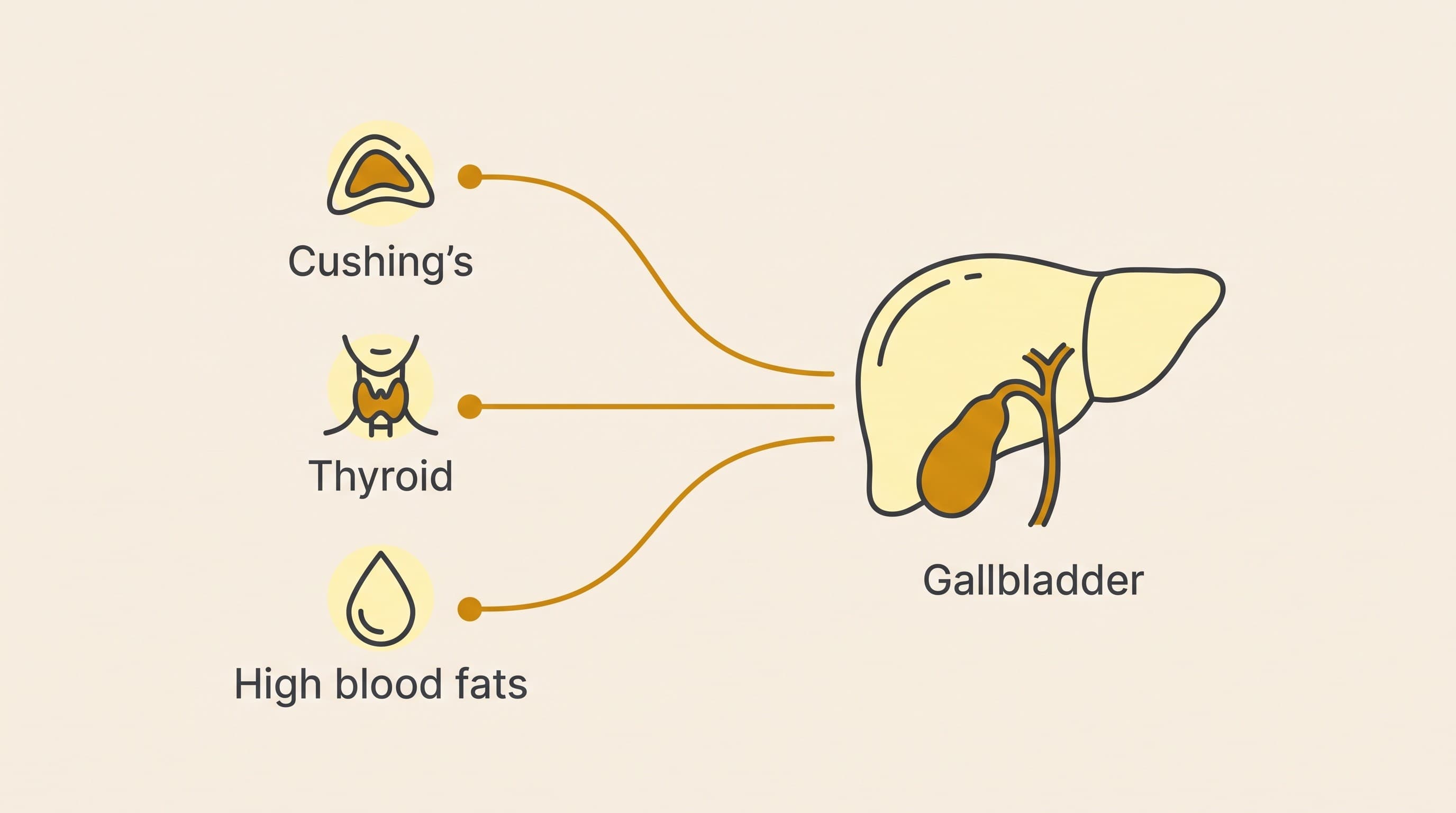
Start with the headline fact, because it is a striking one. Dogs with Cushing's disease (hyperadrenocorticism, meaning the body produces too much of the stress hormone cortisol) have been reported at around 29 times the risk of developing a gallbladder mucocoele compared with dogs without it. That is not a subtle association. It is one of the strongest reasons a mucocoele on a scan should prompt a look at the hormones.
Cushing's is not the only hormonal condition in the frame. Hypothyroidism (an underactive thyroid) is also associated with mucocoeles, and so is hyperlipidaemia, the state of having persistently high fats in the blood. These conditions often overlap, and they share a common thread that helps explain the link.
The unifying idea is that several of these conditions disturb how the body handles fats and how bile is made and moved. Cushing's and hypothyroidism both tend to raise blood fats and alter fat metabolism, and abnormal fats and sluggish bile flow seem to set the stage for the thick, immobile bile that becomes a mucocoele. Add the genetic angle, the ABCB4 gene in Shetland Sheepdogs, which affects how the gallbladder handles certain fats, and you have a picture where fat handling and bile behaviour sit at the centre of the problem.
You do not need the biochemistry to take the practical point: the gallbladder does not exist in isolation, and a mucocoele can be a downstream sign of a hormonal or metabolic problem that is worth finding and treating in its own right. It is also worth saying clearly that the link is a matter of raised risk, not certainty. Plenty of dogs with Cushing's or an underactive thyroid never develop a mucocoele, and not every dog with a mucocoele turns out to have one of these conditions. The associations are strong enough to be worth acting on, but they are tendencies, not a verdict on your individual dog, and your vet interprets them in the context of everything else they know.
How these conditions are actually tested for
If your vet suspects one of the underlying conditions, a few tests come into play, and knowing roughly what they involve takes the mystery out of the recommendation. Blood fats are the simplest: a fasted blood sample can show whether cholesterol and triglycerides are high. Thyroid function is checked on a blood test too, though it can be affected by other illness, so it is interpreted with care. Cushing's is the more involved one, because there is no single perfect test; it usually needs a specific stimulation or suppression blood test, sometimes more than one, chosen and interpreted by your vet, and often combined with an ultrasound of the adrenal glands. This is why a gallbladder finding can lead to what feels like a cascade of hormone tests: your vet is not casting around, but working through the conditions most likely to be sitting behind the mucocoele.
None of these tests is done for its own sake. Each one, if positive, points to something treatable, and treating it is good for your dog regardless of the gallbladder.
Why this changes what your vet does
This link explains two recommendations that owners often find surprising.
If the mucocoele came first, it explains why your vet wants to test for Cushing's and check the thyroid and blood fats. Finding and treating an underlying endocrine condition is part of managing the whole dog, and it may influence how the mucocoele itself is handled. It would be a missed opportunity to remove or monitor a gallbladder while ignoring the hormonal engine that may have driven it.
If the Cushing's or thyroid disease came first, it explains why a mucocoele might be watched for, and why an abdominal scan can be worthwhile in a dog with these conditions. It does not mean every dog with Cushing's will get a mucocoele, and it is not a reason to panic. It is a reason to be aware, and a reason your vet may keep the gallbladder in view.
Treating the underlying condition matters for its own sake too. Well-controlled Cushing's or properly treated hypothyroidism is better for your dog across the board, and getting the blood fats and hormones under control is a sensible part of the overall plan whether or not a mucocoele is present. What treating the underlying condition does not do is guarantee an existing mucocoele will resolve, so it sits alongside the operate-or-watch decision (covered in its own piece) rather than replacing it.
The other Cushing's-liver confusion: the raised ALP
There is a second, separate way that Cushing's and the liver get tangled together on the blood test, and it causes a great deal of unnecessary alarm, so it is worth untangling here.
Dogs with Cushing's very commonly have a high ALP on their bloodwork. ALP (alkaline phosphatase) is one of the "liver enzymes", and seeing it flagged high understandably makes owners fear liver disease. But here is the key: in Cushing's, the raised ALP is often not the liver being diseased at all. Excess cortisol, whether from the disease itself or from steroid medication, induces a specific form of ALP in dogs, sometimes called steroid-induced ALP, which is a canine-specific isoenzyme. In other words, the steroid effect switches on ALP production directly, so the number rises without the liver necessarily being damaged.
This matters for two reasons. First, it should lower the temperature: a high ALP in a dog with Cushing's, or a dog on steroids, is often expected and does not by itself mean liver disease. Second, it is a good example of the single most important idea in the whole liver space: enzymes are a sign, not a diagnosis, and ALP in particular has a long list of causes outside the liver, of which steroids and Cushing's are among the commonest. The plain-English guide to what ALT, ALP and the other enzymes actually mean goes into this properly, and it is the natural next read if the blood-test side of this is what is worrying you.
It is worth adding one nuance so this does not tip into false reassurance. "Often not the liver" is not the same as "never the liver". Excess cortisol over a long time can genuinely affect the liver in dogs, producing changes described as a steroid or vacuolar hepatopathy, so the raised ALP in a Cushing's dog can reflect both the harmless enzyme induction and some real, usually mild, liver change. The practical takeaway is not to panic at the ALP, but also not to ignore the liver entirely; your vet weighs the ALP alongside the other liver values, the dog's clinical picture, and the function markers, rather than reading any single number in isolation. If there is real doubt, the workup ladder (a bile acids test, ultrasound, and so on) is how that doubt gets resolved.
So the two threads are genuinely different and it helps to keep them apart. The mucocoele link is a real structural gallbladder problem that Cushing's makes far more likely. The raised ALP is usually a laboratory echo of the steroid effect, not a gallbladder or liver disease at all. A dog with Cushing's can have both at once, which is exactly why the picture gets confusing, but they are not the same thing.
What to do with all this
If your dog has a mucocoele, ask your vet whether Cushing's, thyroid function and blood fats have been checked, because treating an underlying condition is part of looking after the whole dog and can shape the plan for the gallbladder. If your dog has Cushing's or hypothyroidism, understand that the gallbladder is one of the things worth keeping an eye on, and do not be surprised if a scan is suggested. And if your dog with Cushing's has a raised ALP, take a breath: it is very often the steroid effect rather than a diseased liver, and it should be interpreted in that light rather than as fresh bad news.
There is a quiet reassurance buried in all of this connectedness. The links between these conditions are not just complications piling up; they are also the reason a good vet can look at one finding and know which others to check for, which means problems get caught that might otherwise have hidden. A dog whose mucocoele leads to a Cushing's diagnosis, or whose Cushing's prompts a look at the gallbladder, is a dog getting more thorough care, not worse luck. The web of associations works in your dog's favour when someone knows how to read it.
These conditions are managed together because they are connected, and a vet who is testing hormones after finding a gallbladder problem, or watching the gallbladder in a dog with a hormone problem, is doing exactly the right kind of joined-up thinking. To go deeper on either thread, the introduction to gallbladder mucocoeles explains the gallbladder side and the operate-or-watch piece covers the decision, while the plain-English enzymes guide untangles the ALP question. For the hormonal conditions themselves, our Hormone Health space covers Cushing's and thyroid disease in their own right.
References
- Webster CRL, et al. ACVIM consensus statement on the diagnosis and treatment of chronic hepatitis in dogs. *J Vet Intern Med* 2019;33(3):1173–1200.
Keep track of how your pet is doing
The owners who cope best are the ones who notice changes early. A simple health log shows you what is working, and what is not, before the next vet visit.
Start tracking, freeYou're not doing this alone
Compare treatment journeys and talk to owners managing liver & gallbladder. Free to join.
Join PetsLikeMine