

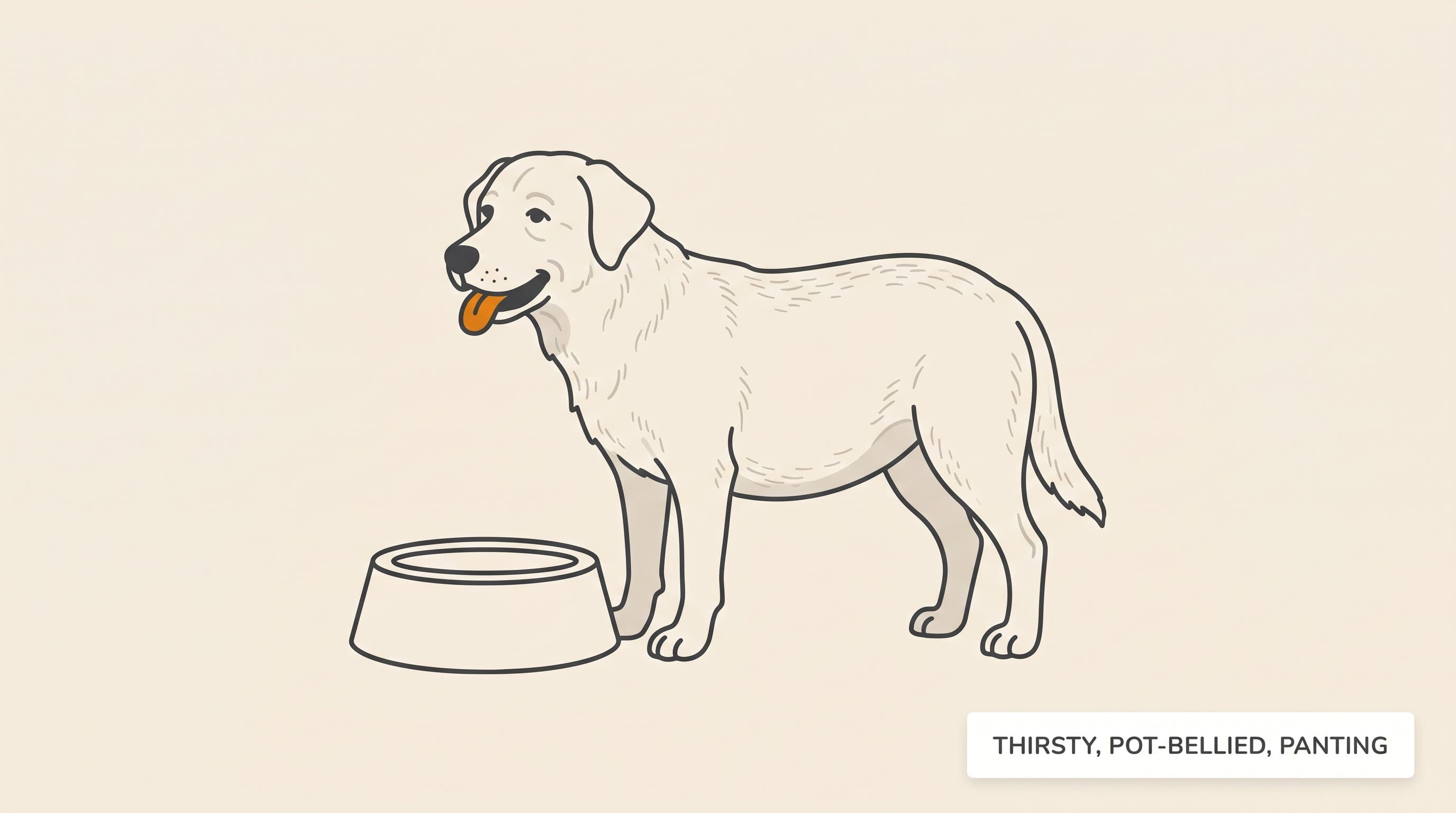
Cushing's explained: the thirsty, pot-bellied, balding dog
Alastair Greenway
BVM&S MRCVS
If you've ended up here, it's probably because your older dog has started drinking gallons, seems hungry all the time, wees more than they used to, and has developed a sagging, pot-bellied look with a thinning coat and a lot of panting. Maybe a vet has already said the word "Cushing's", or maybe you've typed those signs into a search bar and it keeps coming up. Either way, take a breath. Cushing's is common, it's slow-moving, it's well understood, and it's manageable. This piece walks you through what it actually is, why it creeps up so quietly, and what happens next, without the panic.
What Cushing's actually is
Cushing's syndrome (your vet may call it hyperadrenocorticism, or hypercortisolism) is, in plain terms, the body being exposed to too much cortisol for too long. Cortisol is the body's main stress hormone, made by the two small adrenal glands that sit near the kidneys, and it helps regulate things like metabolism, the stress response and the immune system (Cornell Riney Canine Health Center). When there's chronically too much of it, you get the body-wide picture that defines Cushing's.
There are two main spontaneous forms, plus a third, man-made one.
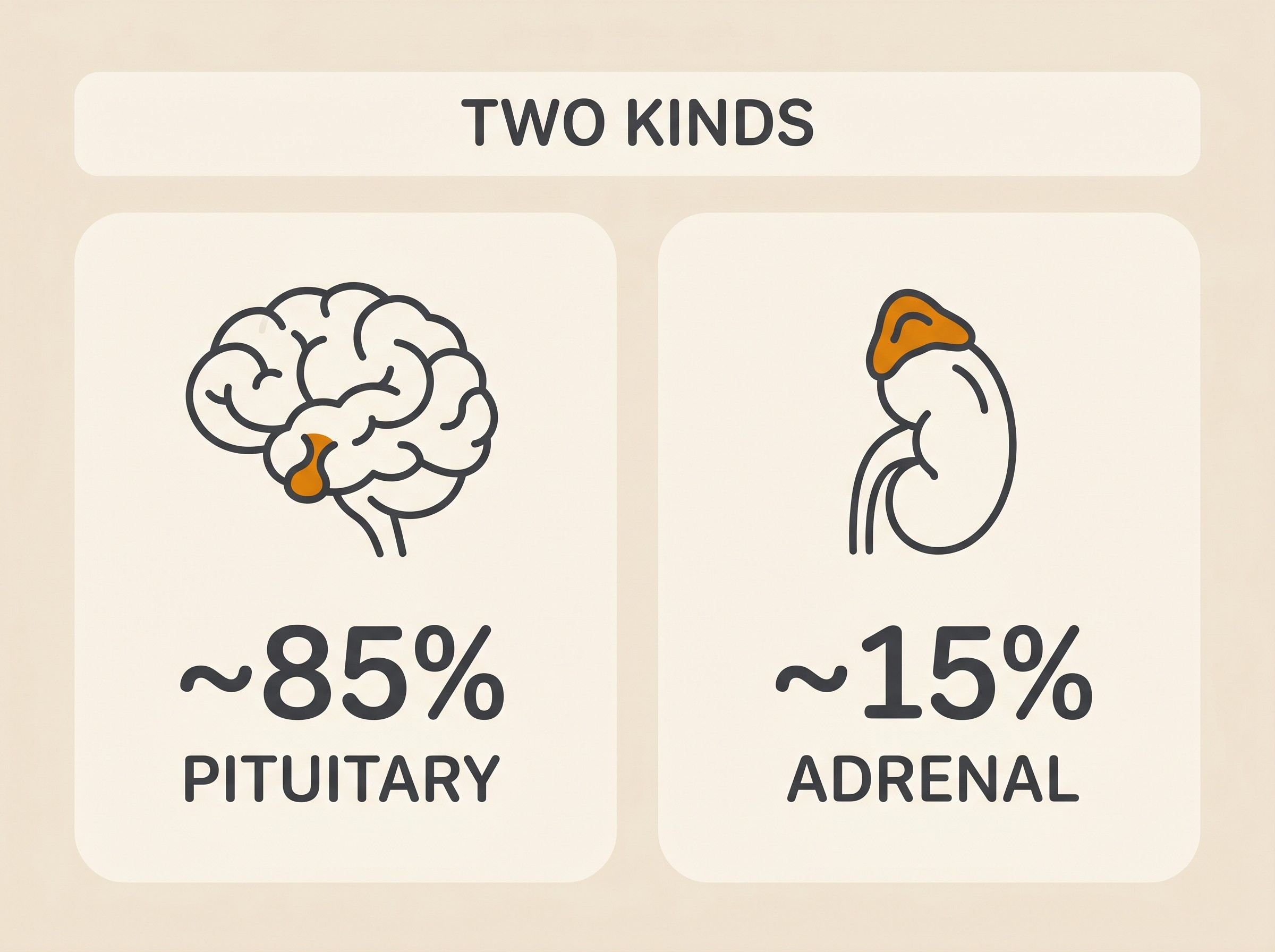
The great majority of cases, about 80 to 85%, are pituitary-dependent (Cornell Riney Canine Health Center; Merck Veterinary Manual). Here a tiny, usually benign growth on the pituitary gland (a pea-sized gland at the base of the brain) pumps out too much of a signal called ACTH, which in turn tells both adrenal glands to over-produce cortisol. The growth itself is often microscopic, and in most dogs it never causes brain-related trouble.
The remaining 15 to 20% or so are adrenal-dependent (Cornell Riney Canine Health Center; Merck Veterinary Manual). Here a growth on one of the adrenal glands themselves churns out cortisol on its own, regardless of the normal signals. These adrenal growths are split fairly evenly between benign and malignant types (Cornell Riney Canine Health Center).
The third kind is worth naming now, because owners can cause it by accident: iatrogenic Cushing's, from steroid medication. If a dog has a lot of glucocorticoid steroid (oral tablets, injections, and even some ear drops and skin creams) at too high a dose or for too long, the body can develop the same picture (Cornell Riney Canine Health Center; AAHA 2023 Selected Endocrinopathies Guidelines). That's a whole topic in itself, and we cover it properly in the steroid-Cushing's article. The key takeaway here: never stop a long course of steroids abruptly, always taper down under your vet's guidance, because stopping suddenly can crash the body's cortisol dangerously.
The classic picture, and why it hides as "just old age"
Cushing's tends to be a disease of middle-aged to older dogs. Almost all affected dogs are over about six years old, with a mean age at diagnosis of roughly nine to eleven years (Carotenuto et al. 2019). Some breeds seem more prone than others, with poodles, dachshunds and various terriers among the classically cited ones, though the lists vary from study to study, so it's worth holding loosely (Merck Veterinary Manual; Carotenuto et al. 2019).
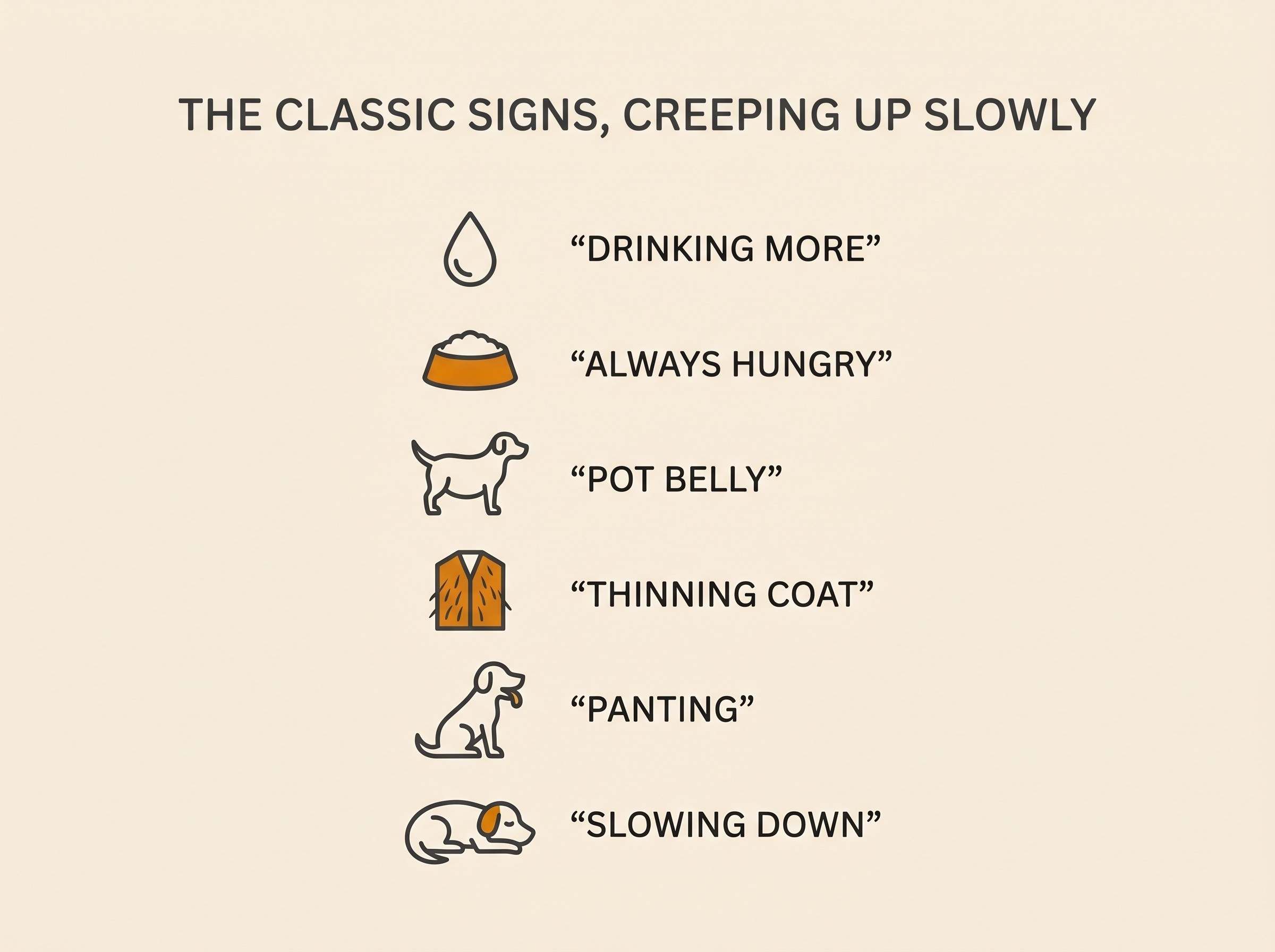
The classic signs are:
- Drinking and weeing a lot. This is the most consistent sign, present in around 80 to 90% of cases (Cornell Riney Canine Health Center). It's also measurable, which we'll come back to.
- A ravenous appetite. Many Cushing's dogs act permanently starving, raiding bins or begging far more than usual.
- A pot belly. That sagging, rounded abdomen isn't simple weight gain. It comes from fat shifting onto the trunk, weakening of the tummy muscles, and an enlarged liver (Today's Veterinary Practice; Merck Veterinary Manual).
- Coat and skin changes. Symmetrical (and crucially non-itchy) hair loss along the flanks and trunk, plus thin, fragile skin (Today's Veterinary Practice).
- Heavy panting and lethargy. A dog that pants at rest, in the cool, for no obvious reason, and generally slows down.
Here's the thing that catches so many owners out: these signs creep in slowly, over months, sometimes longer. Clinical reviews describe the onset as gradual and insidious (Merck Veterinary Manual; Today's Veterinary Practice). One day your dog is drinking a bit more, then they're a little slower on walks, then they're going scruffy and grey, then there's the pot belly. Each step on its own looks exactly like a dog getting old, which is why Cushing's is so often written off as ageing and picked up later than it might have been. It's a reasonable thing to assume, but if several of those signs are stacking up together, it's worth a conversation with your vet rather than a shrug.
A quick word on the thirst, because you can actually measure it
That increased drinking has a number attached to it. Genuinely excessive thirst (the vet term is polydipsia) means a dog drinking more than roughly 100 ml per kilogram of body weight per day, where normal is comfortably under that (Today's Veterinary Practice). So rather than worrying in the abstract, you can put a measuring jug to it: total up everything your dog drinks over 24 hours in millilitres, then divide by their weight in kilograms. If it's pushing past 100 ml/kg/day, that's a real, useful number to bring to your vet. Our "measuring it, and what it means" article and the Thirst and Wee tracker walk you through doing this and logging it over time, which is genuinely helpful both for getting a diagnosis and, later, for checking treatment is working.
It's worth knowing that increased drinking has a broad list of possible causes beyond Cushing's, including diabetes, an over-active thyroid and kidney disease, so measuring it is the start of the conversation, not the diagnosis.
Why it's worth taking seriously
Cushing's is slow, but it isn't harmless, and the reasons we treat it go beyond the obvious thirst and accidents.
Long-term high cortisol makes urinary tract infections more likely, with around half of Cushing's dogs affected, and because cortisol dampens inflammation and the urine is dilute, these infections are often silent with no obvious signs (Forrester et al. 1999). It also commonly drives up blood pressure, with high blood pressure being frequent in Cushing's dogs (García San José et al. 2020). And it tips the blood towards clotting more readily, which raises the risk of abnormal clots, though that's a recognised complication rather than something that happens to every dog (García San José et al. 2020).
None of that is meant to frighten you. The pace is usually slow, and in day-to-day life it's the thirst, the accidents and the coat that bother dogs and owners most, and those are exactly what treatment targets. But it does explain why this is a real medical condition worth diagnosing properly rather than ignoring.
The realistic bit: diagnosis isn't one clean test, and not every dog needs treating
Two things tend to surprise owners, and you deserve to hear them straight up front.
First, there's no single perfect test for Cushing's. The screening blood tests vets use are good but imperfect, and they throw up false positives, particularly in a dog that's actually unwell for some completely different reason. That's why the guidance is clear that these hormone tests should only be run when a dog genuinely has signs that fit Cushing's, and you shouldn't go hunting for the diagnosis on the back of bloodwork alone, such as a raised liver enzyme in an otherwise well dog (Behrend et al. 2013 ACVIM Consensus Statement; Today's Veterinary Practice). In other words, the goal is to test the right dog, at the right time. We unpack the full testing maze, and the over-testing trap, in the diagnosis article.
Second, not every Cushing's dog needs treating straight away. Treatment is usually started when the signs begin to affect a dog's quality of life, and a comfortable dog whose owner can live with the extra weeing may do perfectly well being monitored rather than medicated (Cornell Riney Canine Health Center; AAHA 2023 Selected Endocrinopathies Guidelines). It's a genuine quality-of-life decision, weighing the daily signs against the cost and the monitoring that treatment involves. That's the opposite of what a single-product website will tell you, and it's a decision we walk through plainly in the trilostane article.
When treatment is the right call, it's carefully monitored, never set-and-forget, and that's deliberate and for good reason. Too much of the usual medication, or a bout of illness on top of it, can push cortisol too low, so the rechecks matter. We explain exactly why, and what those rechecks look like, in the treatment articles.
The reassurance to leave you with
Spontaneous Cushing's is a slow-moving condition. It is not an emergency, which means you have time, time to measure the thirst, time to get the diagnosis right, and time to decide on treatment properly rather than in a rush. With an accurate diagnosis, the right treatment and sensible monitoring, Cushing's can be managed very well, and many dogs go on to live comfortably for years (Cornell Riney Canine Health Center). Dogs treated for Cushing's have even been shown to have a better measured quality of life than untreated ones (Schofield et al. 2019).
A sensible next step, if you haven't already, is to measure your dog's water intake over a couple of days using the Thirst and Wee tracker, and take that number to your vet. It's a small, concrete thing you can do today that genuinely helps. From here, the diagnosis article shows you what the testing actually involves, and the trilostane article covers the treat-or-monitor decision when you get there.
References
- Cornell University College of Veterinary Medicine, Riney Canine Health Center — "Cushing's syndrome."
- Merck Veterinary Manual — "Cushing Disease (Pituitary-Dependent Hyperadrenocorticism) in Animals."
- AAHA — "Canine Hypercortisolism (Cushing's Syndrome)," in the 2023 AAHA Selected Endocrinopathies of Dogs and Cats Guidelines.
- Carotenuto G, Malerba E, Dolfini C, et al. "Cushing's syndrome — an epidemiological study based on a canine population of 21,281 dogs." Open Veterinary Journal. 2019;9(1):27–32. DOI: 10.4314/ovj.v9i1.5
- Today's Veterinary Practice — "The Diagnosis of Canine Hyperadrenocorticism."
- Today's Veterinary Practice — "A Stepwise Diagnostic Approach to Polyuria and Polydipsia."
- Forrester SD, Troy GC, Dalton MN, et al. "Retrospective evaluation of urinary tract infection in 42 dogs with hyperadrenocorticism or diabetes mellitus or both." J Vet Intern Med. 1999. PMID: 10587255
- García San José P, Arenas Bermejo C, Clares Moral I, Cuesta Alvaro P, Pérez Alenza MD. "Prevalence and risk factors associated with systemic hypertension in dogs with spontaneous hyperadrenocorticism." J Vet Intern Med. 2020;34(5):1768–1778. DOI: 10.1111/jvim.15841
- Behrend EN, Kooistra HS, Nelson R, Reusch CE, Scott-Moncrieff JC. "Diagnosis of Spontaneous Canine Hyperadrenocorticism: 2012 ACVIM Consensus Statement (Small Animal)." J Vet Intern Med. 2013;27(6):1292–1304. DOI: 10.1111/jvim.12192
- Schofield I, et al. "Development and evaluation of a health-related quality-of-life tool for dogs with Cushing's syndrome." J Vet Intern Med. 2019. PMC6872869
Keep track of how your pet is doing
The owners who cope best are the ones who notice changes early. A simple health log shows you what is working, and what is not, before the next vet visit.
Start tracking, freeYou're not doing this alone
Compare treatment journeys and talk to owners managing hormone health. Free to join.
Join PetsLikeMine