

Crowded mouths: small and flat-faced breeds
Alastair Greenway
BVM&S MRCVS
If you own a Yorkie, a Pug, a Chihuahua or a Persian, you may already have noticed it: the teeth look packed in. They sit tight against one another, some are turned at an angle, one or two overlap like a slightly crowded set of piano keys. Perhaps a baby tooth never fell out and now sits stubbornly beside the adult one. Perhaps the breath has turned already, when your friend's big crossbreed reached ten with a clean mouth and no trouble at all.
You are not imagining it, and it is not something you did. The shape of your pet's mouth is written into the breed, and that shape comes with a genuinely higher and earlier risk of dental disease. The good news is that once you understand why, you can get ahead of it. This is one of those situations where knowing your breed changes the plan. Your dog or cat needs earlier, closer dental attention than the average pet, and here is exactly why, and what to do about it.
Same number of teeth, a much smaller jaw
Here is the root of the whole problem, and it is almost comically simple once you see it.
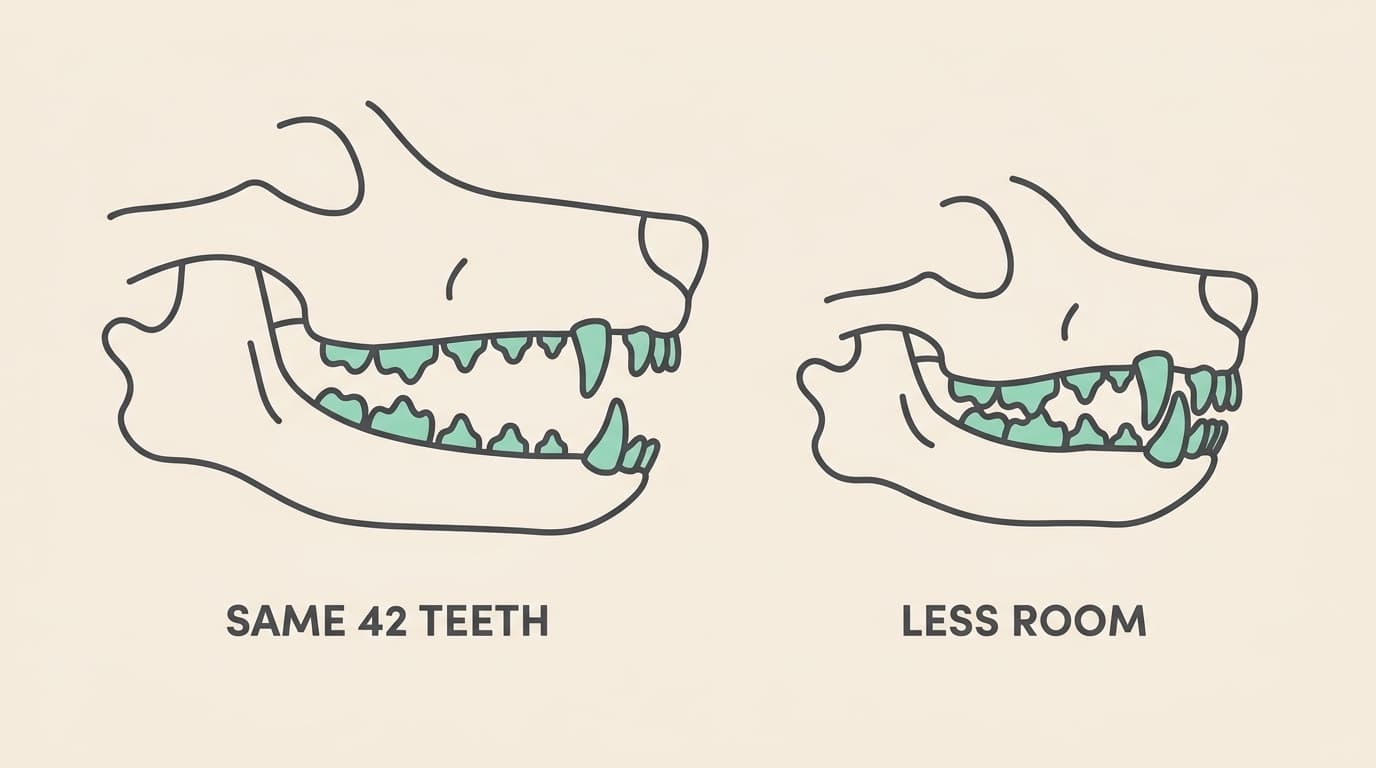
An adult dog, whether it is a Great Dane or a two-kilogram Chihuahua, has 42 permanent teeth. An adult cat has 30. Nature fixed those numbers a long time ago, and selective breeding for a tiny or a flat-faced dog did not go back and remove any teeth to compensate. So a toy breed is trying to fit the same full set of teeth into a jaw a fraction of the size (Niemiec, 2020).
The result is overcrowding. There simply is not enough room along the jaw for every tooth to sit upright, evenly spaced, with a clean gap between neighbours. Instead the teeth get pushed together, rotated, or tucked in behind one another. And every one of those tight, overlapping contact points is a trap: a sheltered spot where food, hair and plaque collect and where a toothbrush or a chew can never quite reach.
There is a second, quieter part of the problem. In a small dog the teeth are close to full size relative to the bone holding them, so each tooth has proportionally less jawbone anchoring it than the same tooth would have in a large dog. That thinner margin of supporting bone means that once periodontal disease does start eating into the attachment, there is far less to lose before a tooth loosens. Disease that a Labrador might carry for years without a wobbly tooth can unseat a Yorkie's tooth much sooner (Niemiec, 2020). Small mouths start further behind, and they have less in reserve.
The baby teeth that never left
There is a specific version of this you may be living with right now: a retained deciduous tooth, usually a little canine (fang) sitting right alongside its adult replacement.
In a normal changeover, the roots of the baby teeth dissolve away and the teeth drop out as the adult set pushes through, finishing at around six months of age. In toy and small breeds, and in flat-faced breeds, this handover often goes wrong. The baby tooth stubbornly stays put while the adult tooth erupts next to it, so the mouth ends up with two teeth where there should be one (Hobson, 2005; Niemiec, 2020).
That is a problem for two reasons. First, it makes an already crowded mouth worse, jamming teeth even tighter and creating a deep, narrow crevice between the retained baby tooth and its neighbour where plaque packs in and gum disease takes hold early, sometimes before the dog is even a year old. Second, the misplaced teeth can knock the adult teeth into the wrong position or push them into the roof of the mouth.
The rule vets follow is simple: two teeth should never occupy one socket. A retained baby tooth is worth removing, and the ideal moment is often when your puppy or kitten is under anaesthetic anyway for neutering, so it can be dealt with in one go. If your young small-breed dog still has a wobbly-looking double set of fangs past six months, that is a conversation to have with your vet sooner rather than later.
Flat faces: the same teeth, rotated and stacked
Brachycephalic breeds, the flat-faced ones, are the Pugs, French Bulldogs, Shih Tzus, Boston Terriers and, among cats, the Persians, Himalayans and Exotic Shorthairs. Their skulls have been bred short from front to back, but again, without any reduction in the number of teeth.
So a brachycephalic mouth takes the crowding problem and adds a twist, literally. With the upper jaw shortened, the teeth that would normally sit in a neat row get rotated, tilted and stacked on top of one another, particularly the premolars along the cheek. Many flat-faced dogs also have a longer lower jaw than upper jaw, an underbite, which changes how the teeth meet and where they rub (Niemiec, 2020). Rotated, overlapping teeth are the perfect scaffold for plaque, and the disease that follows tends to arrive young and move fast.
If your Pug is also a small dog, and most of the flat-faced breeds are, then you have both risk factors stacked on top of one another: the small-jaw crowding and the brachycephalic rotation. That is not a reason to panic, but it is a reason to be genuinely proactive rather than waiting for a problem to announce itself.
Cats count too, and Persians most of all
None of this is a dog-only story. Cats have their own crowded-mouth breeds, and the flat-faced ones are hit hard.
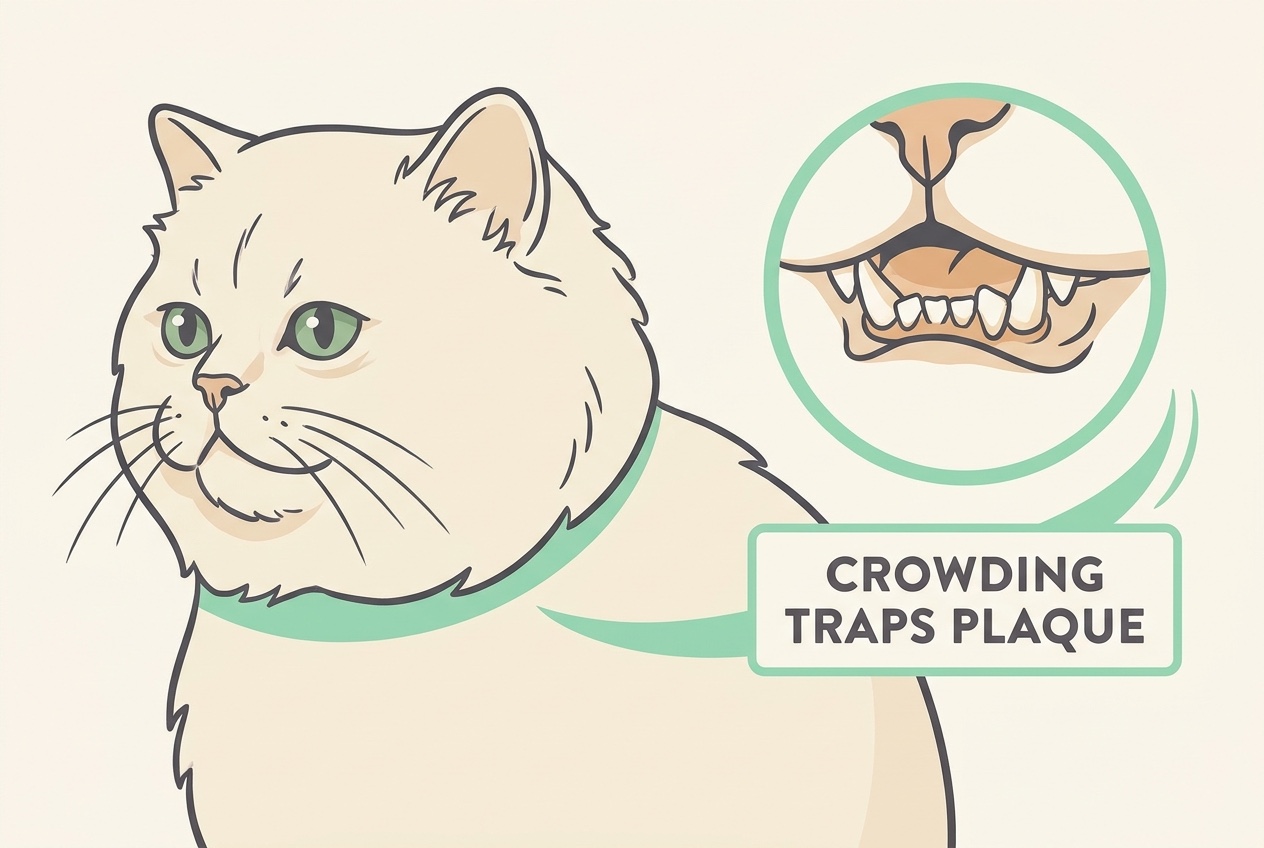
The clearest evidence comes from a study of 58 Persian and Exotic cats, the feline equivalent of the brachycephalic dogs. When these cats' mouths were examined properly, the findings were striking: half of them (50%) had crowding of the incisors, the little teeth at the front, and 30% had a malocclusion of the canine teeth, meaning the fangs did not line up as they should. Most sobering of all, 88% had periodontal disease and 70% had tooth resorption, a painful condition in which the tooth erodes from the inside (Mestrinho et al., 2018).
The mechanism is the same as in dogs. Breed a cat's face short and you crowd and rotate the teeth without reducing their number, and crowded feline teeth trap plaque exactly as crowded canine ones do. Persians and their relatives also seem especially prone to tooth resorption, which is worth flagging because it is genuinely painful and often invisible from the outside. A Persian who has started dropping food, chattering her jaw when she eats, or turning away from the biscuits she used to love deserves a proper look, not a wait-and-see. Our piece on the signs a mouth is hurting goes through the quiet feline tells in detail, because cats are experts at hiding this.
What the numbers actually say about your breed
It helps to see how much the odds really shift, because this is where breed stops being a vague worry and becomes a concrete reason to act.
The largest UK study of its kind, from the RVC's VetCompass programme, looked at more than 22,000 dogs and found that periodontal disease was diagnosed in around one in eight dogs (12.5%) in a single year, making it the most common disorder in dogs full stop. But that average hides enormous variation between breeds. Compared with crossbred dogs, the odds of a periodontal diagnosis were nearly four times higher in the Toy Poodle (odds ratio 3.97), about two and a half times higher in the King Charles Spaniel (2.63), the Greyhound (2.58) and the Cavalier King Charles Spaniel (2.39) (O'Neill et al., 2021).
The same study pinned down the size effect directly: dogs weighing under 10kg had around three times the odds of periodontal disease compared with dogs of 30 to 40kg (odds ratio 3.07). Flat-faced dogs carried a more modest but real increase, 1.25 times the odds of a longer-nosed dog of similar type (O'Neill et al., 2021). The Greyhound on that list is a useful reminder that this is not purely about being small; it is about the shape and set of the teeth, and sighthounds have their own crowded, narrow-jawed conformation. But if your dog is small, flat-faced, or both, the message is the same: the baseline risk you are managing is meaningfully higher than average.
One more figure worth carrying, and it applies to every breed but bites hardest in the crowded-mouth ones: by the age of two, roughly 80% of dogs and 70% of cats already show some degree of periodontal disease (Niemiec, 2020). In a Yorkie or a Pug, that clock runs faster still. The window for getting ahead of this is early, often earlier than owners expect.
The plan: earlier, closer, and started young
So what does all this actually mean for you day to day? Not despair, and not a resignation to bad teeth. It means shifting the whole timeline of dental care forward and being a bit more diligent than the owner of a big, roomy-mouthed crossbreed needs to be.
Start home care young, before there is a problem to fix. The single most effective thing you can do is brush, and the earlier you build the habit the easier it is for life. In a crowded mouth, daily brushing matters more, not less, precisely because plaque has so many sheltered corners to hide in. If your dog is small the job is genuinely quicker; there is simply less mouth to cover. Our step-by-step guide to brushing a dog's teeth walks through building the routine so it survives past the first fortnight, which is where most good intentions quietly die.
Look in the mouth regularly. A 30-second lift of the lip every week or two lets you catch a reddening gumline, a lump of tartar wedged between crowded teeth, or a retained baby tooth while it is still easy to deal with. If you are not sure what you are looking at, our home mouth-check guide shows you what healthy and not-so-healthy look like. Do not ever try to scrape tartar off yourself, though; it damages the enamel and misses the disease that matters, which lives below the gumline.
Expect the first professional dental sooner. A large-breed dog might reach middle age before it needs a scale and polish under anaesthetic. A crowded-mouth small or flat-faced breed often needs that first dental much earlier, sometimes in the first couple of years, and then more regularly thereafter. This is not a practice upselling you; it is the arithmetic of a small jaw. When your vet grades the mouth and recommends a dental, it helps to understand what those grades mean, so our guide to the 0 to 4 dental grades explains where your pet sits and what is still reversible.
Know what to watch for. Bad breath that will not shift, a tooth that has changed colour or angle, bleeding when a toy is chewed, food dropped from one side, or in cats a jaw that chatters at mealtimes. Any of these in a crowded-mouth breed is worth a vet visit rather than a wait, because in these mouths disease tends to be further along than it looks.
There is one broader point worth making. The tendency for your breed to crowd its teeth sits alongside a handful of other predictable, breed-linked health themes, the windpipe in a Yorkie, the breathing and skin in a Pug, and knowing them in advance is half the battle. That is exactly why we build breed-specific health guides, so you can see at a glance what your particular dog or cat is prone to and get in front of it rather than reacting after the fact. Dental crowding is one of the clearest examples of a problem you can genuinely blunt by starting early.
Your pet's crowded mouth is a fact of their design, not a failure of your care. Treat it as a standing instruction to be a little earlier and a little more attentive than average, and most of these teeth will do just fine.
References
- O'Neill DG, Mitchell CE, Humphrey J, Church DB, Brodbelt DC, Pegram C. Epidemiology of periodontal disease in dogs in the UK primary-care veterinary setting. Journal of Small Animal Practice. 2021;62(12):1051-1061. (VetCompass; 1-year period prevalence 12.52%; breed odds ratios vs crossbred: Toy Poodle 3.97, King Charles Spaniel 2.63, Greyhound 2.58, Cavalier King Charles Spaniel 2.39; bodyweight <10kg OR 3.07 vs 30-40kg; brachycephalic OR 1.25 vs mesocephalic.)
- Mestrinho LA, Louro JM, Gordo IS, Niza MMRE, Requicha JF, Force JG, Gawor JP. Oral and dental anomalies in Persian and Exotic Shorthair cats. Journal of the American Veterinary Medical Association. 2018;253(1):66-72. (58 Persian/Exotic cats: incisor crowding 50%, canine malocclusion 30%, periodontal disease 88%, tooth resorption 70%.)
- Niemiec B, Gawor J, Nemec A, et al. World Small Animal Veterinary Association (WSAVA) Global Dental Guidelines. Journal of Small Animal Practice. 2020;61(7):E36-E161. (Tooth counts; small-breed tooth-to-bone ratio and crowding; retained deciduous teeth; brachycephalic rotation and malocclusion; ~80% of dogs and ~70% of cats show periodontal disease by two years of age.)
- Hobson P. Extraction of retained primary canine teeth in the dog. Journal of Veterinary Dentistry. 2005;22(2):132-137. (Retained deciduous teeth in small and toy breeds; the principle that two teeth should not occupy one socket.)
Keep track of how your pet is doing
The owners who cope best are the ones who notice changes early. A simple health log shows you what is working, and what is not, before the next vet visit.
Start tracking, freeYou're not doing this alone
Compare treatment journeys and talk to owners managing teeth & mouth. Free to join.
Join PetsLikeMine