

Too Much Copper in Dog Food? What the 2021-2025 Science Shows
Alastair Greenway
BVM&S MRCVS
If you have already read the headlines and the forum arguments, and what you actually want is the evidence itself, laid out in order, without a slogan attached, this is the piece for you. The question "has the copper in dog food been rising, and is it harming dogs' livers?" has a real scientific literature behind it, and that literature has moved noticeably between 2021 and 2025. It has not, however, reached a settled answer, and one of the most useful things you can know is precisely where the certainty runs out.
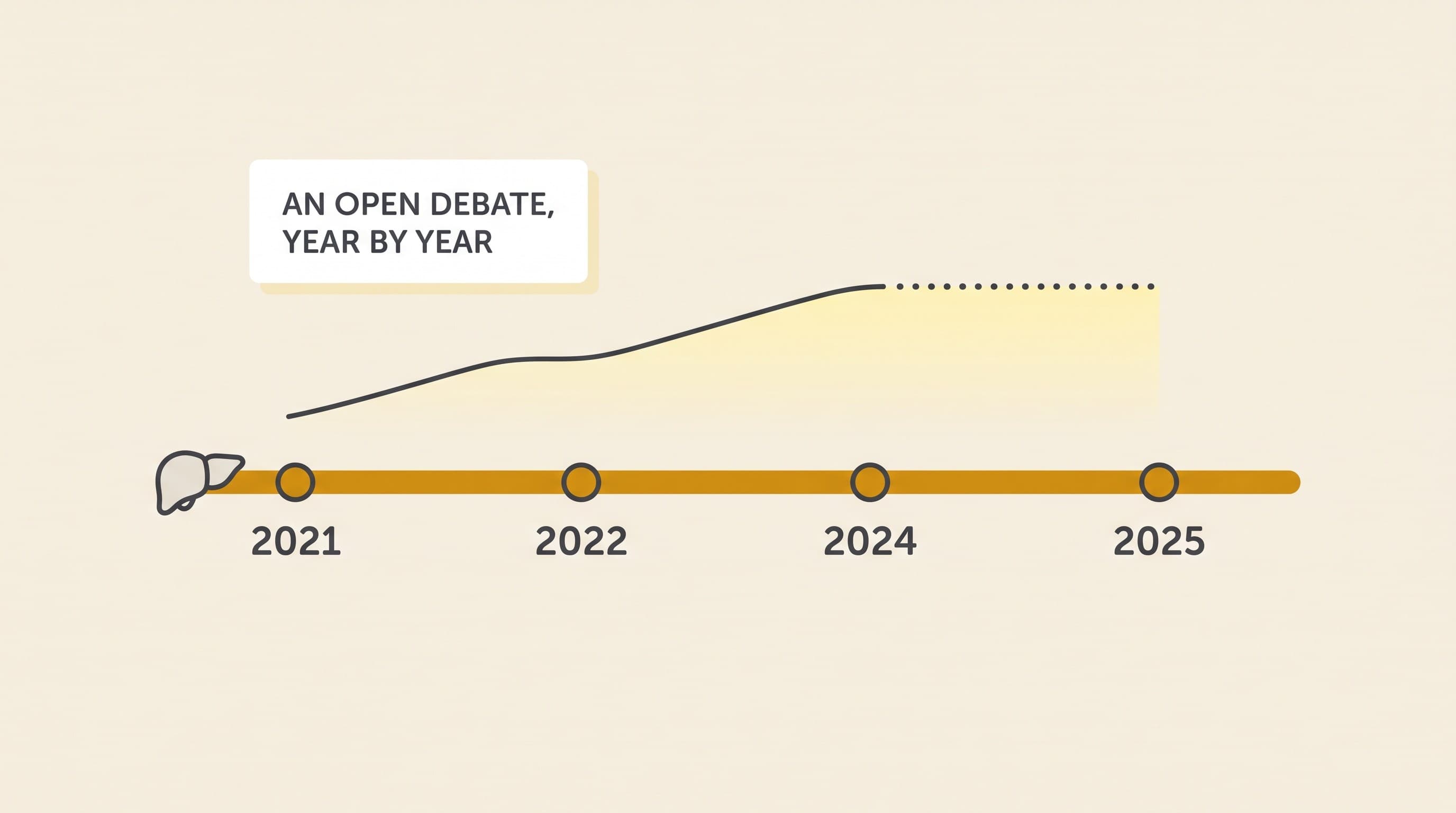
We will go through it chronologically, because the story only makes sense as a timeline: the historical decision that set it up, the 2021 paper that reignited the argument, the regulatory rulings of 2022 and 2024, and the 2025 studies that added weight without closing the case. Throughout, keep one thing in mind, because it is what separates understanding the science from misusing it: none of this tells you whether copper is a problem for your dog. That is a question answered by measuring copper in your dog's liver, not by reading a study. The science tells you why the question is worth asking; the biopsy tells you the answer for your animal.
The background: how the question was set up
To understand the modern debate you have to go back to a decision about how copper is added to dog food. Copper is an essential nutrient, so it has always been included, but the form it is added in matters, because different copper compounds are absorbed by the body to different degrees.
Historically, the pet-food sector moved towards using more readily absorbed forms of supplemental copper, such as copper chelates and copper sulphate, in place of less bioavailable oxide forms. On paper this was a sensible move, ensuring dogs did not become copper-deficient. The concern raised later is that it may have had an unintended consequence: the copper in modern diets is not just present, it is present in a form the liver takes up more efficiently, so the effective copper load on the liver rose even where the labelled amount did not change dramatically. That hypothesis is the foundation everything else is built on, and it is worth holding lightly, because it is a reconstruction of cause rather than a directly measured fact.
2021: the viewpoint that reignited it
The modern debate is usually dated to a 2021 viewpoint article in JAVMA, the journal of the American Veterinary Medical Association. A viewpoint is an important thing to characterise honestly: it is an expert argument and synthesis, not a controlled experiment. Its authors argued that copper-associated hepatopathy in dogs had become more common, that the trend tracked with the changes in dietary copper, and that the maximum copper levels permitted in dog food should be reconsidered.
The strength of the 2021 piece was that it came from respected specialists and pulled together a pattern that clinicians had been noticing: more dogs, of breeds not traditionally associated with copper storage, turning up with copper accumulation on liver biopsy. The limitation, which honest readers should hold onto, is that a viewpoint arguing a trend is not the same as a study proving one. It framed a hypothesis and made a case; it did not, on its own, settle the matter. That is not a criticism, it is simply what a viewpoint is.
2022 and 2024: the regulators decline to move
If the science were clear-cut, the regulator would have acted. It did not, and how it declined is instructive.
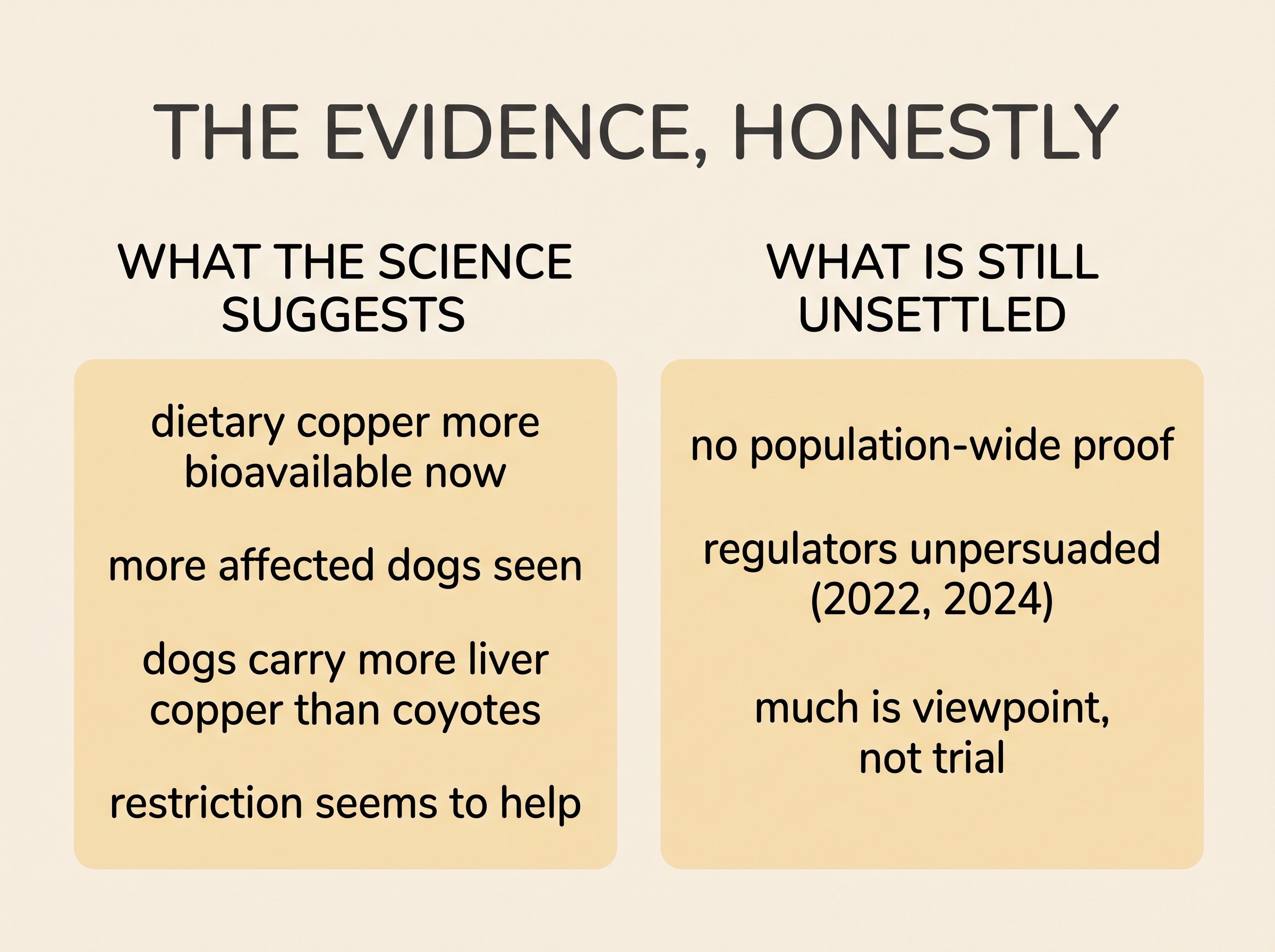
AAFCO, which sets the model nutrient standards that most US pet foods follow, took up the copper question directly. In August 2022 it concluded that there was insufficient evidence to change the maximum copper level in dog food. Then, in May 2024, a proposal to revise the copper guidance was put to a vote and was voted down.
It is tempting to read this as either vindication of the sceptics or as a failure of caution, depending on which side you started on. The fair reading is narrower and more useful: the body responsible for the standards looked at the same evidence and judged it not strong enough to justify a regulatory change. That is a genuine data point about the state of the evidence. It tells you the case, as of 2024, was not considered conclusive by the people whose job it is to weigh it. Whether they were being appropriately rigorous or overly cautious is a matter of judgement, and reasonable specialists disagree.
2025: the evidence gets heavier
The most recent work has tried to move the argument from "clinicians are noticing a trend" towards harder comparisons, and 2025 is where the evidence gained weight.
One notable study compared hepatic copper concentrations in domestic dogs with those in wild coyotes. The logic is neat: coyotes eat a natural, non-commercial diet, so if pet dogs are carrying substantially more liver copper than a closely related wild canid, that is difficult to explain by anything other than diet. A finding of higher copper in domestic dogs supports the dietary hypothesis in a way that clinical impressions cannot, because it uses the wild animal as a natural comparison group.
Other 2025 work looked at the practical question that matters to affected dogs: what happens when you put a dog with copper accumulation on a copper-restricted diet. Evidence that restriction improves the picture strengthens the causal link, because if reducing dietary copper reduces the problem, then dietary copper was plausibly contributing to it. The veterinary hepatologist Sharon Center runs as a through-line author across much of the copper literature over the years, which is worth knowing when you are trying to trace who has actually done the work.
None of this, it must be said, amounts to a randomised, population-wide proof that a given amount of dietary copper causes disease in the average dog. What it does is make the dietary-copper hypothesis progressively harder to dismiss. The direction of travel in the evidence has been towards taking copper more seriously, even as the regulators have held their position. That tension, mounting research pressure against unchanged standards, is exactly where the debate sits at the time of writing.
What this means, and what it does not
Here is where the science stops and honesty about its limits begins. The evidence between 2021 and 2025 supports taking copper seriously as one real cause of canine liver disease. It does not support the claim that copper is behind all liver disease, and it does not support panic-switching a healthy dog's diet on the strength of a study.
Two limits are worth stating clearly. First, most of this literature is North American, and the UK picture differs: British research has found that copper is not the main driver of most UK chronic hepatitis, much of which is immune-mediated (the chronic hepatitis UK picture piece covers this, and the honest copper debate piece works through what it means for a UK owner). A study showing high liver copper in North American dogs does not automatically describe the dog in front of you in Britain.
Second, and this is the one that actually protects your dog: a study cannot diagnose your individual animal. Copper-associated hepatopathy is confirmed by measuring the copper concentration in a liver-tissue sample, not by extrapolating from the literature. The science tells you the question is real and worth asking your vet. Only the measurement answers it for your dog.
So do not read this timeline as a reason to act unilaterally. Do not start a copper-restricted diet or ask for chelation on the basis of having read the studies, because copper restriction and chelation are treatments for confirmed loading and are veterinary decisions, and copper, being an essential nutrient, can be over-restricted to a dog's harm. And it should go without saying, but the debate is about copper levels and the regulatory framework across the whole category, not about any single "toxic" brand.
Where the science leaves you
The useful takeaway is not a verdict but a stance. The dietary-copper hypothesis has grown steadily stronger from 2021 to 2025 and deserves to be taken seriously, especially for predisposed breeds. It has not yet become settled fact, the regulators remain unpersuaded, and the UK picture is not the North American one. Holding all of that at once is not fence-sitting, it is simply where the evidence honestly is.
If your dog has confirmed copper-associated hepatopathy, the science stops being abstract and the next step is entirely practical: how to feed them well within the copper limits, which is covered in the guide to feeding the copper-restricted dog. If you are here because your dog is a predisposed breed, the copper-storage breeds piece gives you the breed-specific detail. And if you simply wanted to know whether the copper scare is real, the honest answer is that it is a real and open scientific question, which is precisely why the responsible response is testing rather than fear.
References
- 2021 JAVMA viewpoint on rising dietary copper and canine copper-associated hepatopathy.
- AAFCO copper position: August 2022 "insufficient evidence"; May 2024 vote-down of proposed change.
- 2025 dog-vs-coyote hepatic copper comparison study.
- 2025 copper-restricted-diet outcome study.
- Center SA and colleagues, hepatic copper literature (through-line authorship).
- Webster CRL, Center SA, Cullen JM, et al. ACVIM Consensus Statement on the diagnosis and treatment of chronic hepatitis in dogs. *J Vet Intern Med* 2019;33(3):1173-1200.
- Bexfield NH. Canine chronic hepatitis: UK breed and signalment study. 2012.
Keep track of how your pet is doing
The owners who cope best are the ones who notice changes early. A simple health log shows you what is working, and what is not, before the next vet visit.
Start tracking, freeYou're not doing this alone
Compare treatment journeys and talk to owners managing liver & gallbladder. Free to join.
Join PetsLikeMine