

Conn's and the rarer adrenal problems worth a name
Alastair Greenway
BVM&S MRCVS
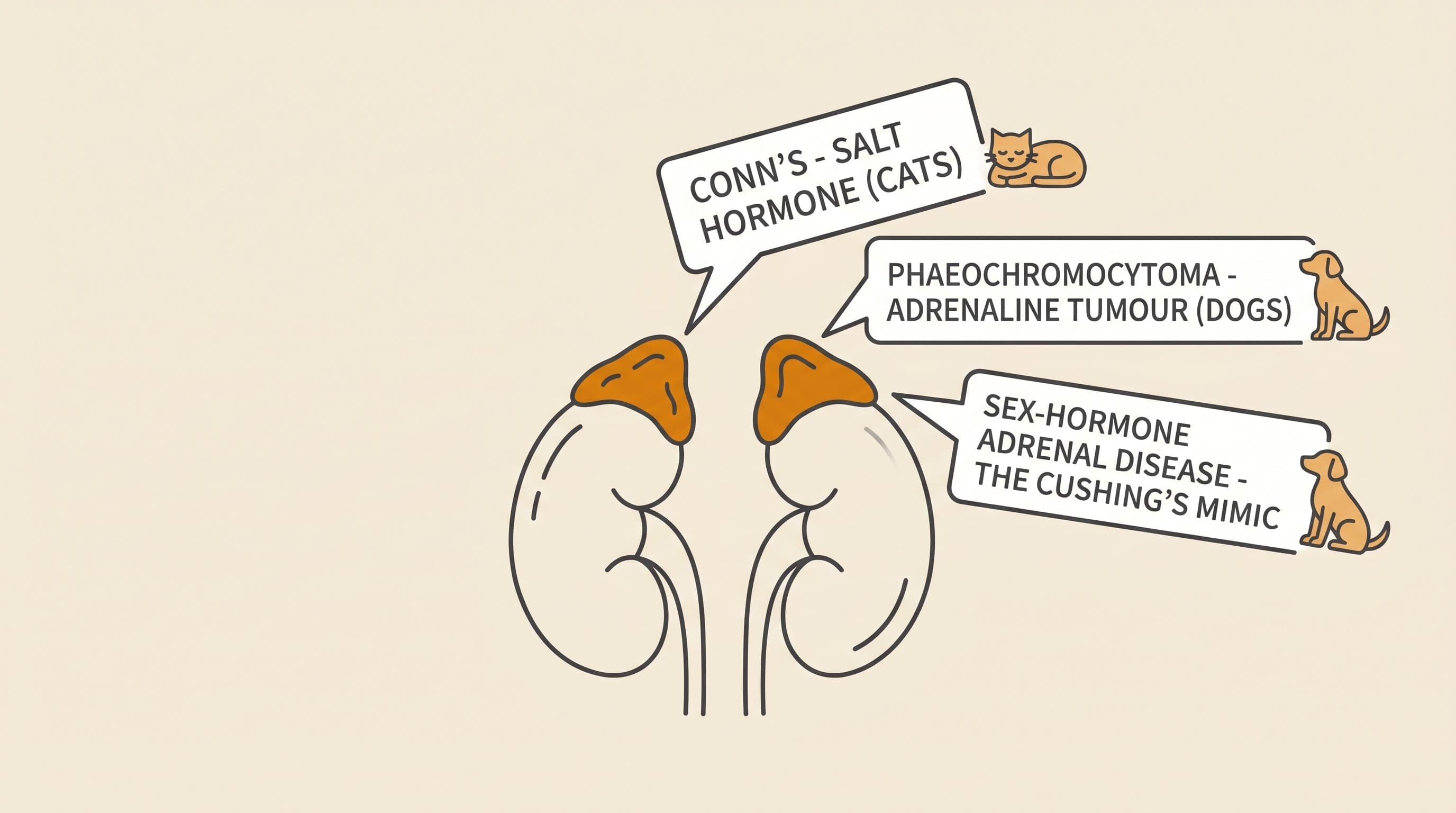
Most of this Hormone Health home is about the common conditions: the over-active thyroid cat, the over-diagnosed under-active thyroid dog, the thirsty pot-bellied Cushing's dog, the great-pretender Addison's. But the adrenal glands, the two small organs that sit just in front of the kidneys, can go wrong in a few rarer ways too. Most owners never meet these, so if your vet has mentioned one, an unfamiliar name on a results page is unsettling and there's almost nothing calm and plain-English written for you.
So this is a "worth a name" piece. It won't make you the expert on any of them, because each is genuinely specialist territory: diagnosed with specific blood tests and scans, and treated with surgery or carefully monitored drugs, usually after a referral. What it will do is give you the name, a sense of what's going on, and a realistic idea of what comes next, so the word stops being frightening. There are three worth knowing.
Conn's syndrome: the "salt hormone" tumour in cats
The lead one, and the only one that's reasonably common for its niche, is Conn's syndrome, which your vet may call primary hyperaldosteronism. It's the cat condition here. The adrenal gland's outer layer (the cortex) makes several steroid hormones, one of which is aldosterone, the hormone that tells the body how to handle salt and potassium. In Conn's, part of the cortex churns out far too much aldosterone on its own, either from a small tumour on one gland or from both glands becoming overgrown and overactive (Djajadiningrat-Laanen et al. 2011; Merck Veterinary Manual). It's thought to be probably the most common disorder of the adrenal cortex in cats, and for years it was almost certainly under-diagnosed (Djajadiningrat-Laanen et al. 2011).
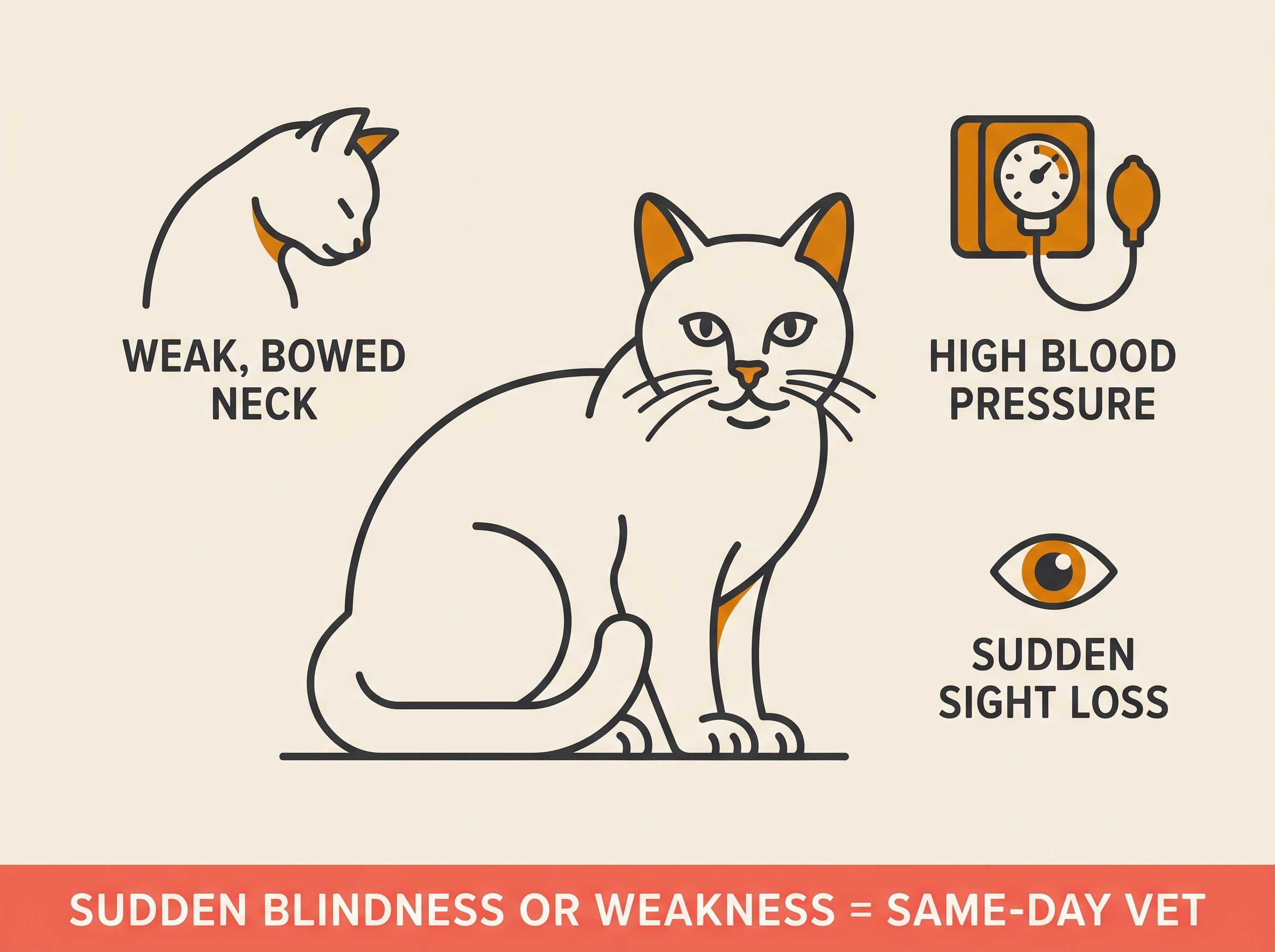
It affects middle-aged to older cats (Ash et al. 2005; Djajadiningrat-Laanen et al. 2011), and the picture isn't the "drinking gallons" story you might expect from a hormone problem. Too much aldosterone drives potassium down, and low potassium makes muscles weak. The signature sign is a cat holding its head and neck flexed downward, the so-called cervical ventroflexion, often with a reluctance to jump, an odd flat-footed stance and episodes of weakness that come and go (AAHA 2023; Ash et al. 2005). The other half of the story is high blood pressure, which can do real damage and, alarmingly, can cause sudden blindness by detaching the retina (AAHA 2023). Drinking and weeing more is only a minor feature, in a minority of cats (Ash et al. 2005), so within the hormone funnel Conn's is more a "weak, wobbly or suddenly blind older cat" than a thirst story.
That blindness point is the one safety note worth carrying. If an older cat suddenly seems to have lost its sight, is bumping into things, or goes weak and floppy in the neck, that's a same-day vet visit, not a wait-and-see. Very high blood pressure is the likely culprit, from Conn's, but also from kidney disease or an over-active thyroid, and caught quickly the sight loss is sometimes reversible (AAHA 2023).
Diagnosis is a job for your vet, usually with a specialist's input. It rests on showing an inappropriately high aldosterone in the blood, ideally measured against a hormone called renin, then scanning the tummy by ultrasound or CT to find which gland is at fault (AAHA 2023; Djajadiningrat-Laanen et al. 2011). In practice a reliable feline renin test isn't always available, so a vet often pieces it together from a high aldosterone, a low potassium and an adrenal mass on the scan (Ash et al. 2005). The point for you is simply that this needs the proper panel, not a guess.
The encouraging part is that Conn's is treatable. If one gland holds a single tumour, surgically removing it (an adrenalectomy) is the treatment of choice and can be curative, and most cats do well afterwards. One multi-centre study of 29 cats found 97% came through to discharge, with a median survival of nearly three years (Del Magno et al. 2023). The surgery isn't trivial, because the adrenal glands sit among big blood vessels and bleeding is the main risk, so it belongs with a referral surgical team (Ash et al. 2005). Where surgery isn't the right call, the condition can be managed medically instead, with potassium supplements, a drug called spironolactone that blocks aldosterone's effect, and amlodipine to bring the blood pressure down (AAHA 2023; Ash et al. 2005). Either route is reasonable, it depends on the cat. And because the high blood pressure overlaps with the kidneys, eyes and heart, and many of these cats have some kidney disease alongside, Conn's sits close to our urinary-health (CKD) material rather than in isolation (Schulman 2020).
Phaeochromocytoma: the "adrenaline tumour" in dogs
The second name is a mouthful, phaeochromocytoma, and it's a dog one. While Conn's comes from the outer cortex, this tumour grows in the inner core of the adrenal gland (the medulla), the part that makes adrenaline and noradrenaline, and it pumps out those "fight or flight" chemicals in surges (Merck Veterinary Manual). It mostly turns up in older dogs, with no strong breed or sex pattern, and it's uncommon in dogs and rare in cats (Merck Veterinary Manual; UK Vet Companion Animal 2023).
Because the hormones come in bursts, so do the signs, which is part of why it's tricky to spot. A dog might have episodes of weakness, lethargy, collapse, a racing or irregular heart, heavy panting and drinking more, then seem fine in between (UK Vet Companion Animal 2023; Merck Veterinary Manual). Roughly half of affected dogs have high blood pressure at diagnosis (UK Vet Companion Animal 2023). Occasionally one causes something dramatic, such as a sudden collapse or internal bleeding, which is why episodic collapse or a racing heart in an older dog is always a "see the vet" sign, not something to monitor at home.
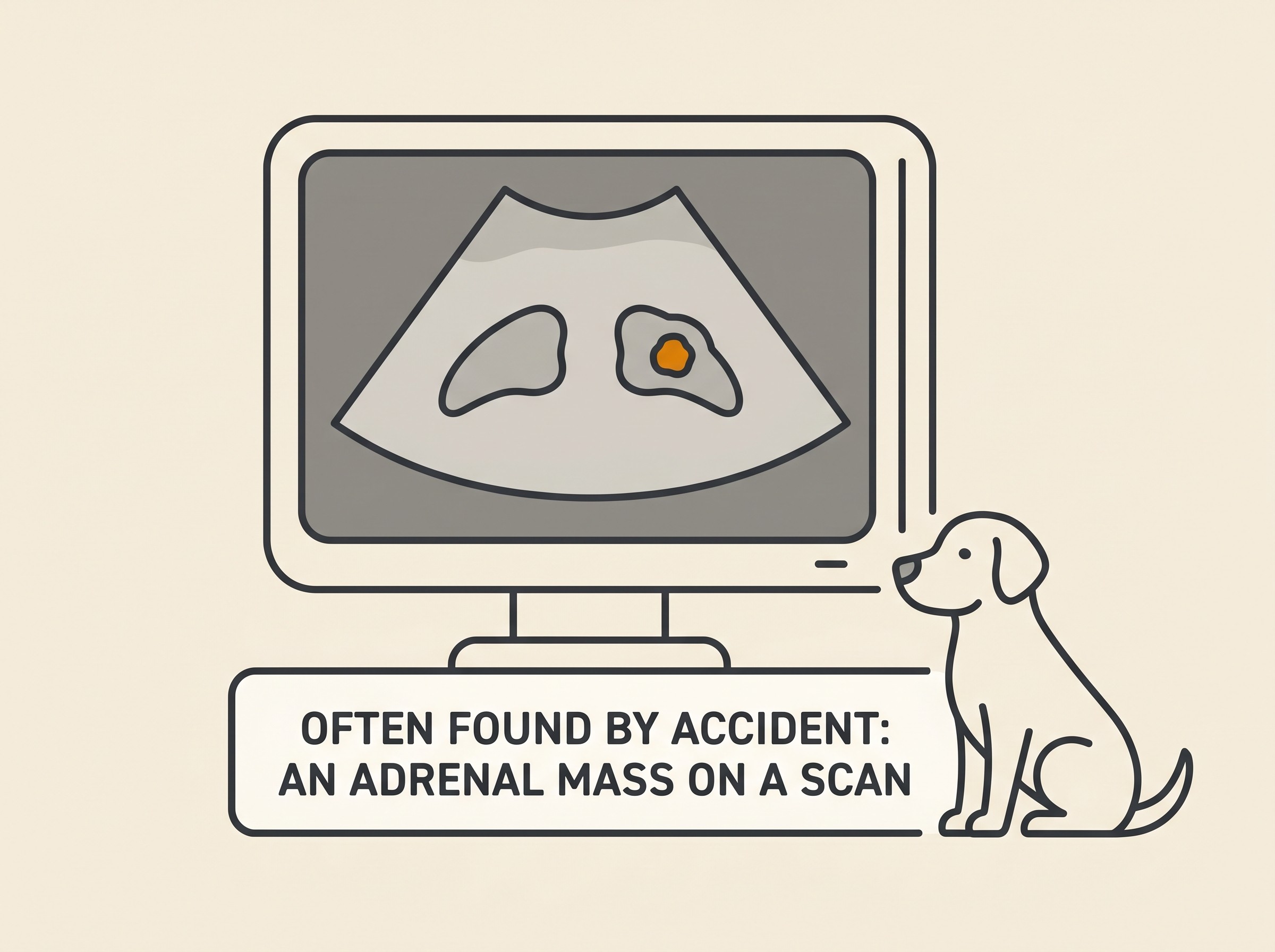
In fact, more than half of phaeochromocytomas are found by accident, picked up as an unexpected "adrenal mass" while the vet scans the tummy for some other reason (Merck Veterinary Manual). So a very common way owners first hear the word is "we found a lump on one of the adrenal glands and we want to check what it is." When a vet does suspect one, the blood or urine can be tested for the breakdown products of those adrenaline-type hormones (Gostelow et al. 2013), and a scan assesses the mass, since these tumours can be locally invasive and a proportion are malignant (Merck Veterinary Manual; Pagani et al. 2016).
Treatment of choice is surgery to remove the affected gland, and dogs that get safely through the operation can do well for a good while, with long-term survival measured in years in one series (Enright et al. 2022). The caveat is that this is decidedly specialist surgery: a hormone surge from the tumour can send blood pressure dangerously high on the operating table, so it needs an experienced anaesthetic and surgical team (Enright et al. 2022; UK Vet Companion Animal 2023). Vets have long given a drug called phenoxybenzamine beforehand to blunt those surges, though recent evidence has questioned how much it improves survival, and it's an area of active debate among specialists (Enright et al. 2022). None of that is a decision you make at home. The takeaway is just that a suspected phaeochromocytoma means a referral team, not alarm.
Sex-hormone (atypical) adrenal disease: the Cushing's that hides
The third one doesn't have a tidy household name, and you'll most likely meet it through a puzzle rather than a label. Sometimes a dog has all the hallmarks of Cushing's, the drinking, the big appetite, the thin skin, the symmetrical hair loss, yet the standard Cushing's tests come back normal. One explanation is that an adrenal gland is over-producing steroids other than cortisol, things like progesterone and 17-hydroxyprogesterone and other sex hormones, which can imitate cortisol's effects and create a Cushing's-like picture even when cortisol itself looks fine (University of Tennessee, Steroid Profiles). This is sometimes called "atypical" hyperadrenocorticism, and it's documented, if uncommon, rather than a theory (Farges et al. 2024).
When the usual tests are normal but the signs aren't, a vet may run an extended adrenal panel for these other steroid hormones, often before and after a stimulating injection (University of Tennessee, Steroid Profiles). And here the home's recurring discipline applies squarely: a single raised hormone on that panel is not, by itself, a diagnosis. These are specialist tests with a real false-positive problem, and even many healthy or simply bald dogs show one raised value, so the result has to be read by a vet alongside the whole clinical picture (University of Tennessee, Steroid Profiles). Treat it as something your vet may investigate when the ordinary tests don't fit, not a label to chase down a search bar.
The thread that brings this one into Hormone Health is the coat. Because these steroids can cause the same symmetrical, non-itchy hair loss as hypothyroidism and classic Cushing's, sex-hormone adrenal disease is part of the same hair-loss-without-itching puzzle, which is why it sits where this home hands over to our Allergies & Skin material. If your dog's main problem is a balding, non-itchy coat and the obvious hormone tests have come back clear, that's the natural place to read next.
Where this leaves you
If you've landed here because your vet mentioned one of these names, the summary is short. They're rare or uncommon, they're well understood by the specialists who deal with them, and each has a real route forward: surgery that can be curative for Conn's and phaeochromocytoma, careful medical management where surgery isn't right, and proper testing before anyone commits to a diagnosis. None of them is a do-it-yourself condition, so the most useful thing you can do is let your vet steer, very likely towards a referral team, rather than match a protocol from the internet.
For the bigger picture, the classic hormone signs and which gland they point to are covered in our start-here funnel, and the various blood tests are explained alongside it. If high blood pressure or extra thirst is part of your pet's story, our urinary-health (CKD) material covers the kidney overlap, and you can keep an eye on water intake with the Thirst & Wee tracker, though for Conn's the thirst is usually a minor part. For a balding, non-itchy coat, Allergies & Skin is the place to go next, and for the sugar-handling tumours sometimes mentioned alongside these, acromegaly and insulinoma, the Diabetes space owns those. An unfamiliar name is unsettling, but for all three, the next step is the same calm one: a proper work-up with your vet.
References
- Djajadiningrat-Laanen S, Galac S, Kooistra H. "Primary hyperaldosteronism: expanding the diagnostic net." J Feline Med Surg. 2011;13(9):641–650. DOI: 10.1016/j.jfms.2011.07.017
- Ash RA, Harvey AM, Tasker S. "Primary hyperaldosteronism in the cat: a series of 13 cases." J Feline Med Surg. 2005;7(3):173–182. DOI: 10.1016/j.jfms.2004.08.007
- Del Magno S, Foglia A, Rossanese M, et al. "Surgical findings and outcomes after unilateral adrenalectomy for primary hyperaldosteronism in cats: a multi-institutional retrospective study." J Feline Med Surg. 2023;25(1):1098612X221135124. DOI: 10.1177/1098612X221135124
- 2023 AAHA Selected Endocrinopathies of Dogs and Cats Guidelines, Feline Hyperaldosteronism. J Am Anim Hosp Assoc 2023;59(3):113–135.
- Schulman RL. "Primary hyperaldosteronism in cats." Vet Clin North Am Small Anim Pract. 2020;50(5):1015–1027.
- Merck Veterinary Manual. "Feline Primary Hyperaldosteronism."
- Merck Veterinary Manual. "Pheochromocytomas in Animals."
- "Canine phaeochromocytoma: a guide to diagnosis and treatment." Companion Animal. 2023. DOI: 10.12968/coan.2023.0036
- Gostelow R, Bridger N, Syme HM. "Plasma-free metanephrine and free normetanephrine measurement for the diagnosis of pheochromocytoma in dogs." J Vet Intern Med. 2013;27(1):83–90. DOI: 10.1111/jvim.12009
- Pagani E, et al. "Ultrasonographic features of adrenal gland lesions in dogs can aid in diagnosis." BMC Vet Res. 2016;12:267. DOI: 10.1186/s12917-016-0895-1
- Enright D, Dickerson VM, Grimes JA, Townsend S, Thieman Mankin KM. "Short- and long-term survival after adrenalectomy in 53 dogs with pheochromocytomas with or without alpha-blocker therapy." Vet Surg. 2022;51(3):438–446. DOI: 10.1111/vsu.13771
- University of Tennessee College of Veterinary Medicine, Endocrinology Service. "Steroid Profiles in the Diagnosis of Canine Adrenal Disorders."
- Farges C, et al. "Hyperprogesteronism associated with adrenocortical tumours in two dogs." Vet Rec Case Rep. 2024. DOI: 10.1002/vrc2.794
Keep track of how your pet is doing
The owners who cope best are the ones who notice changes early. A simple health log shows you what is working, and what is not, before the next vet visit.
Start tracking, freeYou're not doing this alone
Compare treatment journeys and talk to owners managing hormone health. Free to join.
Join PetsLikeMine