

Complementary and Alternative Therapies: What Helps, What's Harmless, What's Hype
Alastair Greenway
BVM&S MRCVS
A diagnosis of cancer leaves most owners wanting to do something with their hands, and the internet is happy to fill that space. There's a supplement for the immune system, a mushroom blend, a diet that "starves" the tumour, a CBD oil that promises calm, and somewhere in the mix a site telling you the vets have got it all wrong. The urge to add something gentle and natural and within your control is about as human as it gets. It isn't foolish, and it doesn't mean you've stopped trusting your vet. It's love looking for a job to do.
Complementary and alternative medicine, often shortened to CAM, is a genuinely mixed bag. Some of it really does help your pet feel better. Some does very little measurably but does no harm, and the comfort it gives you has its own worth. And some is hype, occasionally the kind that costs your pet dearly. This piece is a map for telling those apart.
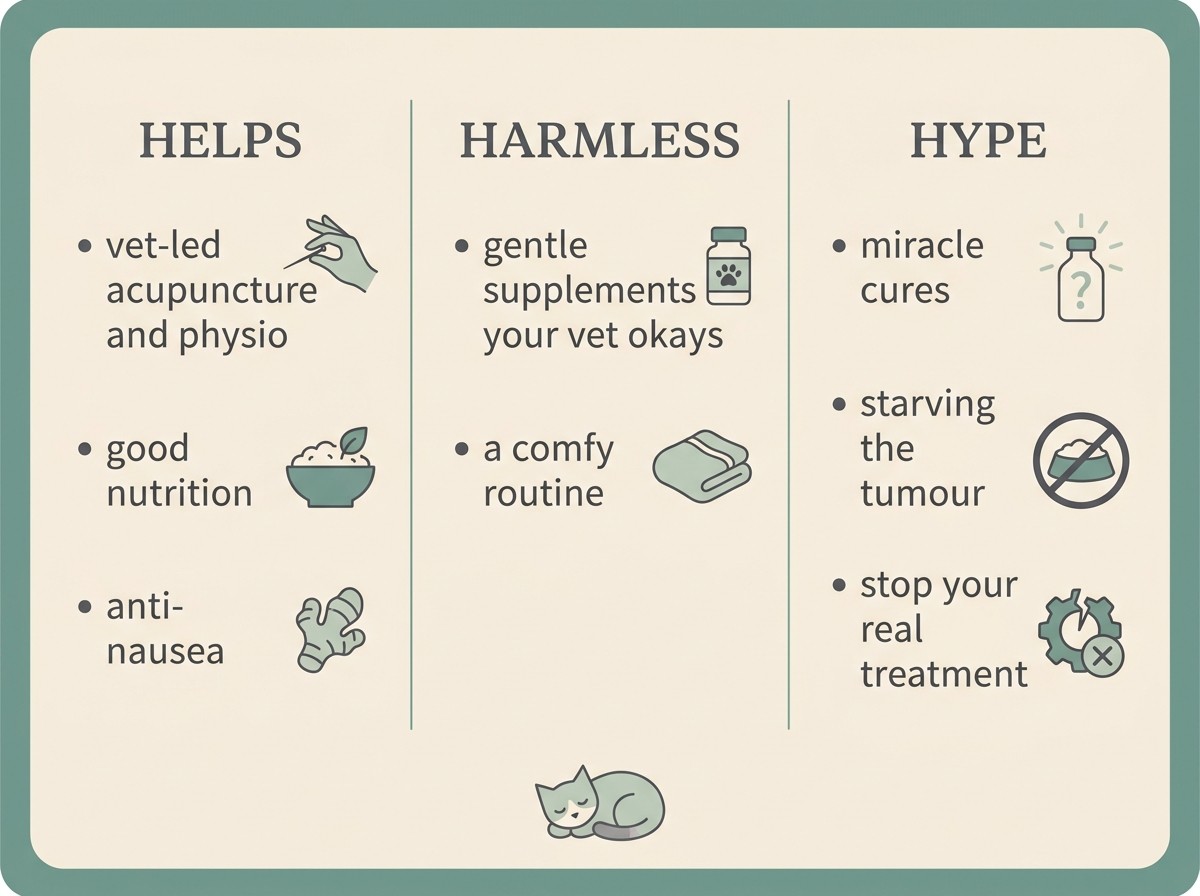
A simple way to sort it
Nearly everything you'll meet falls into one of three boxes, and it pays to decide which before you spend a penny.
Helps. A handful of things have a real, sensible basis for making a pet with cancer more comfortable. They don't fight the cancer, but once you're living with it, comfort is the whole game.
Harmless and comforting. Plenty of gentle additions won't change the disease and probably won't do much you could measure, but they're safe, and the sense of actively caring for your pet counts for something. The only cost is the money, so spend it with your eyes open.
Hype. A smaller, louder group makes claims no responsible vet would, and a few are actively dangerous, either to your pet directly or because they pull you away from care that genuinely works.
One thing runs through all three boxes and matters more than any single product: tell your vet everything you're giving or thinking of giving. Not because they'll disapprove, but because some perfectly "natural" things interact badly with cancer drugs, and your vet can only protect your pet from what they know about.
What genuinely helps with comfort
The most useful complementary care tends to be the least glamorous, and it usually comes from your own vet or a qualified professional rather than out of a bottle.
Acupuncture and physiotherapy, vet-led. This is the part of CAM with the firmest footing. Veterinary acupuncture and physical therapy are recognised in the main veterinary pain guidelines as genuine parts of a multimodal approach, meaning they sit alongside pain medication rather than replacing it (AAHA, 2022; Monteiro et al., 2023). For a pet with cancer pain, stiffness or reduced mobility, a session with a vet trained in these techniques can add real comfort, and there's no good reason to dismiss it. The key word is qualified: in the UK, acupuncture is an act of veterinary surgery and should be done by a vet or under veterinary direction, not by an untrained practitioner.
Good nutrition and a working appetite. Keeping weight and muscle on a pet with cancer matters far more than any exotic ingredient, and our piece on feeding a pet with cancer covers it properly. The short version: calories your pet will actually eat beat any "anti-cancer" recipe, and there's no evidence that cutting carbohydrates starves a tumour. More on that myth below.
Controlling nausea and discomfort. This barely counts as "alternative", but it belongs here because it's what owners are really after when they buy supplements: they want their pet to feel well. Modern anti-nausea medication, good pain relief and appetite support from your vet do that directly and reliably, and they're usually the fastest route to the calm, comfortable pet you're hoping a supplement might deliver.
If one idea sticks from this box, let it be that the proven comforts are mostly things your vet can offer or guide. They're worth asking about before you go shopping.
CBD, told straight
CBD (cannabidiol) earns its own section, because it's everywhere and the marketing has run well ahead of the evidence.
The best veterinary research on CBD is in arthritis and pain, not cancer. A well-run trial in dogs with osteoarthritis found that CBD at 2mg/kg twice daily improved comfort and activity (Gamble et al., 2018), and there's reasonable interest in it for anxiety too. For cancer specifically, though, the picture is thin. Claims that CBD shrinks or cures tumours rest on laboratory and cell-culture work, not on studies in actual pets, and RCVS Knowledge describes a genuine "paucity of clinical research in this field" (RCVS Knowledge, 2026). If CBD has any role for a pet with cancer, then, it's as a possible comfort and anxiety aid, not as a treatment for the cancer itself.
Three real cautions come with it:
- Quality is a real problem. CBD products sold over the counter aren't formally assessed for safety, and testing has repeatedly found products that don't contain what the label says, sometimes including detectable THC, which is toxic to dogs, and sometimes heavy-metal contamination (RCVS Knowledge, 2026). You often can't tell from the bottle what you're actually giving.
- It interacts with other drugs. CBD is processed by the liver and can interfere with how other medicines are handled, with a known interaction with the epilepsy drug phenobarbital, and the same liver pathways matter when a pet is on cancer drugs (RCVS Knowledge, 2026).
- The UK position is specific. No CBD product is authorised for animals in the UK, the Veterinary Medicines Directorate treats CBD for pets as a veterinary medicine, and products on the shelf "offer no guarantee of quality, or that they will provide any therapeutic benefits" (VMD, 2022). A vet can prescribe a human CBD product under the prescribing cascade where it's justified, which is the safest route if you want to try it.
None of that makes CBD a scam. It means it sits in "possibly helps comfort, but quality and interactions are real, so do it through your vet, not behind their back".
Harmless, comforting, and worth a sensible look
A lot of what owners give sits quietly in the middle. Fish oils, certain mushroom extracts, milk thistle for the liver, joint supplements and probiotics are popular, generally well tolerated, and some have a plausible supporting role. Milk thistle, for instance, is sometimes used to support the liver during chemotherapy and may help keep treatment on schedule (Today's Veterinary Practice, 2021). The evidence that any of these change the course of the cancer is weak to absent, so be honest with yourself that you're buying comfort and the feeling of helping, not a treatment.
Two practical points keep this box safe rather than just expensive:
- Supplements aren't regulated like medicines. Their quality and contents aren't checked the way a prescription drug's are, so what's in the tub can vary a lot (Today's Veterinary Practice, 2021). Stick to reputable makers and be sceptical of dramatic claims.
- Antioxidants during active treatment are a genuine grey area. High-dose antioxidant supplements (think large doses of vitamins C and E) worry some specialists, who fear they could blunt chemotherapy or radiation, both of which work partly by oxidative damage; the evidence here is mixed rather than settled (D'Andrea, 2005). The sensible line isn't panic, it's timing: don't start high-dose antioxidants during a course of chemo or radiation without checking with the team running it.
That last point is exactly why the "tell your vet" rule exists. A supplement that's harmless on its own can stop being harmless the week your pet is having chemotherapy.
Hype, and the red lines
Then there's the loud end, where the gentleness has to give way to plain speaking, because this is where pets get hurt. Be very wary of anything that:
- Claims to cure cancer, or to do it "naturally" without the side effects of "toxic" conventional treatment. No good vet promises a cure from a supplement, a diet or a herbal blend.
- Tells you to stop or delay your pet's actual treatment, or hints that vets are hiding the real answer. This is the most dangerous claim of all, because the harm isn't only wasted money, it's the effective treatment, or the good comfortable weeks, lost while you chase something unproven.
- Says sugar feeds cancer, so you should starve the tumour with a carb-free or fasting diet. There's no good evidence this helps a pet, and the real risk runs the other way: a pet with cancer that eats too little loses weight and muscle it badly needs. Don't deny your pet food it will happily eat in pursuit of this idea.
- Costs a fortune for something with no real evidence, especially paid up front to a clinic or seller you've never heard of, on the strength of testimonials and before-and-after stories rather than anything published.
A useful test you can apply at midnight: real complementary care is open about being a comfort rather than a cure, it's safe enough to tell your vet about, and it never asks you to abandon the treatment that's working. Hype is certain of itself, it's secretive about evidence, and it wants you to choose it instead of proper care. Our piece on real hope versus hype goes further into the newer medical options, the trials, and the "miracle cure" pattern, and it pairs naturally with this one.
The one habit that keeps it all safe
Whatever you decide to add, keep a list of everything your pet is taking, supplements and CBD included, and show it to your vet. Bring the actual bottles if it's easier. A good vet won't roll their eyes. They'll be glad you're trying to help, and they'll point that effort at the things most likely to make your pet feel genuinely better while steering you clear of the few that could quietly do harm. That partnership, your instinct to help plus their knowledge of what's safe, is worth more than anything you'll find in a tub.
References
- American Animal Hospital Association (AAHA) (2022). 2022 AAHA Pain Management Guidelines for Dogs and Cats. (Recognises acupuncture and physical rehabilitation within a multimodal approach to pain.)
- Monteiro, B. P., et al. (2023). 2022 WSAVA guidelines for the recognition, assessment and treatment of pain. Journal of Small Animal Practice, 64(4). (Includes physical-medicine modalities such as acupuncture among pain-management options.)
- Gamble, L.-J., et al. (2018). Pharmacokinetics, Safety, and Clinical Efficacy of Cannabidiol Treatment in Osteoarthritic Dogs. Frontiers in Veterinary Science, 5:165. (Cornell/Colorado State trial; ~2mg/kg twice daily improved comfort and activity; some dogs had mild rises in liver enzymes.)
- RCVS Knowledge (2026, updated 20 January). The use of cannabidiol (CBD) in animals. (Notes a paucity of clinical research; possible roles in pain, anxiety and other conditions; product quality, THC and heavy-metal contamination concerns; interaction with phenobarbital.)
- Veterinary Medicines Directorate (VMD) (2022, 28 June). Can I buy CBD oil (cannabidiol) for my pet? (No CBD products authorised for veterinary use in the UK; treated as a veterinary medicine; freely available products "offer no guarantee of quality"; THC can be toxic to animals; a vet may prescribe a human CBD product under the cascade.)
- Today's Veterinary Practice (2021). Raditic DM, Gaylord L. Supplements for Small Animal Cancer Patients. March/April 2021. (Discusses milk thistle, fish oils, curcumin and others; notes a study in which milk thistle/SAMe reduced liver-enzyme rises in dogs on CCNU chemotherapy, that supplements are not quality-regulated like medicines, and the importance of involving the veterinarian.)
- D'Andrea, G. M. (2005). Use of Antioxidants During Chemotherapy and Radiotherapy Should Be Avoided. CA: A Cancer Journal for Clinicians, 55(5), 319-321. (Argues high-dose antioxidant supplements may interfere with treatments that act through oxidative damage; note the wider literature is genuinely mixed.)
Sister tool · Sightline
Track quality of life over time
Sightline, a separate ConciergeVet tool, runs a short adaptive weekly assessment with a quality-of-life focus mode built around exactly these frameworks, tracks a single composite score over time so you can see the trend rather than judge a single bad day, and produces a Sightline Report PDF you can bring to your vet.
A written log, or our printable quality-of-life sheet, does much the same job.
See how Sightline tracks quality of lifeFound a lump? Track it, and know when to act
A lump cannot be told apart by look or feel; only your vet sampling it can. The Lump & Bump Tracker records its size and how it changes, flags when it has crossed a line worth a vet visit, and builds a clean history to take in.
Open the Lump & Bump TrackerYou're not doing this alone
Compare treatment journeys and talk to owners managing cancer. Free to join.
Join PetsLikeMine