

Benign or Not? The Common Lumps That Aren't Cancer
Alastair Greenway
BVM&S MRCVS
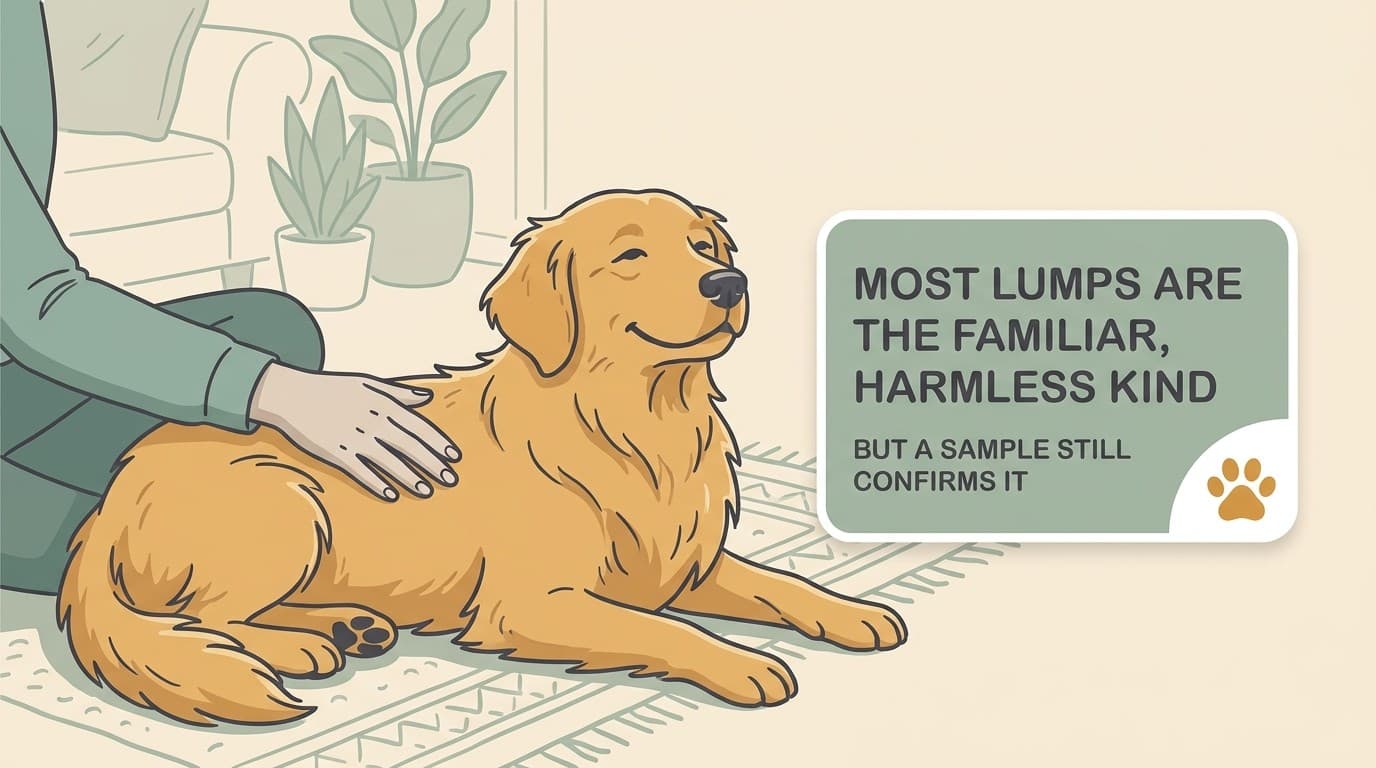
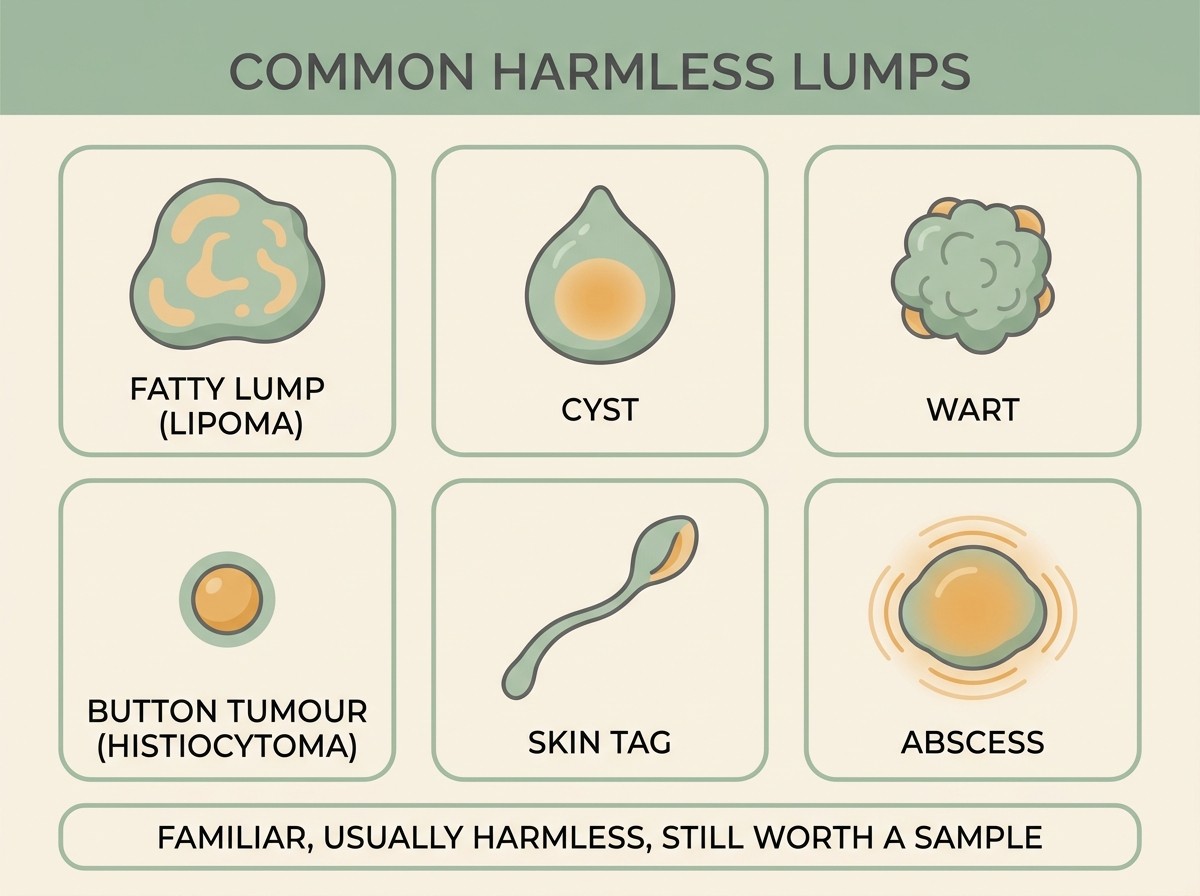
You've found a lump, you've read that most of them turn out to be harmless, and now you'd like to put a name to yours. It's a fair question, and a hopeful one, so let's go through it properly. A handful of everyday lumps and bumps come up again and again in the consulting room: the soft fatty ones, the little cysts, the warty growths. Most of them never cause a pet a moment's trouble.
We'll take each in turn, what it is, what it tends to feel like, and how it usually behaves. One thread runs through all of them, though, and it's worth saying up front. Knowing the common harmless lumps helps you worry less, but it doesn't let you, or us, skip the sample. A lipoma and something more serious can feel identical under your fingers, and the only way to separate them is to look at the cells. So read this for reassurance, and book the vet visit anyway. The two belong together.
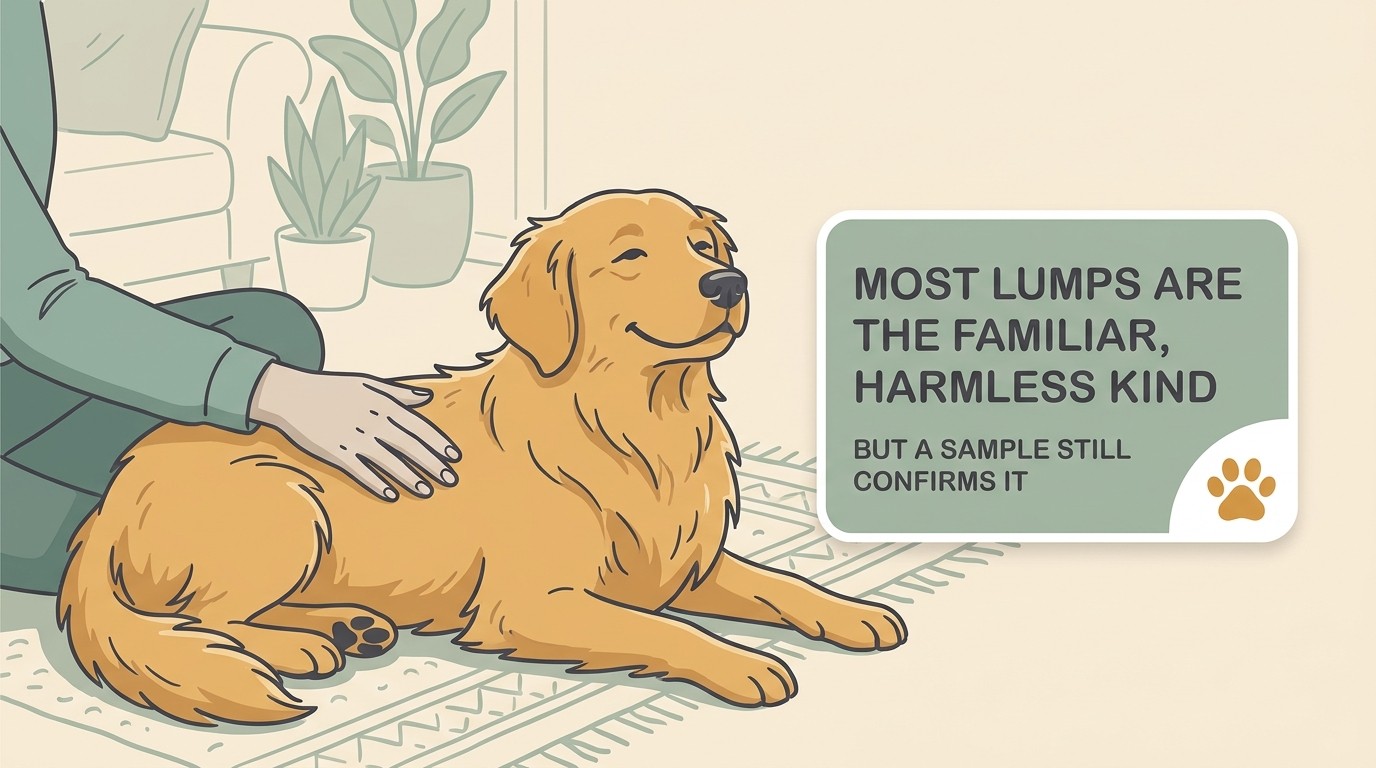
Lipomas: the classic soft fatty lump
A soft, squishy lump that slides around freely under the skin is very often a lipoma. These are just collections of fat cells, and they're the lump owners ask about more than any other. They're a common, benign tumour seen in middle-aged and older dogs, and most dogs grow at least one in their life, often several (VCA, 2024).
A typical lipoma is soft, moveable and slow to grow, and it tends to sit on the chest, the tummy or down the legs. They don't spread, and plenty never need removing at all. The exception is one that grows somewhere awkward, like an armpit, where it starts getting in the way of walking.
This is where the catch comes in, and VCA says it plainly: a lipoma "can be diagnosed by fine needle aspiration" precisely because you cannot be sure from the outside (VCA, 2024). A small number of fatty-feeling lumps turn out to be something less friendly, including a malignant cousin called a liposarcoma, and one or two other cancers can pose as a soft squishy lump as well. A quick needle sample tells the genuine fatty lump from the rare impostor in minutes, which is why we suggest it even for the most innocent-feeling bump.
Cysts: a sac of fluid or sebum
A cyst is, in VCA's words, an "abnormal pocket in tissue" filled with liquid or a thicker material (VCA, 2024). The skin ones owners meet most are the sebaceous and follicular cysts that form around hair follicles. They're common in dogs and unusual in cats, and they're benign.
A cyst often feels like a smooth, well-defined lump, sometimes with a bluish or whitish tinge, and a classic one can discharge a grey, cheesy, toothpaste-like material if it ruptures. Some sit quietly for years. Two things they do tend to catch owners out: they burst, which can look dramatic and messy, and they get infected, since a cyst is prone to a secondary bacterial infection that turns it red, sore and swollen (VCA, 2024).
A cyst can resemble other lumps just like everything else here, so your vet will often check the contents under the microscope to be certain. VCA puts it bluntly: vets "must test to know for sure" (VCA, 2024).
Warts (viral papillomas): the young dog's cauliflower bumps
A young dog, under about two, that has sprouted small, pale, cauliflower-like growths around the lips, muzzle or inside the mouth has most likely picked up viral papillomas, better known as warts. They come from the canine papillomavirus, they're benign, and they often arrive in clusters (VCA, 2024).
What they do next is the reassuring part. In healthy young dogs the immune system usually clears them unaided, and most regress within a month or two without any treatment at all as the dog develops immunity (VCA, 2024). Once a dog has had them, they tend not to return. They can look alarming, and a mouthful of them may put a young dog off eating, but they're rarely anything to fear. Bleeding, infection, or warts still spreading after a few months are reasons to have them looked at rather than left.
Histiocytomas: the young dog's "button" tumour
This one deserves a special mention, because the way it behaves throws people. A histiocytoma is a common, harmless tumour that turns up mostly in young dogs, usually under three years old, often on the head, the ear edges or a leg (VCA, 2024). It looks like a small, round, red, hairless "button", and it tends to come up fast, growing noticeably over just one to four weeks.
That rapid growth is the very thing that frightens owners, since fast-growing feels like it ought to be bad news. With histiocytomas it usually isn't. Most of them regress completely on their own over a few months as the dog's own immune system clears them (VCA, 2024). Left alone, the button often simply shrinks and vanishes.
So why bother with a sample if it's going to disappear anyway? Because a fast-growing red lump on a dog is exactly the kind of thing that can occasionally be something more serious, and the only way to be confident it's a self-curing histiocytoma rather than a tumour that needs acting on is a quick look at the cells. VCA is clear that "accurate diagnosis relies upon microscopic examination" (VCA, 2024). Confirm it, then you can relax and let it run its course.
Skin tags and abscesses: two more familiar non-cancers
Two others round out the list of usual suspects.
Skin tags are small, soft, often stalk-like flaps of skin, the sort that dangle a little and wobble when you touch them. They show up on older and larger dogs, usually where there's friction, around the chest, the legs or the eyelids. They're essentially harmless and don't tend to change over time, although, as with everything here, a new one is still worth a vet confirming rather than assuming (PetPlace, 2023).
An abscess isn't a tumour at all, but it gets mistaken for one so often that it belongs on this list. VCA describes it simply as a "pocket of pus", usually from a bite wound or a foreign body that has worked its way under the skin (VCA, 2024). Its behaviour gives it away: an abscess tends to come up suddenly, it's painful, it often feels hot, it may be soft like a water balloon, and it can burst and drain foul-smelling material. Cats get these especially often after a scrap with another cat. An abscess isn't cancer and usually settles quickly once it's drained and treated, but a sudden, hot, painful swelling is a reason to be seen promptly rather than monitored.
So, reassuring, but still get it sampled
Both halves need holding together. The odds genuinely sit in your favour: the great majority of lumps are exactly the familiar, harmless things on this page, and plenty of them never need anything doing at all. Finding a lump is common, and usually no crisis.
Yet none of these can be diagnosed by feel, not by you and not by your vet. Soft, slow, squishy, moveable, reassuring as those words sound, they don't rule cancer out, and the lumps that mimic the harmless ones are the whole reason the rule is to sample rather than guess. A quick needle aspirate is usually fast, well tolerated and often answers the question the same day. It's the step that turns "it's probably nothing" into "it's nothing", and that peace of mind is worth a great deal.
So use this page to breathe more easily, and book the appointment all the same. To see what that sample actually involves, our guide to [having a lump sampled] walks you through it, and if your lump is one that changes size from week to week, it's worth reading about [mast cell tumours], the one harmless-looking lump that genuinely can be cancer in disguise.
References
- VCA Animal Hospitals. Adipose (Lipoma) Tumors. lipomas as a "common, benign (harmless) fat tumor seen in middle-aged to older animals", soft and moveable, do not spread, and "Typically, lipomas can be diagnosed by fine needle aspiration (FNA)" with biopsy if results are unclear (i.e. cannot be confirmed by feel; liposarcoma as the malignant counterpart).
- VCA Animal Hospitals. Cysts. cysts as "abnormal pockets in tissue that are filled with either liquid or solidified material"; sebaceous cysts "common in dogs but unusual in cats"; both types "prone to becoming infected"; vets "must test to know for sure", cytology with a needle and definitive diagnosis on biopsy/histopathology.
- VCA Animal Hospitals. Papilloma of the Skin. "papillomas are benign, sometimes multiple, tumors caused by viruses", common in young dogs and puppies with immature immune systems, that "often disappear spontaneously" and "will regress within one to two months if the animal develops immunity". (The under-two-years age and classic cauliflower-like oral appearance are standard clinical descriptions of canine viral papillomatosis.)
- PetMD. Histiocytomas in Dogs: Symptoms, Treatment, and More. cutaneous histiocytomas as common benign skin masses of young dogs that grow quickly early on and "usually regress on their own within three months as the immune system controls their growth".
- VCA Animal Hospitals. Cutaneous Histiocytoma in Dogs. histiocytoma as "a common, harmless (benign) tumor of Langerhans cells", mostly in dogs "less than three years old", a "button-like" red bump that grows rapidly over "one to four weeks" then "will regress spontaneously over a few months"; "Accurate diagnosis relies upon microscopic examination of tissue."
- PetPlace. Skin Tags (Acrochordon or Fibroepithelial Polyps) in Dogs. skin tags as benign stalk-like growths of connective tissue, common in older and larger dogs at sites of friction, generally harmless and stable but worth a vet confirming.
- VCA Animal Hospitals. Abscesses in Dogs. an abscess as "a 'pocket of pus'", appearing "suddenly as a painful swelling" that "may be firm to the touch or compressible like a water balloon", may rupture and "drain foul-smelling material (pus)", treated by draining and antibiotics.
- Martins AL, Canadas-Sousa A, Mesquita JR, Dias-Pereira P, Amorim I, Gärtner F. Retrospective study of canine cutaneous tumors submitted to a diagnostic pathology laboratory in Northern Portugal (2014-2020). Canine Medicine and Genetics, 2022;9(1):2. of 1,185 cases diagnosed as cutaneous tumours, "62.9% being classified as benign, and 37.1% as malignant".
Free downloads
Companion worksheets to put what you've read into practice. Free PDFs, print at home.
Sister tool · Sightline
Track quality of life over time
Sightline, a separate ConciergeVet tool, runs a short adaptive weekly assessment with a quality-of-life focus mode built around exactly these frameworks, tracks a single composite score over time so you can see the trend rather than judge a single bad day, and produces a Sightline Report PDF you can bring to your vet.
A written log, or our printable quality-of-life sheet, does much the same job.
See how Sightline tracks quality of lifeFound a lump? Track it, and know when to act
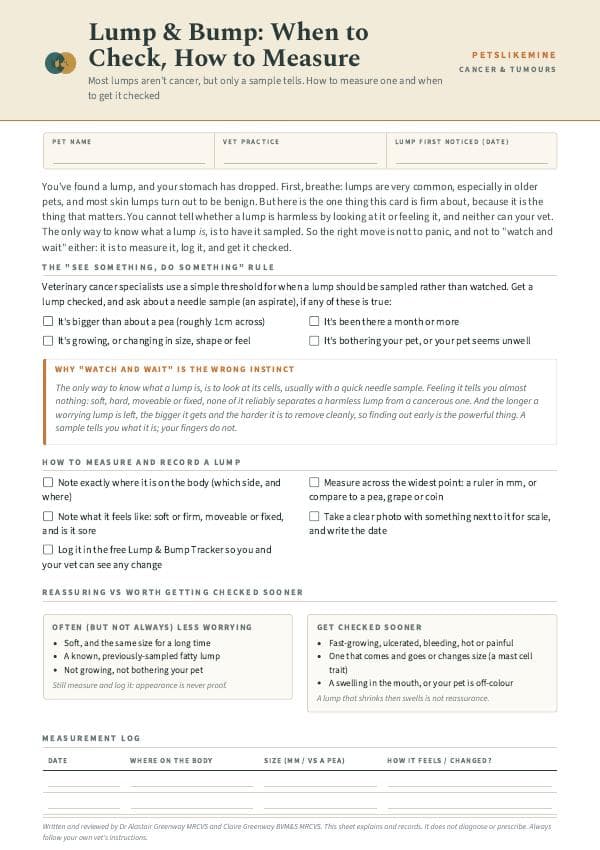
A lump cannot be told apart by look or feel; only your vet sampling it can. The Lump & Bump Tracker records its size and how it changes, flags when it has crossed a line worth a vet visit, and builds a clean history to take in.
Open the Lump & Bump TrackerYou're not doing this alone
Compare treatment journeys and talk to owners managing cancer. Free to join.
Join PetsLikeMine