


Comfort-Focused Care: Choosing Quality of Life When You Don't Treat
Alastair Greenway
BVM&S MRCVS
Comfort-focused care is the path you take when you've decided not to treat the cancer itself. The reasons vary: sometimes the outlook didn't justify what the pet would go through, sometimes the cost was simply out of reach, sometimes it just wasn't the right road for this animal and this family. Whatever brought you to it, one thing is worth saying plainly at the start. Choosing this is an active, loving decision, not a withdrawal of care. You haven't stopped caring for your pet. You've changed what you're caring for.
We've argued elsewhere that there's [no wrong answer in the decision to treat or not], so I won't go back over that ground. This piece is about what comes next, the part nobody really explains: how to do comfort-focused care well. Done properly, it isn't a waiting room. It's a plan, with real things in it that you do every day to keep your pet feeling like themselves for as long as that's genuinely possible.

Care you do, not care you stop
The phrase that gets unfairly stuck to this path is "doing nothing", and it's about as wrong as a description can be. What vets call palliative care simply means the goal has shifted from controlling the disease to keeping your pet comfortable and well. As the team at Colorado State University put it, when curing is no longer the intent, palliative care "provides comfort to the patient and focuses on quality of one's life rather than quantity" (Bishop & Gore, n.d.). You're not giving up on your pet. You're choosing what to give them.
The veterinary literature treats this as genuine, active medicine, not a default. A 2023 review of palliative care in veterinary oncology rests on one simple, powerful idea: "each patient can be helped, regardless of the evolution of the disease," using supportive therapies (Repetti et al., 2023). Not every patient can be cured, but every patient can be helped. That sentence is the foundation of everything that follows, and it's worth keeping somewhere you can see it.
What's actually in the plan
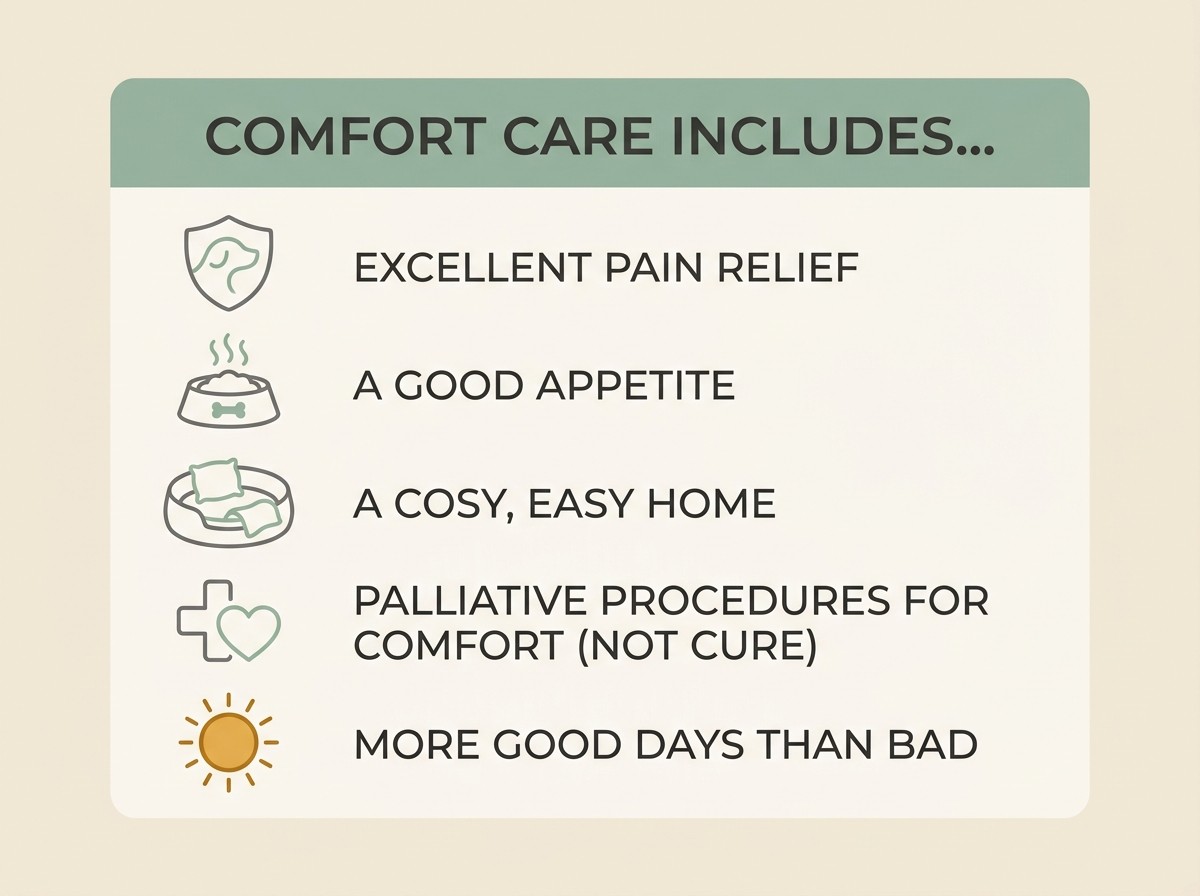
So what are the things you do? More than most owners expect. Comfort care is a toolkit, and you and your vet build the version that fits your pet.
Excellent pain and symptom control. This is the heart of it, and where a good palliative plan does its most important work. Modern veterinary pain relief is genuinely good, often layering more than one medicine so your pet stays ahead of discomfort rather than chasing it. If your pet is in pain, that comes first; we go into it properly in [managing your pet's pain and comfort through cancer]. Symptom control covers the knock-on effects too, the nausea, a cough, an upset stomach, so they don't spoil the days.
Keeping the appetite up. A pet who's eating is a pet who's still in the game, and appetite is one of the truest signals of how they're doing. Warming food, hand-feeding favourites, anti-nausea medication, a gentle appetite stimulant from your vet: all of it is fair game. Don't get hung up on the "right" diet here. The best food is the one your pet will happily eat, and there's more on that in [feeding a pet with cancer].
A comfortable world to live in. The soft bed in the warm spot. The non-slip rug on the slippery floor. The water bowl and the litter tray moved close so nothing's a struggle. The sunny patch they love, the lap, the quiet. None of this is small. For a pet, comfort is quality of life.
Targeted palliative procedures, when they'd help. This one surprises people. Some treatments that look like "cancer treatment" can be used purely for comfort, with no intention of curing anything. A short course of palliative radiation, sometimes just a few sessions and occasionally a single treatment, can take the edge off a painful tumour; the Flint Animal Cancer Center notes it "usually relieves pain and may even shrink the tumours a bit while rarely causing acute effects" (Flint Animal Cancer Center, 2019). If fluid is building up and making breathing hard, draining it (a procedure called thoracocentesis) brings fast relief, with many pets showing "noticeable improvement in breathing and comfort shortly after fluid is removed from the chest," and it can be repeated as needed (Veterinary Specialty Practice, n.d.). These are comfort measures rather than cures, and choosing one doesn't mean you've changed your mind about treatment. It means you've found a way to make your pet feel better today.
Knowing it's working
You don't have to wonder in the dark whether comfort care is doing its job. There's a thing you can watch, your pet's quality of life, and you can watch it in a way that's fairer than a daily gut feel.
The trick is to track it instead of guessing. Score the same handful of things on a regular rhythm, your pet's comfort, appetite, mobility and interest in life, and count the good days against the bad. That shows you the trend over time, which a single anxious evening never can. We go through exactly how to do this in [measuring your pet's quality of life], and you can keep a record in the [quality-of-life assessment] so the picture builds up week by week. The plain yardstick most vets come back to is straightforward: as long as the good days clearly outnumber the bad ones, comfort care is working (Bishop et al., 2016).
That tracking does two kind things at once. When the line holds steady, it gives you permission to stop second-guessing and just enjoy your pet. And when a dip appears, it often points at something fixable rather than the cancer winning: a pain dose that needs nudging up, a bit of nausea to settle, something you and your vet can act on. A falling appetite isn't always the end. Sometimes it's just a problem with a solution.
Building the days that matter
With the medical side handled, comfort care frees you up for the part that's really the point: making the time good. Pets don't count down. They live in the day they're in, so a string of ordinary good days, the breakfast wolfed down, the slow potter round the garden, the evening on the sofa, adds up to a great deal. We've written a whole piece on [making the most of the time], and it's really about giving yourself permission to enjoy your pet rather than grieve them while they're still here. Take it.
Planning ahead, gently
I'll be straight with you about one thing, because pretending otherwise doesn't help anyone. Comfort care holds the line beautifully for a while. Then, with a progressive illness, there usually comes a point where it's no longer enough to keep your pet's days good. Knowing that in advance isn't morbid. It's what lets you stay ahead of it, calmly, instead of being caught out.
It helps to know roughly what decline tends to look like before you're in it, so you can recognise the shift rather than second-guess it; we set those signs out gently in [recognising when the cancer is winning]. It's also worth having the quiet conversation with your vet early, while things are stable, about where your lines are and what you'd want. That way, if the day comes, you're following a plan you made with a clear head rather than deciding in a fog.
When that time approaches, you won't have to work it out alone. The recognising and the deciding, which are the hardest part, are covered with care in [the quality-of-life decision, and where to go next], and from there our whole [End-of-Life space] is built to walk beside you through hospice, the decision itself, and everything after. None of that is for today, though. Today is for the soft bed, the good dinner, and the company.
You chose comfort. Now go and give it to them, fully and without guilt. For a great many pets, this is exactly the right path.
References
- Bishop, G., & Gore, M. Palliative care for pets: Providing comfort and pain relief during illness. Colorado State University, College of Veterinary Medicine and Biomedical Sciences (CSU Source).
- Repetti, C. S. F., et al. (2023). Palliative care for cancer patients in veterinary medicine. Veterinary Medicine (Praha), 68(1), 2-10. (PMC10878255: https://pmc.ncbi.nlm.nih.gov/articles/PMC10878255/)
- Flint Animal Cancer Center, Colorado State University. Pet Cancer Treatment Options: Radiation. 1 September 2019.
- Veterinary Specialty Practice (VSP). Thoracocentesis in Dogs & Cats (Chest Fluid Removal), client education.
- Bishop, G., Cooney, K., Cox, S., Downing, R., Mitchener, K., Shanan, A., Soares, N., Stevens, B., & Wynn, T. (2016). 2016 AAHA/IAAHPC End-of-Life Care Guidelines. Journal of the American Animal Hospital Association, 52(6), 341-356.
Free downloads
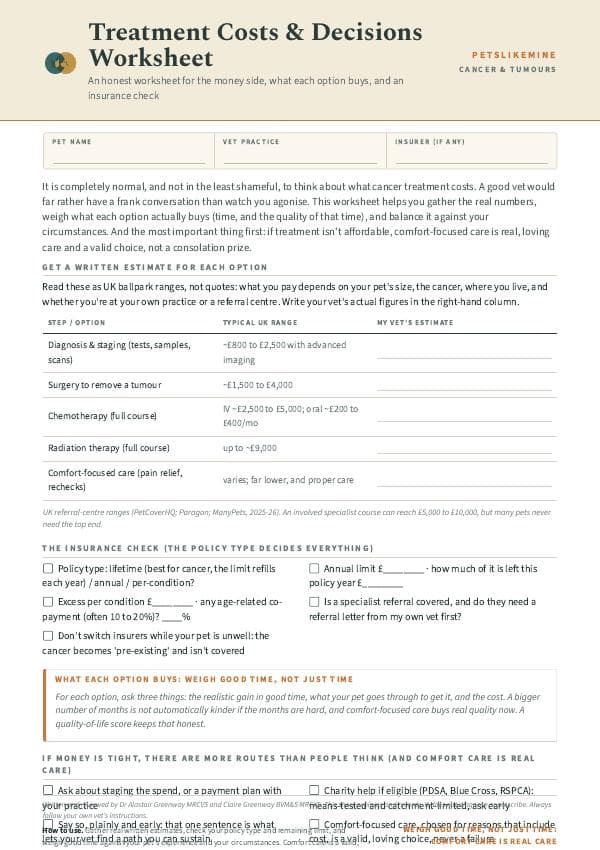
Companion worksheets to put what you've read into practice. Free PDFs, print at home.
Sister tool · Sightline
Track quality of life over time
Sightline, a separate ConciergeVet tool, runs a short adaptive weekly assessment with a quality-of-life focus mode built around exactly these frameworks, tracks a single composite score over time so you can see the trend rather than judge a single bad day, and produces a Sightline Report PDF you can bring to your vet.
A written log, or our printable quality-of-life sheet, does much the same job.
See how Sightline tracks quality of lifeFound a lump? Track it, and know when to act
A lump cannot be told apart by look or feel; only your vet sampling it can. The Lump & Bump Tracker records its size and how it changes, flags when it has crossed a line worth a vet visit, and builds a clean history to take in.
Open the Lump & Bump TrackerYou're not doing this alone
Compare treatment journeys and talk to owners managing cancer. Free to join.
Join PetsLikeMine