

Clinical Trials, Immunotherapy and Newer Options: Real Hope Versus Hype
Alastair Greenway
BVM&S MRCVS
Most owners who go searching after a cancer diagnosis end up in the same place around midnight: a website promising what the vet wouldn't, a powder or a protocol or a clinic that uses the word "cure". The searching itself makes complete sense. You want to leave nothing untried for an animal you love, and that instinct is a good one.
The difficulty is that the very hope driving you forward is what the worst corners of the internet are built to exploit. So this piece sets out to do two jobs. It tells you what is genuinely new and promising in pet cancer care, because some of it really is. And it gives you a workable way to tell the real thing from the con, so the time you spend searching helps your pet rather than draining your money, your energy and the good days you can't get back.
When fear sets the evidence aside
When an animal you love is ill and the news is bad, the calm, weighing part of your mind tends to go quiet. That isn't a personal failing. It's how almost anyone reacts to fear, and it happens to be precisely the frame of mind a "miracle cure" is pitched into. The promise lands hardest on the people who most need it to be true.
Saying that plainly is the best protection you have. Hope and a level head can sit side by side, and the owners who do most for their pets usually keep both: they look at every reasonable option and they put hard questions to each one before they spend or commit. None of what follows is meant to dampen your hope. It's meant to aim it at the things most likely to help.
What's genuinely real now
There has been real progress, and it helps to know what's solid so you recognise it when an oncologist puts it on the table.
Targeted drugs. Some of the newer treatments are built to interfere with the specific machinery a cancer uses to grow, rather than hitting every dividing cell the way traditional chemotherapy does. The clearest example in dogs is toceranib, sold as Palladia. In 2009 it became the first cancer drug ever fully approved by the US Food and Drug Administration specifically for dogs (Pfizer, 2009). It is a tyrosine kinase inhibitor, which means it blocks signals that certain tumours and their blood supply depend on. It is licensed for mast cell tumours, and in the pivotal approval study around 60% of treated dogs had a "biological response", meaning the tumour shrank, disappeared or at least held steady for ten weeks or more (the figure for tumours that genuinely shrank or disappeared was about 37%) (London et al., 2009). Vets also use it off-licence, with care, against some other cancers (Hero Veterinary, 2025). It is given as a tablet at home, which many owners prefer, but it is a real drug with real side effects: mostly stomach upset, and occasionally more serious gut problems such as bleeding or, rarely, a perforation. That is why its data sheet carries a specific warning and the drug needs proper monitoring (Palladia data sheet, FDA). It is a targeted option worth having. It is not a cure.
The canine melanoma vaccine. You may come across a vaccine for oral malignant melanoma in dogs, sold as Oncept. The idea behind it is genuinely clever: it uses a human gene to nudge the dog's own immune system into recognising and attacking melanoma cells, and it was the first therapeutic cancer vaccine to gain a USDA licence, conditionally in 2007 and fully in 2010 (Boehringer Ingelheim, 2024). It is used alongside surgery or radiation, not in place of them. The candid part matters here. The evidence that it actually lengthens survival is mixed, and a 2022 review of the published studies concluded that while it appears safe, it has not been clearly shown to improve outcomes (Pellin, 2022). The licensing route it took, the USDA's, asks for safety and a reasonable expectation of benefit, which is a lower bar than the randomised, placebo-controlled trials a human cancer drug must clear (Pellin, 2022). That doesn't make it a scam. It is a legitimate, vet-administered treatment, but it sits squarely in the "promising and worth discussing" column rather than the "proven" one, and a good oncologist will walk you through both sides.
Immunotherapy in development. The frontier that mirrors the big human breakthroughs is teaching the immune system to fight the cancer itself: checkpoint inhibitors, engineered antibodies, and the kind of cell therapies that have changed some human cancers (Hampel et al., 2024). Veterinary medicine runs a few years behind the human field here, but the gap is closing quickly, with caninised antibodies and combination approaches now in active research (Maekawa et al., 2025). Keep one thing in mind: most of this is still investigational. For now it lives mainly inside clinical trials rather than on the shelf at your practice, which is where the next section comes in.
Inside a clinical trial
If your oncologist mentions a clinical trial, it can land badly, as though your pet would be a guinea pig. The reality is usually gentler than that, and more hopeful.
A clinical trial is a carefully run study testing a new treatment, a new combination, or a better way of giving one that already exists. For your pet it can mean early access to something genuinely promising that isn't yet generally available, often with some or all of the trial-specific costs covered, while adding to knowledge that helps other animals, and sometimes people, since dogs develop many of the same cancers we do (AVMA, 2024). Those are real upsides.
The trade is honest about uncertainty. A trial runs precisely because nobody yet knows for sure whether the new approach is better, so it might help a great deal, a little, or not at all, and there can be side effects that aren't yet fully mapped. Good trials are designed around protecting your pet through that. They set entry criteria so only suitable patients join, they monitor closely, they have ethical oversight, and they require proper informed consent, which means the team explains the unknowns plainly and you stay free to say no or to withdraw at any point (AVMA, 2024). For the right pet, a trial is a reasonable and hopeful choice. It is never a desperate last resort you should feel pushed into.
Finding a real trial in the UK
Reputable trials run through the institutions you would trust anyway, mainly the university vet schools and the specialist referral hospitals. In the UK, the veterinary schools with active oncology research and trials include the Royal Veterinary College, whose Clinical Investigation Centre coordinates its studies, the University of Cambridge's Cancer Therapy Unit, and the University of Glasgow's small animal hospital, among others (RVC, 2025; University of Cambridge, 2025).
The simplest route is to ask your own vet or oncologist directly whether a current trial might suit your pet. They know what is recruiting, and whether your pet's type, grade and stage would even be eligible, and a referral nearly always comes through them. If you want to look yourself, the AVMA's Veterinary Clinical Trials Registry lets anyone search studies by condition and species with no sign-up (AVMA, 2024), though it leans heavily towards US studies. The UK has no single owner-facing register of pet cancer trials, so here the realistic route is institution by institution, which is another reason to start with your own vet and bring anything you find back to them. The same rule holds for any trial as for any treatment: it should be run by qualified specialists, open about what it is testing, and never something you have to pay a fortune for up front to a clinic you have never heard of.
Spotting the hype
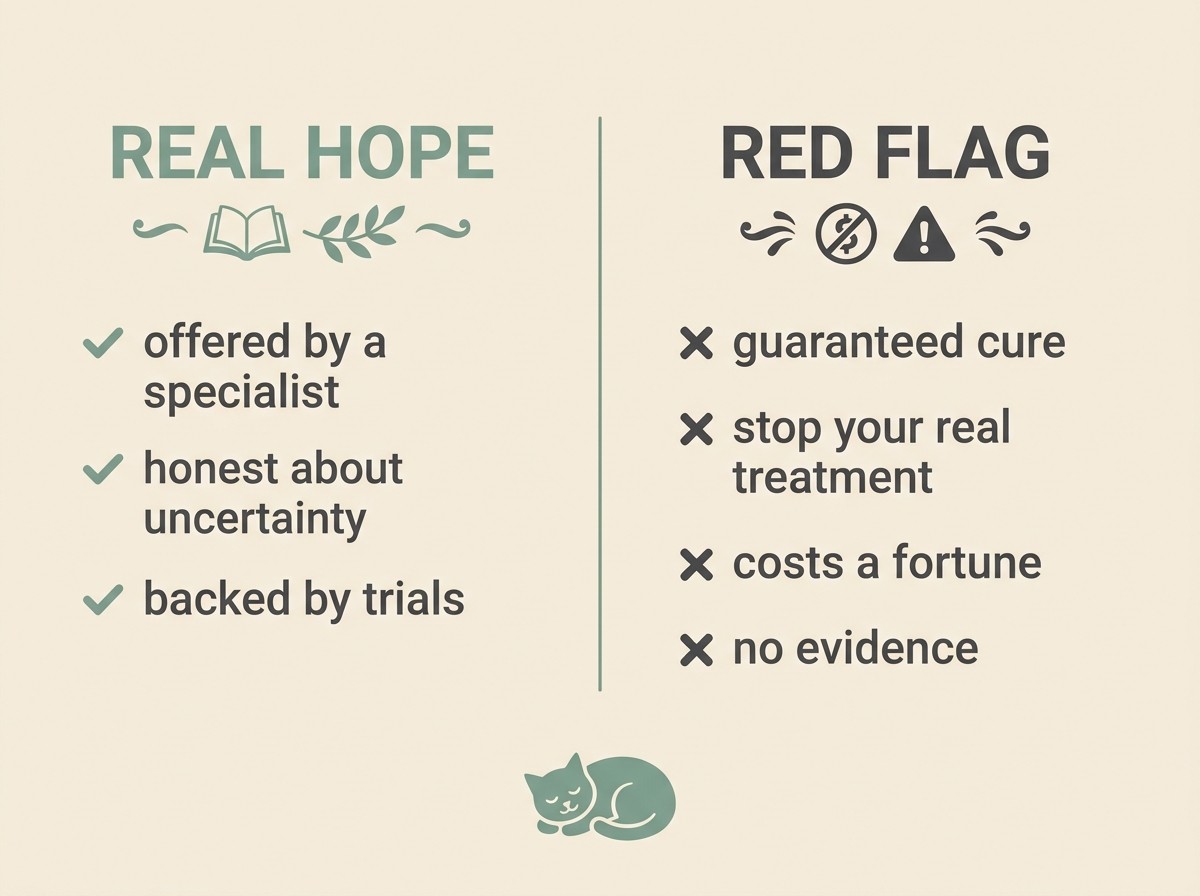
Set against all that careful, real hope, the scams are usually easy to spot once you know the shape of them. Be very wary of anything that:
- Guarantees a cure, or reaches for words like "miracle" and "breakthrough" that no responsible oncologist would use. Real medicine deals in odds and ranges, not certainties.
- Tells you to stop or avoid conventional treatment, or hints that vets and "big pharma" are keeping the real answer from you. This is the most dangerous flag, because the harm isn't only the money. It's the effective treatment your pet loses while you chase the unproven one.
- Costs a great deal for something with no real evidence, especially if you must pay a large sum up front, direct to a clinic or seller rather than through a referral.
- Has no proper backing: no named specialists, no published studies, only testimonials and dramatic before-and-after stories.
So here is a test you can apply at midnight to anything you find. Real hope is open about what it doesn't know, it comes from qualified people, and it never asks you to give up the care that's actually working. Hype is certain, cagey about evidence, and wants your money now. The wider world of supplements and alternative remedies, including the few that genuinely help with comfort, gets a fuller treatment in our piece on [complementary therapies].
When something looks promising, take it to your own vet or oncologist and ask, plainly, "is this real, and would it help my pet?" A good vet won't be offended that you're hoping and looking. They'll be glad to help you point that hope somewhere it can do your pet some good.
References
- Pfizer Inc. (2009). FDA Approves First Canine Cancer Therapy (press release announcing Palladia / toceranib phosphate approval).
- London, C.A., Malpas, P.B., Wood-Follis, S.L., et al. (2009). Multi-center, placebo-controlled, double-blind, randomized study of oral toceranib phosphate (SU11654), a receptor tyrosine kinase inhibitor, for the treatment of dogs with recurrent mast cell tumor following surgical excision. Clinical Cancer Research, 15(11), 3856 to 3865. (objective response rate 37.2%; biological response rate, including stable disease, around 60%).
- Hero Veterinary (2025). Palladia for Oral Melanoma and Rare Canine Tumors: The New Era of Targeted Dog Cancer Therapy.
- Boehringer Ingelheim Animal Health (2024). ONCEPT Canine Melanoma Vaccine, DNA (product information, licensing history).
- Pellin, M.A. (2022). The Use of Oncept Melanoma Vaccine in Veterinary Patients: A Review of the Literature. Veterinary Sciences, 9(11), 597. (review concluding the vaccine appears safe but there is no definitive proof it improves disease-free interval or survival; notes USDA authorisation requires only safety and a reasonable expectation of efficacy, a lower bar than FDA randomised, placebo-controlled trials).
- Hampel, J.M., Cheuk, N., Barbosa, M.M.P., & Fan, T.M. (2024). The promise of immunotherapeutic strategies to advance cancer treatment in pet dogs. Journal of the American Veterinary Medical Association, 262(12), 1583 to 1593.
- Maekawa, N., et al. (2025). Development of caninized anti-CTLA-4 antibody as salvage combination therapy for anti-PD-L1 refractory tumors in dogs. Frontiers in Immunology, 16, 1570717.
- American Veterinary Medical Association (2024). AVMA Veterinary Clinical Trials Registry (relaunched February 2024 from the AVMA Animal Health Studies Database; free to search, no sign-up; owners advised to discuss eligibility with their own vet first).
- Royal Veterinary College (2025). Veterinary Oncology / Clinical Investigation Centre.
- University of Cambridge (2025). Cancer Therapy Unit, Department of Veterinary Medicine (CamVet).
- PALLADIA (toceranib phosphate) tablets, FDA-approved data sheet (Zoetis/NADA 141-295; carries a boxed warning for gastrointestinal toxicity, including rare perforation, and advises monitoring).
Sister tool · Sightline
Track quality of life over time
Sightline, a separate ConciergeVet tool, runs a short adaptive weekly assessment with a quality-of-life focus mode built around exactly these frameworks, tracks a single composite score over time so you can see the trend rather than judge a single bad day, and produces a Sightline Report PDF you can bring to your vet.
A written log, or our printable quality-of-life sheet, does much the same job.
See how Sightline tracks quality of lifeFound a lump? Track it, and know when to act
A lump cannot be told apart by look or feel; only your vet sampling it can. The Lump & Bump Tracker records its size and how it changes, flags when it has crossed a line worth a vet visit, and builds a clean history to take in.
Open the Lump & Bump TrackerYou're not doing this alone
Compare treatment journeys and talk to owners managing cancer. Free to join.
Join PetsLikeMine