
Drinking gallons, always hungry, or fading? What the classic hormone signs mean
Alastair Greenway
BVM&S MRCVS
You've noticed something's off. The water bowl empties twice as fast, or your cat is eating like never before and somehow getting bonier, or an older dog has gone slow and round and just isn't quite right. You've typed "why is my dog drinking so much" or "cat losing weight but eating loads" into a search box, and you've landed on a dozen single-disease pages that each insist it's the one thing they cover.
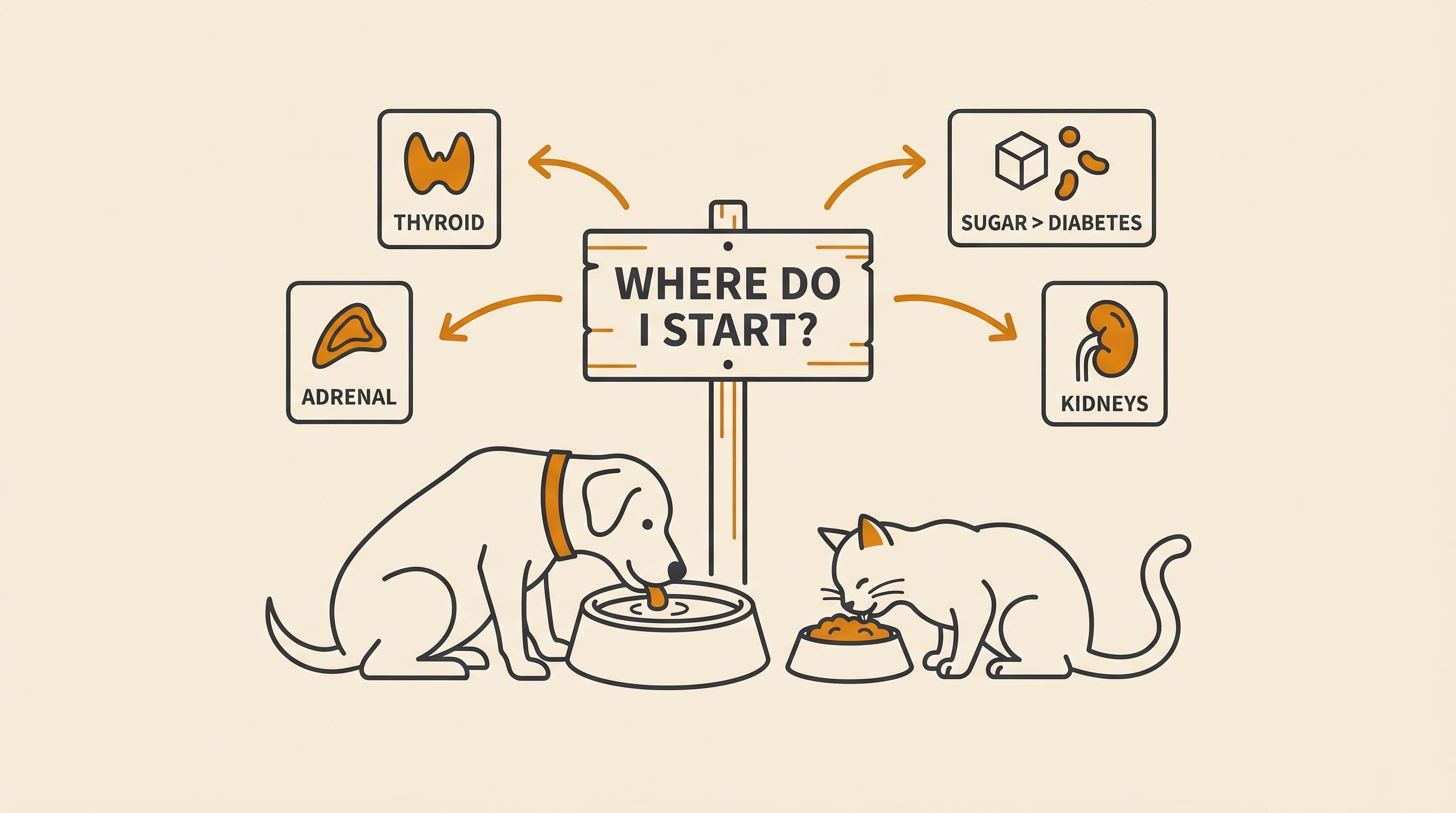
Here's the calm version. A lot of these signs are the body's hormones, the chemical messengers that quietly run things like thirst, appetite, weight and coat, sending up a flare. Too much or too little of one hormone tips a whole system at once, which is exactly why the signs feel so "all over the place". Encouragingly, the common hormone conditions in dogs and cats are well understood and treatable, and there's a sensible order to working out which one you're looking at. This page is the front door. It sorts the signs, tells you how to actually measure the big one, and points you to the right place next.
The four signals, in plain words
Most hormone problems announce themselves through some mix of four changes. None of them is a diagnosis on its own. They're clues.
- Drinking and weeing a lot more (the medical shorthand is PU/PD). This is the single most useful signal, because it's shared by several conditions and, unlike most signs, you can put a number on it. Across dogs and cats, the commonest causes of marked thirst are kidney disease, diabetes, and the hormone conditions, so it's worth taking seriously and worth measuring (Today's Veterinary Practice, "A Stepwise Diagnostic Approach to Polyuria and Polydipsia").
- Appetite changing the wrong way. A cat that's ravenous yet wasting away is the classic over-active thyroid (or diabetes) picture (Carney et al. 2016; Merck Veterinary Manual). At the other extreme, a pet that's gone off food can be telling you something different, and a small group of hyperthyroid cats are actually flat and picky rather than hungry, usually because something else is going on too (Carney et al. 2016).
- Weight shifting with no change in feeding. Losing despite eating well points one way. Gaining or holding despite a normal or even careful diet points the other, towards the under-active thyroid dog or Cushing's (Merck Veterinary Manual).
- The coat or skin going wrong. Thinning fur, balding in a roughly symmetrical pattern that doesn't itch, or a scruffy, greasy older cat that's stopped grooming, all of these can be hormonal (Carney et al. 2016; Today's Veterinary Practice, "The Diagnosis of Canine Hyperadrenocorticism").
If you recognise two or three of these together, that's a good reason to see your vet, not a reason to panic. Let's sort them.
Fork 1: the thirst, and how to measure it first
Thirst is where most people start, and it's the one clue you can actually quantify at home, so do that before you worry.
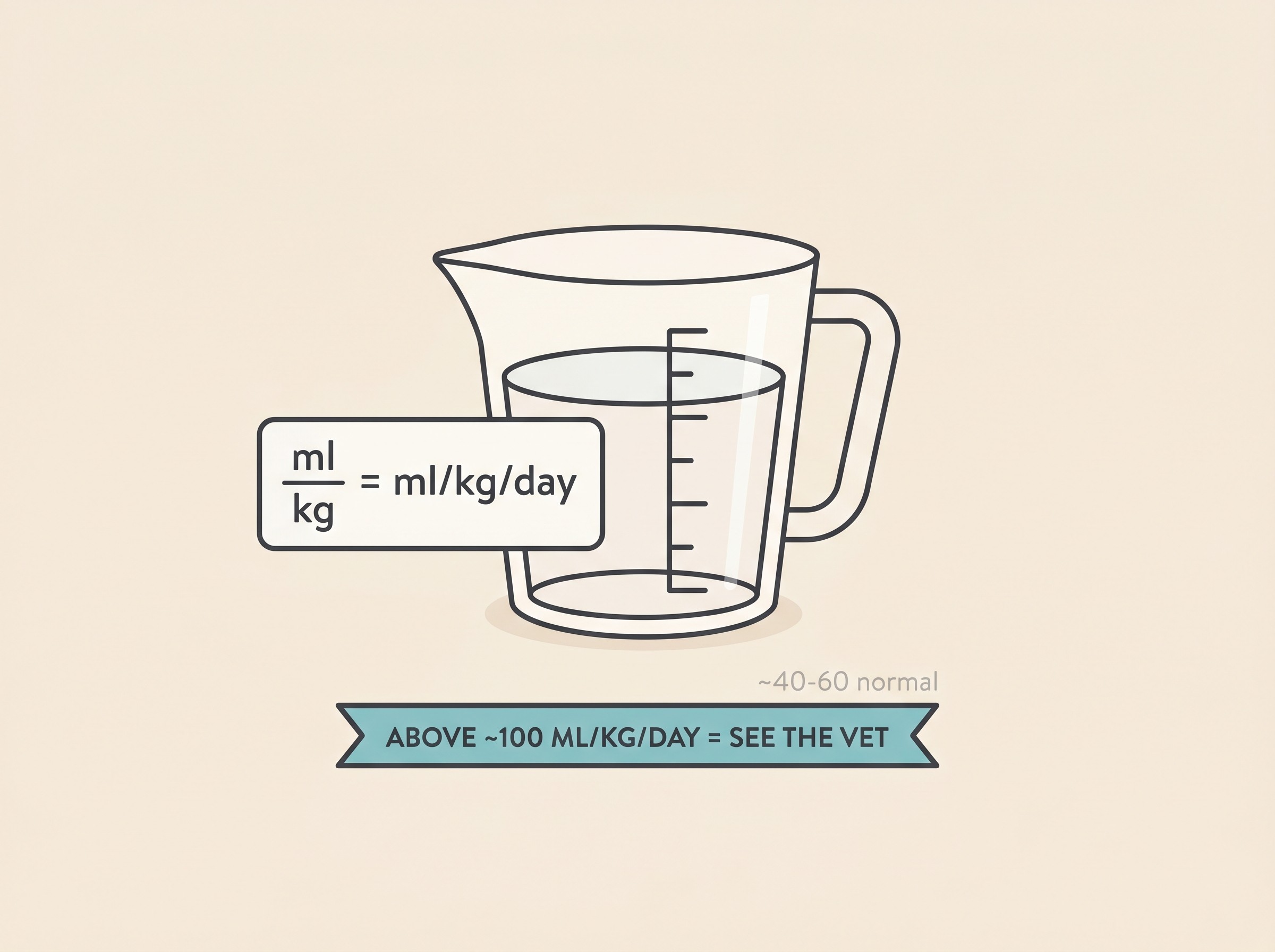
The method is simple. Measure how much water your pet drinks over a full 24 hours in millilitres, then divide by their body weight in kilograms. That gives you millilitres per kilogram per day. The flag to remember is roughly more than 100 ml per kg per day, which is the level vets call genuine polydipsia (Today's Veterinary Practice, "A Stepwise Diagnostic Approach to Polyuria and Polydipsia"). Anything around 40 to 60 ml per kg per day is roughly normal, though that's a rule of thumb rather than a hard line.
A couple of caveats. Intake jumps around day to day with the weather, the food (dry diets drive more drinking than wet), and how active your pet's been, so judge the trend over a few days rather than one reading. And in a multi-pet home you'll need to separate bowls for a day to know who's actually drinking. If measuring at home feels fiddly, our Thirst & Wee tracker does the maths for you and keeps a running chart, and there's a printable "is my pet drinking too much?" measuring card if you'd rather work on paper.
So you've measured it and it's high. What's behind it? The hormone-and-kidney short list is diabetes, Cushing's, an over-active thyroid (in cats), chronic kidney disease, and the much rarer "water diabetes" called diabetes insipidus (Today's Veterinary Practice, "A Stepwise Diagnostic Approach to Polyuria and Polydipsia"). That's the broad map this page helps you navigate.
It also includes a couple of causes that aren't hormonal at all and that a vet will want to rule out quickly. One is a high blood calcium level (hypercalcaemia), which makes pets drink more and has its own set of causes worth checking (Merck Veterinary Manual, "Hypercalcemia in Dogs and Cats"). The other is the important one to know about.
Safety line. An unspayed female dog or cat that's suddenly drinking a lot and seems unwell, off her food, perhaps with a vaginal discharge, could have a pyometra, a womb infection that's a genuine emergency and can tip into serious illness within days (Cornell Riney Canine Health Center; dvm360, "Managing canine pyometra"). That's a same-day vet call, not a web search. And any pet that collapses or goes suddenly, severely weak needs an urgent vet straight away, whatever the thirst is doing.
Fork 2: the weight and the appetite
If thirst isn't the headline, weight and appetite usually are, and the direction of travel splits the differential neatly.
Losing weight while eating well, or even eating more than usual, is the standout sign of an over-active thyroid in an older cat, and of diabetes in either species (Carney et al. 2016; Merck Veterinary Manual). The body's burning through fuel faster than food can replace it, or it can't use the fuel properly. It feels counter-intuitive ("but he's eating!"), which is exactly why these conditions get missed.
Gaining weight, or holding it despite careful feeding, plus a general slowing down, points the other way, towards an under-active thyroid in dogs or Cushing's. The under-active thyroid dog piles on weight without overeating, seeks out warm spots and loses coat in a symmetrical, non-itchy pattern (Merck Veterinary Manual, "Hypothyroidism in Animals"). The Cushing's dog looks rounder too, but it's a specific pot-bellied shape from fat redistribution and a weak tummy wall rather than true fatness, usually alongside a big thirst, a big appetite and a thin, balding coat (Today's Veterinary Practice, "The Diagnosis of Canine Hyperadrenocorticism").
Which test points where (one number rarely settles it)
The thing to say up front is that vets almost never diagnose these on a single number. A typical work-up is a general blood and urine panel to see the whole picture, plus one or more targeted hormone tests aimed at the most likely culprit. Here's the rough map, with the detail saved for our piece on the hormone blood tests:
- Thyroid: a total T4 is the first-line screen, the over-active thyroid in cats and, as part of a fuller panel, the under-active one in dogs (Carney et al. 2016).
- Adrenal (Cushing's): screened with an ACTH stimulation test or a low-dose dexamethasone suppression test. Both can read falsely positive in a dog that's ill for some other reason, which is why vets are careful to test the right dog rather than every dog (Today's Veterinary Practice, "The Diagnosis of Canine Hyperadrenocorticism"; Behrend et al. 2013).
- Adrenal (Addison's): a basal (resting) cortisol is a cheap, sensitive screen. A normal result essentially rules Addison's out, while a low one prompts a confirming ACTH stimulation test (Bovens et al. 2014).
- Sugar (diabetes): persistent high blood glucose with glucose in the urine, with a fructosamine test to tell true diabetes apart from a stress spike, which matters a lot in cats (Merck Veterinary Manual).
- Kidney: the renal panel and a urine sample, run alongside everything else, because kidney disease is one of the top causes of thirst and overlaps the hormone picture (Today's Veterinary Practice, "A Stepwise Diagnostic Approach to Polyuria and Polydipsia").
The reason vets run several is precisely that screening tests have false positives, and the conditions overlap. Reading the results together, against the actual pet in front of them, is how the picture gets made.
Where to go next (the hand-offs)
This is the part the scattered single-disease pages can't do for you. Once you've got a rough sense of the arm you're on, here's where the deeper, condition-specific help lives:
- The sugar arm: diabetes. If glucose is the answer, head to our Diabetes space, which has its own home-monitoring tool and a full management track. Diabetes is common, manageable, and gets its own dedicated home for good reason.
- The kidney arm: chronic kidney disease. If the kidneys are driving the thirst, our urinary-health (CKD) space is the place to go.
- The thyroid arm. For the over-active thyroid in older cats, read "The over-active thyroid: why your older cat is wasting away despite eating everything". For the over-diagnosed, very-treatable under-active thyroid in dogs, see "The under-active thyroid in dogs".
- The adrenal arm. For the thirsty, pot-bellied dog, "Cushing's explained". And for the vague, on-and-off illness that turns out to be Addison's, the great pretender, the piece on it is worth your time, because it's both commonly missed and, once found, has an excellent outlook.
If you want to dig further into measuring the thirst, our piece "He's drinking and weeing far more than usual: measuring it, and what it means" goes deeper, and "Weight changed but nothing else did" unpacks the appetite-and-weight fork.
None of this is a diagnosis, and you don't have to crack it alone. The job here was to turn a frightening, scattered set of signs into a short list and a clear next step. Measure the thirst, note the weight and appetite direction, book the vet, and take this map with you.
References
- Today's Veterinary Practice — "A Stepwise Diagnostic Approach to Polyuria and Polydipsia" (peer-reviewed clinical review).
- Carney HC, Ward CR, Bailey SJ, et al. 2016 AAFP Guidelines for the Management of Feline Hyperthyroidism. J Feline Med Surg 2016;18(5):400-416. DOI: 10.1177/1098612X16643252.
- Merck Veterinary Manual — Diabetes Mellitus in Dogs and Cats.
- Merck Veterinary Manual — Hypothyroidism in Animals.
- Today's Veterinary Practice — "The Diagnosis of Canine Hyperadrenocorticism".
- Cornell University College of Veterinary Medicine (Riney Canine Health Center) — Pyometra.
- dvm360 — "Managing canine pyometra (Proceedings)".
- Merck Veterinary Manual — Hypercalcemia in Dogs and Cats.
- Behrend EN, Kooistra HS, Nelson R, Reusch CE, Scott-Moncrieff JC. Diagnosis of Spontaneous Canine Hyperadrenocorticism: 2012 ACVIM Consensus Statement (Small Animal). J Vet Intern Med 2013;27(6):1292-1304. DOI: 10.1111/jvim.12192.
- Bovens C, Tennant K, Reeve J, Murphy KF. Basal serum cortisol concentration as a screening test for hypoadrenocorticism in dogs. J Vet Intern Med 2014;28(5):1541-1545. DOI: 10.1111/jvim.12415.
Keep track of how your pet is doing
The owners who cope best are the ones who notice changes early. A simple health log shows you what is working, and what is not, before the next vet visit.
Start tracking, freeYou're not doing this alone
Compare treatment journeys and talk to owners managing hormone health. Free to join.
Join PetsLikeMine