

Chronic Hepatitis in Dogs: The Honest UK Picture
Alastair Greenway
BVM&S MRCVS
If a vet has just used the phrase "chronic hepatitis", or you have read the words "chronic active hepatitis" on a biopsy report and had to look up what they meant, you are probably somewhere between frightened and quietly grieving. The dog asleep at your feet looks the same as they did last week, and yet a piece of paper has told you that something serious has been going on inside them, perhaps for a long time. You want the truth about what happens now, without either false cheer or a death sentence dressed up as a diagnosis.
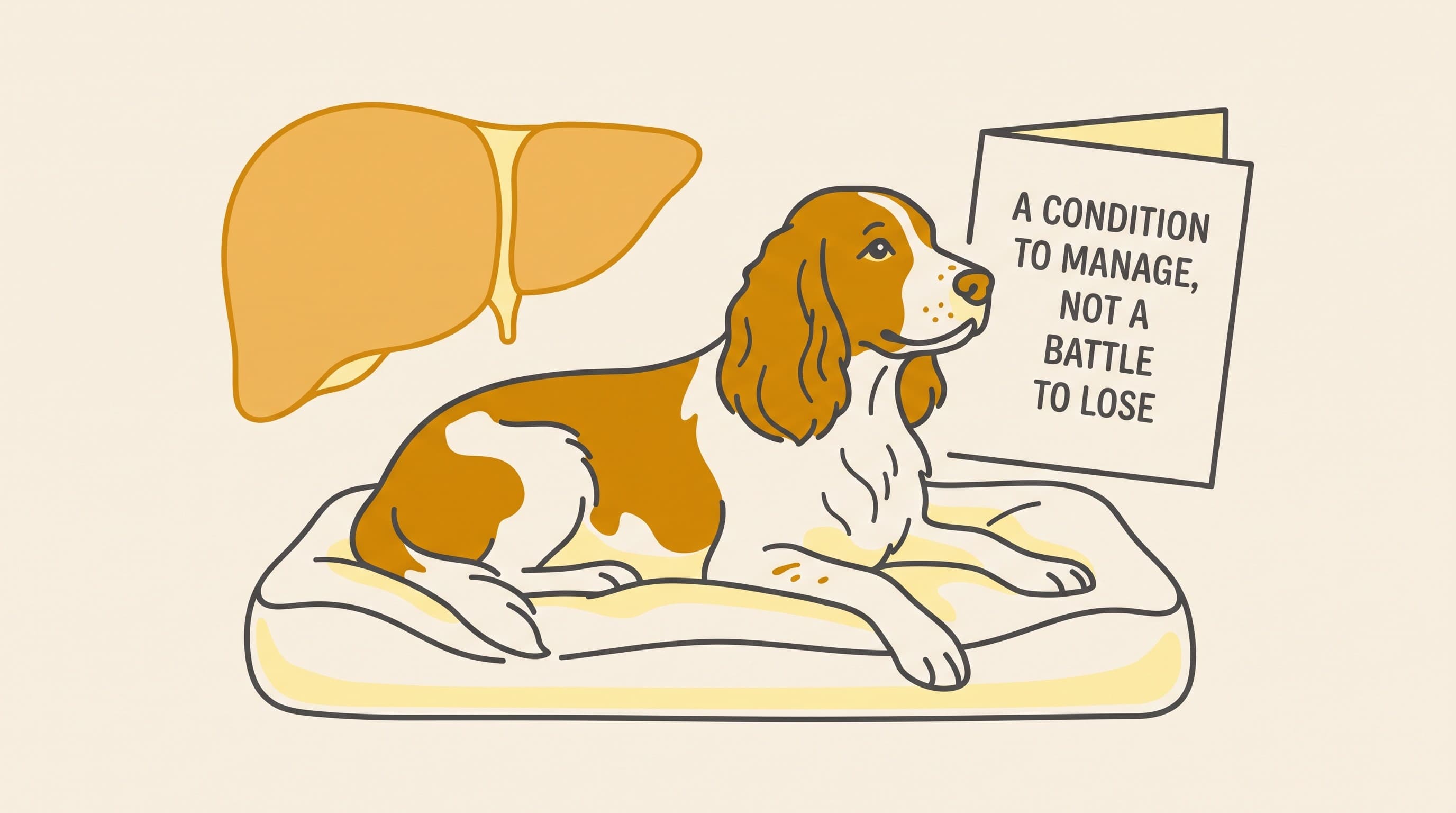
Here is the honest version, and it is genuinely more hopeful than the internet will have led you to believe. Chronic hepatitis is a real and serious condition, but it is one that is managed and monitored rather than fought and lost in a single battle. Many dogs live well with it for a long time. And in the UK in particular, the story is not the one the loudest online voices tell, because much of what you will read comes from North America and is framed around copper, which for most British dogs is not the main driver at all. Let's walk through what chronic hepatitis actually is, why the UK picture differs, how it is properly diagnosed, and what treatment can and cannot do.
What chronic hepatitis actually is
Chronic hepatitis is ongoing inflammation of the liver that, left unchecked, gradually replaces healthy liver tissue with scar tissue. That scarring process is called fibrosis, and at its most advanced it becomes cirrhosis. The key word is chronic, meaning it is a process that unfolds over months to years, not an event like a poisoning or a sudden infection.
This matters because it changes how you should think about it. A one-off raised liver enzyme on a blood test is not chronic hepatitis. Enzymes leaking into the bloodstream tell you that liver cells are being damaged, but they do not tell you whether that damage is a passing insult or a smouldering, long-term inflammatory process. Chronic hepatitis is specifically the second thing, and the only way to know you are dealing with it is to look at the liver tissue itself under a microscope.
The liver is remarkable at coping. It has a large reserve capacity and it can regenerate, which is why a dog can carry a good deal of inflammation and scarring before showing any outward sign of illness. That is the double edge of this condition. It is why your dog can look completely well while the process is under way, and it is also why catching it before the liver decompensates, before it can no longer keep up with its work, genuinely changes the outlook.
The UK twist, told honestly
If you have spent any time searching online, you will have run into copper. North American discussion of canine chronic hepatitis is dominated by the idea that dietary copper is the main culprit, and there is real science behind that concern in that setting. But the British picture is meaningfully different, and this is the part almost no owner-facing page gets right.
In the UK, a large proportion of chronic hepatitis is what vets call idiopathic, meaning no single external cause is found, and much of it appears to be immune-mediated, where the dog's own immune system is driving the inflammation. This is not guesswork. Bexfield's UK breed and signalment work found that copper was not the main driver of most British chronic hepatitis, and that the disease was better explained by breed-linked, immune-flavoured processes. The English Springer Spaniel is the clearest example: this breed's chronic hepatitis has been linked to particular DLA haplotypes, the canine equivalent of the immune-system genes that predispose people to autoimmune disease.
So when you read an American forum thread insisting that your dog's liver disease is a copper problem caused by their food, you can place that in context. It may be true for some dogs, but for a great many UK dogs it is not the explanation. "All liver disease is copper" is simply wrong here.
Now the crucial nuance, because this is where honesty cuts both ways. The fact that copper is not the main UK driver does not mean copper is irrelevant to your individual dog. Some UK dogs do accumulate copper in the liver, and some breeds are genuinely prone to it. The only way to know whether copper is part of your dog's picture is to measure it, and that is done on a biopsy sample. This is exactly why the copper debate deserves its own honest treatment rather than a slogan, and why we have written about it separately (see the copper and the liver piece). The short version to carry with you: copper is one cause worth testing for, not the universal answer, and the UK is not North America.
How chronic hepatitis is diagnosed properly
This is the single most important thing to understand, because it protects you and your dog from being treated for the wrong thing. Chronic hepatitis is diagnosed on a biopsy, not on enzymes.
Blood enzymes such as ALT and ALP will often be raised, and they are what usually raise the first flag. But raised enzymes have a long list of causes, many of them outside the liver entirely, and they cannot tell you what type of liver disease you are dealing with, how much scarring has built up, or whether copper is involved. Even an abdominal ultrasound, useful as it is for showing the liver's structure, size and any gallbladder or blood-vessel problems, cannot see the microscopic pattern of inflammation that defines chronic hepatitis.
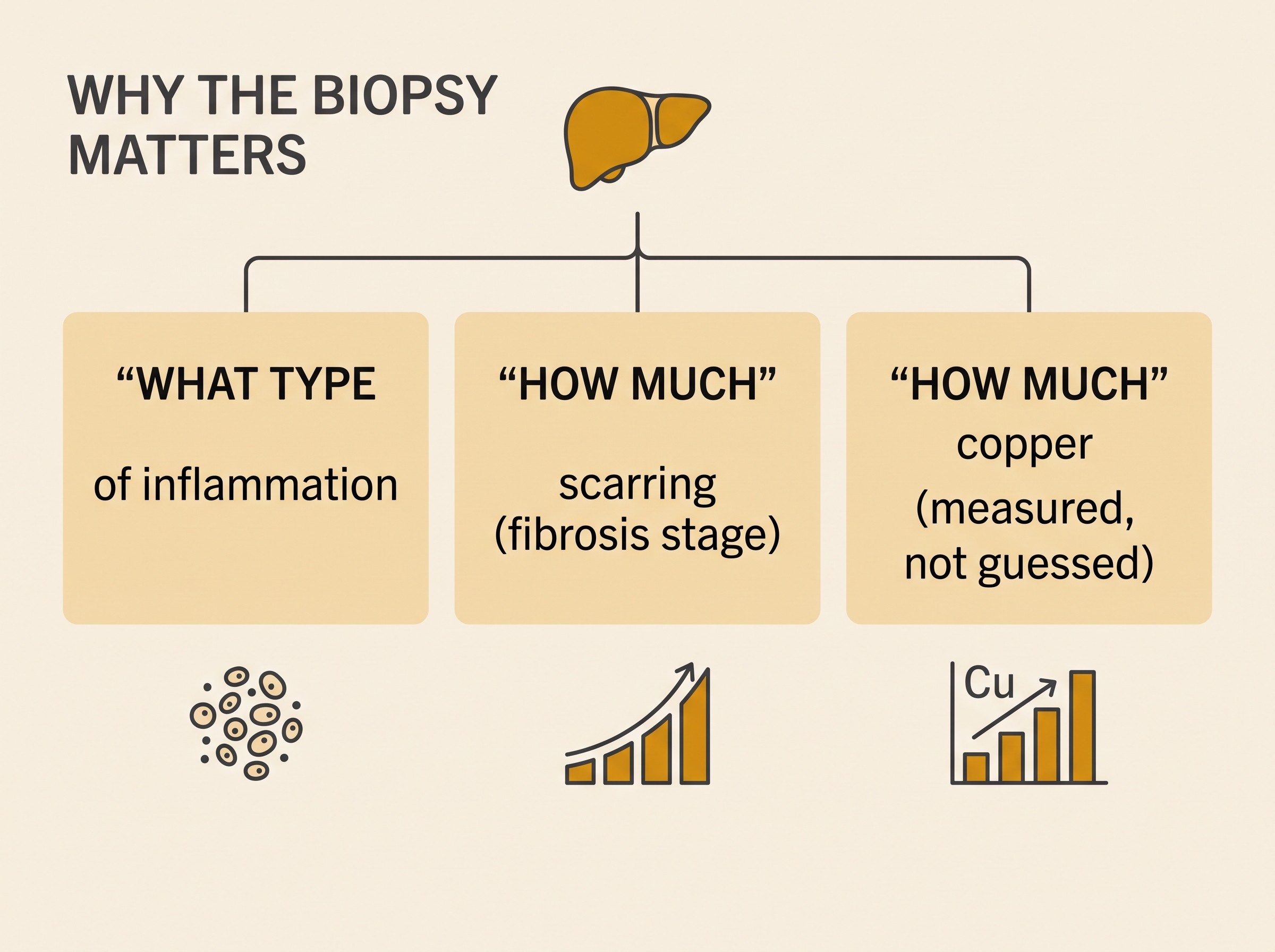
A liver biopsy does three jobs at once, and each one changes the plan. It confirms the diagnosis and identifies the type of inflammation. It stages the fibrosis, telling you how much scarring has already happened. And, critically, it allows the laboratory to quantify the copper in the tissue, which is the only reliable way to know whether copper restriction and chelation belong in your dog's treatment at all. The ACVIM consensus statement on canine chronic hepatitis is built around this: you do not treat chronic hepatitis properly until you know what you are treating.
Biopsies can be taken in different ways, from a needle sample guided by ultrasound through to surgical or keyhole samples that give the pathologist a larger, more informative piece of tissue. Your vet will weigh the quality of information against the invasiveness for your particular dog. It is a reasonable thing to ask about, and it is reasonable to ask whether the copper level was actually measured, because sometimes it is missed.
What treatment actually looks like
Once you know what you are dealing with, treatment has a clear logic, and it is worth being honest up front about its goal. The aim of treatment in chronic hepatitis is to slow the progression of the disease and preserve the liver's function for as long as possible. It is not, in most cases, to cure. That sounds bleak at first, but "slow and preserve" can mean a great many good years, and it reframes your job from chasing a fix to protecting a trajectory.
Treatment is tailored to what the biopsy found, which is the whole reason the biopsy matters:
- If the inflammation is immune-mediated, and this is the confirmed picture in many UK dogs, treatment often involves medicines that damp down the overactive immune response. These are used only when histology supports an immune cause, because they are not benign drugs and giving them to the wrong dog does harm rather than good.
- If the liver is copper-loaded on quantitative testing, then reducing copper matters: a copper-appropriate diet, and sometimes chelation medication that helps the body remove stored copper. Neither of these should be started on a breed or an enzyme result alone, only on confirmed copper loading, because over-restriction has its own risks.
- Supportive care runs alongside whichever path applies, aimed at protecting liver cells and supporting the dog generally. This is also where liver supplements come up, and it is worth reading an honest account of what the evidence for them actually shows rather than assuming they are doing more than they are (see the Denamarin and SAMe piece).
What you will not find, if the advice is honest, is a single magic treatment that fixes chronic hepatitis. Any page or product promising that is not telling you the truth. The right treatment is the one matched to your dog's biopsy, adjusted over time as the numbers respond.
Living with it: watch the trend, not the number
Here is the part that turns a frightening diagnosis into something you can actually live with day to day. Chronic hepatitis is managed by watching the trend over time, not by fixating on any single blood result.
Your dog will have repeat blood tests, at first fairly frequently and then spaced further apart as things stabilise. What you and your vet are watching for is direction. Is the ALT falling as treatment takes hold? Is the albumin, one of the proteins the liver makes and a genuine marker of how well the liver is working, holding steady? A single number on a single day tells you very little. The shape of the line over months tells you almost everything about whether the plan is working.
This is exactly what the Liver Values Tracker on PetsLikeMine is built for. Rather than trying to interpret a fresh number in a panic each time, you can plot your dog's ALT, ALP, bilirubin, albumin and bile acids across every visit and actually see the trend, and take that picture to your recheck appointments. It turns a scattered pile of lab printouts into a story you and your vet can read together.
An honest word on prognosis
You want to know how long, and you deserve a straight answer, which is that it varies a great deal and depends heavily on the stage at which it was caught and the type it turns out to be. Dogs diagnosed before the liver has decompensated, and whose disease responds to treatment, can do well for years. Dogs whose disease was advanced by the time it was found, or whose inflammation does not respond, do less well, and it would be dishonest to pretend otherwise.
What tilts the odds in your dog's favour is not luck. It is early, accurate diagnosis, treatment matched to the actual disease, and consistent monitoring so that changes are caught and the plan is adjusted before things slip. That is the honest reason to stay engaged rather than despair. You cannot change the biology your dog was dealt, but the diligence of the management genuinely moves the needle.
Watch, too, for the signs that the liver is struggling to cope, because a dog living stably with chronic hepatitis can occasionally decompensate and that is a situation that needs prompt veterinary attention rather than a wait. Yellowing of the gums or eyes (jaundice), a swelling or fluid build-up in the belly, marked confusion, staring, circling or seizures, or unexplained bruising and bleeding all warrant a same-day call to your vet (see the liver red flags piece for the full list).
If you take one thing from this, let it be this: you are not powerless here, and you have not been handed a countdown. You have been handed a condition that rewards attention. The next useful step is to understand whether your dog's breed shapes their risk, and whether copper is part of their particular story, so that the plan you build with your vet is the right one for the dog in front of you.
References
- Webster CRL, Center SA, Cullen JM, et al. ACVIM Consensus Statement on the diagnosis and treatment of chronic hepatitis in dogs. *Journal of Veterinary Internal Medicine* 2019;33(3):1173-1200.
- Bexfield NH. Canine chronic hepatitis: UK breed and signalment study; copper not the main driver of UK chronic hepatitis. 2012.
- English Springer Spaniel chronic hepatitis and DLA-haplotype association (Bexfield / Watson / Dyggve et al.).
- WSAVA Liver Standardization Group (van den Ingh, Rothuizen, Cullen, Twedt et al.), nomenclature of canine and feline liver disease.
Keep track of how your pet is doing
The owners who cope best are the ones who notice changes early. A simple health log shows you what is working, and what is not, before the next vet visit.
Start tracking, freeYou're not doing this alone
Compare treatment journeys and talk to owners managing liver & gallbladder. Free to join.
Join PetsLikeMine