

Going Through Chemo: What's Normal, and What Isn't
Alastair Greenway
BVM&S MRCVS
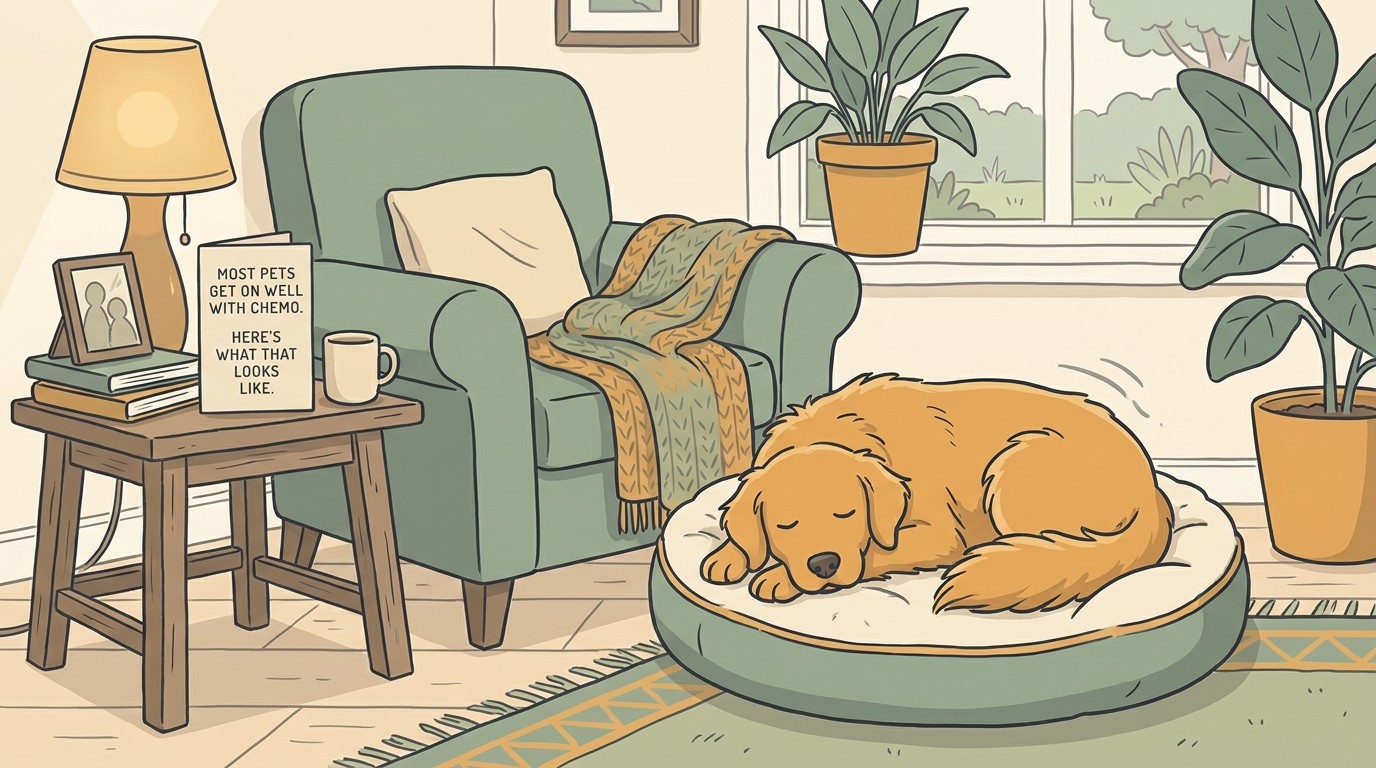
Fewer than one in four pets on chemotherapy get side effects you'd actually notice, like being sick or having loose stools, and most have none you can see at all (Michigan State University, 2024). That's the number worth holding onto in the early weeks, when every yawn looks like tiredness and every skipped biscuit looks like a warning sign. Vets dose chemo the way we do precisely to keep your pet feeling like themselves, so the everyday reality is usually a normal dog or cat who happens to pop to the vet now and then.
This page is the steady read for the gaps between treatments: what the ordinary picture looks like, so you're not reading a side effect into every quiet evening.
There's one part you do need to know cold, and it comes later on this page: the handful of signs that mean ring the vet today, not in the morning. Hold that thought. Everything else here is the reassuring bit.
The rhythm of treatment, and why bloods come first
Chemotherapy works in a rhythm rather than one big event. Your pet comes in, usually has a quick check and a blood test, has the treatment (often an injection or a short drip, sometimes a tablet you give at home), and goes home with you the same day. Then there's a gap, and you do it again. Once you settle into that rhythm the appointments become routine, and a lot of dogs trot in happily once they twig that the vet means fuss and treats.
The blood test before each dose isn't a formality. Your team runs it to check that your pet's white cells and organs have recovered from the last treatment before they give the next one (Today's Veterinary Practice, 2021). Think of it as the speedometer on the dashboard. If the numbers look good, you carry on as planned.
When the plan changes
This one throws a lot of owners, so let me say it plainly: it is completely normal for a dose to be delayed or reduced, and it does not mean treatment is failing.
If the pre-treatment bloods show the white cells haven't bounced back enough, your vet will usually wait a week and recheck before giving the next dose (Today's Veterinary Practice, 2021). If your pet had a rougher time than expected after a dose, or the count dipped low, the vet may nudge the dose down a little, often by around 10%, for next time (Today's Veterinary Practice, 2021). Both are routine fine-tuning. The protocol is a starting point, and your oncology team adjusts it to your individual pet so they get the benefit without being knocked about. A delayed or trimmed dose is the safety system doing exactly its job.
The window to keep half an eye on
For most of the gap between treatments there's nothing special to watch for. One stretch is worth a little extra attention.
Chemotherapy hits fast-dividing cells, and the cells in the bone marrow that make infection-fighting white cells divide fast too. So for a few days after a dose those white cells can dip, usually reaching their lowest point around a week afterwards, somewhere in the five-to-ten-day window depending on the drug (AAHA, 2026; Today's Veterinary Practice, 2021). Vets call that low point the nadir. While the count is down, an ordinary bug your pet would normally shrug off has less holding it back.
You don't need to wrap your pet in cotton wool during that week. Just be a touch more alert, the way you would around a friend who's run down. If they're bright, eating and themselves, all is well. If they suddenly aren't, that's your cue to ring, which brings us to the only part of this page you really must take away.
Normal, or call now? The two pictures side by side
Most of what you'll notice falls into the ordinary, settles-by-itself column. A smaller set of signs belongs firmly in the other one. The dividing line is whether it's mild, brief and getting better (normal) or sudden, severe, not settling, or landing together with a fever (a phone call today).
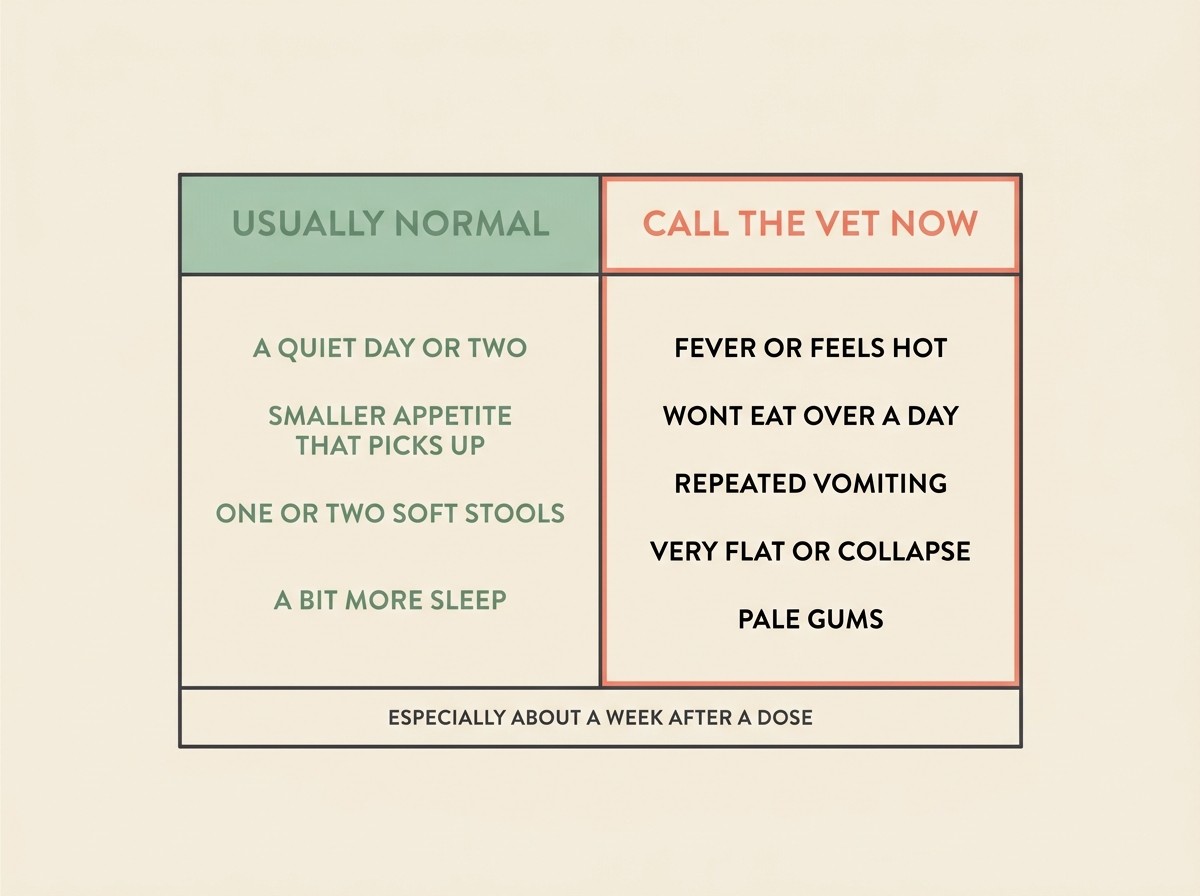
In the usually normal column: a quieter day or two after a dose, a slightly smaller appetite that picks back up within a day, one or two soft stools that settle, a bit of extra sleep, and mild tiredness around treatment. These are the everyday face of chemo, and you can simply mention them at the next check (Michigan State University, 2024).
In the call the vet now column: a fever or feeling hot, not eating for more than a day, repeated vomiting or vomiting with blood, diarrhoea that won't settle or has blood in it, marked flatness or collapse, and pale gums. If you're comfortable taking a resting rectal temperature, anything above about 103°F, which is 39.4°C, is a fever and a reason to ring straight away (Michigan State University, 2024). Any one of these, especially in that five-to-ten-day window, means contact your vet or the emergency service the same day. The worry behind that list is a hidden infection taking hold while the white cells are low, and it's the one thing not to sleep on. Our [cancer treatment emergencies] page walks through every one of these signs in full, and it's worth a read on a calm day so you know it before you need it.
When you genuinely can't tell which column you're looking at, treat it as the right-hand one and ring. A phone call costs nothing, and nobody on an oncology team will ever think less of you for checking.
Eating, and the days after a dose
Appetite is the thing owners watch most, and a small wobble is common. If your pet goes a bit off their food for a day around a treatment, try smaller meals offered three or four times through the day rather than one big bowl, and warm or hand-feed something tasty (Michigan State University, 2024). Most appetites perk back up within a day or so.
If your pet won't eat for more than a day, or goes off food at the same time as seeming unwell, that crosses into the call-now column. Keeping calories going in matters during treatment, and your vet can prescribe anti-sickness medicine or an appetite stimulant if your pet needs a hand, so it's worth asking rather than worrying alone. Our [feeding a pet through cancer] guide goes into what to put in the bowl, including why the old "sugar feeds cancer" line isn't something to starve your pet over.
Handling things safely at home
This part sounds more alarming than it is, so let's keep it in proportion. For a short window after a dose, small traces of the drug can pass out in your pet's wee, poo, vomit and saliva, so a few simple, sensible habits keep everyone safe (North Carolina State University, 2024). You don't need to keep your pet at arm's length. Normal cuddles, walks and company are all fine and good for them.
The practical version:
- Wear disposable gloves if you give chemo tablets at home, and to clear up any wee, poo or vomit, then wash your hands afterwards (North Carolina State University, 2024).
- Treat the waste as carrying traces for a short window: roughly 48 to 72 hours after an injected or drip treatment, and up to about a week after oral medication (North Carolina State University, 2024).
- For cats, scoop the litter tray daily, then double-bag the waste and put it in the household bin (North Carolina State University, 2024).
- For dogs, pick a quiet outdoor spot for toileting where you can, away from where children play, and rinse wee away with a watering can; sunlight helps break the traces down (North Carolina State University, 2024).
- Wash any soiled bedding or towels twice, separately from the rest of the laundry (North Carolina State University, 2024).
One firm line: anyone who is pregnant, trying to conceive, breastfeeding or immunocompromised should not handle the chemo medication or clear up after the pet, and should hand that job to someone else in the household (North Carolina State University, 2024). If that's you, you can still enjoy your pet's company entirely as normal.
Keep a simple log, and trust your gut
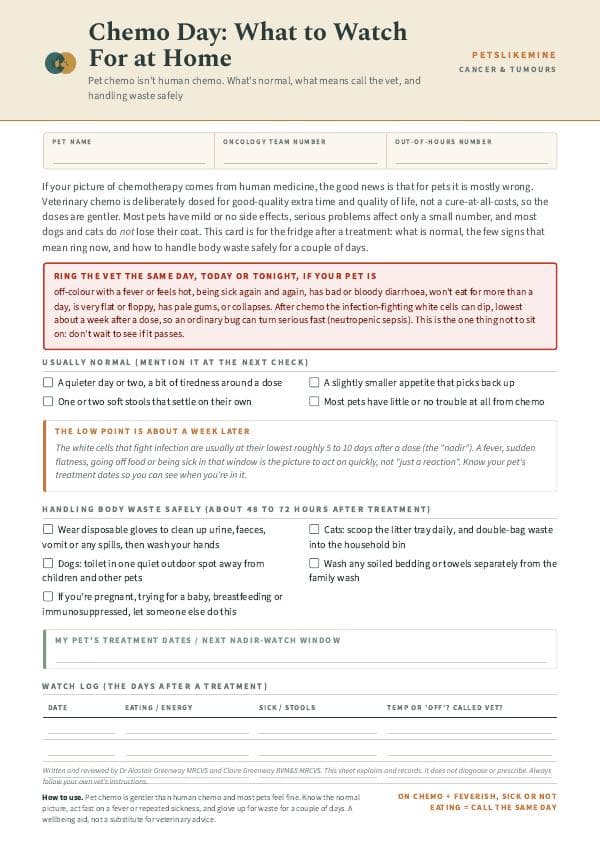
The most useful habit between visits is a few quick notes: the date of each dose, how your pet's eating, energy and toilet habits are doing, and anything that seems off. It turns a vague "I think he's a bit quiet" into something you and your vet can actually read, and it helps you tell a one-off quiet evening from a real change. Our chemo-day "what to watch for" download gives you a ready-made page to jot it on.
Above all, you know your pet better than anyone. The everyday picture of chemotherapy is a dog or cat living an ordinary, comfortable life with the odd quiet day, and that's what most pets have. Keep half an eye on that five-to-ten-day window, hold the call-now list in your back pocket, and otherwise get on with enjoying the good days, because there are usually a lot of them. If something tips into the call-now column, our [cancer treatment emergencies] page is the next click, and your vet is one phone call away.
References
- Michigan State University, College of Veterinary Medicine, Oncology Service (2024). Chemotherapy Safety / Care at Home (side effects such as vomiting or diarrhoea in fewer than 25% of pets, most pets show no visible side effects; small frequent meals for poor appetite; take a resting rectal temperature and attend an emergency room if above 103°F / 39.4°C; call if appetite is poor for more than 48 hours, if vomiting is persistent, or if diarrhoea fails to resolve after 48 hours, especially with a fever over 103°F).
- North Carolina State University, College of Veterinary Medicine, Veterinary Hospital (2024). Safe Handling of Chemotherapy for Pet Owners (wear chemotherapy-rated/nitrile gloves to give oral chemo and to handle waste, then wash hands; handle urine and faeces as contaminated for 48 to 72 hours after intravenous chemotherapy and up to 7 days after oral medication; clean cat litter trays daily and double-bag litter into household waste; toilet dogs in a separate low-traffic outdoor area with sunlight; wash soft items such as bedding and towels twice, separately from other laundry; owners who are pregnant, trying to conceive, breastfeeding or immunocompromised should not handle chemotherapy drugs or clean up after pets).
- Today's Veterinary Practice (2021). Monitoring of Chemotherapy Patients in General Practice (a CBC is performed before chemotherapy treatments to ensure recovery from previous cytopenias; the neutrophil nadir is anticipated between 5 and 10 days after drug administration; chemotherapy is delayed and restarted once the count recovers above the cutoff, the authors using 1,500/µL for neutrophils; dose reductions, the authors typically beginning with a 10% reduction, are warranted for significant neutropenia).
- American Animal Hospital Association (2026). 2026 AAHA Oncology Guidelines for Dogs and Cats / From the Guidelines: Chemotherapy Nadir Appointment Considerations (the nadir "usually occurs 7 days after treatment, although it can vary, especially for drugs like carboplatin"; the nadir appointment and CBC to detect neutropenia, with temperature checked as identifying fever is crucial in neutropenic patients; "febrile neutropenia is an oncologic emergency and requires hospitalization"). and https://www.aaha.org/trends-magazine/publications/from-the-guidelines-chemotherapy-nadir-appointment-considerations/
Free downloads
Companion worksheets to put what you've read into practice. Free PDFs, print at home.
Sister tool · Sightline
Track quality of life over time
Sightline, a separate ConciergeVet tool, runs a short adaptive weekly assessment with a quality-of-life focus mode built around exactly these frameworks, tracks a single composite score over time so you can see the trend rather than judge a single bad day, and produces a Sightline Report PDF you can bring to your vet.
A written log, or our printable quality-of-life sheet, does much the same job.
See how Sightline tracks quality of lifeFound a lump? Track it, and know when to act
A lump cannot be told apart by look or feel; only your vet sampling it can. The Lump & Bump Tracker records its size and how it changes, flags when it has crossed a line worth a vet visit, and builds a clean history to take in.
Open the Lump & Bump TrackerYou're not doing this alone
Compare treatment journeys and talk to owners managing cancer. Free to join.
Join PetsLikeMine