

My Cat Is Straining in the Litter Tray: What's Going On, and What to Do
Alastair Greenway
BVM&S MRCVS
A cat who goes to the tray, crouches, strains, and walks away with little or nothing to show for it, then heads back ten minutes later to repeat the whole thing, is one of the commonest reasons owners ring us. Sometimes there's a spot of blood. Sometimes they've weed on the bath mat instead. It's unsettling to watch, and the hardest part is not knowing how worried to be. So this page sorts that out first, quickly and plainly, before we get into any of the why.
There's one question that decides everything else, so we'll start there.
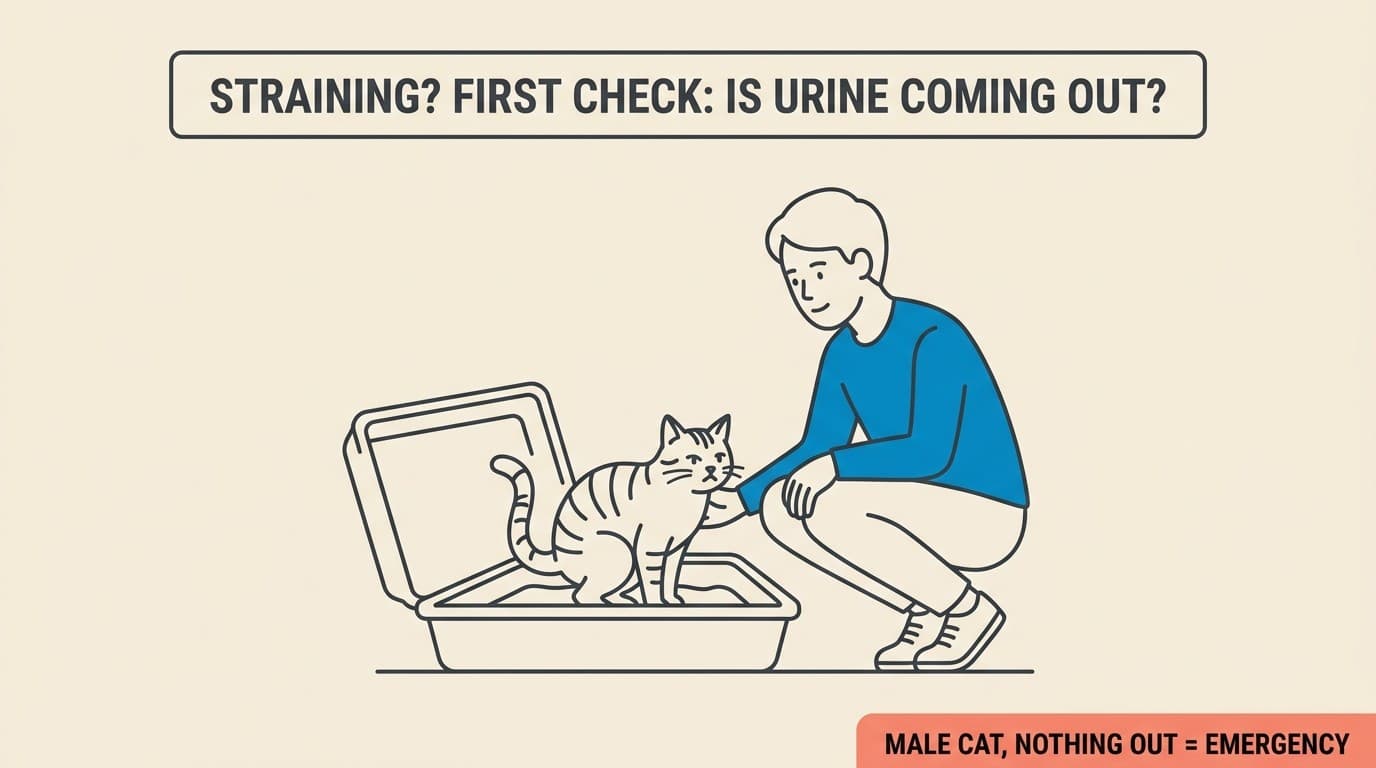
First, the one question that matters
Is your cat actually passing urine?
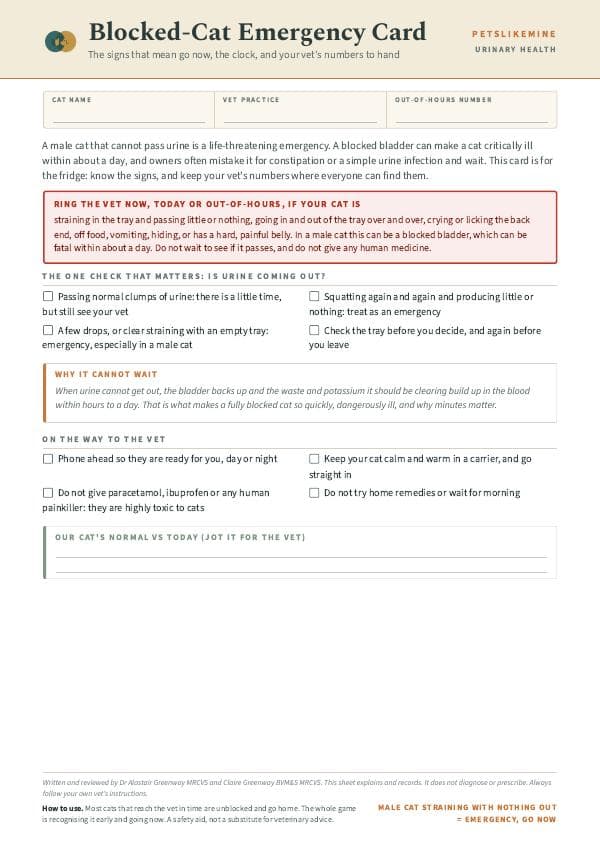
This is the fork the long encyclopaedia pages bury, and it's the one that matters most tonight. A cat who's producing normal-sized clumps of urine, even with a bit of straining or a little blood, has some time. A male cat who's straining over and over and passing little or nothing may have a blocked bladder, and that is a genuine, life-threatening emergency that can be fatal within a day or two if it isn't relieved (Cornell Feline Health Center, 2023; PDSA, 2023). It is not constipation, and it is not a simple urine infection.
So before you read another word, go and look in the tray. If your cat is male and you can't find fresh, normal clumps, if every trip produces only a few drops or nothing at all, ring your vet or the emergency vet now, tonight, and say you think your cat may be blocked. Don't wait to see if it passes. (There's a fuller account of why the clock matters this much in our blocked-cat emergency article, and the Blocked-Cat / Straining-Cat triage tool will walk you through it in under a minute.)
If your cat is comfortable and clearly is passing urine, you can breathe out a little and read on. We'll come back to exactly how urgent your particular cat is further down.
What "straining" usually means
Once a true blockage is off the table, straining in the tray nearly always comes down to a short list of causes, and they're not the ones most owners expect.
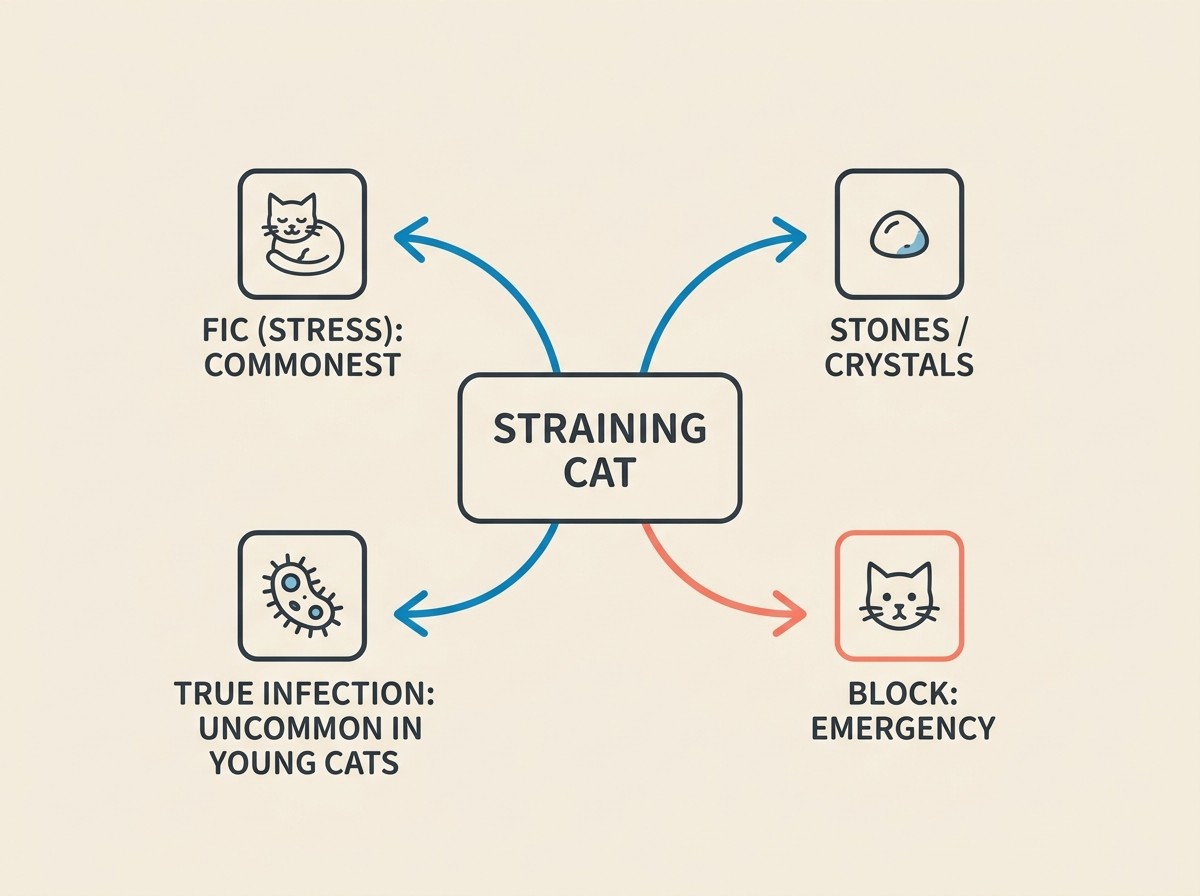
By far the commonest is feline idiopathic cystitis, or FIC. It's a sterile, stress-linked inflammation of the bladder lining, and despite looking exactly like a urine infection, it usually isn't one. In cats under about ten years old, FIC accounts for somewhere between 55 and 63% of all lower urinary signs (Lekcharoensuk et al., 2001; Cornell Feline Health Center, 2023). That changes what actually helps, and we've given it its own article: feline idiopathic cystitis, why stress gives your cat a sore bladder.
Next come bladder stones or crystals, which irritate the bladder wall and, in cats under ten, cause roughly 15 to 22% of cases (Lekcharoensuk et al., 2001). Whether a stone can be treated with diet or has to be removed depends entirely on its type, which is the whole story of our bladder-stones article.
A true bacterial infection, the thing everyone assumes is happening, is actually uncommon in otherwise-healthy young and middle-aged cats. In studies of cats with lower urinary signs it's been found in well under one in ten, and often under about 3% (Litster et al., 2011; Weese et al., 2019). It becomes more likely in older cats and in cats with kidney disease, diabetes or an overactive thyroid (Weese et al., 2019). We've unpacked exactly why in our "is it a UTI?" article.
And then there's the dangerous one, a urethral obstruction, the blocked cat, which sits behind that first question and which we'll keep coming back to.
The signs, and what they're telling you
The signs of all these conditions overlap, which is why you can't always tell them apart at home, and why your cat needs a vet to sort it out. But it helps to know what you're looking at.
- Frequent trips and small amounts. Going to the tray again and again, producing only a little each time, is one of the most typical signs of bladder irritation.
- Straining and crying. A cat who strains, scratches around the tray for a long time, or cries out is in pain, and pain is the common thread across FIC, stones and a block (International Cat Care, 2023).
- Blood. Anywhere from a faint pink tinge to obvious red. It's alarming to see, but on its own it doesn't tell you the cause, and a comfortable cat passing urine with a little blood is usually not an emergency. There's more on grading it in our article on blood in your pet's urine.
- Licking the back end. Often a sign the area is sore or irritated.
- Weeing outside the tray. This one trips up a lot of owners, because it looks like bad behaviour. It usually isn't. When the bladder is inflamed, urinating hurts, and cats quickly come to associate the tray itself with that pain and start going elsewhere to escape it. Periuria, the technical word for weeing in the wrong place, is one of the common signs of FIC, alongside the straining, blood and frequent small wees (Defauw et al., 2011). So before anyone calls it spite or a litter-tray protest, the medical causes need ruling out first. Our article on weeing in the house walks through telling the two apart.
How urgent is my cat?
Here's a simple way to sort your own cat, tonight.
Emergency, go now (out of hours if needed): a male cat straining and passing little or nothing. This is the one that can't wait, even by a few hours.
Same day: any cat who's clearly distressed, in obvious pain, lethargic, hiding away, vomiting or off their food, whatever the tray is showing.
A prompt appointment: a comfortable cat who is passing urine normally but with a little blood, or who has occasional bouts of straining that settle. Book in soon rather than tonight. And in the meantime, getting more water into your cat and taking the pressure off their environment won't do any harm, and may genuinely help. There's a whole article on why getting more water in is the best thing you can do for your cat's bladder, and another on managing the environment with MEMO.
If you're unsure which box your cat falls into, that's exactly what the Blocked-Cat / Straining-Cat triage tool is for. When in doubt with a male cat, treat it as the emergency and ring.
What the vet will do
Knowing what to expect takes some of the fear out of the visit.
Your vet will start by feeling your cat's bladder, which tells them a great deal: a small, painful bladder points one way, a large, firm, painful one in a male cat raises the alarm for a block. They'll usually want a urine sample to look for blood, crystals and signs of infection, and they may take an X-ray or ultrasound to look for stones (Cornell Feline Health Center, 2023; International Cat Care, 2023). Our guide on how to describe urinary signs to your vet and collect a urine sample makes that part easier.
Now brace yourself for the part that surprises people. In a lot of cats, those tests come back showing no infection at all. That isn't a dead end or a failure of the testing. It's the expected result, and it's the clue that points to FIC. When that happens, the plan shifts away from antibiotics, which wouldn't help a sterile, stress-driven problem, and towards water, environment and pain relief instead (Weese et al., 2019; International Cat Care, 2023). If your vet doesn't reach for antibiotics, that's good medicine, not them holding back. Our articles on getting the diagnosis and on the "is it a UTI?" question explain why in full.
What you can start at home, for a non-emergency cat
If your cat is comfortable and passing urine, and you've got a prompt appointment in the diary, there are a few sensible things you can do while you wait.
- Get more water in. Dilute urine is less irritating to a sore bladder and less likely to form crystals, which is why increasing water intake is the cheapest and most effective lever in the whole of feline urinary health (International Cat Care, 2023). Shift some of the diet to wet food, add a fountain or a few more water bowls, and put them away from the food and the tray. The full set of tricks is in our water article, and you can keep an eye on intake and flares together with the FIC Flare & Water-Intake tracker.
- Take the pressure down. FIC flares are driven by stress, so a calm, predictable few days, with clean trays, quiet spaces and somewhere to hide, can take the edge off. The practical version is in our MEMO article.
- Keep the trays clean and plentiful. A scooped, uncovered tray in a quiet spot is more inviting to a cat who already associates the tray with discomfort.
And a short list of what not to do. Don't give human painkillers of any kind. Many, including paracetamol and ibuprofen, are dangerously toxic to cats, even in tiny amounts. Don't bother with cranberry products or human cystitis sachets, they're aimed at a bacterial infection your cat probably doesn't have. And above all, don't sit on it overnight if your cat is male and straining to pass nothing, hoping it'll sort itself out by morning. That's the one situation where waiting costs the most.
The bottom line
Straining at the tray is frightening to watch, but most of the time it's a painful bladder rather than a catastrophe, and most of those cats do well. The one exception is worth burning into memory: a male cat passing little or nothing is an emergency, every time, no matter the hour.
If you're still weighing it up, run your cat through the Blocked-Cat / Straining-Cat triage tool, and read our blocked-cat emergency article next so you'll always recognise it fast. If your cat is comfortable and the tests are pointing to FIC, the feline idiopathic cystitis article is the right place to go from here, because that's where the real, hopeful work of fewer flares begins.
References
- American Veterinary Medical Association. (2023). Feline lower urinary tract disease (FLUTD).
- Cornell Feline Health Center. (2023). Feline lower urinary tract disease. Cornell University College of Veterinary Medicine.
- Defauw, P. A. M., Van de Maele, I., Duchateau, L., Polis, I. E., Saunders, J. H., & Daminet, S. (2011). Risk factors and clinical presentation of cats with feline idiopathic cystitis. *Journal of Feline Medicine and Surgery*, 13(12), 967-975.
- International Cat Care. (2023). Feline lower urinary tract disease (FLUTD).
- Lekcharoensuk, C., Osborne, C. A., & Lulich, J. P. (2001). Epidemiologic study of risk factors for lower urinary tract diseases in cats. *Journal of the American Veterinary Medical Association*, 218(9), 1429-1435.
- Litster, A., Thompson, M., Moss, S., & Trott, D. (2011). Feline bacterial urinary tract infections: An update on an evolving clinical problem. *The Veterinary Journal*, 187(1), 18-22.
- PDSA. (2023). Blocked bladder in cats. People's Dispensary for Sick Animals.
- Weese, J. S., Blondeau, J., Boothe, D., Guardabassi, L. G., Gumley, N., Papich, M., Jessen, L. R., Lappin, M., Rankin, S., Westropp, J. L., & Sykes, J. (2019). International Society for Companion Animal Infectious Diseases (ISCAID) guidelines for the diagnosis and management of bacterial urinary tract infections in dogs and cats. *The Veterinary Journal*, 247, 8-25.
Free downloads
Companion worksheets to put what you've read into practice. Free PDFs, print at home.
Keep track of how your pet is doing
The owners who cope best are the ones who notice changes early. A simple health log shows you what is working, and what is not, before the next vet visit.
Start tracking, freeYou're not doing this alone
Compare treatment journeys and talk to owners managing urinary health. Free to join.
Join PetsLikeMine