

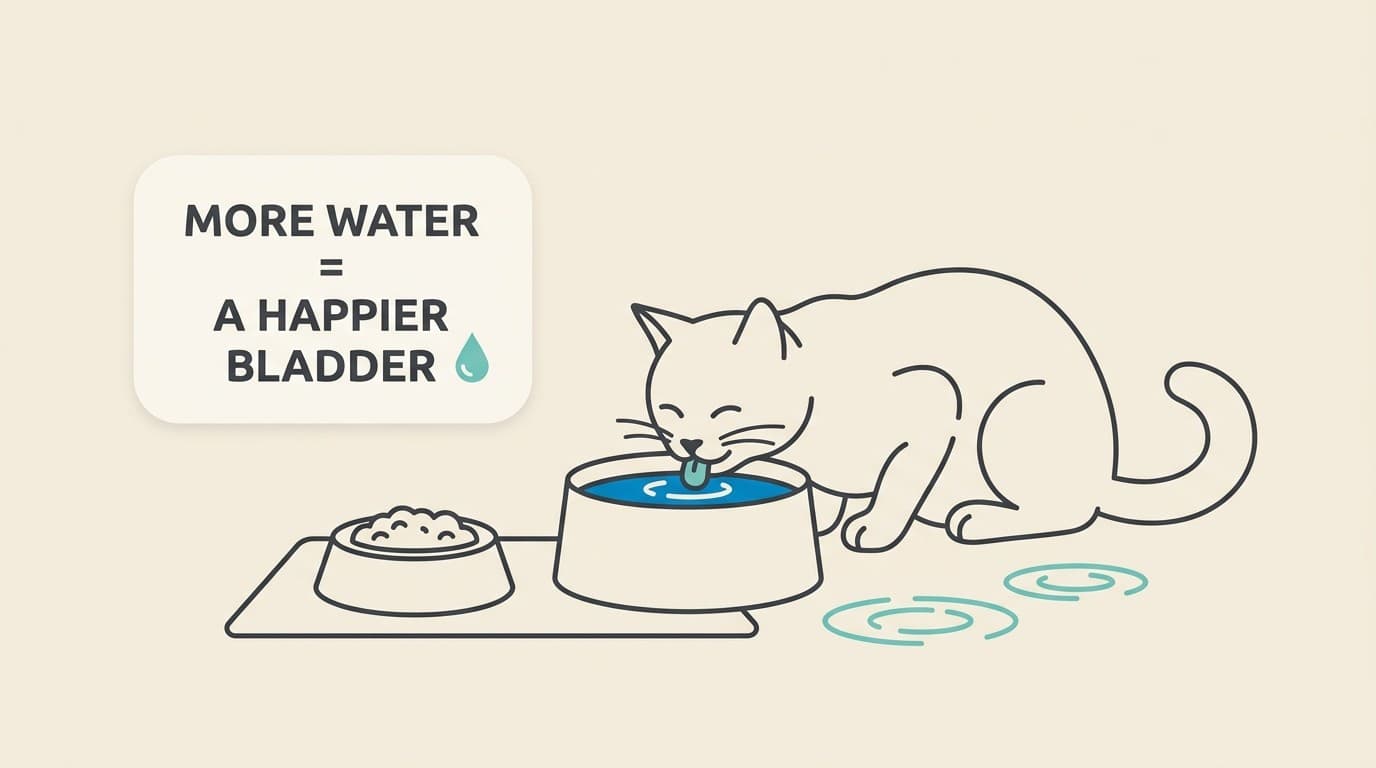
Water, Diet and Your Cat's Bladder: Increasing Intake and When a Urinary Diet Helps
Alastair Greenway
BVM&S MRCVS
Cats treat "get more water into them" with the contempt they reserve for most of our ideas. They drink when they feel like it, ignore the lovely new bowl, and leave you wondering whether this "drink more water" business is real medicine or just something vets say to fill the silence. If your cat has idiopathic cystitis, has formed a stone, or has recently been unblocked, you've almost certainly heard the advice already and watched it bounce straight off.
It's real medicine. Of everything in this whole space, getting more water through your cat's bladder is the cheapest, most useful thing you can do, and the evidence behind it is better than for most of the expensive supplements and diets sold alongside it. This page is the practical version: why water matters so much for a cat's bladder, how to get more in when your cat is determined to drink less, and the plain truth about "urinary diets", which are not the one-size-fits-all answer the tins make them look.
Why water is medicine for a cat's bladder
The logic is the same whatever the diagnosis, and it's worth understanding because it's what makes the effort worthwhile. The more water your cat takes in, the more dilute their urine becomes, and the more often they empty the bladder. That matters in three concrete ways.
Dilute urine is gentler on a sore bladder lining, which is exactly the problem in feline idiopathic cystitis (FIC), the stress-linked, sterile inflammation that is by far the commonest reason a cat strains, and almost never an infection. There's more on the whole picture in [feline idiopathic cystitis: why stress gives your cat a sore bladder]. Dilute urine also holds the minerals that form crystals and stones in solution, instead of letting them drop out and clump, which is why dilution sits at the centre of preventing [bladder stones]. And in a male cat, fewer crystals and a more dilute, free-flowing urine mean less of the gritty plug material that can block the narrow urethra, which is why "more water" is the first line of every plan for [preventing a re-block after your cat comes home].
How dilute is dilute enough? Vets measure urine concentration as "specific gravity", and the aim for a cat with urinary trouble is to bring it down towards around 1.030 to 1.035, well below the very concentrated urine many cats produce on dry food alone (International Cat Care; Royal Canin Academy). You don't need to measure that at home, but it's the target your vet is working towards, and it's reached almost entirely through water and diet rather than medicine.
The single best piece of evidence for this is a year-long study of cats with idiopathic cystitis fed the very same urinary diet as either tins or biscuits. Signs came back in only about 1 in 9 of the cats on the wet version (2 of 18), against roughly 4 in 10 of those on the identical food as dry biscuits (11 of 28), and the cats on the wet food were passing more dilute urine (Markwell et al., 1999). Same food, same minerals. The water was doing the work.
Wet food is the biggest lever, by a long way
If you change one thing, change this. Tinned and pouched food is roughly 70 to 80% water, while dry biscuits are closer to 8 to 10% (International Cat Care). A cat living on dry food has to drink a great deal at the bowl just to break even, and most simply won't, because cats evolved from desert animals and are built to get their water from prey, not from lapping. Shifting some or all of the diet to wet food pours water in through the food bowl, where your cat isn't paying attention, and it raises total intake far more reliably than any amount of coaxing at the water dish.
This is why the leading feline-medicine guidance recommends feeding a wet diet and increasing water intake for any cat with lower urinary signs (2025 iCatCare consensus guidelines), and why the Cornell Feline Health Center recommends canned food to push water intake up in cats prone to bladder trouble (Cornell Feline Health Center). A common rule of thumb among feline vets is that at least half of a urinary cat's diet should be wet.
If your cat is dry-fed and set in their ways, don't switch overnight, as a sudden change of food is itself a stressor, and stress is the last thing a FIC cat needs. Move across slowly over a week or two, mixing in a little more wet each day. Warming the food to body temperature makes it smell stronger and far more tempting. A splash of warm water or salt-free, onion-free broth loosens it into a gravy and pushes intake higher still, and offering it as several small meals suits a cat's natural little-and-often grazing.
If your cat genuinely won't accept wet food at all, you haven't failed. Plenty of cats stay partly or wholly on dry food, and the water tactics below, plus the right diet, still help. Wet food is the most powerful lever, not the only one.
Coaxing a reluctant cat to actually drink
Wet food does the heavy lifting, but a few small changes to the water itself add to it, and they matter most for the cats who turn their noses up at tins. Cats are oddly particular about water, and a lot of the time the problem is the setup, not the cat.
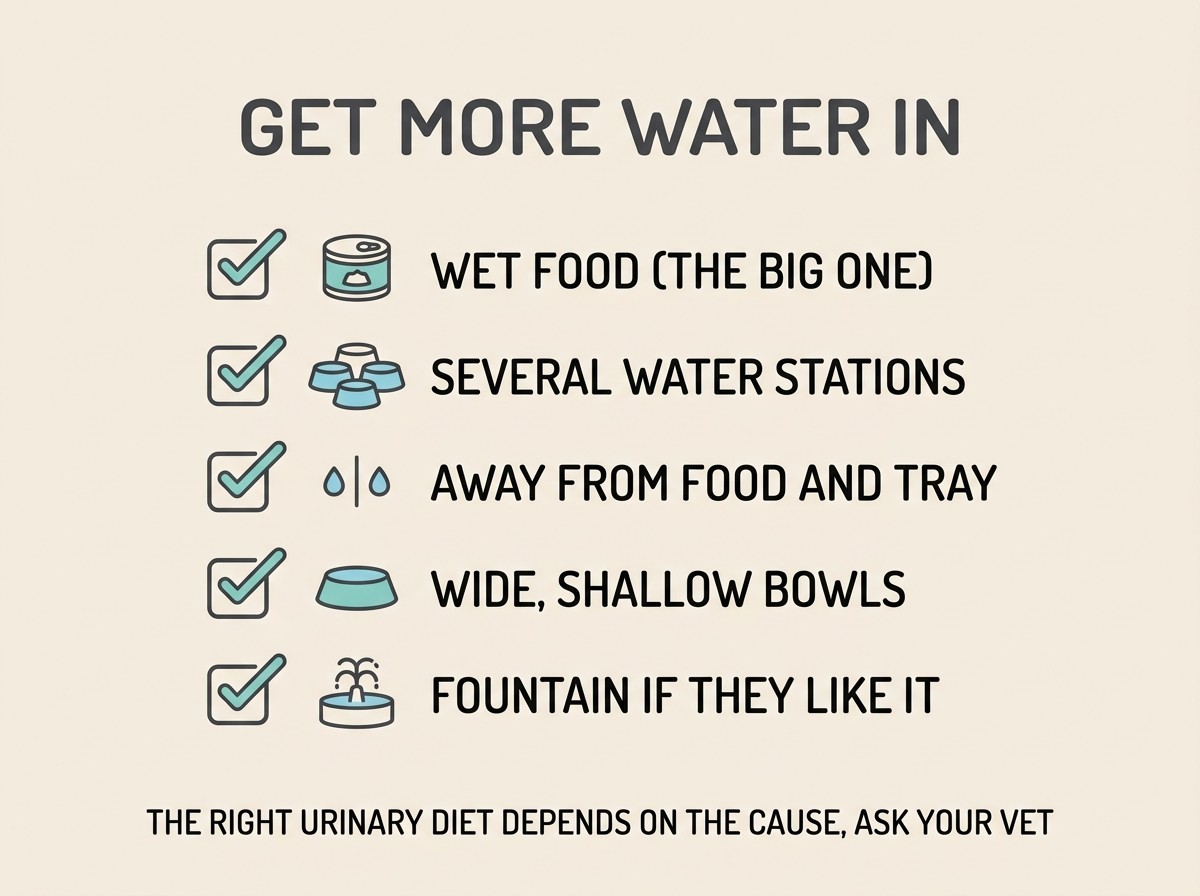
- Several water stations, away from the food and the litter tray. Cats instinctively avoid drinking right where they eat or toilet, so a bowl tucked beside the food often goes ignored. Put water in a few separate, quiet spots around the home, including upstairs, so there's always a safe drink nearby. This is the same "separate, plentiful resources" principle behind the litter-tray advice in [managing FIC with MEMO] (AAFP/ISFM Feline Environmental Needs Guidelines).
- Wide, shallow bowls, filled near the top. Many cats dislike their whisker tips brushing the sides of a narrow bowl, and a brim-full one means they needn't dip their head awkwardly. A wide ceramic or glass dish beats a deep plastic one, which can also taint the taste.
- Fresh water, every day. Stale, dusty or sun-warmed water is off-putting. A clean bowl topped up daily beats a fancy fountain that nobody descales.
- A fountain, if your cat likes moving water, but with realistic expectations. Some cats clearly prefer a fountain and drink more from it. The evidence is mixed, though: one study found cats appeared to take in more from a fountain, yet their urine was no more dilute than from a bowl, possibly because much of the "extra" was splashing rather than swallowing (Grant, 2010). So a fountain is worth trying for a cat who snubs still water, but treat it as a nice-to-have, not a replacement for wet food. If your cat ignores the gadget and drinks from the dripping tap instead, that's a win too.
Cats are individuals, so experiment, watch what your particular cat actually uses, and keep that. The goal is simply more water in, by whatever route your cat will accept.
"Urinary diets": what they do, and the real catch
You'll see prescription "urinary" diets recommended a lot, and for the right cat they genuinely earn their place. They're formulated to do two things: encourage the cat to produce more dilute urine, and control the minerals and the acidity that drive specific problems. For a cat that won't tolerate enough plain wet food, a good urinary diet is a sensible, evidence-backed tool.
But here is the catch the marketing tends to skip, and it matters: there is no single "urinary diet". The right one depends entirely on what you're actually treating, and some of them pull in opposite directions.
Stones are the clearest example. A diet designed to dissolve a struvite stone deliberately makes the urine more acidic and lowers certain minerals, and it can often clear a struvite stone in a few weeks and avoid surgery altogether (2025 iCatCare consensus guidelines). But that same acidifying approach is exactly wrong for a cat prone to calcium oxalate stones, which cannot be dissolved at all and are actually encouraged by overly acidic urine. So a diet that helps one cat can quietly harm another. This struvite-versus-oxalate fork is covered in full in the [bladder stones] section, and it's why your vet wants to know the stone type before choosing a food.
For idiopathic cystitis it's gentler but the principle holds: there are calming "stress" urinary diets that combine dilution with added tryptophan and milk-derived calming proteins, and they may help some cats, but the guidance is candid that diet alone is unlikely to fix FIC and that the wetness of the food matters more than the brand on the tin (2025 iCatCare consensus guidelines). A wet ordinary diet often does more good than a dry "urinary" one.
Two practical takeaways, then. First, a urinary diet is a decision to make with your vet once you know the diagnosis, not a tub to grab off the shelf because the box says "urinary". Second, if your vet does recommend one, ask whether it comes in a wet form, because the wet version of the same diet almost always produces more dilute urine, and therefore does more, than the dry version (Markwell et al., 1999).
What to leave on the shelf
A couple of popular things aren't worth your money for most cats. Cranberry products and human cystitis sachets are designed to stop bacteria sticking to the bladder wall, which is useful in a genuine bacterial infection, but cats with urinary signs usually don't have one in the first place, so they're solving a problem your cat probably hasn't got (there's more on this in ["is it a UTI?"]). And don't pile on supplements without advice. More isn't better, and some can nudge the urine chemistry the wrong way for your particular cat. If a flare is making your cat miserable, the things that genuinely help are pain relief from your vet, more water, and a calmer home, not a shelf of capsules.
Measure it, so you can see it working
The quiet reward of getting more water in is that, unlike most of what you do for a sore bladder, you can actually watch it pay off. Keep a rough handle on how much water your cat is taking in, the wet-to-dry ratio, fountain or bowl use, or actual millilitres if you're able to measure, and log it alongside any flares or urinary signs on the [FIC Flare & Water-Intake tracker]. Over a few weeks you'll often see the two lines move together: intake climbing, flares thinning out and spacing further apart. That feedback is genuinely motivating on the evenings a fussy cat is testing your patience, and it gives your vet something concrete to work from at the next visit.
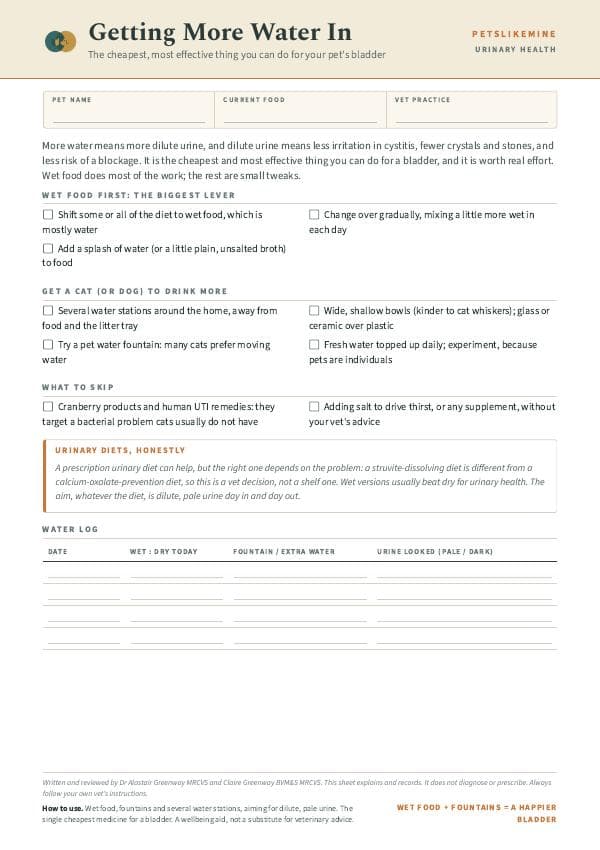
If you'd like it on paper, our [water-intake boosting guide] gathers the wet-feeding tips, the bowl-and-fountain tricks and some rough daily targets into one printable place. Start with the wet food, add a couple of water stations away from the food and tray, and give it a fortnight. For most cats' bladders, it's the single most useful thing you'll do, and it costs next to nothing.
And the one rule that overrides everything on this page: if your cat is a male and he's straining in the tray and passing little or nothing, no amount of water will fix that in the moment, because he may be blocked. That's a life-threatening emergency, so ring your vet or the out-of-hours service straight away and check the [Blocked-Cat triage] if you're unsure. Water is prevention, not rescue.
References
- Markwell PJ, Buffington CA, Chew DJ, Kendall MS, Harte JG, DiBartola SP. *Clinical evaluation of commercially available urinary acidification diets in the management of idiopathic cystitis in cats.* Journal of the American Veterinary Medical Association, 1999;214(3):361-365. PMID: 10023397. (Same diet fed wet or dry; signs did not recur in 16/18 cats on the canned diet vs 17/28 on the dry diet, i.e. recurrence ~11% wet vs ~39% dry; cats on the moist food had lower mean urine specific gravity, ~1.037 vs ~1.052.)
- Taylor S, Boysen S, Buffington T, et al. *2025 iCatCare consensus guidelines on the diagnosis and management of lower urinary tract diseases in cats.* Journal of Feline Medicine and Surgery, 2025;27(2). doi:10.1177/1098612X241309176. (Increasing water intake and feeding a wet diet recommended across FLUTD; FIC frequently sterile and antibiotics not indicated; struvite dissolution by diet over ~2-3 weeks, calcium oxalate not dissolvable; diet alone unlikely to resolve FIC.)
- International Cat Care (iCatCare/ISFM). *Feline idiopathic cystitis (FIC) in cats* (multimodal management; wet diet and increasing water intake to dilute urine; target urine specific gravity).
- International Cat Care (iCatCare/ISFM). *How to encourage your cat to drink* (wet food ~70-80% water vs dry ~8-10%; multiple water stations away from food and tray; bowl type; fountains).
- Ellis SLH, Rodan I, Carney HC, Heath S, Rochlitz I, Shearburn LD, Sundahl E, Westropp JL. *AAFP and ISFM Feline Environmental Needs Guidelines.* Journal of Feline Medicine and Surgery, 2013;15(3):219-230. doi:10.1177/1098612X13477537. (The five pillars; multiple separated resources including water placed away from food and litter.)
- Cornell Feline Health Center. *Feline lower urinary tract disease* (feline idiopathic cystitis the commonest diagnosis in cats with lower urinary signs; canned food, at roughly 75% moisture, recommended to increase water intake and lower urine specific gravity).
- Grant DC. *Effect of water source on intake and urine concentration in healthy cats.* Journal of Feline Medicine and Surgery, 2010;12(6):431-434. doi:10.1016/j.jfms.2009.10.008. (Intake slightly greater from a fountain, but urine concentration not significantly different from a bowl; results did not support replacing a bowl with a fountain to dilute urine.)
- Royal Canin Academy. *How I approach... Urolithiasis and specific gravity in cats* (target urine specific gravity for urinary patients; dilution central to stone prevention).
- Lulich JP, Berent AC, Adams LG, Westropp JL, Bartges JW, Osborne CA. *ACVIM Small Animal Consensus Recommendations on the Treatment and Prevention of Uroliths in Dogs and Cats.* Journal of Veterinary Internal Medicine, 2016;30(5):1564-1574. PMID: 27611724. doi:10.1111/jvim.14559. (Increasing water intake and feeding moist food central to urolith prevention; struvite dissolvable by diet, calcium oxalate not.)
- Weese JS, Blondeau J, Boothe D, et al. *International Society for Companion Animal Infectious Diseases (ISCAID) guidelines for the diagnosis and management of bacterial urinary tract infections in dogs and cats.* The Veterinary Journal, 2019;247:8-25. doi:10.1016/j.tvjl.2019.02.008. (True bacterial UTI uncommon in young cats; antimicrobials and cranberry not indicated without a confirmed infection.)
Free downloads
Companion worksheets to put what you've read into practice. Free PDFs, print at home.
Keep track of how your pet is doing
The owners who cope best are the ones who notice changes early. A simple health log shows you what is working, and what is not, before the next vet visit.
Start tracking, freeYou're not doing this alone
Compare treatment journeys and talk to owners managing urinary health. Free to join.
Join PetsLikeMine