

Cancer Treatment Emergencies: When to Call the Vet Right Now
Alastair Greenway
BVM&S MRCVS
There is one situation on cancer treatment where the difference between ringing tonight and ringing in the morning genuinely matters, and this page is about that situation. Most days, a pet on treatment is doing fine, and most of the small worries you'll have settle on their own. A few don't, and the trick is knowing which ones to act on straight away.
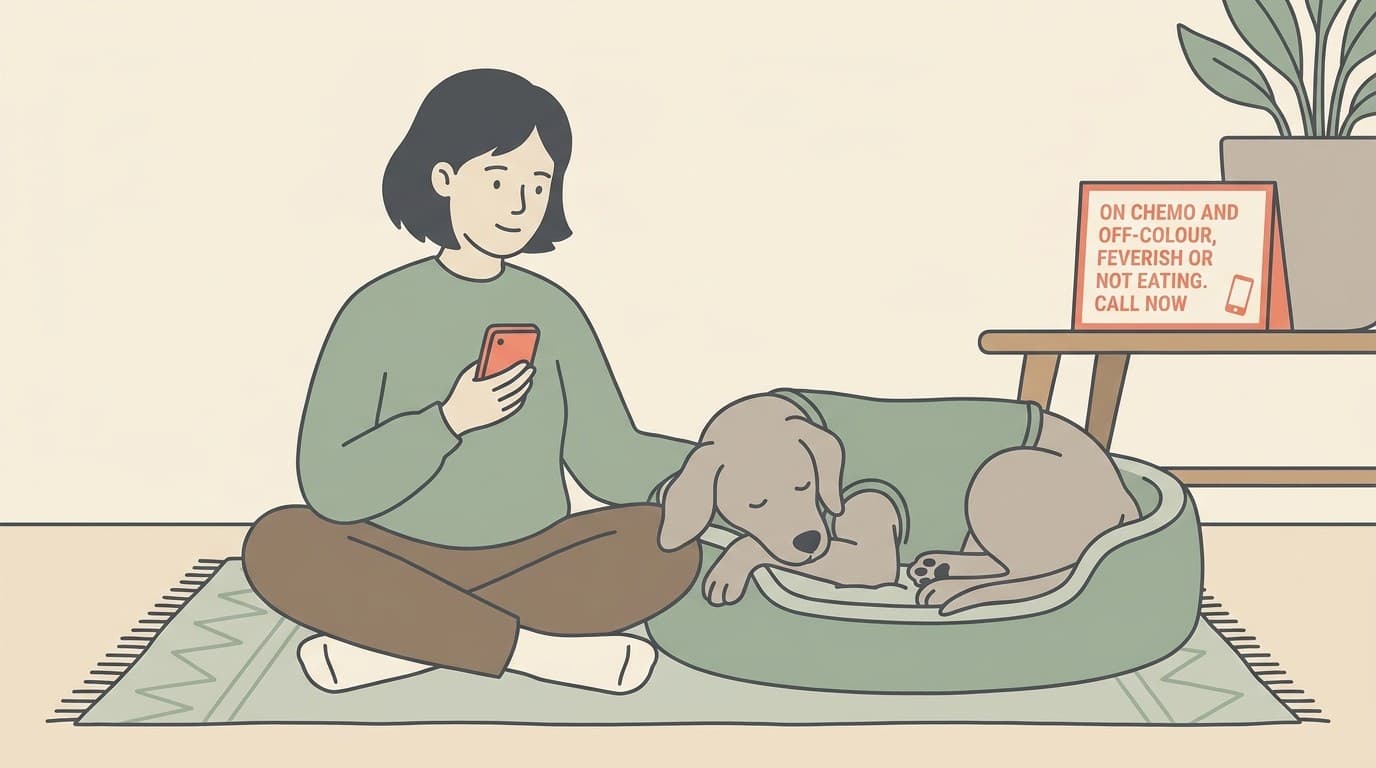
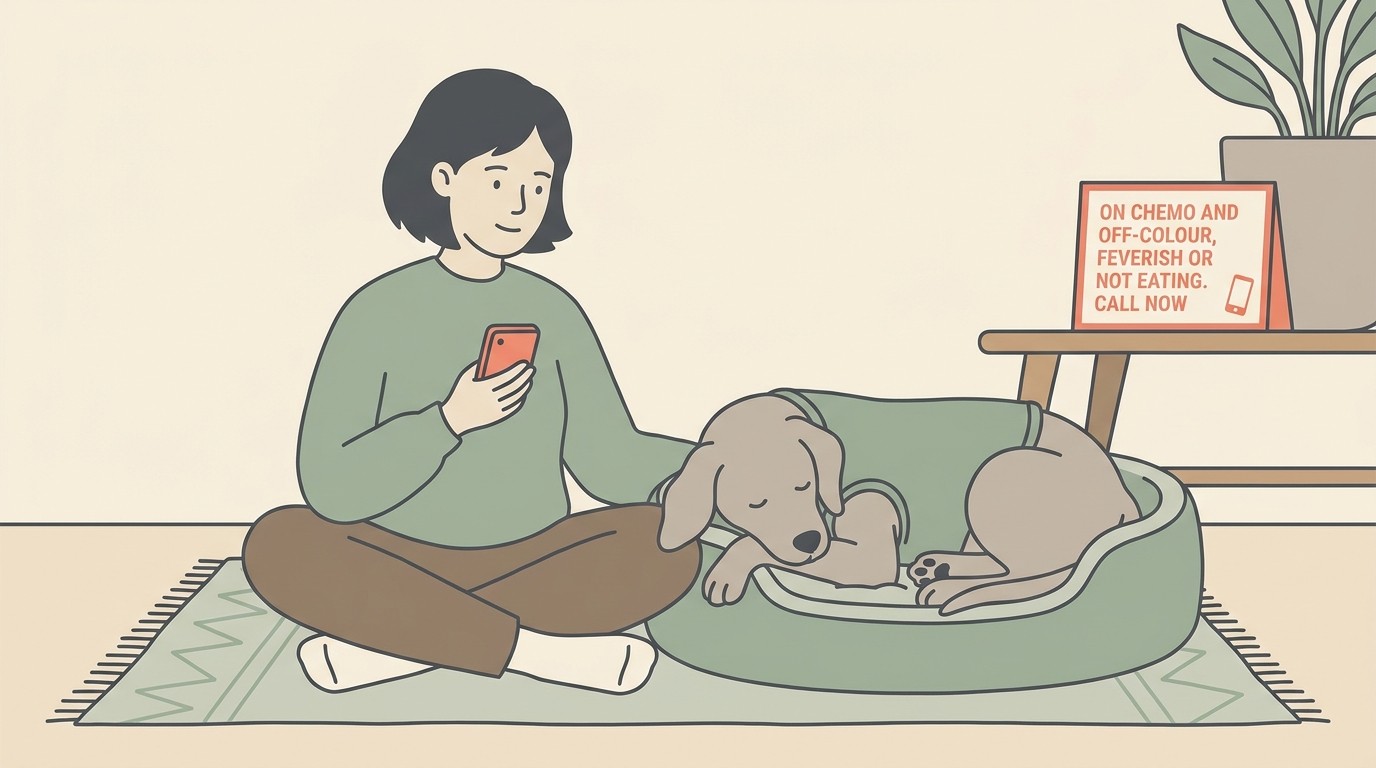
Here is the rule the rest of the page hangs on. If your pet is on chemotherapy, or had it in the last week or two, and is suddenly off-colour, off their food, being sick again and again, or seems hot or floppy, ring your vet or the emergency vet now. Don't wait to see if it passes. You will not be wasting anyone's time, and this is the one situation that turns dangerous fastest.
The call-now signs
Below are the signs that mean ring the vet the same day, not in the morning. You don't need all of them. Any one, especially in the week or so after a dose, is enough.
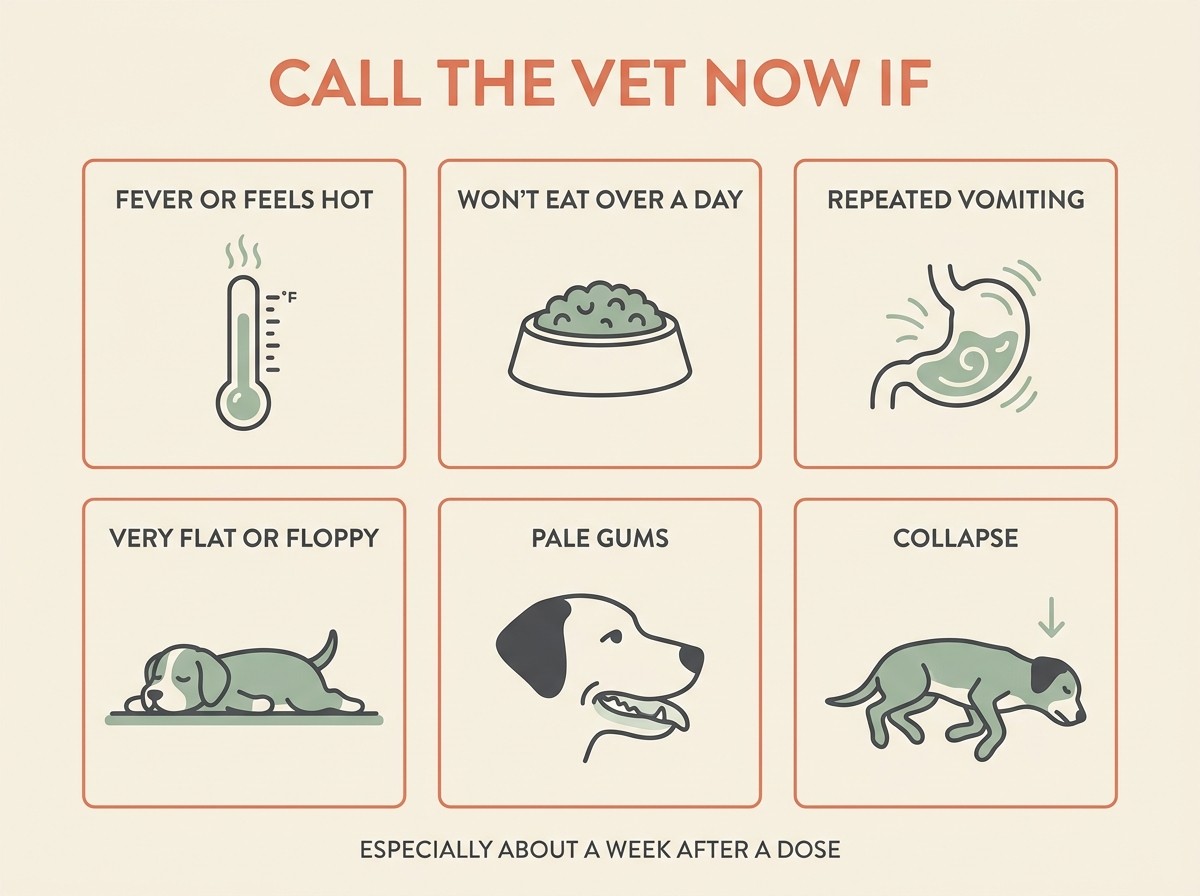
- A fever, or your pet feels hot, shivery or shaky. If they seem unwell and you can take a rectal temperature, anything above about 103°F, which is 39.4°C, is a fever and a reason to ring now rather than wait (Michigan State University, 2024). If you can't or would rather not take a temperature, that's fine; the "off-colour and hot to the touch" instinct is enough to act on.
- Being sick again and again. A single vomit can happen for ordinary reasons. Repeated vomiting, vomiting that won't stop, or any vomit with blood in it is a call-now sign (Royal Veterinary College, 2024).
- Diarrhoea that's severe, won't settle, or has blood in it, particularly alongside any of the others here.
- Not eating for more than a day, or going right off their food at the same time as seeming unwell.
- Marked tiredness or weakness, the kind where they won't get up to eat, drink or go outside, or any sudden collapse.
- Pale gums, fast or laboured breathing, or any bleeding you can't stop. Healthy gums are a salmon pink; gums that have gone pale, white or grey mean blood isn't reaching where it should, and that needs a vet immediately.
That last group matters for one cancer in particular. If your dog has a splenic haemangiosarcoma, the tumour can bleed suddenly inside the belly, and a dog who seemed fine that morning can become weak, pale-gummed, breathing fast and unable to stand within a few hours (Cornell University, 2024). That's a drop-everything emergency, and we cover it fully in our [guide to haemangiosarcoma].
What usually isn't an emergency
It would be no kindness to leave you panicking at every quiet evening, because most of what you'll see sits at the gentle, ordinary end of things. Roughly three in four pets have little or no trouble on chemotherapy, and where side effects do appear they are usually mild and manageable at home (Michigan State University, 2024).
A quiet day or two, a slightly smaller appetite that picks back up, one or two soft stools that settle, or a bit of tiredness in the day after a dose are usually nothing to rush about. The dividing line is whether it's mild, brief and getting better, which is the ordinary picture you can mention at the next check, or whether it's sudden, severe, not settling, or landing together with a fever, which is the picture that needs a phone call now (Michigan State University, 2024). When you genuinely can't tell which one you're looking at, treat it as the second and ring, because a phone call costs nothing and the team would far rather hear from you early. We've a separate [guide to what's normal during treatment] that walks through the everyday side of it.
Sorting the kit out before you need it
The calmest version of an emergency is the one you've quietly prepared for, so it's worth getting these in place on a good day:
- Your oncology team's daytime number, and the out-of-hours or emergency number, saved in your phone and stuck on the fridge. Know who to ring at 2am before it's 2am.
- Your pet's treatment dates, so you can see at a glance whether you're in that five-to-ten-day low-white-cell window when a fever matters most.
- A pet thermometer, if you're comfortable taking a rectal temperature, though it really is optional. Your sense that your pet is "just not right" is a perfectly good reason to call on its own.
Keep a short note too of which drug your pet is on and the dose, the kind of thing the emergency vet will ask if they're not your usual practice.
You are the early-warning system
Everything here comes down to one idea. The monitoring, the pre-treatment bloods, the "watch them around day seven" advice: none of it exists to promise you that nothing will go wrong. It's there because the occasional thing does, and catching it early changes how it goes. A pet brought in promptly with a fever and a low white count is a problem vets treat well every week. The same pet left until morning is a harder one.
So trust the instinct that brought you to this page. If your pet on treatment is suddenly off-colour, feverish, repeatedly sick or won't eat, you ring, and you ring now. For the everyday, settle-on-their-own things, our [guide to what's normal during chemo] is the steadier read, and our piece on the [sudden haemangiosarcoma bleed] covers the one cancer where collapse can come out of nowhere.
References
- American Animal Hospital Association (2026). 2026 AAHA Oncology Guidelines for Dogs and Cats, and From the Guidelines: Chemotherapy Nadir Appointment Considerations (the nadir "usually occurs 7 days after treatment, although it can vary, especially for drugs like carboplatin"; "febrile neutropenia is an oncologic emergency and requires hospitalization", with hospitalisation when the neutrophil count is below 1500/µL and the patient is febrile or unwell; "severe, life-threatening side effects, such as febrile neutropenia, which may require hospitalization, occur in 5–7% of cases"). and https://www.aaha.org/trends-magazine/publications/from-the-guidelines-chemotherapy-nadir-appointment-considerations/
- Michigan State University, College of Veterinary Medicine, Oncology Service (2024). Chemotherapy Safety / Care at Home (owner guidance: take a resting rectal temperature if the pet seems unwell and visit an emergency room if it is above 103°F / 39.4°C; call or attend if vomiting is persistent or accompanied by fever over 103°F, if diarrhoea fails to resolve after 48 hours or worsens, or if appetite is poor for more than 48 hours; side effects such as vomiting or diarrhoea in fewer than 25% of pets, most pets showing no visible side effects).
- Royal Veterinary College (2024). Canine Cancer Services: Owner's FAQ ("you may notice vomiting, diarrhoea and/or a loss in appetite"; "if at any point you are concerned about your pet receiving treatment it would be advisable to contact your vet for advice").
- Cornell University, College of Veterinary Medicine, Riney Canine Health Center (2024). Hemangiosarcoma in Dogs (ruptured splenic haemangiosarcoma presents acutely with collapse or severe weakness, pale gums, rapid or difficult breathing, and can cause sudden death).
- Williams, J., Phillips, C., & Byrd, H.M. (2017). Factors Which Influence Owners When Deciding to Use Chemotherapy in Terminally Ill Pets. Animals (Basel), 7(3), 18. (context for owner expectations of chemotherapy side effects; open access via https://pmc.ncbi.nlm.nih.gov/articles/PMC5366837/)
Free downloads
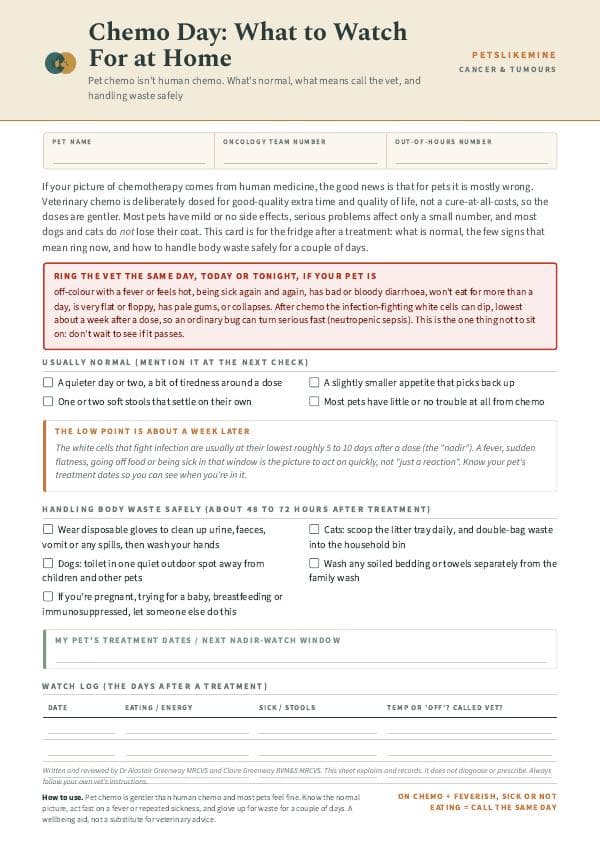
Companion worksheets to put what you've read into practice. Free PDFs, print at home.
Sister tool · Sightline
Track quality of life over time
Sightline, a separate ConciergeVet tool, runs a short adaptive weekly assessment with a quality-of-life focus mode built around exactly these frameworks, tracks a single composite score over time so you can see the trend rather than judge a single bad day, and produces a Sightline Report PDF you can bring to your vet.
A written log, or our printable quality-of-life sheet, does much the same job.
See how Sightline tracks quality of lifeFound a lump? Track it, and know when to act
A lump cannot be told apart by look or feel; only your vet sampling it can. The Lump & Bump Tracker records its size and how it changes, flags when it has crossed a line worth a vet visit, and builds a clean history to take in.
Open the Lump & Bump TrackerYou're not doing this alone
Compare treatment journeys and talk to owners managing cancer. Free to join.
Join PetsLikeMine