

Remission: What It Means, and Watching for the Cancer Coming Back
Alastair Greenway
BVM&S MRCVS
Remission means your pet has come back to themselves. The lumps have gone, they're bright again, eating, daft, well. You'd think that word would bring nothing but relief, and partly it does. But for most owners there's a low hum of fear sitting just underneath it that never quite switches off. Every longer sleep, every skipped meal, every time you feel for those glands in the dark, the same question surfaces. Is it returning.
That's not morbid, and you're not the only one living that way. Going from recheck to recheck has a real weight, and the word people reach for is scanxiety, which captures it well enough. This piece is about what remission actually means, so the fear at least has the right shape, and what you can sensibly do with it, so you can get back to the good part.
What remission actually means
Remission is the cancer responding to treatment and pulling back. Your pet looks and feels well, and the signs you could see have settled. It's genuinely good news, and it's what most treatment is aiming for.
There are two kinds, and it's worth knowing which your vet means. Complete remission is when every sign of cancer that could be measured has gone, and the disease can no longer be detected (DogCancer.com, 2024). Partial remission is when the cancer has shrunk substantially, usually by at least half, but some of it is still there (Dog Cancer Blog, 2024). Complete remission is the one you're hoping for, and for cancers like lymphoma it's what most treated pets reach.
Then there's the harder part, and it's better held from the start than sprung on you later. For most cancers, remission is control rather than cure. Even in a complete remission, when nothing at all can be found, there are usually a few cancer cells still somewhere in the body, too few to detect (DogCancer.com, 2024). So for most pets remission is a stretch of good time rather than a full stop. Being glad of it isn't false hope. It's just honest to know what it is you're glad of.
Why the recheck schedule matters
Once treatment is over, your vet will want to keep seeing your pet regularly even while they seem completely well. When everything's going fine, those visits can feel unnecessary. They're doing the opposite of nothing.
Rechecks exist to catch any return early, while there's the most you can still do about it. Take lymphoma: the usual chemotherapy course runs for around six months, then stops while the pet is in remission, with rechecks roughly every month afterwards to pick up any sign of relapse, spacing out over time if all stays well (NC State Veterinary Hospital, 2024). At each visit your vet goes over your pet properly, feels the lymph nodes, weighs them, and runs bloods or imaging where the cancer calls for it.
One small thing worth asking for: have your vet write down the lymph node sizes, any mass measurements and your pet's weight at every visit, and ask for a copy. A trend on paper beats trying to recall whether a node felt bigger than it did a month ago. Catching a change a few weeks sooner genuinely counts, because early relapse is more treatable than late.
What to watch for at home
You see your pet every day, which makes you the best early-warning system going, provided you know what you're looking for. The right things to watch depend on the cancer, so ask your vet what matters most for your pet in particular. With the common lymph node cancers, the classic sign of return is the glands swelling up again, firm, rounded, usually painless, often on both sides (NC State Veterinary Hospital, 2024).
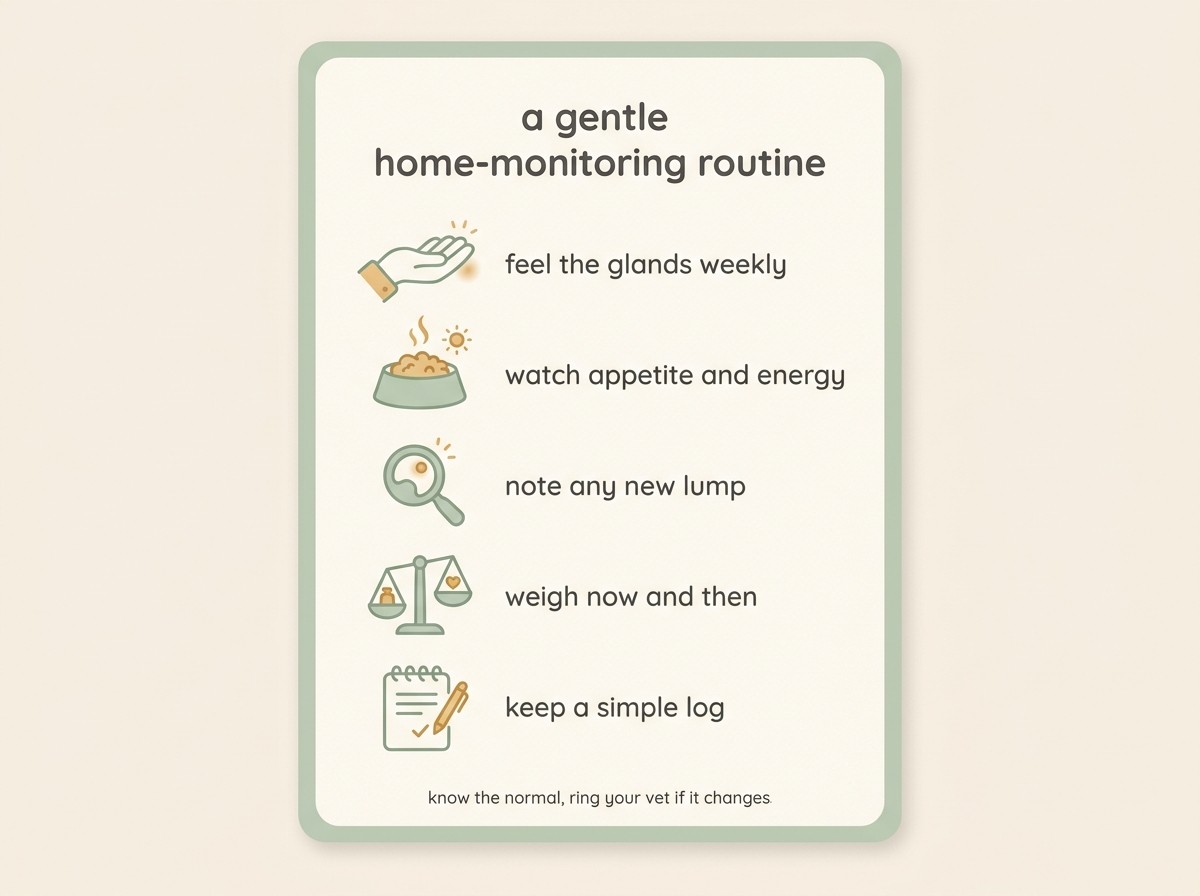
A gentle weekly routine, rather than a daily anxious patrol, is about the right level:
- Have a feel for the lymph nodes your vet showed you, the ones under the jaw, in front of the shoulders and behind the knees, about once a week. You're just checking they still feel normal.
- Notice appetite and energy across a run of days, not in a single moment. A real change is one that lasts.
- Watch for any new lump, swelling, sore that won't heal, or unexplained weight loss, along with the signs specific to your pet's cancer.
- Weigh your pet now and then if you can, since steady weight loss is easy to miss by eye.
- Keep a simple log, a note on your phone or a page on the fridge, so "I think he's been quieter" turns into something you can actually show your vet.
The aim isn't to make an anxious inspector of yourself. It's to know your baseline so well that a real change stands out, and then to ring your vet rather than wait and watch. If your pet is suddenly unwell rather than subtly off, that's a same-day call, and our piece on cancer treatment emergencies covers exactly when not to wait.
If it does come back
With some cancers, relapse is common, and lymphoma is the plainest example. Most dogs who reach remission with chemotherapy will relapse at some point, and the figure often quoted is that around 95% eventually do (NC State Veterinary Hospital, 2024). That reads bleakly on the page, so here's what belongs right beside it: relapse usually isn't the end of the road.
When lymphoma comes back, there are second-line treatments, often called rescue protocols, that can win another stretch of remission. Sometimes it's simply a matter of restarting the original chemotherapy, which carries around an 80% chance of inducing a second complete remission, and there's a range of other drug combinations to turn to besides (NC State Veterinary Hospital, 2024). These second remissions tend to be shorter than the first, and each one after that shorter again, but they can still be real, good time. In one study of dogs retreated with the original protocol the median second remission was around five months, and it lasted longer in the dogs whose first remission had been a long one (Flory et al., 2011). Pets can move through several protocols, one after another, for as long as they keep feeling well and responding (NC State Veterinary Hospital, 2024).
Cats too. Cats who reach a complete remission with lymphoma live longer than those who only partly respond, and a small number live well beyond two years (NC State Veterinary Hospital, 2024). It's another reason the rechecks earn their place, because a relapse caught early, while your pet is still well, gives the rescue options the best chance to work.
Not every cancer behaves like lymphoma, and not every relapse can be re-treated, so this is a conversation to have with your vet about your pet's particular cancer. But "it's come back" very often means "there's another option to try", not "there's nothing left to do".
Living with the not-knowing
Once your pet is well again, the hardest part can turn out to be your own head, and nobody really warns you about that.
The uncertainty doesn't fully lift, and that's normal. Some owners cope by leaning into the routine, the weekly check, the log, the next recheck booked, because having a system to aim the worry at is calmer than free-floating dread. Others find they have to consciously set the fear down between rechecks, because you can't live well while bracing for bad news every single day, and nor can your pet, who reads you more closely than you'd think.
So give yourself permission to enjoy this. Genuinely. The whole point of treatment, the entire reason for the visits and the cost and the effort, was to buy good time, and good time is wasted if it's spent only waiting for it to end. A remission isn't a countdown you're obliged to watch. It's an invitation to get back to walks and naps in the sun and the daft games your pet loves, and our piece on making the most of the time is about exactly that.
You won't feel relaxed all the time, and you don't have to. But the days are real, your pet is here and well, and that's worth being present for. If you'd like a way to keep a steady eye on how they're truly doing without it tipping into daily anxiety, tracking quality of life gently over time does that job, and our piece on measuring quality of life shows you how to read the trend rather than fret over a single day.
You've already done the hard thing. The job now is mostly to live the good time, keep your routine, trust your rechecks, and ring your vet if something changes. That's it. The rest is yours to enjoy.
References
- DogCancer.com. Dog Cancer Remission. Basedow K; reviewed by Hensley A (DVM) and Duffy M (DVM, ACVIM Oncology).
- Dog Cancer Blog. Complete Remission Definition and Partial Remission Definition. and https://www.dogcancerblog.com/articles/glossary/partial-remission-definition/
- NC State Veterinary Hospital. Medical Oncology: Canine Rescue Lymphoma.
- NC State Veterinary Hospital. Medical Oncology: Feline Lymphoma.
- Flory AB, et al. Evaluation of factors associated with second remission in dogs with lymphoma undergoing retreatment with a CHOP chemotherapy protocol: 95 cases (2000-2007). Journal of the American Veterinary Medical Association. 2011;238(4):501-506.
Sister tool · Sightline
Track quality of life over time
Sightline, a separate ConciergeVet tool, runs a short adaptive weekly assessment with a quality-of-life focus mode built around exactly these frameworks, tracks a single composite score over time so you can see the trend rather than judge a single bad day, and produces a Sightline Report PDF you can bring to your vet.
A written log, or our printable quality-of-life sheet, does much the same job.
See how Sightline tracks quality of lifeFound a lump? Track it, and know when to act
A lump cannot be told apart by look or feel; only your vet sampling it can. The Lump & Bump Tracker records its size and how it changes, flags when it has crossed a line worth a vet visit, and builds a clean history to take in.
Open the Lump & Bump TrackerYou're not doing this alone
Compare treatment journeys and talk to owners managing cancer. Free to join.
Join PetsLikeMine